|
||||||||||||||||
Click on Blue Links in the left column to jump to that section within this issue. Most blue links are hyperlinked to other sections or URLs. |
||||||||||||||||
|
||||||||||||||||||||
|
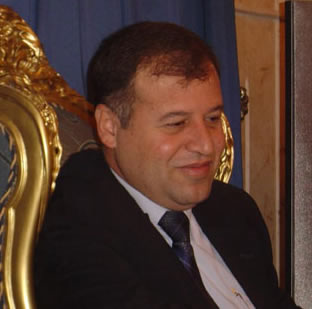
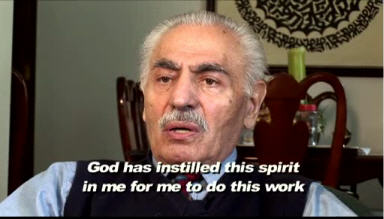
Exclusive Zinda Interview with Ninos Bithyou In his recent trip to the United States, Ninos Bithyou sat down with Zinda Magazine and answered some questions that lay heavy on people’s minds about the Assyrian Democratic Movement in Iraq. Ninos Bithyou is the former General Secretary of the Assyrian Democratic Movement, and currently serves on the Central Committee.
[ZINDA] Thank you for taking the time to answer some questions, Rabbi Ninos. Our first question is: What is the ADM doing toward the goal of making the Nineveh Plains part of our Administrative Rights? [Ninos Bithyou] We have put together a formal proposal for the Nineveh Plains Administrative Unit, legally. With the help of legal professionals in Iraq we have created a proposal. Also, we have already spoken with all political parties in the Iraqi Parliament (Sunni, Shia, etc.) and they are aware of our proposal. Our desire is to have all of the external Assyrian organizations speak with one voice about the Nineveh Plains, so that we all have one goal, and they all support this effort [for the Nineveh Plains Administrative Unit]…for the nation to have one voice. [ZNDA] If Iraq breaks apart, what is the ADM plan for Assyrians in Iraq? [NB] First of all, we do not see Iraq breaking apart, it does not look like Iraq is breaking apart and there is no sign that Iraq will break apart. Second, our stand and our work is so that Iraq does not break apart. This is Zowaa’s official position. And the breaking up of Iraq would, again, leave Assyrians scattered among different areas, just like they are now, in different countries in the Middle East, for example. We do not want this to happen. I don’t think there are signs that Iraq will break apart, but if it breaks apart, as much as we can, we will try to ensure most Assyrians are together in one “piece”, one area. We would work for this. [ZNDA] Why does the ADM choose not to respond to criticism? [NB] Our politics is that we don’t like internal fighting, within the nation, internal disputes. We have problems from outside of our nation, difficulties on the road to gaining our rights. We don’t want to increase internal fighting within the nation, nor do we want Zowaa or the Assyrian nation to spend their time with such things. Many of the critical things said about Zowaa, after some time passes it becomes known that those criticisms were not true, those allegations were not true. And they will never end, today one thing will be said, tomorrow some others, so our response is to just let time pass. [ZNDA] Where does your money come from? [NB] 100% of our money comes from the nation. From our members, our organizations, and our supporters. We have not taken help from other organizations, non-Assyrian organizations, so that our independence and decision making power isn’t taken from our hands. [ZNDA] What was the main goal of the use of the “ChaldoAssyrian” name? [NB] Our goal is to make unity in the nation. In this time, what we are in need of the most is unity so that we may have a place in Iraq, now that Iraq is in transition, each group in Iraq is working for their own rights, to gain their highest level of rights. We are in need of this national unity. And the problem of the names, to us, is lost time, and division in our nation. The subject of the name is not important right now. The solution of this problem will come after we all work together, then we will have more time to discuss this matter, we must respect all of these names, because none of these names are names of strangers – they are all from our history and from our country, Bet Nahrain. We must respect them. This is a historical issue, not a political issue. Zowaa is a political group. We cannot, by force, say that one name is right and another is wrong – we leave this to historians to discuss this. When will they be able to discuss this? When we are close to each other, and in harmony with each other. This name, to us, is a way to become close to each other now and work together, so we can discuss this name in comfort, and solve this problem and come to a conclusion. [ZNDA] Was the name meant for Assyrians, Chaldeans, and Syrian Orthodox to use to describe themselves, personally? [NB] The name is a political compromise. It was decided in a national Chaldean Assyrian Syriac conference that took place in Baghdad [October 2003]. It is a political agreement, a political contract. First, it is so that in Iraq we are referred to as one nation, not three nations which will minimize our rights. Second, using this name shows that these factions of our nation respect each other. If we do not use it, if we do not get used to each other, there will be no closeness between us. Its use, I believe, is good. If one does not use all three, but only two or one, we again must respect that name, but we believe it is better to use all our names. [ZNDA] Mr. Sarkis Aghajan has been credited with much development work and help in the Nineveh Plains. How are the Assyrians living in the Kurdish controlled region? [NB] In that region, for many years now, there has been peace. There’s no violence. People are living comfortably. There are problems of land and villages, but our relations are, in general, good with the Kurds in the Kurdish province. In the Nineveh Plains, there is also peace, but the help you are asking about, from Mr. Sarkis Aghajan, we see them as something good that’s being done, for our nation, and our churches are gaining more from this help. At the same time, from our point of view, this help would have perhaps been more beneficial if other avenues were taken. We believe it is good, but if they had been done another way, the good that has come from it perhaps would have been better, more, today, for the nation. [ZNDA] What do you mean, if the aid had been given “in another way”? [NB] The groups that the money was spent on, especially in the first year, were spent on churches, decoration of churches, and for the ways of priests and church leaders. If there had been projects, spent on infrastructure, it would have been more beneficial for the people. Toward the end, there were projects on infrastructure, and we think that is a very good thing, and it was a step in the right direction, but there is still much room for improvement. [ZNDA] We hear that the ADM is helping to deliver food and aid to Assyrians in Baghdad and other dangerous areas. Please tell us a little about this program. [NB] Zowaa itself does not do the work. The Iraqi branch of the Assyrian Aid Society does these things. You all know that under the circumstances in Iraq, they need Zowaa’s help in administering the aid. So they take help from AAS America, Europe, Australia, Canada, and also they are one of the official organizations in Iraq, they get help from other human rights organizations, and they divide that aid among our people in Garbiya, and also where it is needed more in Nineveh Plains and Baghdad and Mosul. They have programs and they administer the aid. Zowaa is a supporter and a helper – we guide them to villages, let them know where the most help is needed, we have more information than they do regarding which villages are the most lacking, and these last 3 weeks, the AAS gave out to 2,500 families in Nineveh Plains, food, blankets, and household needs (pots, etc). [ZNDA] What do the Assyrians of Iraq need most from Assyrians in the Diaspora? [NB] First, in the countries Assyrians live, they should let their governments know about our rights, to be supported politically, from Congress, Parliaments, etc. of these countries. Second, tell human rights organizations about the needs of our people, to help with the needs of our people in Iraq, so that help reaches them. Third, let the media channels know about who we are, that we are a nation and what our desires are, and what we need and lack. Fourth, our nation in Diaspora has organizations, and we want the organizations in Diaspora to work with the organizations in Iraq so that we have one united voice, or one stand, for the whole world, and the Iraqi government, so that we are strengthened and we are able to more easily gain our highest rights in Iraq. [ZNDA] Many Assyrians believe that there is little difference between Mr. Sarkis Aghajan’s relationship to the KDP, and Zowaa’s previous relationship with the KDP, as you have also worked with Kurds. Is your relationship with the Kurds today similar to that of the Assyrian Patriotic Party, Mr. Sarkis Aghajan, Bet Nahrain, etc. – how was your relationship before and what is it now? [NB] I will not talk about the relationship of the others with the Kurds. Only about Mr. Sarkis Aghajan I will say he is a member of the KDP. The other organizations, the other parties you mentioned, I won’t talk about them, I will only discuss Zowaa. We are proud, that we have built the first political relationship between our nation, and the Kurds, between our ChaldoAssyrian people and the Kurds. Our people have always been members of Kurdish political parties, during their revolution, demanding their rights, a large number of our people worked with them. But we didn’t have a political party to establish political relations, as nation-to-nation. Zowaa built this relationship. Because of that relationship, we got a lot of criticism from the same people who are already working with the Kurds, and prior they criticized Zowaa for this. We built this [relationship] on two foundations; first on the idea of having a relationship between two nations, and second on the idea of our free will of our nation. And we still believe in that, and our relationship with the Kurds is still on that path. If there has been a problem, it was because we stood firm on the rights of our nation, and we spoke about some problems regarding lands and villages, but it does not mean our relations have been damaged. We still have a representative in the Parliament of the region, and are together in political actions, and in the Iraqi government we stand close together - or together - in many issues, and sometimes we differ on our national rights, or our nation’s prosperity. We have no problem, but those sides that you mentioned, they are painting a blurry picture about our relations with the Kurds. But we are still working on the same basis of our relationship with the Kurds, and we haven’t changed. [ZNDA] Recently, Nechirvan Barzani stated the KDP would support Assyrian Autonomy in Kurdistan. What is Zowaa’s response to this? [NB] It is a very exciting thing to hear, and makes us happy. He is a high-level official, to support this. All officials, whether inside the country or outside of this country, who support this thing [autonomy] makes us very happy. This is a sign that our nation is reaching their rights. It is a sign that our nation is going in the right direction to reach its rights. But at the same time, as Zowaa, we give and take according to official documents, and only on that basis do we negotiate. We are hoping that this stand will be an official stand of the leadership of the Kurdish people, and on this basis, we as Zowaa will negotiate and declare our stand and our opinions. [ZNDA] One final question, what is the ADM’s official policy regarding churches? [NB] Since our inception in 1979, we have had a statement in the bylaws that says Zowaa is an organization that is political, nationalistic, patriotic, democratic, it has no religious specification. We wrote this at the very beginning, because we differentiate between politics and church. And especially, our people are not all in one church, but in many, we respect them all, we separate political work from church-related work, and we have demonstrated this in the last 26 years of our existence, this is our policy, it always has been and we will never change it. Because the experience of the world, and especially in Europe (the West), has shown that separation of church and state is the best policy for all nations. A Political Struggle between Zowaa and the KDP Albert Michael Someone once came up to me during the early 1980’s and asked, "Have you heard that we have an Assyrian militia in Iraq?" It wasn't long after, that I first heard the name "Zowaa" (Assyrian Democratic Movement) mentioned. Some will claim, as I assume they would do, that they too have been around since 1973 fighting for the Assyrian cause. Nimrod Baito, the secretary general of the Assyrian Patriotic party (APP) and a Kurdish appointed minister in the KRG, recently sent shockwaves throughout the Assyrian world. He revealed in a Zinda Magazine interview, that his party was established in 1973 and in Baghdad! Of all the places that were available to them - they went ahead and chose Saddams' back garden to do it in! Amazingly, and only he knows how he did this, claims that the year after their establishment, he and other cofounders expelled William Shaul from APP after learning that he was a Baath intelligence agent. Many that know Mr Shaul have told me that he was a feared man and totally loyal to the Baath party! Meaning you “chose” your words very carefully and most certainly never talked politics or Assyrian nationalism when he was around! If Mr Baito could only reveal how he directed the operations of the APP from Baghdad to at least 1993 without he, or a member of his party ever being captured, interrogated, imprisoned, tortured, let alone martyred? Are you seriously asking us to believe that the APP, an Assyrian underground movement operating in Baghdad got rid of Mr Shaul and have lived to tell the tale? There used to be a common consensus in Saddam’s Iraq, that even if you dreamt about opposing Saddam, the likelihood were that you’d probably wake up dead! The reason why Baito, Shaul and others set up shop in Baghdad and had nothing to fear was because they were established as the “Assyrian Baath Party” with the blessing of the Ace of Spades! Whereas we know that in 1985 many members of Zowaa were captured and three martyrs - Yousip, Youbert and Youkhanna were executed. We also know that Zowaa has roots in the north, it has something to show from its' labor. Can Mr Baito please reveal what his legacy has left behind? Around the time of the 1992 regional elections in northern Iraq where Zowaa won 4 out of the 5 designated seats, Bet Nahrain Democratic Party (BNDP) in Iraq emerges as a new political entity. What was the urgency behind the creation of another political party just when our Assyrian Chaldean Syriac people had placed their trust in Zowaa via the ballot box? Were the KDP shaken into action by the result of Zowaa’s popularity, hence the creation of BNDP? It was after those elections that the KDP finally realized that their totalitarian intent over our nation was now being seriously challenged. Zowaa has helped establish schools, building projects, medical centers, farming projects, etc, etc. It has provided food and shelter for the destitute and security for the towns and villages in the Nineveh Plains. And let’s not forget that all this was done with the KDP looking on anxiously. Can either BNDP or APP provide details of their achievements in Iraq, if any exist? Zowaa has demonstrated in three elections, one regional and two national, that it has in excess of 80% of our nations support. In both of the last two national elections, Raabi Yonadam Kanna was the only Assyrian mandated into the Iraqi parliament by our people. The Chaldean Syriac Assyrian general conference (CAS), hosted by Zowaa & Mtaqasta (Assyrian Democratic Organization), which convened in October 2003 in Baghdad, declared the following: 1. The unity of our Chaldean Syriac Assyrian nation Read the complete declaration here: click here. It takes a lot more than mere declarations to achieve any goal, particularly in our nations’ quest for equal status as shareholders of Iraq. Zowaa exemplified that when it enshrined our political, religious and cultural rights in the Transitional Administrative Law (TAL) and current constitution. And today we hear more and more people proclaim the decrees of the 2003 Chaldean Syriac Assyrian general conference. Sarkis Aghajan is one of them. He has said that we are one people “Chaldean Assyrian Syriac” and that our demands for an Administrative region be guaranteed, subject to, the Nineveh Plains being annexed to Kurdistan! Meanwhile, Sarkis Aghajans’ agents, financed by the KDP have infiltrated our communities worldwide. They are selling a Kurdish commodity named Aghajan, and to remove any doubts of his sincerity towards our nation, he is in a way being dubbed the Assyrian Moses! He that shall lead us to our promised land – after all, he is the one that demanded our own region from the KRG, right? Well, that all depends on what the KDP flavor of the month is! I’m sure that it won’t surprise most of you to learn that just over a year ago, Sarkis Aghajan was in fact whistling a completely different tune! But now all the Kurdish appointed Assyrian ministers and officials have all come out one by one to back Mr Aghajan. This is wonderful, but we need to remind them that our nation will only trust those that are not members of a Kurdish political party or inspired by them. Furthermore, those whom we place our trust in have made it abundantly clear to the KRG that the issue of the self administrative region in the Nineveh Plains will be placed before the central government of Iraq and also subject to a referendum. In a recent interview on Ashur TV, Raabi Ninos Pityo, member of the central committee and former secretary-general of Zowaa, stated that neither the KDP nor the parliament of the KRG have discussed the mechanism behind the Nineveh Plains project that Aghajan’s spin masters are selling, other than it becoming a part of Kurdistan! Simply put, all they are interested in is increasing their territories at our expense. “The Christian areas of Kurdistan” - this is how the KDP and their well-trained Assyrian puppets would like the world to refer to us in the future. But this is the Kurdish vision and will remain Kurdish irrespective of how many Assyrians they purchase from the rejects stand! Sarkis Aghajan Mamendu was amongst those whom met with British MP Dr. Robert Spink on his visit to northern Iraq in September 2005. According to MP Dr. Robert Spink, Aghajan and others were against the idea of an autonomous region for “Christians”, and that they viewed this as “propaganda” coming from people outside Iraq. Here is an extract of that report made by MP Dr Spink during a British parliamentary debate on 25 October 2005. “I was keen to get the views of the Christian community. I spoke to Christian MPs, including the Speaker, Mr. Adnan Mufti, and the Deputy Prime Minister, Sarkis Aghajan Mamendu. I met the Christian Bishop and Father William Jacob, a Kurdish Christian church leader in Sweden who may soon return to Kurdistan, and Christian community leaders. I also visited the Christian community of Ankawa and spoke with ordinary Christian people, both Iraqis and expats from this country and from America, who have lived there for years. Such people are supportive of the KRG and are pleased with progress. They are concerned at what they see as propaganda by people largely from outside their communities in Iraq who call for an autonomous administrative region for the Christian communities. That is being sold as a safe haven, but from what I saw and heard first hand from the Christian people in Iraq, and from their democratically elected representatives and community leaders, the concept of a safe haven is wholly inappropriate.” The complete report can be found here: click here. As one can see from the report by MP Dr Robert Spink, it’s blatantly obvious that Mr Aghajan is serving an agenda that is beyond his control? How else can he explain his sudden shift from one extreme to another, if it’s not what we all know it to be? The KDP have put an Assyrian face on their political struggle against Zowaa. Winning the hearts and minds of our people is the main battle. This is where the KDP hopes to score decisively by empowering Aghajan to maximize his “spend, spend, spend” policy as an enticement aimed at diminishing Zowaa’s support base. This is why, more so now than ever before, there is the need to be extremely vigilant and mindful of the rapidly unfolding developments, unless of course being referred to as Kurdish Christians doesn’t offend you. The fact is that Sarkis Aghajan is a leading member of the KDP. His loyalty is to his party first; he cannot under any circumstances implement his own policy without the approval of the KDP. Up until recently the KDP were opposing Zowaa’s right to demand a region for our people, they demonstrated this during the January 2005 Iraqi elections and then confirmed by Sarkis Aghajan to a British MP that an autonomous region is not what the “Christians” of Iraq want, that they are happy with the KRG and that this is all mere propaganda from those living outside of Iraq. In his letter to Prime Minister Tony Blair in May 2005, Raabi Yonadam Kanna made clear the demands of the Assyrian nation. The core of that letter rotated around the following three demands: 1. The creation of an Assyrian (ChaldoAssyrian) administrative region in the Nineveh Plains, This letter was written whilst Sarkis Aghajan’s party was working hard trying to block Zowaa’s demand for an administrative region for our Assyrian Chaldean Syriac people. I now invite you to watch an extract of an excellent presentation made by my brother Johnny Michael weeks before the December 2005 elections. http://www.themesopotamian.org/jm1205.wmv In this video you’ll see MP’s, Lords and UK government officials, confirm Zowaa’s position in relation to its demands on behalf of our nation. The message is clear; our neighbours in Iraq must treat us as equal partners, and only those that were democratically elected by our people must drive our pursuit towards our national rights – anything short of this is totally unacceptable.
Purple Badge of Shame Paul Isaac One year ago, on December 15, 2005, I traveled to a polling station in Virginia set up for the Iraqi Parliamentary elections. After receiving my ballot, I punched “740” for Zowaa (ADM) and dipped my finger in the purple ink. The December 17, 2005 issue of Zinda Magazine displayed a picture of me, smiling wide and full of hope. Today, I look back at that picture and at that day and feel only disgust. Disgust at both myself for lack of judgment and at Zowaa for the injustice it has used my vote to achieve. I have never felt more betrayed by any act of trust as by that one vote.
What led me to originally vote for Zowaa was a desire to believe that this organization, which had been established more than 25 years previously, which seemed to have many supporters in Iraq and in the U.S., could actually do well by our people. And this emotion is exactly what I see drawing a significant amount of youth to the organization: it is an established and equipped machine. Who wouldn’t want to believe in something like this? However, as I have come to see, since the liberation of Iraq, that machine’s actions (and inactions) have caused our people more damage than benefit. I would not like to see the demise of Zowaa; to the contrary, salvaging the party and setting it on the right path would be the best solution. But at this moment, the ADM is a liability to the Assyrian cause, not an asset. If Zowaa would ever like my support or vote again, the following are the actions it must take. (Note: I speak for myself only, and if the party does not want my support, then that is its decision. Others may forgive for less, while still others will never be able to forgive Zowaa for what it has done).
Examples of ADM’s unwillingness to work with other Assyrian parties (and to attack them instead) are plentiful. Prior to the first Iraqi elections, late December 2004, the ADM political bureau in Baghdad released a communiqué to offices outside Iraq giving instructions on how to campaign for the elections. At one point, the document encourages its members to “accuse the head of the [Assyrian National Assembly] slate Mr. Audisho Malko with nomadic tribal behavior and refrain from supporting his cultural literate productions,” and to “focus the attack on Eshaya Esho.” In the same letter, it states, “that it is very important not to mention our alliance with the Kurdistani Slate in Erbil, we ask that you play ignorance of this and deny it if need be. We also ask you to benefit from the fact the Diaspora is not participating in the Kurdistani National Parliament.” (Note: ADM disputes the authenticity of this document. However, they have failed to provide evidence as such, while others have reported receiving the instructions when first published and stand by its validity. The letter touches on many subjects, many of which are commonplace.) Prior to the second Iraqi elections in December 2005, Romeo Hakkari of BNDP in Iraq entered into talks with ADM with the goal of forming a combined slate. As was reported on the Ankawa news site, talks were held for over one week. While Hakkari was led to believe an agreement would result, ADM refused to commit. On the final day available to enter the elections, ADM claimed that a “bad phone connection” prevented the party from delivering a position, thus preventing Hakkari from participating in the national elections, with or without ADM. Even Bashir Saadi of the Assyrian Democratic Organization (ADO) in Syria commented recently that the relationship with ADM was in “a state of inertia and apathy.” And today, as five Assyrian parties meet on a regular basis to formulate demands and discuss the future of Assyrians in Iraq, Zowaa spurns every invitation and refuses to participate. When asked recently why ADM refuses to work or even maintain a relationship with these groups, Mr. Ninos Petyoo remarked “We already know their positions.” Thus, the decision of the ADM Baghdad congress in July to “launch dialogue” with other Assyrian parties was mere words and never intended for implementation. Apparently the party’s operating definition of “unity” is ADM and nothing else. If ADM cannot dominate the dialogue, it chooses to destroy.
“In the last fourteen months, there has been a movement to demean the functions and the title of the non-secular hierarchy of Assyria, and to place the national leadership into the hands of a political party that has entrenched itself in the annals of the Kurdish Parliament in northern Iraq. This movement, and its sycophants, including at least one high-ranking Church of Assyria Archbishop, namely, Mar Bawai Suro, with a few adherents among the lesser Church of Assyria laity in the ranks of Priests, are hard at work enunciating to portray the Church of Assyria, and its titular head, Mar Dinkha, as lackadaisical and obtrusive on the path of the political arena of Assyria…This misappropriation by one of the political parties of Assyria and its followers seems to have become more aggressive in its format, and in its plebeian pantheon of absolute authority…To surrender the future of a nation into the hands of one party is synonymous with desecrating the walls of democracy in favor of autocracy and eventual dictatorship.” And when asked privately, shortly after the Mar Bawai’s split from the ACOE, about possible ADM involvement, Yonadam Kanna reportedly began with the now-tired line, “We do not get involved in Church matters” but then contradicted himself, adding “…but when they get involved in our affairs, we have to get involved in theirs.” And all have seen the despicable tactics in the United States. Shortly before the Synod of the Assyrian Church of the East, where Mar Bawai split from the Church, ADM took it upon itself to organize a protest against the ACOE in Chicago; this was cancelled at the last minute by Mar Bawai. Immediately after the Synod, Mar Bawai returned to California and attended a rally, accompanied by senior ADM members/supporters from Chicago: Agnes Mirza (member and senior official), Eprim Rashoo (member), William Youmara (supporter), Ashur Adadseen (supporter), and Dr. Edward Odisho (supporter). Just this past August 2006 in Chicago, for our national Martyr’s day, many Assyrians gathered to mourn the losses of all Assyrian martyrs. ADM leadership turned the moment into an ADM rally, placing their flags and banners around the cemetery. Sheba Mando, head of the Mootwa in Chicago (and who attended ADM’s congress in Baghdad), and Aladin Khamis of the Federation arranged for Mar Bawai to be conferenced in to the event by telephone to deliver a speech. Many Assyrians walked out in disgust. And when I asked Mr. Ninos Petyoo recently, very simply, “Do you condemn the statements by your supporters and members who support the attack and division of the Assyrian Church of the East,” he refused, claiming he has no responsibility over these people. If Zowaa is unable to control the actions of its members, or even issue a statement denouncing such actions, then the party is even more ineffective than I thought previously. The truth, however, is that the attacks were always, and continue to be, sanctioned by central ADM leadership. Zowaa has proven it has no love for the ACOE and that it would prefer to remove any institution that it perceives to be standing in its way. I have run out of patience for diplomatic language that dances around the issue, calling Zowaa’s stance “unnecessary” or “foolish”, or that leaders “did little to diffuse the situation”. A spade should be called a spade, a crime should be called a crime, and a betrayal should be called a betrayal. The ADM has quite clearly placed a higher priority on causing a schism within the Church than on bringing tangible fruits to the table of Assyrians in Iraq. This is a crime of the highest magnitude and only a full admission and signal of atonement will suffice. Yet even from a dispassionate power-perspective, does the policy make any sense? No reasonable person can argue that the support for Mar Bawai has done Zowaa any good; in fact, it has brought more harm upon it than anything the ACOE currently faces. What has Zowaa achieved but division, resentment, and a vastly reduced base of support? Only a year and a half ago, the vast majority of Assyrians in the Diaspora supported Zowaa. Today, primarily because of the attack on the Church, support for the ADM has dwindled to a handful, forcing its remaining base to rely on underhanded, corrupt, and shameful practices. The AANF’s discreet transfer of $25,000 to William Youmara and Ashur Adadseen is but one example, while the election theft of the Federation is another. I ask again, what benefits have been achieved vis-à-vis the costs? Is it out of a sense of loyalty to a bishop who was a key backer of the party? Mar Bawai was a staunch supporter of the “ChaldoAssyrian” terminology in Iraq but even more so in his churches in the U.S., going so far as suspending a member who spoke against it. He forged a key alliance with Chaldean Bishop Sarhad Jammo, the architect of the mythical and separatist “Chaldean renaissance” and arguably the most destructive individual for Assyrian nationalism since Saddam Hussein. See last issue’s photo opportunity of the two bishops’ meeting on December 7 under the guise of “unity.” As Zahrira has now proudly (and belatedly) proclaimed, Mr. Ninos Petyoo met with Sarhad Jammo and Mar Bawai the very next day. See also Isaac Isaac’s (ADM central committee member) recent high profile meeting and dinner with Bishop Jammo, also announced on Zahrira. Mar Bawai, while still with the Church, was asked to contribute to a fund the Church had established for Assyrians in Iraq; Mar Bawai contributed only $1,000, admitting he had already given $50,000 of Church funds to Assyrian Aid Society (AAS was established by ADM and the president of AAS of Iraq , Rommel Moushi, is a member of ADM). Assyrians later watched on television as Zowaa members in northern Iraq were distributing food and supplies, saying, “This is from Mar Bawai” (not the Church of the East). And although a reasonable person could deduce who received the hundreds of thousands of dollars mortgaged from the now-contested ACOE Church properties in California, I will wait for the legal proceedings to produce the truth. The question remains, even after all these items are considered, why will Zowaa not cut its losses?
Returning to the actual policy position, the above may deliver a bit of a shock to many Zowaa supporters. Many are convinced that Zowaa’s actual position on the Nineveh Plains is that if such a unit were to be formed, it should only be under Baghdad control, and not Arbil’s. Those who believe this are not at fault; every communication (however few) from members and supporters has given this impression. Before analyzing the merits of the case, let us see why Zowaa may be advocating such a policy. The ADM has manifestly and undeniably lost all clout and credibility in the North. Regardless of what may be in the national interest, Zowaa now realizes that its last remaining zone of influence as an organization is in the Green Zone. Hence, it viciously attacks anyone working with the KRG.
Now, let us look at the merits of the case itself. In a unified and stable Iraq (which is highly hypothetical), a Nineveh Plains governorate tied to Baghdad may have advantages (and disadvantages) versus one tied to Arbil. However, this is all academic at this point. First of all, Arab leaders have not even recognized a proposal for such a move. Has one senior Arab even allowed the words “Nineveh Plains” to leave his lips? No, they are too busy slaughtering each other and innocent Assyrians in Baghdad, Basra, and Mosul, who are fleeing en masse out of the country and to the North. Furthermore, and as mentioned above, Zowaa has done absolutely nothing to make this an issue in the Baghdad parliament. On the other hand, along with several Assyrian parties, the KRG Minister of Finance Sargis Aghajan has openly called for the Nineveh Plains as an autonomous unit, demanded changes to the constitution drafted by his own party, and funded the construction of housing complexes in the region. On December 6, 2006, Prime Minister of the KRG Nechirvan Barzani publicly declared his support for the “right to autonomy in the Nineveh Plains.” Where are Zowaa’s demands? If the ADM is unwilling, for whatever reason, to demand the rights for an Assyrian autonomous region, then it has a duty to step aside and allow leaders who are willing to step forward. How many more hundreds of thousands of Assyrians must leave Iraq before the time of evasive measures and obscure rhetoric is over? Moreover, the future of Iraq as a state is highly dubious at this point; why place all our eggs in the Baghdad basket? I am not saying Assyrians should only work towards a unit tied to Arbil; I am only arguing that it is unwise and disingenuous to sabotage progress made at the KRG level, as Zowaa has done. Assyrians should be playing both sides of the coin, keeping the bidding up for resources and autonomy. But labeling the Baghdad position as a stance of “principle” while that of Arbil as “traitorous” is laughable. Let no Assyrian forget that Iraq was invented out of thin air (and a pen) by the British and a group of Arabs. Now Kurdistan has been invented by the United States and a group of Kurds. How is a choice for Moqtada Al-Sadr and the Shia Arabs of Baghdad more righteous than one for Barzani and the Kurds of Arbil? Why is one more legitimate than the other? Assyrians need to start looking out for their own national interests, and choose the path where those interests are best served. Assyrians should not sacrifice the national cause on the altar of Zowaa’s well being. The common theme among all these problems and all these attacks is ADM’s absolute unwillingness to tolerate the voice of any other Assyrian, whether that of an individual, political party, organization, or church. Again, I call on all Zowaa supporters and members with the national cause still at heart (which I truly believe to be many) to take back control of the party that served us so well in the past. The Assyrian Democratic Movement has been hijacked by a group of self-seeking individuals, and at this point in time is doing the Assyrian cause more harm than good. Reform yourself, and I will support you once again. Until and unless these points are adequately addressed, do not count on another purple-stained finger from my hand. Beware the Kurdish Undercurrents Filham Y. Isaac On 11 December 2006 issue of Zinda Magazine the following was posed as a poll question: “Should the Assyrian Democratic Movement replace Yonadam Kanna with a new leader in Iraq?” Before we replace Mr. Yonadam Kanna, may I suggest, for the next edition, to see the same survey for Mr. Sargis Aghajan or even better for all those non-elected groups that want Nineveh Plains linked to the Kurdish Region? I have no personal animosity towards any of these people put please know that I am responding to uphold my right when I voted in two previous elections to democratically elect certain representative whom I trusted and gave them the right to represent me. I look towards them to make the decisions on my behalf when the time is right. Some decisions that will impact my future are being made on behalf of the people that voted by people that did not win the right to represent them. Case in point the Nineveh Plains issue. At this moment in time and from what the past and present indicators are, I want to say to my fellow Assyrians that they should be aware of those who are promoting Nineveh Plains linkage to the Kurdish region. One may think that the current monies that are flowing freely through Mr. Sargis Aghajan’s and how some prominent Assyrian personalities are rushing to pick a few fat cheques from Mr. Aghajan and showing their gratitude in volumes of praise as well as in dangling large medallions on this most generous “Rabbie” giving the unsuspecting the impression that all is well and we are that much closer to the promised land. It may be seen as very generous that the Kurds are promoting the Nineveh Plains idea and showing full support in painting a bright future for the entire region using money and influence of a few prominent leaders amongst the different denominations of this nation to buy out our people’s acceptance of their scheme. If you look closer you will find that there are strong under currents that will yield different results for us. For now the Kurds may fool a few but we need to be aware of their hidden agenda and never to lose sight of what the Kurds are dreaming of. The Kurds will do all these things and more, using the Assyrians to attain their small region which will in fact enable the Kurds to set a foothold in the Nineveh province thus expanding their region to the core of our historical lands. Their design is to completely dominate our future claim to our historical lands and in such move they would have not only and completely usurped Assyria but also the indigenous people’s fate would be sealed by having them to live under the Kurdish rules and absolute control. Blinding us with riches and big houses may look like the Assyrian boat is cruising peacefully past some tranquil scenic shores but please pay attention because in a less than a decade and when the Assyrian ship is in the middle of the lake the Kurds will pull the plug and the Assyrian ship will sink in much deeper and darker waters, making it that much more difficult, if not impossible to float to the surface, and the idea of a semi-autonomous Assyrian region will be just that; a broken vessel at the bottom of the lake. So before I vote yea or nay to this survey, I would like to ask whether Mr. Kanna had the same political freedom and the financial support of the Kurds or for that matter from any other sectarian group within Iraq or outside. I know for a fact that some groups of his own people have been harassing him personally as well as the entire ADM central committee. So In order to judge the overall performance of one person or a group one needs to be fair in knowing that the ADM has not had anyone helping them in any shape or form other than what they have received from their own people. Now if I was to stand back and see what has this party achieved with what was made available to them and compare it to the millions of dollars thrown at our people by the Kurds via Mr. Aghajan then the conclusion is very easy because ADM has done admirably well under the circumstance and could have done that much more if the obstacles were removed and our share of the money was handed over as it should. For a small and very much a divided nation like us, the decision making process in Iraq by a small party does not follow the same norms like in the western societies. The Kurds have not shown us any goodwill. To make a believer out me, they can start handing our share of the money, if not retroactively then from now on, to our elected representative instead of controlling it and spending it as a divisive instrument that would give rise to such a survey. Had ADM received equal circumstances and less constraints then I could easily make up my mind to remove or not remove Mr. Yonadam Kanna. What conclusive decision can such a survey provide? One should not personally care if it is Mr. Kanna or Mr. Aghajan or any other person. People come and go. It is their track record and deeds that would speak for them. We need ALL of our political parties to always put this nation first. Our people have been screaming for unity but no one has responded. On this matter, I hold ALL parties equally responsible. The vote should not centre on what have you done form me, lately. The other question that we also seem to always ignore is: what is that I, you and you have done for them. Our loyalty should be to our people and that is the only issue. We do need people like these two gentlemen as long as they have the same loyalties. So please pardon me if I refuse to vote because that would absolve all other parties from their national responsibilities.
|
||||||||||
Christians Debate Self-Autonomy to Halt Exodus Courtesy of the Compass Direct News (ZNDA: Washington) A new plan for Christian self-autonomy within Iraq’s Kurdish region has sparked debate among Iraqi Christian leaders desperate to halt the mass exit of Christians from Iraq. With church-bombing and priest-kidnapping on the rise in Mosul and Baghdad, Iraq’s Christian population is estimated to have dropped below 450,000, half the size it was in 1991.
“A year ago, the plight of the Christian community was not very well known,” Michel Gabaudan of the United Nations High Commissioner for Refugees (UNHCR) told The Associated Press in a December 15 article. “But that has changed, because we now have very clear evidence that they have been persecuted.” Iraq’s half-a-dozen or more historical churches, many of them dating back to the first three centuries after Christ, agree that something must be done to preserve their existence. But consensus on a solution has proven elusive. Disagreement exists over whether to cooperate with Kurdish leadership to form an autonomous area within Iraq’s Kurdish federal state, or to go it alone and create a new federal state solely for minorities. One Chaldean archbishop has said that either plan would only make things worse by creating a Christian “ghetto.” Sarkis Aghajan is one man who may have the biggest say in the future of the Christian community. As Iraqi Kurdistan’s Minister of Finance and Economy and a Christian member of the governing Kurdistan Democratic Party, Aghajan has financially supported thousands of Christian refugees from the south while calling for a Christian region attached to Iraqi Kurdistan. “I demanded the right of autonomy for our [Christian] people – Chaldean, Syriac, Assyrian – to be fixed in the Kurdistan Region Constitution,” Aghajan told Compass by e-mail. Aghajan publicly backed a statement last month by five Christian political parties calling on drafters of Kurdistan’s Regional Constitution to guarantee an autonomous Christian area in the Nineveh plain, Iraqi Christianity’s ancestral homeland north of Mosul. “Since the Nineveh plain falls within the expanded boundaries [of the Kurdish region], we propose to include in the constitution a clear text of our people’s right to autonomy within the said plain,” the November 10 document stated. Divided Opinions Kurdish leaders’ initial response was positive. “It is their right to have their rights recognized and fixed in the Kurdistan Regional Constitution, including their right to autonomy in Nineveh plain,” Iraqi Kurdistan Prime Minister Nechirvan Barzani said in a December 6 press conference. “This is our permanent policy.”
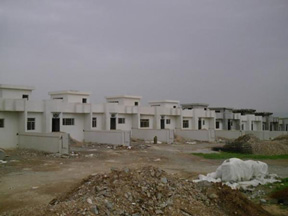
But some Christian leaders have opposed any plan to cede the area to Iraqi Kurdistan, saying that Christians and other minorities need a completely separate federal state. Most vocal on the international scene has been Pascale Warda, former Iraqi Minister of Displacement and Migration. Warda visited the United States in October to drum up support for a separate federal state for non-Muslim minorities in the Nineveh plain, a plan supported by the Assyrian Democratic Movement (ADM). The ADM’s campaign has been fueled by reports from the Assyrian International News Agency that Kurdish police and militia have been terrorizing Christians. According to a December 18 Religion News Service article, Kurds have also seized land owned by Assyrian Christians. Compass sources in the area were unable to confirm these reports. In a November interview with Zinda Magazine, Iraqi Kurdistan’s Christian Tourism Minister Nimrud Baito denied outright allegations that Kurds were taking Christian lands. Despite negative reports, Kurdish leaders appear to have made a sincere bid to attract Christians to their northern region. “We welcome any Christian brothers who choose to come and live in Kurdistan, whether temporarily or more permanently,” Iraqi Kurdistan President Massoud Barzani said in December 2005. “You are free to accept this fraternal co-inhabitance and to help in the building of your country.” Christian finance minister Aghajan has made good on that promise, constructing more than 100 new villages and churches for Christian refugees. Village being built “Over 5,000 houses have been constructed for Christians, in addition to schools, health centers, Internet centers and occasion halls,” Aghajan told Compass. Even Kurdish Muslim converts to Christianity enjoy a wide range of freedoms traditionally limited to the historic churches, building churches and openly identifying themselves as Christians.
“I’d rather see a Muslim become a Christian than see him become a radical Muslim,” Kurdistan’s regional prime minister told Radio Sawa in May. ‘Violently’ Backfiring But incorporating a Christian Nineveh plain into Iraqi Kurdistan is more complicated than squeezing a guarantee into the new Kurdish constitution, up for vote in April 2007. The real test for any form of autonomy would be winning the required approval in Iraq’s national parliament in Baghdad, where minority Christian ministers would need to bargain for the backing of Kurdish or Shia groups. Three districts that constitute the Nineveh plain would also need to hold separate referendums to obtain self-government, within Iraqi Kurdistan or otherwise. Kurdish forces currently occupy the districts and provide security, though the area belongs to the Mosul governorate under Baghdad’s central government. Many of the villages surrounding Mosul, the biblical city of Nineveh, are majority Christian. But the plain remains diverse, holding Yezidi, Shebek, and Sunni Arab groups. Observers told Compass that any referendum for autonomy would likely need at least a coalition of Christians and Yezidis to succeed. It is highly unlikely that Iraq’s Sunnis, who currently control the Mosul government that administers the three districts, would support a plan for any form of minority autonomy. And that is where problems may begin, Chaldean Archbishop of Kirkuk Luis Sako told Compass. One of the few Iraqi clergymen to raise his voice on the issue, Sako said he expected that any announcement that Christians were pursuing their own region would violently backfire. “We have 300,000 [Christians] in Baghdad, Kirkuk and Basra, and in most cases they will have problems, maybe even be persecuted for that,” the archbishop said. “Others will say, ‘Get out of here, go to your own area.’” The archbishop said that he doubted the Nineveh plain could be made secure, sandwiched as it is between the Arab and Kurdish regions. “Christians cannot live in isolation – we are in the north, we are in the middle of Iraq and we are in the south,” Sako said. “Wherever we are living, we should cooperate with citizens. We don’t have to create a ghetto.” ‘Last Chance’ But some leaders pointed out that attacks on Christians were already on the rise before any plan for Christian self-autonomy was publicized. “We’ve been seeing attacks against our people in the Mosul area anyway,” commented Tourism Minister Baito, a strong supporter of Christian autonomy within the Kurdish region and head of the Assyrian Patriotic Party. “The Kurds want to work with us to show the United States and Europe that they are democratic and look after minorities,” said Paul Koshaba, the leader of a Christian tribe that in 1964 split from one of Iraq’s largest Christian communities, the Assyrian Church of the East. Koshaba has been working to heal the rift, believing that only a united church can survive in Iraq. “This is our last chance,” Koshaba told Compass in a new village constructed by Aghajan outside of Dohuk last month. “We have to grab it now or it will slip away from us.” Personal Struggles of Iraqi Refugees Bundled against the cold, a handful of Iraqi Christians served their guests hot sweet coffee in a blown-out concrete school building, all that remained of their village in northern Iraq last month. Three months ago, the village of Havrez lay completely deserted, empty since Saddam Hussein’s forces destroyed it in 1978. Until recently, anyone willing to follow a faint set of tire tracks through farm fields to find Havrez could be forgiven for assuming that the lone concrete structure was still vacant.
But two weeks ago, Iraqi Kurdistan’s Christian finance minister, Sarkis Aghajan, began funding the construction of new homes for 25 Armenians from Baghdad who returned to the village outside Dohuk city as part of an increasing flow of Christians forced northward and abroad by escalating violence in Iraq’s south. “Some 40 houses will be built urgently as a first stage before the snowfall in order to house those miserable families,” a member of Aghajan’s staff told Compass. For the villagers, day-to-day survival supersedes debate over a safe haven. “The UNHCR gave us warm tents, but they collapsed under the heavy rains last week,” one villager told Compass. Now all the women and men sleep in two large concrete rooms, the windows covered with tarp to retain some heat while they await their new homes. Like many members of the refugee village, Adis Yohannes Markar was a former car electrician in Baghdad. He does not know how to raise crops and has no source of income at his new home in the middle of farming country. “This is my father’s village and my grandfather’s, it is my home” he replied, when asked why he didn’t move to the cities of Zakho or Dohuk, where he might have practiced his trade. “These are the poor people of Iraq who have nowhere else to go,” explained one visitor to the village. Most Christians with the means to do so have already left the country, and a second wave of refugees – the poorest of the poor – have been moving steadily to the Kurdish controlled region in the north. The influx of refugees has fed unemployment and dramatically increased the cost of living. “The biggest problem here in the north is economical, not religious,” the Christian deputy governor of Dohuk, George Shlimon, told Compass last month. “People fleeing north have no experience farming; they need jobs.” But most refugees prefer unemployment in the north to sectarian violence in the south. Islamic gangs have begun implementing a tax on Christians in the city of Mosul, Christian sources still in the city told Compass. Those who refuse to pay are often kidnapped and killed. “The sheikh at the mosque next to our house told Muslims over the mosque loudspeaker not to buy houses from the Christians because the land was already theirs,” a Christian from Mosul told Compass in Dohuk last month. The former bank manager had fled north with his family after his home had been bombed for refusing to pay 3 million Dinars (US$2,276) to a local gang. Last week, three Armenian Orthodox brothers were killed at their car repair shop in Mosul while physically resisting a terrorist group that had attempted to take them hostage, sources in the city told Compass. In a separate incident last week, a Christian man identified only as “Khayri” was killed and his young child held for ransom. The captors initially demanded US$50,000 for the child’s return but eventually accepted US$35,000 from a relative, sources in Mosul said. The Christian’s widow and two children have now moved to the predominantly Syrian Orthodox village of Bartalla, 25 kilometers (15 miles) east of Mosul. A Christian Exodus from the Arab World Courtesy of Der Speigel
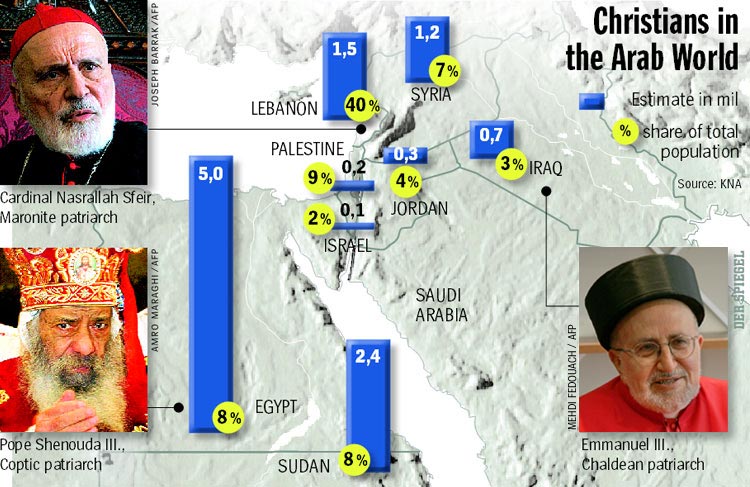
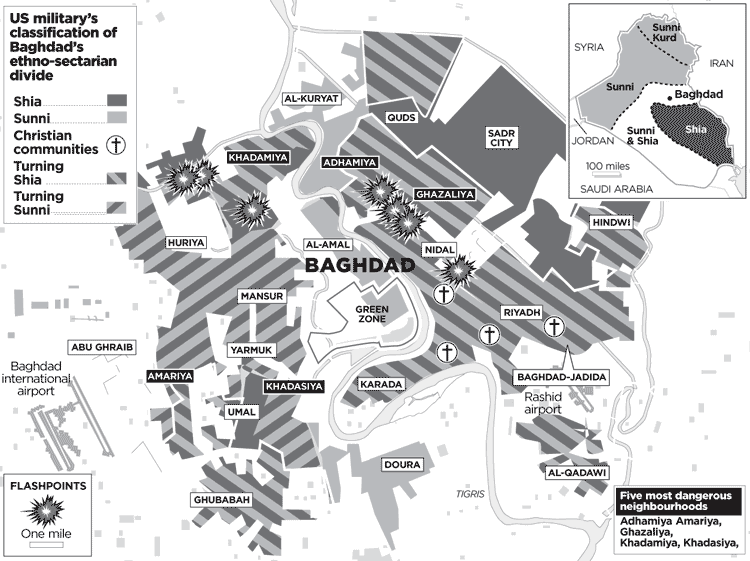
Violence, terrorism and the Islamists' growing influence pose a threat to Christianity in the Middle East. In some countries, members of an unpopular Christian minority are already fighting for their survival -- or fleeing for their lives. In New Baghdad, the driver of a minibus, a Shiite named Ali, set out at 7 a.m. on the last Sunday before Christmas. A few hours earlier he had received a call on his mobile phone with instructions to pick up five passengers for a long trip outside the city. His first passenger, he had been told, would tell him who the other passengers were and what their destination would be. He was also told not to mention a word to anyone.The first passenger was a 24-year-old man named Raymon, who was sitting on his suitcase a few blocks away. He directed Ali through the city's dreary east side, where having a Shiite as a driver is a smart move -- first to the Karrada district, where Amir and Fariz boarded the bus, and then to Selakh, where Wassim and Qarram were waiting. By 9 a.m., Ali had picked up all of his passengers and the bus left Baghdad and began traveling to the northeast -- for the 350-kilometer (218-mile) journey to Kurdistan, the only part of Iraq that is anything close to safe. The five young men traveling in Ali's red Kia were the last seminary students at the Chaldean Catholic Babel College to leave Baghdad. Four priests have been abducted since mid-August, and two others were murdered. Father Sami, the director of the seminary, was kidnapped in early December. The community managed to raise $75,000 to buy his freedom, but after hesitating for weeks, Emmanuel III, the Chaldean patriarch, decided to withdraw the teaching institutions of his community from Baghdad. He ordered the evacuation of the city's four Catholic churches, the Hurmis monastery and the college in the city's Dura neighborhood, but chose to remain behind in the city as the lonely shepherd of a rapidly shrinking congregation. A history that traces back to the Ottoman Empire Present-day Iraq was still part of the Ottoman Empire when Iraq's Catholics opened their first priest seminary. They moved it from Mosul to Baghdad 45 years ago and, in 1991, untouched by then dictator Saddam Hussein's regime, they founded the Babel College for Philosophy and Theology in Dora. It would only exist there for 15 years, a flicker in the history of the Chaldean people. "I don't know when or whether we will ever return," says Bashar Varda, the man Father Sami has entrusted with running the seminary. Christians have lived in the Arab world for the past 2,000 years. They were there before the Muslims. Their current predicament is not the first crisis they have faced and, compared to the massacres of the past, it is certainly not the most severe in Middle Eastern Christianity. But in some countries, it could be the last one. Even the pope, in his Christmas address, mentioned the "small flock" of the faithful in the Middle East, who he said are forced to live with "little light and too much shadow," and demanded that they be given more rights. There are no reliable figures on the size of Christian minorities in the Middle East. This is partly attributable to an absence of statistics, and partly to the politically charged nature of producing such statistics in the first place. Lebanon's last census was taken 74 years ago. Saddam Hussein, a Sunni who is himself part of a minority, was fundamentally opposed to compiling denominational statistics. In Egypt the number of Christians fluctuates between five and 12 million, depending on who is counting. Given the lack of hard numbers, demographers must rely on estimates, whereby Christians make up about 40 percent of the population in Lebanon, less than 10 percent in Egypt and Syria, two to four percent in Jordan and Iraq and less than one percent in North Africa. But the major political changes that are currently affecting the Middle East have led to shrinking Christian minorities. In East Jerusalem, where half of the population was Christian until 1948, the year of the first Arab-Israeli war, less than five percent of residents are Christian today. In neighboring Jordan, the number of Christians was reduced by half between the 1967 Six Day War and the 1990s. There were only 500,000 Christians still living in Iraq until recently, compared to 750,000 after the 1991 Gulf War. Wassim, one of the seminary students now fleeing to Kurdistan, estimates that half of those remaining Christians have emigrated since the 2003 US invasion, most of them in the last six months.
Greater affluence Demographics have accelerated this development. Christians, often better educated and more affluent than their Muslim neighbors, have fewer children. Because the wave of emigration has been going on for decades, many Middle Eastern Christians now have relatives in Europe, North America and Australia who help them emigrate. Their high level of education increases their chances of obtaining visas. Those who leave are primarily members of the elite: doctors, lawyers and engineers. But there are deeper-seated reasons behind the most recent exodus: the demise of secular movements and the growing influence of political Islam in the Middle East. It was a Syrian Christian, Michel Aflaq, who founded the nationalist Baath movement in 1940, a career ladder for Iraqi Christians until 2003 and still a political safe haven for many Syrian Christians today. Former Egyptian President Gamal Abd al-Nasser had no qualms about paying homage to the Virgin Mary, who supposedly appeared on a church roof in a Cairo suburb after Egypt's defeat in its 1967 war with Israel. And former Palestinian President Yasser Arafat, who died in 2004, insisted on sitting in the first row in Bethlehem's Church of the Nativity during the annual Christmas service.But those days are gone. The last prominent Christians -- Chaldean Tariq Aziz, Saddam's foreign minister for many years, and Hanan Ashrawi, Arafat's education minister -- have vanished from the political stage in the Middle East. And since the election victories of the Muslim Brotherhood in Egypt and Hamas in the Palestinian Authority, the rise of Hezbollah in Lebanon and the bloody power struggles between Sunni and Shiite militias in Iraq, the illusion that Christian politicians could still play an important role in the Arab world is gone once and for all.
Coptic activists have been complaining about discrimination at the hands of the Egyptian state for years. Yussuf Sidham, editor-in-chief of Watani, a Coptic weekly newspaper, says that unlike the 1970s, there is little open violence between Muslims and Christians today. "Instead," he continues, "we are now struggling against the sick ideas of Islamic fundamentalists. There is an ever-widening gap between liberal and fundamentalist forces." When Egyptians elected a new parliament in 2005, the ruling National Democratic Party included only two Copts on its list of 444 candidates -- and today only one cabinet member, the finance minister, is a Coptic Christian. Sidham faults the party for promoting this way of thinking. "The party says that candidates were elected because of their religious affiliation. Copts stand less of a chance. So why put forward Copts as candidates in the first place?" This sort of persecution is nothing new in Egypt. When Napoleon's troops advanced into the Nile delta in 1798 and occupied Egypt, they noticed strange customs. Coptic women were required to wear one blue and one red shoe. The men were permitted to ride on horseback, but only facing backwards. The French quickly realized that the Copts were subjects "de troisième classe" -- third-class citizens. Some continue to feel that way today.When Christians apply for an identification card in Egypt, they are occasionally registered as Muslims -- without their knowledge. Once the record is official, it can take up to a dozen visits to the relevant government agency to amend the entry. For decades, obtaining a permit to build a new church in Egypt was a true test of patience for Coptic Christians. Under an archaic Egyptian law from the Ottoman days, no less than the president's approval was required for a project as insignificant as repairing a church roof. Hosni Mubarak, the current president, only abolished the law last year. Coptic women who work for the government and refuse to wear a headscarf are routinely harassed, as are Coptic men who find themselves working for the wrong company. A 31-year-old employee of a major American software company says that his boss faces daily harassment. His problem, says the employee, is not that he is a poor supervisor, but simply that he is a Copt. Life is even more difficult for the estimated 100 Egyptian Muslims who convert to Christianity each year. Violence erupted in Alexandria in October 2005 after a play was performed about a Copt who regrets his conversion to Islam. A number of Muslim demonstrators were killed and a church was damaged. Abandoning one's faith is a serious crime in the eyes of most Muslims. But for Christians who want to convert to Islam, the government has even introduced a streamlined procedure. About 1,000 Copts convert to Islam each year. Trouble for Lebanon's Maronites When Christian missionaries were about to embark on a mission to convert the Saracens, St. Francis of Assisi told them: "The Lord says: Behold I send you forth as sheep in the midst of wolves. Begin neither quarrels nor disputes." Nothing could be further from the thoughts of Nasrallah Sfeir, 86, than to preach about missionary work. Sfeir, the patriarch of the Maronites, Lebanon's largest Christian community, faces an entirely different problem: His flock is abandoning him. Sfeir shuns the bustling streets of Beirut, choosing instead to reside in a magnificent sandstone palace in the Cedar Mountains, where he lived in the summer during the war with Israel. He is still wrestling with the consequences today. Sfeir is both a religious leader and a politician. Black limousines are regularly parked in front of his estate, mainly those of wealthy Christians seeking the patriarch's religious and political advice. His visitors enter a long hall lined on both sides with ornamental wooden benches. The Maronite patriarch sits beneath a portrait of Pope John Paul II. He looks tired, as an advisor whispers into his ear. Then the old man speaks, quietly but clearly and with sharp language. He criticizes Iran and Syria for abusing Lebanon as a proxy battlefield, and Hezbollah for having established, with Iran's help, a state within a state. These things are unacceptable, says Sfeir. "We are the smallest and weakest state in the Arab world!"
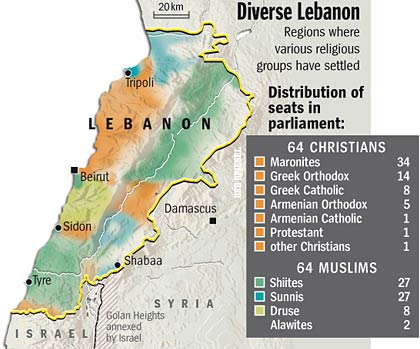
The patriarch's voice is melancholy as he discusses the consequences of political upheaval, especially the growing numbers of Christians now leaving Lebanon. According to Maronite church leaders, more than 730,000 emigrated during the Lebanese civil war from 1975 to 1990, with another 100,000 abandoning the country this past summer. According to Sfeir, other Christian denominations, including the Greek Orthodox, Greek Catholic and Armenian Christian communities are also dwindling, leading to a decline in Christian political influence in Lebanon. "It is unlikely," says Sfeir, "but if Hezbollah were to assume power one day, the Christians in this country would emigrate in even greater numbers." If that happened Lebanon, traditionally a safe haven for minorities, would lose one of it oldest religious communities. In the ninth century the Maronites, whose name is derived from St. Maron, a Syrian monk, fled into the mountains of Lebanon to escape Muslim persecution, and in the 12th century they joined the Roman Catholic Church."We even survived the Crusades," says the patriarch. "Now the war is driving people away. They are losing hope. But we have also seen the opposite taking place. We have had Christian heads of state in Lebanon since the 1940s -- the first time this has happened in four centuries -- and our Muslim fellow citizens have had no objections." Sfeir is referring to Lebanon's fragile proportional system of government, under which the president must be a Christian, the prime minister a Sunni and the speaker of parliament a Shiite. But the system, put in place in 1943, has long since been rendered obsolete by demographics. Sfeir senses that the political balance of power has also changed -- and does not favor Christians. Hope in Syria and Iraq's Turkish Autonomous Zone Many Christians currently see a ray of hope in neighboring Syria. Since the fall of Baghdad, the regime in Damascus, isolated by the United States, has taken in many thousands of Iraqi refugees. In doing so, it has demonstrated to the West the long-forgotten merits of the Arab nationalist Baath Party's non-denominational doctrine. "Nobody here cares whether we are Sunnis, Shiites or Christians," says Farid Awwad, a souvenir vendor who fled Iraq. Awwad's 12-year-old daughter was killed in an attack on a Chaldean church in Baghdad two years ago. "No one can take away our pain," he says. "But at least we can live here, where we are treated like brothers." The number of Christians within the Syrian Baath Party organization is disproportionately high, although most are non-practicing. Their presence in government service, including the military and intelligence agencies, is unprecedented in the Arab world. President Bashar Assad recently opened a conference of Arab law associations under the motto: "The fatherland is for everything, but religion is a matter for God" -- words that would be alienating if not impossible in countries with a stronger Islamic influence. In Saudi Arabia, for example, which has no Christian minority of its own but employs tens of thousands of Christian guest workers from the Indian subcontinent and Africa, Christian church services are banned and punishable with severe penalties. Bibles and crucifixes are routinely confiscated. The Wahhabite religious police, the Muttawah, have even been known to raid private religious services. Other Gulf states are more liberal, although religious freedom in the Western sense is virtually nonexistent in Qatar, Kuwait and the United Arab Emirates. The Islamist opposition in Damascus, especially the banned Muslim Brotherhood, disparages the country's unpopular Christians as "worshippers of a godless regime." There is only one other region of the Middle East where Christians enjoy freedoms comparable to those in Syria: the Kurdish Autonomous Zone in northern Iraq.
Several Christian parties recently introduced an unusual bill in the regional parliament in Arbil, the Kurdish capital. They proposed the establishment of a Christian autonomous zone in the eastern portion of the Iraqi province of Nineveh, the traditional homeland of Assyrian Christians and now partly controlled by Kurdish Peshmerga fighters. Under the bill, the Chaldean, Syrian and Assyrian Christian minorities would be granted official status under the constitution -- first by the Kurdish regional parliament and then by the National Assembly in Baghdad. The plan, which is everything but Christian folklore, has a good chance of succeeding. Units of the 750-member Hamdaniyah Brigade -- a Christian militia that defends its churches with the same tactics Sunni and Shiite militias use in central Iraq to defend their mosques -- are already patrolling the streets of Bartalla, a fast-growing Christian settlement 20 kilometers (12 miles) east of Mosul, the violence-ridden provincial capital. Bearded men wielding Kalashnikovs stand guard at a barrier in front of the town's Syrian Orthodox Church of the Virgin Mary. Photography is strictly forbidden."What else can we do?" asks Ghanem Gorges, the 43-year-old mayor of Karamlis, a Chaldean village a few kilometers south of Bartalla. Armed men, presumably mujahedeen from nearby Mosul, forced their way into the village four times this fall. Two weeks ago they kidnapped and murdered Shakib Paulus, a 25-year-old crane operator, whose body was found on the street in Arbil a few days later. Anyone wishing to attend services at St. Peter's Cathedral in Arbil must first pass a guard carrying an automatic pistol. A huge new building, to be used as a dormitory for the Babel College students who fled Baghdad, was dedicated at Christmas on the cathedral grounds, which are surrounded by a tall fence. At this year's Christmas service, Pastor Sisar did not deliver his sermon in Aramaic, the old church language of northern Iraq's Christians, as is customary in Arbil. This time the mass was held in Arabic, because, like the pastor, the 400 men and women attending the service are all from Baghdad. Sisar ended his sermon with the words "Barakat Allah aleikum" -- "May the blessing of the Lord be with you."
|
||||||||||||||||
Appointment of Helena Guergis as Canada's Secretary of State Office of the Prime Minister 4 January 2007
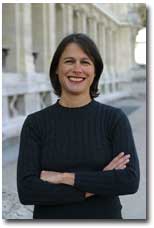
Today, Prime Minister Stephen Harper announced the appointment of Helena Guergis, Member of Parliament for Simcoe–Grey, Ontario, as Secretary of State (Foreign Affairs and International Trade). “Helena Guergis is a hard-working and impressive two-term Member of Parliament from Ontario. She will work with Minister Peter MacKay and Minister David Emerson on protecting and advancing Canada’s interest and values on the world stage,” commented the Prime Minister. “She will also take on the additional responsibility of Secretary of State (Sport), assisting Minister Bev Oda. She will be an excellent representative for our athletes and our athletic community.” Helena Guergis’ appointment was part of Prime Minister Harper’s announcement designed to strengthen his ministerial team as well as create six Secretaries of State, as Canada’s New Government gets ready for the return of Parliament and its second year in office. The Honorable Helena Guergis Helena Guergis was first elected to the House of Commons in 2004 and re-elected in 2006. In February 2006, Ms. Guergis was appointed Parliamentary Secretary to the Minister of International Trade. Most recently, Ms. Guergis has served on the standing committees on International Trade and on the Status of Women. Previously, she served as Official Opposition Critic on a number of files and as a member of standing committees. Prior to her election, Ms. Guergis was a policy advisor to the former Ontario Finance Minister, Janet Ecker, and worked for Progressive Conservative member of the Ontario legislature, Joe Tascona. She has also owned a small business. Ms. Guergis has volunteered with the Barrie Rape Crisis Centre and has contributed to fundraising efforts for a local food bank for several years. She has also been a literacy tutor for seniors. The First Assyrian Helena is the first Assyrian elected to the house of commons. She was born in Barrie, raised in Angus, Ontario in 1969, where she grew up working in her father’s business, George’s Furniture, before operating her own small business. Helena comes from a politically active family and got her start in politics on her grandfather’s re-election campaign for the Reeve of Essa Township. Sens. McCain & Liberman Remarks on Assyrians (ZNDA: Washington) On Friday, 5 January 2007 U.S. Senators John McCain and Joe Liberman delivered remarks on Iraq at the American Enterprise Institute in Washington when they also made references to the situation of the Assyrians. The following are excerpts from this conference courtesy of the CQ Transcripts Wire and the Washington Post.
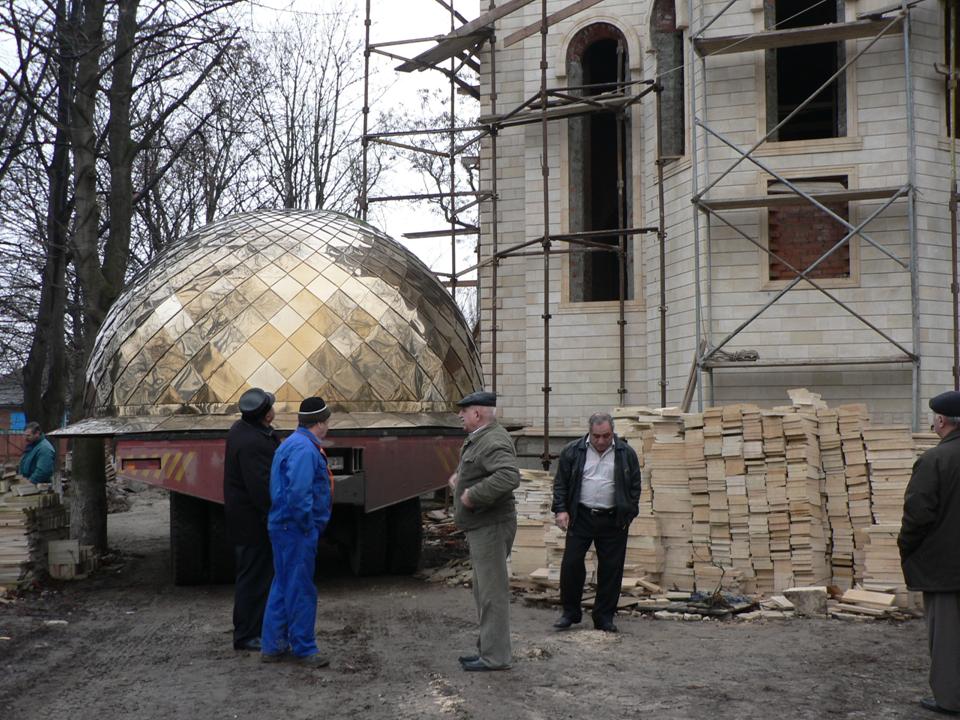
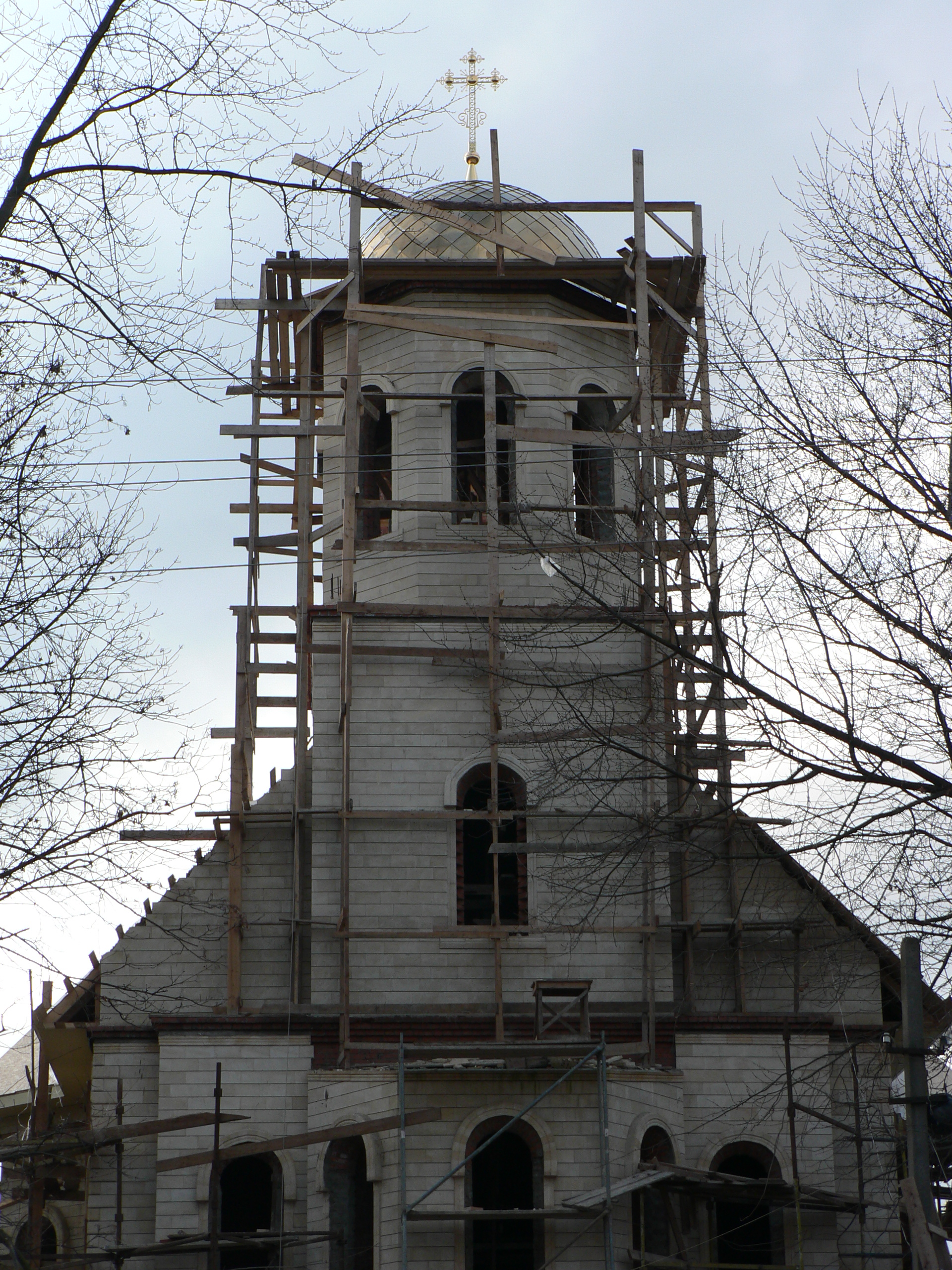
QUESTION: There's been no mention of the Assyrian Christians who are about 10 percent of the population. And the Iraqi government publicly, a while ago, offered to set aside one province for the Assyrian Christians and some of the minorities. What advice would you give to the Assyrian Christians and the other minorities that are being marginalized and, in many ways, nearly half the population has already left? MCCAIN: My only advice is that if we can get a functioning government, they will then receive the same protections as other citizens in a stable environment. Without it, then obviously many minorities -- Turkomen, many of the other minorities that are residing in Iraq -- are at great risk. It's not just Sunni versus Shia, as we know. It's to some degree, in the view of extremists, ethnic cleansing. LIEBERMAN: Agreed. QUESTION: Senators, what about the tensions in the north, and especially about Kirkuk? Should the planned Kirkuk referendum be delayed? LIEBERMAN: In the broad sweep of things, I'd say the best thing for this United States senator is to say that that ought to be left to the Iraqis for now. In other words, this is majoring in the majors. We've got to help them achieve security and build a functioning government and economy. And that has to be the priority. MCCAIN: Every time I meet with Kurdish leaders, including Barzani, I talk about this. We all know that it's exacerbated by the movement of people from Baghdad by Saddam Hussein into Kurdish areas, and Kurds were displaced and now there's huge disputes within Kirkuk. We have to do whatever we can to see that this issue is disposed of fairly inequitably. It's going to be very, very difficult, as varying conflict claims are tried to be adjudicated by now not very frequently. Krasnodar Celebrates the Final Stage of Church Construction On January 5, 2007 in Krasnodar, Russia the Golden Dome and the Cross of the Mar Giwargis Assyrian Church of the East were mounted on the church building. The event was celebrated as a final stage of the construction of an Assyrian church in Krasnodar, a city with approximately 4,000 Assyrian residents.
The land on which the church building is constructed was provided by the local Russian authorities to the Assyrians of Krasnodar, Russia in 1997. In 1998 Mar Giwargis Sliwa, the Metropolitan of the Assyrian Church of the East (for Iraq and Russia) blessed the land and the future construction of Mar Giwargis Church (St. George) while he was visiting Assyrians of Russia. The construction, which began in spring of 1999, has been made possible thanks to the Assyrian community of Krasnodar, led by Mr. Oleg Georgizov (the President of the Assyrian Association of Krasnodar and the territories “Khayadta” and the President of Center of National Cultures of Krasnodar). Many Assyrians of Krasnodar took part in the building of the church, financially and physically, a few of whom are:
Many Russian friends of Assyrians, individuals like Mr. Yuriy Lobodin who helped choose the land and legalize the paperwork, also took part in the building of the Church. The Bell Tower is planned for completion during the first quarter of this year. Best Selling American Writer Turns to Assyrian Enclave in Iraq
(ZNDA: New York) Former Time magazine Paris bureau chief, Tom Sancton, makes a transition to fiction in this intriguing political fiction describing the setting up of a pro-Western democratic Christian enclave in Iraq. The story is about the Paris-based New York Chronicle reporter Sam Preston who, after the bombing of an Assyrian church in Paris, stumbles onto the U.S. government's plot to back an Assyrian leader-in-exile wanting to form a breakaway republic in Iraq, and the U.S. Administration who wants to accelerate the final battle of Armageddon and secure U.S. access to significant hidden oil reserves. Preston becomes the quarry of an international array of spies and bad guys, narrowly escaping death through numerous lucky escapes. He becomes the confidant of several players key to the intrigue; soon enough his life is in danger, but he's willing to risk all to break the true story of the Armageddon Project. Sancton's narrative skill is evident as he efficiently moves the action from the sands of Iraq to the halls of power in Washington, France, and Israel. As the hero, Sam is sketched a bit lightly, but there's no mistaking who's who in the American government. The president cuts brush and runs the country by the Bible. The vice-president sneers. This is a fast and furious read that really could be ripped from the headlines. Tom Sancton was named Paris bureau chief in 1992. He joined TIME in l979 as a staff writer in the World section. Sancton was named an associate editor in l981 and moved to Paris as a correspondent the following year. In l985 he became a Paris-based associate editor for TIME International, concentrating on European affairs. He returned to New York in l986 to edit TIME's Back-of-the-Book sections, and was named a senior editor in 1988, moving to the Nation section in September of 1990. As Nation editor, he directed TIME's coverage of the 1992 presidential election, culminating with the "Man of the Year" feature on Bill Clinton. Sancton has written more than 30 cover stories for TIME, including the 1981 "Man of the Year" story on Lech Walesa and a 1987 cover story on Soviet political reforms, for which he shared an Overseas Press Club Award. He has written extensively on the Soviet Union and Eastern Europe and was co-author in l987 of a TIME book, Mikhail S. Gorbachev: An Intimate Biography. The son of New Orleans novelist Thomas Sancton, he studied the clarinet with some of the city's veteran musicians and began sitting in on French Quarter jam sessions as a teenager. In September 1990, G.H.B. Records released Tom's seventh album, "New Orleans Reunion," a collection of traditional blues and standards that he recorded with a clarinet-drum-piano trio. A subsequent album "Together" was released by Fleur de Lys Records in 1992. His musical background made Sancton the obvious choice to chronicle "The New Jazz Age" for a TIME cover story in October 1990 Sancton has a B.A. in American history and literature from Harvard College and a doctorate in European history from Oxford, which he attended as a Rhodes Scholar. His Oxford thesis, America in the Eyes of the French Left, was awarded the Gilbert Chinard Prize by the Society for French Historical Studies in l979. He lives in Paris, France, with his wife and two children.
Deir Al-Surian's Syriac Manuscripts
Courtesy of al-Ahram Online The Coptic monastery known as Deir Al-Surian, or the Monastery of the Syrians, contains more than 3,000 books as well as a vast number of texts in Syriac, Aramaic (the language of Christ), Coptic, Arabic and Ethiopic. They date upwards from the fifth century and today, as a result of the revival in Coptic monasticism in recent years, a new generation of educated monks are anxious to safeguard this heritage. Both Syrian and Coptic monks are engaged in their conservation, as well as restoration of the monastery itself. Collaborating with them on what is known as the Deir Al-Surian Library Project is the Levantine Foundation. The aim is twofold: to salvage old manuscripts which, after surviving a century and a half in a living community, are in danger of being lost, and to conserve the remaining literary inheritance of more than 1,000 Syriac manuscripts for future generations.
The project is moving ahead and members of the conservation team, with the help of volunteers and on a shoe-string budget, are surveying, restoring, cataloguing and storing the Syriac texts in a suitable environment. A digital photographic record of each manuscript will eventually be made to facilitate access for scholars, and appropriate storage for the manuscripts and facilities for visiting scholars is also planned. Father Bigoul Al-Suryani, the curator of the library, has good reason for being enthusiastic about the project. "Storage is particularly important because most of the manuscripts are in a perilous state and continue to deteriorate," he says. "Hopefully, with adequate support, our aims can be achieved. Monks are being trained in various conservation techniques, not only with the manuscripts but also the wall paintings." It is interesting to note that there is no evidence of Syrian settlement in the monastery earlier than 815 when, as is attested by early Syriac and Coptic texts in the library, Syrians and Copts co-existed. Only in the 10th century did Syrian monks gain prominence, and at this time Moses of Nisibis is credited with valuable additions to the library. In 927, when he went to Baghdad as a representative of the desert monasteries in an effort to obtain tax exemption for the monastic communities of Wadi Al-Natrun from the Abbasid Caliph, he took the opportunity to travel widely and managed to secure valuable volumes which greatly enriched the library of Deir Al-Surian. When a pious and charitable Syrian named Abram Ibn-Zarah ascended to the patriarchal throne in 974, Deir Al-Surian became closely associated with, and indeed was under the patronage and the protection of the Copts. By the 11th century it rated as the third largest monastery at Wadi Al-Natrun. In the second half of the 15th century, however, the monastery was re- inhabited by several Syrian monks. Among them were Dawoud Ibn Boutros and Habib of Takrit, both of whom were engaged in outstanding literary activities. They wrote homilies dealing with ascetic life, historical treatises about the names of church fathers, and a scribal note in a manuscript written in the monastery in the 16th century which records that 148 monks were living in the monastery at the time, of whom 25 were Egyptian. It is no surprise, in view of the above, that a great deal of our knowledge of the monasteries of Wadi Al-Natrun comes, not from Coptic sources, but from Syrian monks who probably made the earliest collections of manuscripts. In fact, Syriac continued to be used until the 17th century when it began to fade away and Coptic became the dominant language of church literature.
The 17th-century French consul in Damietta, Father Coppin, made several visits to Deir Al-Surian and drew attention to the literary treasures of the monastery. When in 1638 news of its extensive library spread abroad, Pope Clement XI, a patron of art and literature, commissioned Gabriel Eva, the abbot of the Monastery of St Maura in Lebanon, to look into the matter. "His report was so impressive that in 1707 Elias Assemani was sent to Egypt where he acquired 40 volumes of Syriac manuscripts for the Vatican library," Father Bigoul says. "Another librarian, his relative J S Assemani, followed and was successful in his acquisition of more books from both the Monastery of Abu Maqar (St Macarius), and the Monastery of the Syrians, where he discovered more excellent Syriac manuscripts." When the monks realised that the books were not being returned to them after study and that they were losing their valuable literary heritage, they became less hospitable to subsequent visitors. Some were refused entry to the library, while others were given access but were monitored. They were allowed to inspect Coptic, Syriac and Arabic books on parchment and cotton paper but not to make purchases. Not until the 19th and 20th centuries did travellers and bibliophiles start journeying across the barren desert west of the Delta towards Wadi Al-Natrun and were able to buy manuscripts from the monasteries, especially those written in Syriac. Many of these volumes are now in the British Museum, the Vatican Library, the National Library in Paris and elsewhere. Despite the fact that so much of the Syriac literary heritage is no longer in Egypt, the remaining collection at Deir Al-Suryan represents an inheritance of enormous scholarly value. Whereas early visitors were primarily interested in the manuscripts, recent research tends to focus also on the monastic communities that have lived in the monastery from antiquity to the present day. Researches and conservators are asking what we know about the creators and the custodians of this important heritage. Confirmation of Syrian occupation of the monastery comes from an eighth- to ninth-century wall painting discovered during recent restoration. It is a representation of a saint with children on his lap which has proved to be Abraham, Isaac and Jacob in Paradise. One part revealed a Syriac text under several layers of plaster which mentions that restoration of the church was completed in the year 992. The more than 1,000 Syriac manuscripts in the library of Deir Al-Surian have a prominent place in the field of Syriac studies generally and are, in the words of Anba Matta, bishop of the monastery, "a rare legacy that is now receiving due attention".
|
||||||||||||||||||||
|
What about Recognition of Youel Baaba’s Work? Mikhael K. Pius The Bet-Nahrain Organization held in early December 2006 a cultural program at their cultural center in honor of the late Mishael Lazar Essa, a noted prolific Assyrian story writer, dramatist and poet, who died in Baghdad prematurely in 1962 at the age of 44. The program was hosted by Yasmin Dawood and was aired on the organization’s satellite station, AssyriaSat.
Yasmin read out the life sketch of the celebrated writer, and several other persons—all Bet- Nahrain members—paid sketchy tributes to the deceased. Sargon Dadisho read out a commentary on Meshael’s book Khamis Libbeh d’Prizla (Khamis, the Iron-hearted) and then read out a few comments made by readers on the book and the author. The program was a fitting gesture from Bet-Nahrain in memory of the man who produced in a relatively short lifespan quantitative and qualitative prose and poetry for our Assyrian readers and who might have been an icon among the Assyrian men of letters had he lived into old age and had taken advantage of the publishing opportunities that our people in this country are enjoying. However, I thought the program had a few deficiencies. It did not include the views of a few other people who knew Meshael Lazar Essa well and particularly one, Youel Orahim Baaba, who knew him much more than those who spoke about him. Secondly, despite Youel Baaba’s significant role in the life and writings of the celebrated author, Youel’s name was mentioned only passingly just once during the program. And thirdly, I also noted a few discrepancies in the talks. I’d therefore like to put in my two cents worth in order to shed some more light on the subject. When Yasmin referred to the Gilgamesh Magazine anthology, skillfully arranged and typeset in Assyrian by Daniel David Benyamin and published and distributed by Youel Baaba, she did not mention the above two names. Didn’t the creators of such beautiful monumental work deserve to be recognized and known by the listeners and viewers? Yasmin’s sketch also did not touch on the author’s domicile in Maratha Lines, Hinaidi. Young Mishael worked then for NAAFI and he and his family (mother and seven siblings) lived in the small local labor camp adjoining the RAF Station, from 1932 (when their father Lazar died prematurely) to 1936 when they relocated to Civil Cantonment of Habbaniya, along with the other families of the camp. Following the disbandment of Mundan refugee camps near Mosul in May 1921, a score of Bne-Gangachin families who decided not to return to Persia, including the Essa family, lived in an Arab village by the eastern bank of Tigris River in Baghdad until 1932. This village, owned by an Armenian, was called—yes, Minas Camp and was not Gailani Camp as Yasmin thought. Meshael and his own family did live in Gailani Camp but after he married Yoliteh in 1943 and until his death in March 1962 when he passed away unexpectedly in Dora while visiting his late brother Shimshon and family. (Incidentally, a mile downstream from Minas Camp was another Arab village called Khatun Camp, also owned by an Armenian, a hard-of-hearing widow of an Englishman. In this village lived, among others, from about mid-1920s to 1932 several of our Bne-Mawana families, along with a few Armenians, including the family of Chachan, the father of the late former well-known Habbaniya sportsman, Jerar Chachanian. Chachan owned a small grocery shop close to our hovel of a house. Youel Baaba knew Meshael Lazar Essa both personally and literarily. He too had interest in literature and took part in Mishael’s staged plays and the two weregood friends for a few years before Youel came to America in March 1952. And more important, Youel Baaba who dubbed the writer in recent years “Father of the Assyrian Novel,” has brought to light, according to my knowledge, at least two of Meshael’s major works, by publishing and distributing them, along with the works of a few other noted Assyrian writers. (Actually, in my humble opinion, Meshael was father of the Assyrian short story and novelette, because most of his long stories were much shorter than an average novel’s length, which is usually over 100 thousand words of fiction involving a complex plot or pattern of events.) Anyway, according to the information in Tounayeh d’Mishaiel Lazar Essa (Stories of Meshael Lazar Essa) published by Youel Baaba in California in 1992, Meshael’svery first book Marganita d’Qam Khzoureh (Jewel Before Pigs) was printed and distributed by Youel Baaba in Baghdad in 1950. For lack of readers, however, only 200 copies were sold, which I assume left Youel Baaba in the red. So my question is: Where was Youel Baaba? Why wasn’t he taking part in the program? Was he invited or did he decline to take part? And why wasn’t his name given the credit due him? Was it because of Assyrian politics, or what? TV media is now considered a forceful form of journalism and a journalist’s primary duty is to tell the truth, regardless of the writer’s feelings for, or viewpoint on, the subject. It is a pity that today in Assyrian journalism—in fact in all forms of expression by Assyrians—there is a tendency to exaggerate and lie as well as to steal others’ credit, or deny credit where credit is due! As a young budding writer (even though I wrote in English) I was an admirer of Meshael Essa the literary figure, the Assyrians’ William Saroyan, and his death has been a sad episode in my life. Mishael had a big family to support and because he had an unstoppable urge in spending much of his time writing, with little or no benefits of financial remuneration, he could not publish his work. And all of his cronies were just ordinary people, not big-wigs or literature enthusiasts who could finance his projects. As stated on the program much of Meshael’s work is still unpublished. Some of his hand-written manuscripts were lent to friends and relatives who did not return them. The rest remain with his family unpublished, basically because of lack of resources to have them printed and distributed but also due to insufficient Assyrian readership! Since Bet-Nahrain and Meshael Essa’s family on one hand and Youel Baaba on the other don’t seem to be in tune, why doesn’t Bet-Nahrain, which has both the financial and promotional resources, publish and distribute Meshael’s stashed-away manuscripts before they too are “stolen”?
I saw Mishael as a rather shy, modest, and down-to-earth sort of person who loved the common people. If you look at the group picture of the players Braqaleh d’Kiltounya, he is standing behind all, on the extreme right, virtually “hiding” himself instead of taking the center stage and flashing a big smile, with thumbs up, like some who are full of themselves do. Because of his shyness, he was also somewhat uptight. I remember when his late brother Shimshon took him out of the CC Cinema in Habbaniya at the interval of one of his 1953 plays to have a soda drink at the adjoining canteen, he was so self-conscious and nervous that his trembling hands dropped the bottle down to break into splinters. I knew Meshael Essa and his siblings since the early 1930s, but wasn’t acquainted with him until 1957 after one of my younger brothers, the late Raphael (Appaiel) became his friend when Meshael wrote the lyrics to four Assyrian songs to Western music that Appaiel produced through Germany on two single-play records. Three of the songs were sung by our maternal aunt Wardiya Kakkou and the fourth by Polous Babajan, a member of Meshael’s group of friends. Another of his close friends was the late Enviya “Hawindu” David. Of Meshael’s several plays, two of them were staged in Habbaniya, namely Rakhmeh w’Dimmeh and Awaheh w’Bnooneh. Both of these plays were reviewed by me in the now defunct The Iraq Times in June and in November, 1953, respectively, and they were in fact the basis of our striking up friendship with each other a few years later, for both of us were shy and needed something to have in common to make friends. At that time Meshael was managing the Iraqi Iron Industries showroom, just around the corner from our Coronet Bookstore in Babul Sharji. So after Appaiel left for U.S. in March 1959 Meshael would occasionally drop in on me for a little chat at the bookstore before going home after he closed his shop. It is common knowledge to people who knew him that Meshael loved wine and spirits—as did my brother Appaiel—and his best work was probably produced while he was high. And he always had a drink or two before he came to see me. Alcohol, which I believe Mishael used as “medication” for his shyness, was also the direct or indirect cause of his untimely death, just as the addiction killed his friend Appaiel at the youngish age of 49, two decades after Meshael’s death. Mishael was with my late brother Aprim (Appy) and me at our home in Arasaat Bahoshy in Baghdad the very night he died. He suddenly dropped in on us one evening. I think it was probably the first time he was visiting our home, and I’m fairly sure that had he not already had a few drinks he wouldn’t have mustered the “courage” to visit us. He said he had already eaten when we offered to bring him some food, but he asked for a drink. We brought him one and each had one ourselves. We sat and chatted for a couple of hours, while he had another drink. It was getting late and we offered to drive him to his home in Gailani Camp, two or three miles away. He said he didn’t want to go but wanted to stay with us overnight. Of course we decided that it was not right for him to stay with us since his family would be worried about him. So we talked him into the car and as we drove towards Gailani Camp he suddenly changed his mind and didn’t want to go home but insisted on going on the bus to his brother Shimshon’s home in Dora, several miles away. When we told him that we had no idea where his house in Gailani was to inform his family, he assured us that he would inform his family from Dora. So we drove him across the bridge to the bus station near the former King Faisal’s Statue. We set him on the bus to Dora and Aprim placed half-a-dinar in his pocket in case he had no bus fare and we drove back to home. And the next day we heard that Meshael had died in Dora. I’ve always wondered what would have happened had we decided to put up Meshael for the night at our home, or driven him to his own home against his will? Would he still have died? Or was his fate already written on his forehead, as we say? It’s a question that has been haunting me for many years! A Matter of Life or Death Voltaire E Warda I received this morning from AINA the report titled "Sadr Followers Target Assyrian School Girls in Baghdad". My questions to our leadership at the Assyrian Church of the East are as following:
I have many more questions to ask but for now I and many Assyrians like to get some answers and I hope the answer will not be that H.H. Mar Dinkha doesn't get involved in politics. This is a matter of life and death and some one should do something right now. God bless and protect our innocent Assyrian people in their homeland of Iraq.
Mehrdad Izady & the History of Kurdish Christianity Fred Aprim Kurdish writer, Mehrdad R. Izady, continues in the ongoing campaign to Kurdify northern Mesopotamia ( Assyria) and corrupts the history of the indigenous Assyrian people. See his latest stunt published about the Kurds under the title "Christianity" here (click here): One problem with this kind of publication, i.e., material published on private web sites such as kurdistanica, is that it is hard to respond and challenge Izady. It is not possible to respond and have that response posted on the same web site to offer readers the opportunity to read the other side of the argument since the nationalists Kurds who run kurdistanica would not agree to post any challenges to their corrupted version of history. This is unlike the case where an article is posted in a public magazine or newspaper as one can send a reply to that publication, with at least a chance to be published and the people will have a chance to read the challenge. I have responded earlier to two of Izady's previous writings: The first, "Kurdishmedia.com Attempts to Rewrite History – Again," appeared in Zinda magazine in response to an article by Izady in kurdishmedia.com. Click here to read that response. The second response was to an article titled "Back from the Brink" by David Axe published in Archaeology magazine, Volume 59 Number 4, July/August 2006 issue. In that article, Axe, a Kurdish sympathizer; interviewed Izady and the latter went on with his wild claims that the Kurds are the descendents of the ancient Mesopotamian Halaf, Ubaidian, Hurrians, and other civilizations. Of course, this is the biggest lie in the history of Mesopotamia. The magazine has yet to respond to my letter. Meanwhile, in her letter to Archeology, Dr. Eden Naby asked the magazine: "Why Mr. Axe, a journalist with apparent credentials that you accepted, does not cite one specialist on Mesopotamian archeology - whether Prof. MacGuire Gibson from the Oriental Institute at the University of Chicago or Prof. Simo Parpola from Helsinki University - is a mystery. And why ARCHEOLGY accepted an article so submissive to Kurdish myth-making is yet more shocking." Many have challenged Izady's writings repeatedly and there are those who choose to ignore him since he is not trusted as a historian. In his latest article, Izady surpassed all revisionists before him; he deserves to be awarded the title "the father of all revisionists." In his latest article about Kurds and Christianity, Izady proves yet again to be a master plagiarist. His bibliography is centered on the work of a few western missionaries who did interact with Kurds starting in the late 19 th century. However, those missionaries never stated what Izady claims. If we read any scholarly work about Christianity and Christians in Asia in general and Mesopotamia in particular, one would convincingly find that despite the fact that missionaries were sent to evangelize the Kurds in late 19 th and early 20 th centuries, however, the Kurds were never part of early Christian enterprise in Asia. Lets visit with all the following scholars, theologians and historians who are the experts on Christianity and Christians in Asia and the Middle East, early and modern: Alphone Mingana (The Early Spread of Christianity in Asia), Aziz Atiya (History of Eastern Christianity), Samuel Moffett (A History of Christianity in Asia), John Stewart (Nestorian Missionary Enterprise), Kenneth Latourette (A History of Christianity), Robin Waterfield (Christians in Persia), Everett Ferguson, Michael McHugh and Frederick Norris (The Encyclopedia of Early Christianity), W. A. Wigram (History of the Assyrian Church), P. Y. Saeki (The Nestorian Documents and Relics in China), Gordon Chapman (Christianity Comes to Asia), Donald Hoke (The Church in Asia), Nicolas Zernov (Eastern Christendom), J. F. Coakley (the Church of the East and the Church of England), Lawrence Browne (The Eclipse of Christianity in Asia), Aubrey Vine (The Nestorian Churches), Mark Dickens (The Church of the East), etc., etc. My question to Izady is: In which book of the above are the Kurds mentioned in the manner presented, i.e., played any role in early Christianity in the region? Would Izady refer to one sentence from any of the above reputable publications and show the readers when and where are Kurds mentioned as Christians in early or medieval periods? Izady's article is full of fallacies. He begins by talking about the so-called Kurdish Royal House of Adiabene. The Royal House of Adiabene in question was not Kurdish rather Assyrian. The Royal House of Adiabene in the said period was represented by Queen Helena and her son Izates who converted to Judaism in A.D. 30. Not a single historian ever referred to Helena as Kurdish. There is no better authority on this matter than the accounts of the Jewish historian Flavius Josephus (A.D. 37 – c. 100) who supports this statement and refutes Izady's claims (Read Whiston, William. trans. The Works of Josephus. 14 th ed. Massachusetts: Hendrickson Publishers, Inc. 1999. pp. 526-530). Later, Izady makes his largest leap into fantasy yet and writes: "With the waning and isolation of Christianity in Kurdistan and the Middle East following the expansion of Islam, the dwindling Christian Kurdish community began to renounce its Kurdish ethnic identity and forged a new one with its neighboring Semitic Christians. The Suriyâni (Nestorian) Christians of Mesopotamia and Kurdistan, who have recently adopted the ethnic name Assyrian, are a Neo-Aramaic-speaking amalgam of Kurds and Semitic peoples who have retained the old religion and language of the Nestorian Church, and the court language of the old Kingdom of Adiabene. A large number of these Suriyâni Christians lived, until the onslaught of World War 1, deep in mountainous northern Kurdistan, away from any ethnic or genetic influence of the Semitic Christians of lowland Mesopotamia. Their fair complexion, in marked contrast to that of their Semitic "brethren" in the Mosul region, also bears witness to their Kurdish origin. Yet they speak Neo-Aramaic and insist on a separate ethnic identity." This is myth making at its most imaginative! How would one respond to such nonsense? Is a response really worth it? The fact is that Izady has no degree in ancient history. Izady has a degree in Kurdish culture from Harvard, which, lucky for him, was granted when few people knew anything about the Kurds. In this vacuum of knowledge and genuine historical sources about Kurds, the Kurdish nationalist movements play a big role in shaping what is published; politicized Kurdish publications masquerade as academic studies. Izady takes advantage of the vacuum in academia and lets his pen run wild in laying claims to parts of history about which he knows almost nothing. While he is little more than a joke in modern Middle East studies, even among Kurdish scholars, yet he is happily hoodwinking others. For a critique of Izady's flawed concept of Kurdish ancient history and the so-called Kurdistan, see Maria T O'Shea, Trapped between the Map and Reality: Geography and Perceptions of Kurdistan. New York: Routledge, 2004. O'Shea argues that Kurdistan lacks a real definition and that the concept survives the reality, which is a mixture of myths and modern ambition. For comments on Izady's obsession with creating a Kurdish ancient history that does not exist, see the works of real Kurdish scholars published in a series of books on Kurdish history. Izady is a Kurdish chauvinist and he has ambiguous credentials that he uses to construct a myth about the Kurdish pre-16 th century history of the region. Both Kurdish and other trained historians have exposed Izady's questionable campaign as totally flawed. The fact remains that most of the Kurdish early stages history is fabricated. As Dr. Eden Naby noted, we need a committee of few capable, educated and resourceful people who will make it their responsibility to respond to popular press accounts, both to encourage good writing and dissuade publications from reproducing rubbish. This must come to pass and it must be an organized effort. In the meantime, we, as individuals, will continue to do our best to undo the damage done by such writers like Izady who have a dangerous agenda: to corrupt the glorious history of northern Mesopotamia ( Assyria). A Comment on Davix Axe's Article re Origin of Kurds Fred Aprim I read the article titled "Back from the Brink" by David Axe in "Archaeology", Volume 59 Number 4, July/August 2006 issue, about Arbil and the origin of Kurds with great concerns. The article with one-sided view, i.e., that of Merhdad Izady, is full of fallacy. The Kurds have been embarking on corrupting and falsifying the history of northern Iraq for some 80 years and since the creation of Iraq in 1921. To write a serious article one must get different opinions from different historians and scholars of history and from archaeologists before passing judgment on the origin of a certain region and its people. Merhdad Izady is not an authority on the history of Mesopotamia (Assyria and Babylonia) or Iraq, which he refers to its northern region as Kurdistan. It is unfortunate that we become so casual in looking at a sensitive topic such as history and rush to accept a certain myth just because certain "historians" legitimized it for one questionable reason or another. This is not fair or good reporting. Real archaeologists and historians tell us other realities about the history of northern Iraq. I challenge Izady to point to one archaeologist who has ever dug out anything that is specified as "Kurdish" in northern Iraq. I challenge Izady to name one monument, artifact, etc., that reflects a "Kurdish culture" and civilization in northern Iraq before the 20th century. The Kurds play with words and make every ancient culture, such as Halaf, Ubaidian, Hurrians, that contributed to the history of Mesopotamia as Kurdish when that is the biggest lie in history of Mesopotamia (Iraq). Izady does not stress on the real Assyrian history and heritage of northern Iraq; he is politicizing the topic as Kurds continue their methodical policy of Kurdifying the region. Here is a challenge for all readers. Please visit any public library near you, search and then collect all books written by scholars and archaeologists on ancient Mesopotamia and read them. Let's see if anyone can find one paragraph where it discusses and argues the presence of "Kurdish culture" in Mesopotamia in the ancient times. Northern Iraq was part of the Assyrian Empire for over a millennium. Assyrian Christians were the predominant population of the region until the outbreak of World War I. After the fall of the Assyrian Empire in 612 B.C., northern Iraq (Assyria) was conquered by the Persians, Arabs, and many Turkmen tribes, Mongols, and finally Ottoman Turks and others in between. Kurds are not mentioned in the past history of Mesopotamia. Reporters have a moral obligation to print the truth and not spread anything that they hear without undertaking thorough investigation. The said article presented the origin of Arbil and northern Iraq basically as Kurdish based on what a Kurd, i.e., Izady, stated. Well, I am saying I could show the author every book on the history of Mesopotamia and they all will show without any doubt that Mesopotamia has nothing to do with the Kurds and that the Kurdish homeland is in the Zagros Mountains in northwestern Persia (Iran). If interested, I could present many historical facts to refute Izady's unfounded claims.
Last Week's Poll Question: Do you feel optimistic about the year 2007 as regards the Assyrian people? Readers' Comments Shamasha Dan Daniel Too many chiefs: Asshur S. Lazar If Assyrian communities, globally, continue to gravitate toward the left-leaning, atheistic, secular progressive movement in the West, then we will utterly fail to realize our nationalistic dream of regaining our ancient homeland. Human pride is our greatest obstacle, faith in Christ is our only hope and prayer is our most powerful weapon against the worldly forces that seek to destroy us. Make no mistake, we are now on the road to oblivion. Only God can rescue us. Whatever steps we take from this moment forward to establish Assyria as a nation again, must be done according to God's Will and not our own and we must not glory in any success we realize. The Glory belongs to God alone. There is only one question we must ask ourselves, viz., who do we love most of all - ourselves or our Creator?
|
|
Lecture in London: Dr. Racho on Genocide in Turkey Assyria Society (SOAS) together with Firodil Institute and Gomidas Institute presents Genocide in Turkey Saturday 13, 3 PM (17:00) School of Oriental and African Studies A lecture on the Assyrian-Greek-Armenian genocide by Dr. Racho Donef from Sydney Australia. Celebrating the book launch of Dr. Donef’s translation of Ahmet Refik’s “Two Committees Two Massacres” Free Admission and refreshments For more information contact Nineb Lamassu of Assyria SOAS Society at nineb@soas.ac.uk or Firodil Institute at info@firodil.co.uk. Syriac Studies Symposium V Prof. Amir Harrak The Syriac Studies Symposium V along with the International Forum on Syriac Computing will meet in Toronto on June 25-27, 2007. |
Cry Iraq Courtesy of Countercurrents.org
There is in Le Louvre a diorite stela from the 18th century BC, on which are inscribed the 282 laws of the Code of Hammurabi: pretty much the earliest recorded set of laws we have (centuries older than Exodus, it includes the principle of “an eye for an eye”)–at a stretch, it might almost be called the world’s first written constitution. A picture of it is displayed in the British Museum, that Aladdin’s cave of looted treasures from Britain’s former colonies, near the Stela of Nabonidus. Made of basalt, 58 cm high by 46 cm wide, and dating from the 6th century BC, this has carved upon it in bas-relief is a figure wearing the traditional dress of a Babylonian king, who is thought to be Nabonidus, the last ruler of Babylon before it was conquered by Cyrus the Great of Persia in 539 BC. Crudely speaking, these two artefacts bookend the period of (uneven) Babylonian supremacy in Mesopotamia. We may put this another way by saying that this is the point at which we reach the most persistent of Babylon’s real life and real history. In the 6th century BC, the Babylonian New Year would be marked by an extravagant pageant along the Processional Way and through the Ishtar Gate, an 11-day ceremony which, it was hoped, would guarantee for another year the favor of the gods, grateful for all the attention lavished on them (Jones, "Short Cuts," 2005: 22). Nabonidus was away from Babylon for most of his reign, leaving the city in the hands of his son Belshazzar, he of the feast and the writing on the wall (in a modern materialization of the myth, an American soldier has carved the word The fall of the Tower is perhaps the central urban myth; it is certainly the most disquieting. In Babylon, the great city that fascinated and horrified the Biblical writers, people of different races and languages, drawn together in pursuit of wealth, tried for the first time to live together–and failed miserably. The result was bleak incomprehension. Ambitious technology striving to defy the natural order of things was punished as the tower that was meant to reach the skies crumbled. Irreligion and promiscuity inevitably conjured the apocalypse. And unlike Egypt, which in popular imagining continued serene through the centuries, Babylon is seen to have flourished and fallen again and again, the reading of each episode informed and deformed by those that went before. Mythical or historical, they go on and on: The Tower of Babel; the conquests of Nebuchednezzar and the invasion of Babylon by Alexander; the glorious court of Haroun-Al-Rashid; the devastation of Baghdad by the Moguls in 1258, where the Tigris ran black with the ink of the manuscripts from the ransacked libraries and the Euphrates ran red with the blood of the slaughtered. Still, is there any other culture from which the distant past, real or imagined, still wields power?
Let’s first take on the antiquities of Mesopotamia, which reveal the constants of Middle Eastern politics. Endlessly fluctuating frontiers and proliferating religions mean endless wars. Here, in the sculptured reliefs, are the cities bombarded, the women and children abused and killed, the aggressive signs of military power displayed, the brutality of militaristic regimes paraded, the puppet rulers installed, deposed, and at times hanged. Baghdad fell in 2003, but Babylon falls everyday in the National Gallery. In Rembrandt’s Belshazzar’s Feast, painted in Amsterdam in the 1630s, a corrupt and doomed ruler is about to be deposed by foreign armies, all supposedly in the name of a God he had disparaged. The writing on the wall announces that Belshazzar has been found wanting and that his kingdom will be divided among foreign occupiers. In a few hours divine retribution will strike. It is the biblical story as depicted by the 17th century Dutch painter. And if the National Gallery shows the night before the debacle, the morning after the invasion is exhibited at the British Museum. In 539 BC, Cyrus, the King of the Persians, entered Babylon and overthrew the tyrannical regime. The event is well known from Hebrew scriptures. But the British Museum also has evidence from another perspective–a cylinder of baked clay about 30 cm long, known as the Cyrus cylinder. It is an extraordinary document, in which Cyrus, using the script and language of his new kingdom, decrees that the cults of the different gods are to be restored and honored, and that the deported populations are to be allowed to return home. Unlike the Hebrew scriptures or Rembrandt’s painting, this is the story as it seemed in Mesopotamia itself. The Iran-Iraq war of 539 BC introduced a new order to the Middle East. A great Persian empire ultimately spread from the borders of China to the Bosphorus. For modern Iranians, Cyrus’s great victory and the empire are the basis of a national myth. Under Persian protection Jews returned from Babylonian exile to rebuild the Temple in Jerusalem (though many remained in Baghdad until the 1950s). For the Jews, this became a crucial memory that remains alive in modern Israel. If Babylon has this enduring topicality for Iranians and Israelis, it need hardly be said that its resonance for Iraq is enormous. Saddam Hussein, a potentate sans pareil, except perhaps for Suharto of Indonesia, was fascinated by ancient Babylon and Assyria. He made money available to protect and develop the archaeological sites. The great achievements of Mesopotamian civilization were pressed into the service of the Ba’athist regime, which labored hard to protect the cradle of human civilization (MacGregor, "In the Shadow of Babylon," 2005: 2).
The looting of the Baghdad Museum after the fall of Baghdad in April 2003 made headlines around the world. Images of priceless objects from the very roots of our civilization being carted away in the chaos that followed the collapse of the regime caused unprecedented outrage in the West and the Rest. But what is not known is that the treasures of Iraq have been plundered over many years, and on a massive, organized scale. Archaeologists, historians, and UN officials are appalled but seemingly helpless to stop the flow of artifacts out of Iraq and into the hands of museums and collectors in the antiquity-hungry West. Was the emptying of the Baghdad Museum simply random looting in the confusion following the war? Probably not. There is now strong evidence that some of it was a pre-planned professional operation aimed at feeding the huge Western appetite for Iraq’s incredible heritage. What costs less than a dollar to dig up in the deserts of Iraq can sell for $400,000 at one of the prestigious auction houses of New York, Paris, or London. We can now only dimly imagine how sand bags, used to protect the green zone, are filled with deposits containing shards, bones of memory. Gravel is brought from elsewhere to make car parks and helicopter landing pads, contaminating the archaeological record. Fuel has leaked into the ground. Nine of the molded dragons on the foundations of the Ishtar Gate have been damaged. The brick pavement of the Processional Way has been broken by the wheels of heavy equipment, and further damage to objects still under the ground is likely to accrue. “The movement of heavy vehicles on the surface is,” John Curtis, “generally regarded as very bad practice on an archaeological site” ("The Worst Devastation Since the Mongols," 2003: 12). Maybe it takes an expert to know this kind of thing: it is fairly easy for someone (me, for example) with no idea of what to look for to visit a site of archaeological significance and fail to notice that there is anything special about it. The people trampling over Babylon, ignorantly stamping out the fragile remains of a centuries-old civilization, are soldiers, not archaeologists. But that being the case, why are they there at all? The only possible justification for their presence is to protect the sites from looting and other damage in the chaos following the invasion, but as in almost every other aspect of this woefully misconceived adventure, the coalition has ended up doing far more harm than good. The mise à sac of Baghdad is symptomatic of the thoughtlessness–and the disregard for history and indeed collective memory, ancient and modern–that has characterized this war since its first devising. As the horror and shame of the present time continue, what can we do to denounce an illegal war and a cultural genocide of the worst kind that still go on in Iraq as I write? Very little, except to cry out loud that whoever fights a monster, as Nietzsche once put it, should see to it that in the process he does not become a monster himself. “When you look long into the abyss,” he wrote, “the abyss also looks at you.” Even so, one can only wince at the manner in which ignorant armies clash by night and go on the rampage of an ancient land and culture while the rest of the Arab world continues to stand by idly quarreling over fallen bread crumbs around the kitchen table, or masturbating in the bedroom where the Real Thing happens as Lacan would have it. In the meantime, Iraq, Afghanistan, and Palestine are burning. Otherwise, how can we describe the double invagination of 8,000 years of history? One answer comes to mind: the deliberate destruction of Iraq’s heritage is meant to tell the rest of the Arab world that henceforth Iraqis and the rest of us are without collective narrative, history, past, memory. This is the brink of life, or life at the brink.
In the meantime, the suffering of a people should not be used as a pretext to justify the mediocre, cliched, and threadbare, in any form of artistic expression. It is not acceptable that because we are on the tragic edge of history the painting should be reduced to a poster, the lyric to a military anthem, the play to a sermon, the novel to straight ideology, or the poem to a slogan. Unfortunately, Bush Murder Inc. has done just that. The stench of the operation now hangs in the air over Nineveh and Khorsabad, two Assyrian capitals; Mosul, an important museum containing Assyrian and Islamic artifacts; Ommayad Mosque, Mujahid Mosque, mosque to the prophet Jonas, mosque to Prophet Jerjis, Palace of Qara Sarai; Ashur, Assyrian capital near Makhmur; Arbil, ancient Roman town of Arbela, continuously inhabited for 5000 years; Kirkuk, supposedly site of the fiery furnace in the Book of Daniel; Samarra, Northern capital of al-Khalifa al-Almutasim, built in 836, Great Mosque, Ma’shouq Palace, Abu Duluf Mosque, Askari Tomb; Haditha, near Anah with Babylonian inscriptions and Assyrian minarets; al-Ramadi, ancient town of Heet on the Euphrates; Fallujah, ancient site with cuneiform tablets drawn by Pellugto, ruins of pre-Islamic Anbar, most important city in Iraq after Ctesiphon in 363; Baghdad, capital of Abbassid dynasty, world famous National Museums of Antiquities, Abbassid Palace, Mustansiryah College (possibly the oldest university in the world), Martyr’s Mosque, Archaeological sites of Jemdat Nasr and Abu Salabikh; Kerbala, Shi’a shrine to Imam Hussein, most renowned to Iraq’s Islamic sacred attractions; Babylon; Borsippa Ruined City; Kish Biblical Site, capital of King Sargon, founder of first Mesopotamian Empire; Najav, most important Shi’a shrine to Imam Ali and one of Islamic world’s principal centers of instructions; Uruk, Sumerian city, 4000 BC; Ur, Iraq’s most famous site, perhaps earliest city in the world; Basra al-Qurna, said to be the site of the Garden of Eden with Adam’s tree and its shrine dating back to early days of Islam. This is the reality on the ground today (Elich, "Spoils of War," 2004). Even so, the only heritage in occupied and now mostly ruined Iraq is the most sophisticated state of the part product–namely, weaponry conceptually minimalist and gracefully postmodern. Consider AC 130U Spooky, F117A Nighthawk, CH47 Chinook, AH64 Apache, B2A Spirit, UH60 Black Hawk, A10 Thunderbolt, Global Hawk RQ4A, E3 Awacs, B52H, Predator, Humvee, M2A Bradley, M1 Abrams, and bombs of a type to make one shudder: BLU82B, GBU32JDAM, GBU28, Tomahawk missiles, AGM 114 Hellfire, CBU 87B plus the nuclear arsenal, and the case will be clear enough. Maybe we should learn to appreciate the refined elegance of high-tech and high-altitude precision bombing. Yet, the majority of Iraqis are aware that they must resist military might, not an easy task. Both as victims of a ruthless regime that lasted nearly 30 years and now as prisoners of an invading super-power, they must suffer deprivation and attempt to survive the constant threat, curfew, collective punishment, and humiliation of the worst kind. Living under the pressure of pain, they must endure (Carmel, "L'arsenal . . . ," 2003: 51). Whether the assault on Iraq is a crusade ordered by God or an unusually aggressive corporate takeover by a consortium of Texas oil companies, we are not sure. What is, however, certain is that the “showdown is all about imperial arrogance unschooled in worldliness, unfettered either by competence or experience, undeterred by history or human complexity, unrepentant in its violence and the cruelty of its technology.” In such a case, it is impossible to forgive let alone forget the shame inflicted on a culture that goes back forever, back to the very beginning of time; in its blood and bone and brain it carries the memories and traces of all humanity. For Babylon is also the birthplace of civilization, Abraham, Hammurabi, Nabuchodonosor, Salahueddine, Harun al-Rashid, Scheherazade, Aladin and his magic lamp, Abu Al-‘Ala’ Al-Ma’arri, Al-Mutanabbi. Baghdad is also the city of Mustansirya University, built 25 years before the Sorbonne, the tale of Gilgamesh, The Arabian Nights, Babel with its majestic tower and majestic gardens. Maybe Baghdad, once called Madinat a-Salam (City of Peace), is forever doomed to destruction as Psalm 137 tells us: “O Daughter of Babylon . . . / Happy the man who shall seize / And smash / Your little ones against the rock!” The devil is in the verse.
The destruction of Iraq’s cultural turath (heritage) and açala (originality) is a criminal act of the first degree, the loss of life an unforgivable consequence. The terror that arises every day from the fear of occupation is best described by Said, who writes: "All this and more was deliberately obscured by government and media in manufacturing the case for the further destruction of Iraq which has been taking place for the past month. The demonization of the country and its strutting leader turned it into a simulacrum of a formidable quasi-metaphysical threat whereas, and this bears repeating its demoralized and basically useless armed forces were a threat to no one at all. What was formidable about Iraq was its rich culture, its complex society, its long-suffering people: these were all made invisible, the better to smash the country as if it were only a den of thieves and murderers. Either without proof or with fraudulent information Saddam was accused of harboring weapons of mass destruction that were a direct threat to the US 7.000 miles away. He was identified with the whole of Iraq, a desert place “out there” (to this day most Americans have no idea where Iraq is, what its history consists of, and what besides Saddam it contains) destined for the exercise of US power unleashed illegally as a way of cowing the entire world in its Captain Ahab like quest for re-shaping reality and imparting democracy to everyone" ("Diary," 2003: 28). Or, to put it differently, the goal of the invasion was clear from the outset: to control the flow of oil, to halt and potentially reverse what the Bush Administration consider to be the decadence of Islam and the rise of Islamism needless to add the sheer humiliation of the Arab world. No wonder that the year ended with a colonial hanging! That it took place on Aïd al-Idha was quite telling. The lynching of the former President of Iraq was intricately designed to administer an exquisitely vicious and inhumane form of punishment upon the colony’s famous prisoner who, as well as being judged guilty of crimes against humanity, as if he were the only one on planet Earth, Ariel Sharon and Bush come to mind, was in denial of having perpetrated. Apparently, he was unaware of his execution until late into the fatal night when he met with a pack of straw dogs, who taunted him even as he was dying. The law in the Arab world is essentially male, but to work effectively it had to engage in a spot of strategic cross-dressing. The Iraqi judges, clad in robes designed by the US for the occasion, played the role of middle men. One of their intentions was doubtless to legitimate an authority increasingly uncertain of itself. They belong to what one historian has called the “theater of the scaffold,” an arena in which violence and counter-violence must not only be done but must be seen to be done. On this view, a private execution would be as pointless as an orgy of one. If Saddam Hussein had his day in the sun, so did the occupying power and its lackeys. By some irony of fate, he, who lead an undignified life, was finally dignified amid his lynch mob when he dared on the scaffold to tell the bitter truth that Iraq has become “hell.” It is well-nigh to remember that this reality. The upshot is that the US program for the Arab world has become the same as Israel’s for Palestine. If the Iraq of yesteryear stood for an Arab identity par excellence, today, it represents the loss of that very identity. The aim of the invasion was to reshape the Middle East so that Palestine will become Israel, Jordan Palestine, and Iraq the Hashemite Kingdom. This plan was devised as early as 1996 by Paul Wolfowitz and Richard Perle, when they were acting as consultants to Benjamin Natanyahu’s election campaign. According to their philosophy, the Middle East is a blank page on which can be inscribed the schemes of weak-minded policy hacks like themselves. Nearly four years after the invasion took place, while the specter of hell haunts Iraq, the US continues to drop cluster bombs, fuel-air explosives, and use earthmovers and tank-mounted ploughs to bury the dead alive in their trenches. In these circumstances, changing the world for the better involves a curious kind of doublethink. If we (humanity) are to act effectively, the mind must address itself austerely to the actual, in the hope that recognizing the situation for what it truly is, will generate the much needed moral and political wisdom. The only trouble is that such knowledge is also desperately hard to come by, and is perhaps unattainable in any complete sense. The difficulty is not so much the solutions themselves, but grasping the way it is with a particular part of the world–especially the Middle East. The problem is not only that there are many competing versions of how it is with the world, including A Bowl of Scorpions Nina Burleigh
My mother, an Assyrian Christian born in Kirkuk, Iraq, emigrated to the United States in the 1950s. A retired school-teacher now, she spent the last three years glued to her armchair in Chicago, watching the destruction of her homeland at the hands of the nation of her children and citizenship. The televised gore, and ensuing rage and depression did a number on her. She just barely survived a triple bypass and valve replacement last month. I explain this as way of explaining what I was doing in Kirkuk in the summer of 1968, at the age of eight. I've been to Iraq several times as a journalist, but my first trip over was to visit family members my siblings and I, American children, had never met. Our Iraqi relatives doted on us, lavished us with treats, entertained us. I am embarrassed to say we whined about their food and were deeply bored by the incomprehensible language. One twilight evening, as the broiling sun was going down, to amuse us an uncle took my brother and me out to the desert - or what we thought was desert - on the edge of town. Everywhere we looked, the flat, dry brown earth was pocked with tiny, half-moon shaped holes. He'd brought along an old, cracked bowl and a bent kitchen soon, and with the spoon he scratched away at some of the holes. Out crawled the inhabitants, giant, hideous scorpions. Soon, he'd collected a black one and a yellow one. He herded them into the bowl together, where they proceeded to raise their horrible spiked tails at each other and grip each other with their nasty claws, rolling over and over. My mother ran out and dragged us away from this show before we got to see the creatures kill each other, which our uncle had promised us they would do before our eyes. I don't know why I didn't remember this incredibly apt metaphor for our national involvement in Iraq until recently. Many weirder things happened that summer, in America and in Iraq, and my little eight-year-old brain soaked it all up. I have a lot of memories from that lost, almost unbelievable era when it was safe for American children to visit Iraq, when Iraqis, in fact, admired and adored what they thought our nation stood for. There are, needless to say, no family members left in that blighted land. I guess that makes me a sort of expert on Iraq, so listen up.
Like some other writers posting here tonight, I couldn't bring myself to watch the President's speech last night. It is sufficient to scan his words in black and white off newsprint, devoid of the sound and sight of his delivery. That way, the words are as meaningless to me as they are to the man who reads them off the teleprompter. Not watching the speech, however, doesn't mean that the President's intentions haven't registered. On the contrary, I recognize, as do so many others writing here tonight, that this speech marks a rather terrifying turning point in our situation. The speech was confirmation of the President's sheer unfitness, yes, possible mental illness, but it was also a goad to us, the people of this good but abused nation, to acknowledge what desperate straits we are in, right now. The Democrats in Congress now constitute our planet's last, best hope for avoiding a regional war in the Middle East, which is about to be provoked by a man with the mind of a mad little boy poking a bowl of scorpions. With that dire understanding in mind, here's a plan for the Democrats. It's not about playing to your base right now. These are dangerous, desperate times. Bush has proven himself utterly unable to make anything resembling "foreign policy." He is surrounded by know-nothing sycophants, thieves and neocon zombies who will not try to stop him. With the executive operating as a military dictatorship and planning to expand a dangerously misguided war without approval, and the judiciary in its pocket, your duty is much greater right now than figuring out how to win the next election. It's about the Constitution, stupid. The regime must be stalled. Now. Use the first hundred days to deliver subpoenas to every hack in the White House, OEOB and Pentagon and make those busy plotters lawyer up. Gather every smart lawyer in your ranks and slow the Bush machine with every legal mechanism in the books. If the right wing elves could do it over a blow job with a popular president, surely you have enough ammunition with war crimes, negative approval ratings and enough malfeasance and inefficiency to keep the GSA busy for years. Finally, start a back channel negotiation with Iran and Syria and Europeans. Now. As a recent Iraqi émigré explained to me in an interview that will appear in next week's New York Magazine, the Iranians are already IN Iraq. Farsi is heard as often as Arabic in the markets of Basra. There will be no end to this war without their participation. Explain to them that if they can resist responding to whatever provocation our mad President throws at them, the United States will soon work with them, not against them, to help insure a secure and peaceful region. Two years is a long time to wait for the white hats to come save us from this grim folly. Time really is running out.
The Assyrians in Persia in 1919
This is a United States Department of State report on the dependence of Assyrian refugees on American relief funds. Before the conclusion of the First World War, many Assyrians had escaped from Persia and the Ottoman Empire to avoid reprisals and many of them ended up in the Baqubah refugee camp just outside Baghdad.
|
||||||||||||||||
Jonathan Hermes is Now a Centenarian Maha Hermes On 10 December 2006, family and friends of Mr. Jonathan Hermes celebrated his 100th birthday at the Assyrian Church of the East in San Francisco, California. The United States currently has the greatest number of centenarians in the world, numbering over 55,000 in the year 2005.
|
||||||||||||||||
|
||||||||||||||||
|
||||||||||||||||
ZINDA Magazine is published on Mondays. Views expressed in ZINDA do not necessarily represent those of the ZINDA editors, or any of our associated staff. This publication reserves the right, at its sole discretion, not to publish comments or articles previously printed in or submitted to other journals. ZINDA reserves the right to publish and republish your submission in any form or medium. All letters and messages require the name(s) of sender and/or author. All messages published in the SURFS UP! section must be in 500 words or less and bear the name of the author(s). Distribution of material featured in ZINDA is not restricted, but permission from ZINDA is required. This service is meant for the exchange of information, analyses and news. Any material published in Zinda Magazine will not be removed later at the request of the sender. For free subscription to Zinda Magazine, send e-mail with your name, address, telephone number to: zcrew@zindamagazine.com. ZINDA means "Spark of Fire" in modern Syriac (Assyrian); Zinda's Red Swoosh is a rendering of the seventh letter in the Assyrian alphabet, letter ZEN, and the first letter in the word "Zinda". For more information about the Assyrian culture and heritage write to Zinda Magazine. Zinda Magazine™ Copyright © Zinda Inc., 1994-2006 - All Rights Reserved - www.zindamagazine.com |



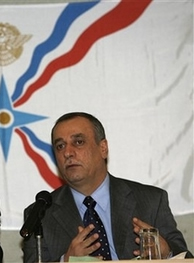

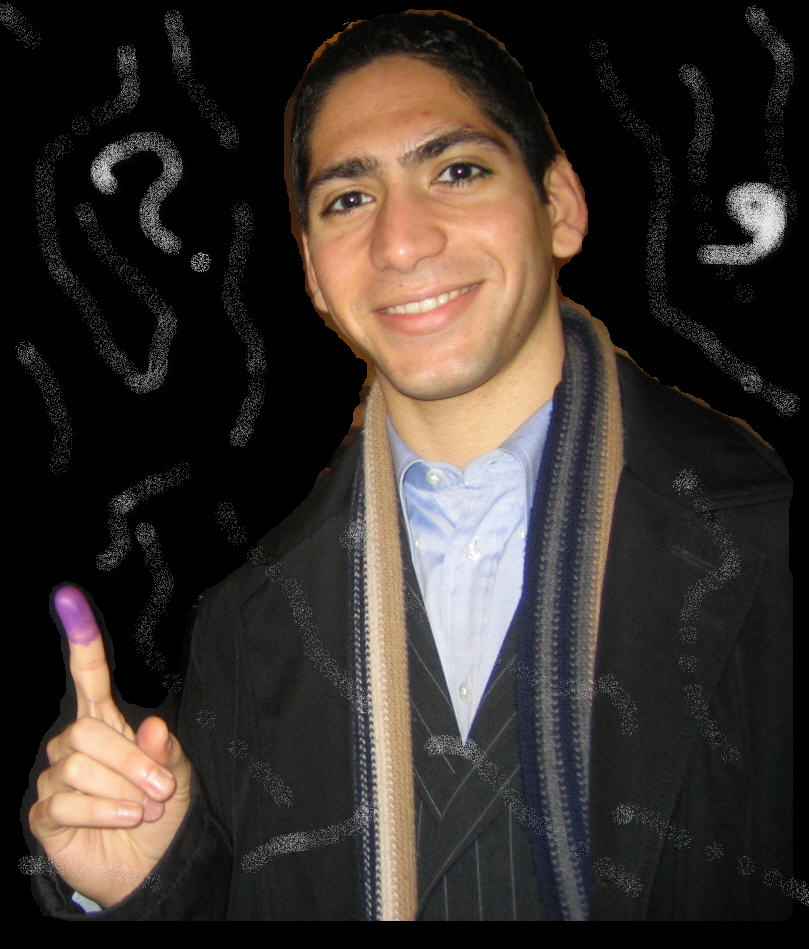
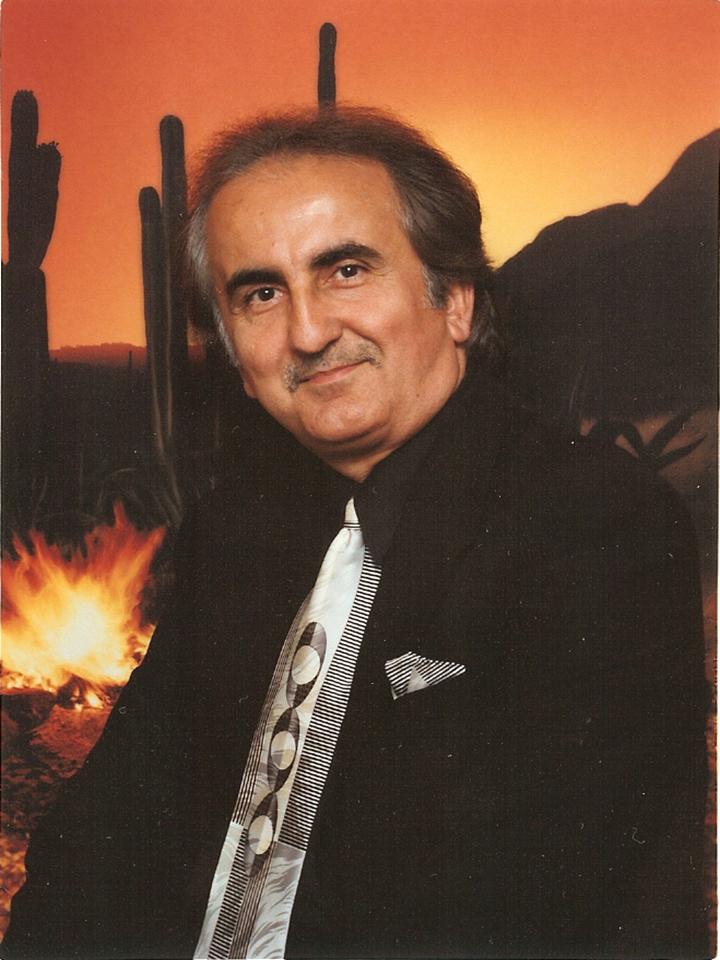
 On Saturday, 13 January 2007, Mr. Yonadam Kanna, Secretary General of the Assyrian Democratic Movement, and member of Iraqi Parliament will be interviewed on Ashur TVs "Opinion and Politics" program, which will air via Appadana TV at 11:30 a.m. (California Time), 10:30 p.m. (Baghdad Time). This live interview, conducted by Ms.
Jackie Bejan, may also be viewed on
On Saturday, 13 January 2007, Mr. Yonadam Kanna, Secretary General of the Assyrian Democratic Movement, and member of Iraqi Parliament will be interviewed on Ashur TVs "Opinion and Politics" program, which will air via Appadana TV at 11:30 a.m. (California Time), 10:30 p.m. (Baghdad Time). This live interview, conducted by Ms.
Jackie Bejan, may also be viewed on