|
|||||
 |
101
San Fernando Street, Suite 552
San Jose, CA 95112 U.S. Voice (408) 918-9200 Fax (408) 918-9201 |
||||
|
|||||
|
|||||||||||
|

|
| In 1991 I met Dr. Alexander George at one of his popular lectures on international peace and conflict studies. After his talk I quietly approached the podium to inquire about his views on the Gulf War. After all this was the man behind Bush Sr.’s policy of “Coercive Diplomacy” which led to the implementation of the economic sanctions against Iraq. I asked Dr. George: “What makes you believe that these sanctions would work?” He insisted that coercion works only if the policy is imposed upon a rational actor. After two major military assaults on Iran and Kuwait, attacking citizens of one’s own country with chemical weapons, and destrcution of 4000 Assyrian and Kurdish villages in less than two decades – we can safely say that the United States for the past 12 years, in her handling of the Iraqi affairs with Saddam Hussein, has not dealt with a rational actor. Diplomacy works when leaders of two countries respect the international treaties like the 1984's U.N.-sponsored Convention Against Torture and Other Cruel, Inhuman or Degrading Treatment or Punishment, and can reach an agreement to benefit the majority of their populations. Coercion works when the coercee cares enough for the welfare of his people that he may seek means to end their suffering. Saddam Hussein is an evil man who has committed genocide and other gross violations of human rights. He loves no one, cares for no one, and has no regard for the past or the future of Iraq and its people. Tonight he is not defending the people of Baghdad or Tikrit – if he is still alive. He is protecting only himself and his two sons at all costs. To end the reign of terror of such criminal leader, so twisted in his ways, there can be no diplomatic solution. Hence, military action against Saddam for the purpose of liberating 23 million Iraqis – including 2 million Assyrians - is justified. When Gulf War II is behind us, many innocent lives will have been lost. By then several archeologically important sites may be destroyed, and thousands of artifacts will be carried off with the returning soldiers and sold on eBay for a few dollars. In the meantime, most of us will still be struggling to understand if the outcome of victory over Saddam is good for the Assyrians. Our modern history shows that what is good for the majority people in Iraq or any of our adopted countries is good for the Assyrians. Assyrians thrive in difficult conditions and succeed even more when the environment improves. A free and democratic Iraq, under the protection of the Coalition forces or the United Nation, will give the Assyrian people an opportunity unlike any witnessed in the last 150 years. We can quickly replicate the experiements carried out in North Iraq in the last 15 years and expand our educational and cultural endeavors in Mosul, Baghdad, and elsewhere. To accomplish this we must separate humanitarian and philosophical values from our Assyrian national interests when it comes to dealing with a leader who has the will and power to exterminate our race. The arguments of “Humanity First, then Nationalism” works for a nation of fifty or more million fast-breeding individuals. Assyrains cannot afford to entertain such fanciful ideas. For the sake of the survival of the Assyrian identity in Iraq, using any military force to put a final stop to the systematic Baathist repression in Baghdad is justified. The dogs of war have been unleashed once again in the land of Hammurabi and Nebuchednezzer. I often wonder what Dr. George would have said about Bush Jr’s policy of “pre-emptive war”. As he was about to leave the lecture hall that evening 12 years ago, he murmured something about his mother’s cooking and used the word “dolma”. I immediately asked him about his background and a few seconds later, we were discussing the villages in Urmia-Iran where our parents had come from. How ironic that the man behind the policy of economic sanctions against Iraq was indeed Assyrian. I invited him to my place to enjoy authentic Assyrian food. He declined my offer, and asked if there were still any Assyrians left in the United States who spoke Assyrian and knew what dolma was. I left the lecture hall dismayed and discouraged. Let us not cheat ourselves and betray our past by subscribing to the “one-world” philosophies put forth by the powerless non-political entities. A free and democratic Iraq in the heart of Bet-Nahrain, liberated via quick and decisive military campaign carried by western coalition, is our only salvation from complete and utter extinction. Wilfred Bet-Alkhas SEEKING ASSYRIAN WOMEN OF IRAQI BACKGROUND Even as war continues, Non-Governmental Organizations (NGOs) in the United States and elsewhere are gearing up for work in Iraq. Some strong and active NGOs that are entering the planning stages for this work are beginning to collect resumes of likely people to tap as consultants, state-side organizers and in field administrators. Among these are NGOs that concentrate on recruiting women, especially those with professional training and experience who, in exile, may be operating below their capabilities. Assyrian women need to make themselves known so that they too can
become involved in this reconstruction work. Assyrian women¹s
involvement will not only help make our community better known, but
it will help Assyrian women gain NGO experience, help our community
in Iraq, and expand the opportunities for employment in a useful and
Spearheading this push to get our community women involved is Dr. Katrin Michael, who recently met with President Bush at the White House. She would like to encourage Assyrian women of Iraqi ancestry or those born in Iraq to send in their professional resumes or biographical sketches so that we will have a pool upon which to draw as the occasion demands. Knowledge of Arabic or written Assyrian is not required. But if you have these skills, do not be shy about saying so. If you are interested in putting your resume into this pool, please make sure it contains the following:
If you have worked as a teacher at any level, lawyer, community activist, doctor, dentist, journalist and similar professions, your experience could be very helpful. Assyrian women step forward and be counted in the ranks of those who can work only as Assyrian women can. Send your resumes to Dr. Michael at AssyrianIraqiWomen@zindamagazine.com. Zinda Magazine
|
IN TWO WORLDSI have lived in two worlds for far too long. I am an Assyrian born in Iraq, yet I am also an American raised in California. Growing up, my two worlds were very well demarcated. I am a product of American pop culture; I grew up watching MTV and cheering for the San Francisco 49ers. Yet at home, I spoke Aramaic and listened to great fairy tales my grandmother told me about the legendary city of Baghdad. As a young girl, I would sit on Nanna's lap as she told me vivid fables about the princess who ruled over Baghdad and the evil dragon that was trying to capture her. Her brown, almond-shaped eyes would mist over as she recalled the devastation that has engulfed Iraq in the past 50 years. She lost two of her sons, my uncles, to the many wars in Iraq. As a child, I would throw my arms around Nanna to try to take her pain away. I could not understand the immense sadness she felt, nor the tears she shed. But now, as a woman, I am beginning to understand the repercussions of war. Today I sit in peaceful Delmar and watch the enchanting city of Baghdad being bombed by missiles and my two worlds come crashing together. I was not raised by typical Iraqi parents. My parents, who were both well educated and belonged to the middle class in Iraq, realized long ago that we must fight for freedom in order to survive the politics of oppression. My parents left Iraq when I was 5 years old so that they could provide my two sisters and me with the opportunities that they knew we would never have in a country ruled by fear and devastated by a tyrant. The opportunity for equality, the opportunity for education, the opportunity to live and love freely in a country where the statue of a woman stands tall and proclaims, "Give me your tired, your poor, your huddled masses yearning to breathe free ... ." As I drove home one cold night, I saw people standing on street corners in Albany to protest the war. I smiled to myself because I believe in the freedoms that they were expressing, yet know that these people would be seeking liberation if they were being ruled by an oppressor. These are the same type of people that the regime of Iraq has silenced. My friends who are anti-war cannot understand why I so badly want the "coalition of the willing" to liberate Iraq. They do not realize the crippling fear that Saddam has instilled in the Iraqi people. They call me an idealist for wanting a secular, democratic Iraq. I am deeply wounded every time a Westerner makes a crude remark about a region that is filled with heterogeneous groups of people. First of all, not all Iraqis are Muslim. Second, not all Iraqis are Arabs. The Assyrian people are the indigenous people of Iraq. They were among one of the first civilizations to accept Christianity during the late second century. The New Testament was written in Aramaic and Hebrew, and Christ spoke Aramaic. Some of the oldest churches and Christian communities can be found in northern Iraq. Churches that Saddam has burned in villages that Saddam has starved. Typical Americans do not understand this; they are ignorant of the fact that 5 percent of the Iraqi people are Assyrian-Chaldean. I am disappointed in the American media for not focusing on the Christian minority in Iraq. Iraq does not belong to one regime; Iraq belongs to its diverse people who practice many different faiths. Saddam Hussein does not discriminate against those he murders or brutalizes, be they Assyrian, Arab, Kurd, Turkomen and, now, American. Beyond anything else, I am saddened by our world today. I am haunted by the images blazing through our television sets of Iraqi children who will never have the same opportunities that my sisters and I had. They come to me in my dreams and ask me for food to nourish their bodies, for prayer to heal their souls, for peace to ensure their future. I am troubled by the death and capture of our American soldiers -- men and women I probably would see at the local grocery store, men and women who, in happier times, I would befriend and socialize with. And so the two worlds that I kept separated so well have come colliding over a beautiful fabled city that I still dream about. My Nanna died while I was away at college and while she was away from her precious homeland. I long to throw my arms around her now to tell her that I finally understand her sadness. I still remember her warm eyes, her passionate stories and her quiet strength. She once said to me, "As long as there is oppression, as long as there is no freedom, there will be no peace. You must stand up for what you believe in." Dr. Vian Younan [Z-info: Dr. Vian Younan is a physician living in the State of New York. This article appeared in the Sunday edition of the Times Union newspaper]. MY TURN I was five years old when my parents nestled my sister and I in a secret compartment in the back of a truck and told us to “Be quiet, we are going on a wonderful journey!” That journey was an escape in the middle of the night from the country of Iraq – the only home my parents had ever known – to the West. They left Iraq in 1981 because of religious and political persecution, because the Iran-Iraq war was looming on the horizon like a threatening storm and because they had two young daughters that they wanted to not simply survive the ravages of war, but to thrive in a country of freedoms and liberties they themselves never tasted. So now, twenty-two years later, I find myself living in a country that is bombing, on a nightly basis, the city of my birth. I, along with the rest of America, watch the minute-by-minute news coverage of the war on my television set with an inner turmoil and a sense that things will never be the same. And I have never been as proud to be an American as I am right now. Why am I so passionate about my support for the war? Because I, and my people, have felt the venom of Saddam Hussein ever since he came into power in Iraq in the late seventies. As Assyrians, we are the indigenous Christian minority in Iraq, the direct descendents of the ancient Aramaic-speaking Assyrian nation, which inhabited the “fertile crescent” between the Tigris and the Euphrates (modern day Iraq). My parents can trace their lineage in Iraq back through generations and sadly through eras of cultural and religious genocide. At the bloodied hands of Saddam Hussein, Assyrians in the past several decades have suffered unheard-of human rights atrocities, culminating in recent years with Saddam’s desecration of ancient Assyrian historical sites in Iraq. Saddam’s dictatorship has led to the diaspora of the Assyrian peoples, with my family as just one example. I have aunts, uncles and cousins right now in every country in Europe, North America, Australia and New Zealand. These family members are the lucky ones … they were able to escape. My pride in being American is commingled with my knowledge that in many countries (Iraq being just one) there is an absence of the incredible liberties that so many Americans take for granted. While some may argue that it is up to the Iraqi people to claim their own freedom from a cruel dictatorship, my only answer is that it is virtually impossible to rid a country of that sort of power-hold internally, especially when the populate is starving and surrounded; that sometimes even when that power is ousted, it is often replaced by a similar evil. For Hitler’s regime to end, there had to be a more-powerful entity to end it. For the Iraqi people, that entity is the United States and Britain. Many of my friends and business colleagues ask me what I envision for a future Iraq, an Iraq without Saddam and his Ba’ath party. My surging hopes are tempered by the realization that there will be years of unstability as a population that is used to being powerless is suddenly asked to take part in the structuring of a nation. The people of Iraq may attempt to rule with violence, as this is all they have known. There are many factions within Iraq now that are clamoring for power in a post-Saddam Iraq. My knowledge of the many different religions and cultures in Iraq, and the need for those ideologies to dominate each other, dampens my hope at times. There are times, however, in the midst of the play-by-play newscasts of the war, in the middle of the bombs and bullets, I see Baghdad on the television set and spy the beautiful buildings, the palm and date trees still swaying gently, determined to grow. And in those small moments when I turn off the television set and sit in the resounding silence, I think of a future Iraq as peaceful, thriving and perhaps one great day, even celebrating its incredibly diverse history. Marian Kaanon [Z-info: Mrs. Marian Kaanon is a Public Relations Consultant, based in Phoenix.]
I had opposed the war on Iraq in my radio program, on television, and in my regular columns, and I participated in demonstrations against it in Japan. But a visit to relatives in Baghdad radically changed my mind. I am an Assyrian Christian, born and raised in Japan, where my father had moved after World War II to help rebuild the country. He was a Protestant minister, and so am I. As an Assyrian I was told the story of our people from a young age: how my grandparents had escaped the great Assyrian Holocaust in 1917 and settled finally in Chicago. There are about 6 million Assyrians now, about 2.5 million in Iraq and the rest scattered across the world. Without a country and rights even in our native land, it has been the prayer of generations that the Assyrian nation will one day be restored. A few weeks ago, I traveled to Iraq with supplies for our church and family. This was my first visit ever to the land of my forefathers. The first order of business was to attend church. During a simple meal for peace activists after the service, an older man sounded me out carefully. Iraqis: “We Want the War” Finally he felt free to talk: ''There is something you should know--we didn't want to be here tonight. When the priest asked us to gather for a peace service, we said we didn't want to come because we don't want peace. We want the war to come." “What in the world are you talking about?” I blurted. Thus began a strange odyssey that shattered my convictions. At the same time, it gave me hope for my people and, in fact, hope for the world. Because of my invitation as a ''religious person'' and family connections, I was spared the government snoops who ordinarily tail foreigners 24 hours a day. This allowed me to see and hear amazing things as I stayed in the homes of several relatives. The head of our tribe urged me not to remain with my people during its time of trial but instead go out and tell the world about the nightmare ordinary Iraqis are going through. “We Live Like Animals” I was to tell the world about the terror on the faces of my family when a stranger knocked at the door. ''Look at our lives!'' they said. ''We live like animals: no food, no car, no telephone, no job, and, most of all, no hope.'' That's why they wanted this war. “You cannot imagine what it is to live like this for 20, 30 years. We have to keep up our routine lest we would lose our minds.” But I realized in every household that someone had already lost his or her mind; in other societies such a person would be in a mental hospital. I also realized that there wasn't a household that did not mourn at least one family member who had become a victim of this police state. I wept with relatives whose son just screamed all day long. I cried with a relative who had lost his wife. Yet another left home every day for a ''job'' where he had nothing to do. Still another had lost a son to war and a husband to alcoholism. As I observed the slow death of a people without hope, Saddam Hussein seemed omnipresent. There were his statues; posters showed him with his hand outstretched or firing his rifle, or wearing an Arab headdress. These images seemed to be on every wall, in the middle of the road, in homes. “Everything will be all right when the war is over,” people told me. ''No matter how bad it is, we will not all die. Twelve years ago, it went almost all the way but failed. We cannot wait anymore. We want the war, and we want it now.'' The People Don't Want the U.N. When I told members of my family that some sort of compromise with Iraq was being worked out at the United Nations, they reacted not with joy but anger: ''Only war will get out of our present condition.'' This reminded me of the stories I heard from older Japanese who had welcomed the sight of American B-29 bombers in the skies over their country as a sign that the war was coming to an end. True, these planes brought destruction, but also hope. ''I Felt Terrible About Having Demonstrated Against the War'' I felt terrible about having demonstrated against the war without bothering to ask what the Iraqis wanted. Tears streamed down my face as I lay in my bed in a tiny Baghdad house crowded in with 10 other people of my own flesh and blood, all exhausted, all without hope. I thought, ''How dare I claim to speak for people I had not even asked what they wanted?'' Then I began a strange journey to let the world know of the true situation in Iraq, just as my tribe had begged me to. With great risk to myself and those who had told their stories and allowed my camera into their homes, I videotaped their plight. But would I get that tape out of the country? To make sure I was not simply getting the feelings of the oppressed Assyrian minority, I spoke to dozens of other people, all terrified. Over and over they told me, ''We would be killed for speaking like this.'' Yet they did speak, though only in private homes or when other Iraqis had assured them that no government minder was watching over me. I spoke with a former army member, with someone working for the police, with taxi drivers, store owners, mothers, and government officials. All had the same message: ''Please bring on the war. We may lose our lives, but for our children's sake, please, please end our misery.'' ''Soldiers Hated Their Work'' On my last day in Baghdad, I saw soldiers putting up sandbags. By their body language, these men made it clear that they dared not speak but hated their work; they were unmistakably on the side of the common people. I wondered how my relatives felt about the United States and Britain. Their feelings were mixed. They have no love for the allies--but they trust them. ''We are not afraid of the American bombing. They will bomb carefully and not purposely target the people,'' I was told. ''What we are afraid of is Saddam and the Baath Party will do when the war begins.'' The final call for help came at the most unexpected place--the border, where crying members of my family sent me off. The taxi fares from Baghdad to Amman had risen within one day from $100 to $300, to $500 and then to $1,000 by nightfall. My driver looked on anxiously as a border guard patted me down. He found my videotapes, and I thought: It's all over! For once I experienced what my relatives were going through 365 days a year--sheer terror. Quietly, the officer laid the tapes on a desk, one by one. Then he looked at me--was it with sadness or with anger? Who knows? He clinically shook his head and without a word handed all the tapes back to me. He didn't have to say anything. He spoke the only language left to these imprisoned Iraqis, the silent language of human kindness. Rev. Ken Joseph
|
OVER 4000 ASSYRIANS RALLY IN SUPPORT OF U.S. TROOPS IN CHICAGOCourtesy of the Windy City Reporter (31 March) (ZNDA: Chicago) The largest pro-American rally to happen in the United States to date was held in Chicago this past Sunday by thousands of Assyrian-Americans who support the U.S. operations in Iraq. Assyrians are the indigenous people of Iraq, Iran, Turkey, Syria
and Lebanon. They come from the vast area that was once known as Mesopotamia,
with the heart or capital of their original homeland being located
between the Euphrates and Tigris rivers, in what is now modern day
Iraq.
OVER CENTURIES OF PERSECUTION, ASSYRIANS HAVE KEPT THE FAITH Courtesy of religonjournal.com (30 March) (ZNDA: Chicago) Nearly forgotten by the world, 1.2 million Assyrian Christians live a precarious existence in Saddam Hussein's Iraq. They are the remnants of the great Assyrian Empire, which ruled Mesopotamia – or present-day Iraq, Iran, Syria and Turkey – thousands of years before Christ. Assyria has played a central role in world and Christian history. Its capital, Ninevah, repented to Jonah. Ninevah later believed the gospel preached by the Apostle Thomas, becoming one of the first Christian nations. In the first century, newly converted Assyria launched a missionary force that carried Christianity as far as China and Japan. Over the years since the Assyrian monarchy was abolished in the 4th century, Assyrians have lived with a minority status in the lands they once ruled, oppressed by the Persians, Mongols, Turks, Kurds and Arabs. Then in the 20th century, mass dispersion occurred. Four million Assyrians left the Middle East for 40 nations after the Ottomans massacred hundreds of thousands of Armenians and Assyrians in 1915. Assyrians believe that after World War I they were betrayed by the League of Nations, which had promised them a homeland. Throughout the centuries of persecution, Assyrians kept the faith. Today, the indigenous Christians of ancient Mesopotamia belong to several sects and denominations including the Chaldean Catholic Church, the Church of the East, the Syriac Orthodox Church, the Syriac Catholic Church, and some Protestant denominations. Assyrian Christians also have preserved a dialect of Aramaic, the language spoken by Jesus. Assyrians have "a special passion" about using and preserving Aramaic, Ronald Michael, president of the Assyrian American League, told religionjournal.com. Aramaic is passed down from generation to generation, said Michael, who speaks the language fluently. He was born in Beirut, moved to Iraq, grew up in the United States, and now lives in Illinois, where he is a member of the Church of the East. The times are again perilous for Assyrian Christians, Michael said. Iraq, a secular nation, formerly allowed Christians more freedom than many other Middle Eastern nations. Yet anti-Christian sentiment has risen as Saddam Hussein portrays himself as a defender of Islam against the imperialist West, according to political analyst Jonathan Eric Lewis. Saddam's Baath Party has implemented policies aimed at erasing the identity of Assyrian Christians as a distinct people. According to Lewis, this ethnic cleansing has included denying the ethnic identity of Assyrians in government records, removing textbooks about Assyrian history and accomplishments, looting ancient artifacts, and killing clerics. Saddam might incite a bloodbath against the Assyrians now that Iraq has been invaded, Lewis said. Still another threat to Assyrians comes from ethnic Kurds in northern Iraq. The area has been protected as a British and American no-fly zone since the 1991 Gulf War. Free from Saddam's control, the Kurds have lived at relative peace with Assyrian Christians, who have built Christian schools and churches. Yet those 200,000 Assyrians are "very much under pressure to toe the Kurdish line," Michael said. An additional half million Assyrian Christians live just outside the no-fly zone, and 750,000 to 1 million live in Baghdad. With the collapse of Saddam's regime – a common enemy for the Kurds and Assyrians – historic differences between the groups could resurface. Some Assyrians fear that, in the chaos of war, the Kurds might seek an independent state, grabbing oil-rich land and inciting violence and tyranny, according to ABC News. What many Assyrians really want is a homeland of their own, according to Ken Joseph, whose Assyrian grandparents escaped from massacres at the hands of the Kurds occurring in Iraq in 1919. "If there is a Jewish state and Muslim states, there should also be a Christian state." He said he believes that most Assyrians living overseas would return if a state homeland was established. For his part, Michael said he hopes for a democratic Iraq "where all citizens enjoy freedom of religion." After the war, Americans must stay engaged long enough to make sure the post-Saddam regime protects all of Iraq's minorities. Unlike other Iraqi opposition groups, Assyrians are not trying to grab land or oil, Michael said. "We wish to survive, to build our churches and schools, to preserve our language, and to live as any human being should be able to live. Our challenge to Arab governments and the broader Arab world is to push as vigorously for Assyrian rights as they do for Palestinian rights. Otherwise, they risk losing credibility and appearing to be hypocrites." American Christians know little about Assyrian Christians, yet "there is a natural kinship," Michael said. And when American Christians realize that a portion of the body of Christ is struggling to survive, Michael's hope is that they will "commit themselves and reach out to them."
ASSYRIAN CHRISTIANS AFRAID FOR RELATIVES STILL LIVING IN IRAQ Courtesy of Daily Herald (31 March); Story by Cass Cliatt A bomb blast flashes behind closed eyes. Smoke shrouds the scorched crater that was her family's home in Baghdad. Soldiers march past civilian dead. She can't see the faces. Could it be her uncle, her brother's wife? Ashtar Shamoon wakes. The clock reads 5 a.m. when she turns on the news in her Arlington Heights home. Shamoon abandoned her vigil here just four hours earlier, but worry compels her to watch a war progress toward the city she used to call home. "If I don't watch the news, it's like I don't care about it," the 44-year-old Shamoon said. "It's still your country." But fear has kept the hair stylist away from her homeland for more than 20 years. She is tormented by reports about other U.S. families sending letters to their fathers, sisters and sons in military service in the Middle East. For Shamoon, the hold Saddam Hussein has over Iraq grips her, even here, stifling her with fear of maintaining too much contact with her own family. She is among thousands of Iraqi expatriates who carried their sense of oppression to the Northwest suburbs, away from Iraq's borders. They harbor a dread here that continues to alienate them from families back home. "I have my brother's wife, his sister, her daughter, my uncle, many cousins," Shamoon said. "Now with the war starts, I've been talking to them every two days, but I'm scared even to mention their names. Maybe the government of Saddam Hussein just go after them." Shamoon is one of about 80,000 Assyrian Christians in the Chicago area, a large majority of whom fled Iraq because of political persecution, according to the Assyrian National Council of Illinois. As much as they fear that their families could fall victim to the ravages of the war, some worry even more that they could unleash torment on their own relatives. "Sometimes, for example, if someone is talking against the government or against the regime in Iraq, they cut his tongue," said Isho Lilou, director of the Assyrian council. "If a man doesn't want to serve in the army, they cut his ear." The punishment can be much worse for families seen as American sympathizers, Lilou said. "Basically, the government point of view is, whoever is outside, especially in America and they have relatives there, they treat them as if they are all Americans," he said. "And the regime hates America. "If there is communication, you don't know what will happen. Some people will either disappear or they get hit by a car," Lilou said. "One way or another, they are gone." It's the main reason Shamoon hasn't been back to Baghdad since she left in 1981. She and her family were among the estimated 1 million Assyrian Christians in a country that's 97 percent Muslim. She says she left because Hussein's government asked her to spy on other Christians who were customers in the hair salon where she worked. "To see what the people say about Saddam Hussein, if they like him," Shamoon said. "I say I can't do that. I say I am a Christian. I do my job and come home. I said I can't talk politics." Yet they kept at her for five months. Shamoon had to get out. She came to the United States with her teenage sister in 1981 and became a U.S. citizen 10 years later. Shamoon, her sister, now 40, and her 73-year-old mother now live in Arlington Heights, afraid to ever return to Iraq. But tomorrow, Shamoon will make one of her increasingly frequent calls home to Baghdad. Since the war started last week, Shamoon's questions are always the same. "Are you safe? Nobody is killed and nobody is bombing there? How is uncle, how are nieces and nephews? ... Do not go outside. Stay at home." Three minutes on the phone with her family is all Shamoon will risk - five at the most. "I don't say anything about what's going on here," Shamoon said. "They (the government) listen on their phone when you talk, and maybe someone here, the Muslim people here contact them. You never know." Louise Cainkar, a professor at the University of Illinois at Chicago, said many people might classify the fear felt by Shamoon and others as paranoia. But that doesn't make their fear any less real. "It's the nature of the society when you live under oppressive conditions and you know people are watching other people and reporting on each other," said Cainkar, who specializes in Arabs and Muslims in the United States. "I think it's how most Iraqis feel, whether they're Muslim or Christian," she said. "They're afraid to call their families. They have been traumatized by a watchdog society." The potential to regain open lines of communication with her family makes Shamoon welcome the war, in a way. "I'm glad they're going to get Hussein and they're going to kill him, but I'm feeling bad for a lot of people who are there - my family, the other Assyrian Christians and a lot of poor people," Shamoon said. "They're going to die, too." The last time Shamoon risked talking to her relatives, they told her they sit huddled inside, wondering how long the groceries they bought a month ago will last. All of the businesses are closed and no one is working. "They don't know what's going to happen to them, if they're going to bomb everything there," Shamoon said. She rushes from work today, as she does everyday, and immediately turns on the news when she gets home. Troops remain on the outskirts of Baghdad. Shamoon will probably stay glued to her television until 1 or 2 a.m. again. She'll definitely try to call her family in Iraq tomorrow. The phone lines have remained clear so far, but Shamoon doesn't know how long she should rely on them - rely on the peace of mind so many other families get from hearing their relatives' voices on the other end of the line. "If I can't hear nothing from them, I can't go to work," she said. "I would be nervous every day. I can't sleep."
Courtesy of Chicago Sun Times (30 March); story by Dave Newbart The mood among the Iraqi-born men who gather each week at this Northwest Side club was unusually low-key Friday night. Conversations moved fluently between Assyrian, Arabic and heavily accented English as they sat around tables smoking cigarettes, drinking beer and whiskey and eating beef kabobs well past midnight. But unlike most of these gatherings, no Iraqi music played in the background. Some of the men squeezed strings of "sipha'' beads to relieve stress. As the war in their homeland unfolds, the members of Chicago's Assyrian Social Club are gravely concerned about the safety of their friends and family still in Iraq. Despite their fears, they are clear on their thoughts about Operation Iraqi Freedom. "We want Saddam overthrown by any means,'' said Sam Dibato, 66, a retired geologist who fled Iraq two years ago when he learned he was going to be arrested on false charges. "We are not supporting war. We are supporting a free Iraq.'' The mostly older men are part of Chicago's Assyrian-American community, which numbers nearly 100,000. Members of the community are holding a rally today at Warren Park in support of the U.S. troops. Organizers said they canceled the annual Assyrian New Year's parade scheduled for next week because of the war. Like Dibato, thousands of Assyrians--who boast of being some of the oldest Christians in the world--have been persecuted and killed by Saddam Hussein's Baath party. Despite their religious beliefs, the men said using force to oust Saddam is the only option to save their country. They say that even knowing that innocent civilians have died and more will die because of the war. But they believe more people would perish if Saddam remained in power. "He is cutting the ears off the people, cutting the tongues, killing people to stay in power,'' Dibato said. That includes 10 members of Dibato's extended family, who disappeared from a village in northern Iraq in 1988 and are thought to have been burned alive when Saddam accused them of opposing his regime. Dibato was forced to leave when he was accused of the same. His mother, two daughters and two brothers remain in Iraq. The men believe most in Iraq shares their feelings about Saddam but are too afraid to speak out. But they also think many Iraqis aren't convinced the United States will back them if they rebel, considering they were abandoned following the 1991 Persian Gulf War. "They don't trust anybody, not Saddam Hussein, not the American government,'' said Khoshiaba Jaba, 50. Jaba took up arms against Saddam in 1998, and witnessed the effects of a chemical attack on another Assyrian village in northern Iraq that left two people dead and 200 with deformities. He left in 1990. "We are a peaceful people,'' said Jaba, who now lives in Skokie. "Saddam is not.'' The men offered mixed views on the United States' role if Saddam is overthrown. One said he'd like to see the United States there "forever,'' while another said he would oppose any American rule over Iraq. No matter what, most said they were likely to return to an Iraq free of Saddam. "Of course we'll go back,'' said Edward Isaac, 65, of Skokie.
IRAQ BECKONS FEW LOCAL ASSYRIANS (ZNDA: Modesto) Though they have strong ties to Iraq, for some Assyrians who immigrated here their country is a distant memory and they have no desire to return. "No way," said 77-year-old Youab Yonan of Turlock, who
left Iraq in 1966, years before President Saddam Hussein came to power.
"Because what am I going to see? Injustice." Others say they remember Iraq as a beautiful place and would like to visit in more peaceful times. "I'd love to go, definitely," said Elki Issa, 31, of Modesto. "Not now. One day." She said it would be "something like Alex Haley going back to Africa and seeing your roots, where you came from." Assyrians, a tiny minority in Iraq, say they have experienced religious discrimination for many decades in Iraq because of their Christian beliefs. But while most say it is past time for Saddam to go, a few have differing takes. When Yonan, a retired mechanical engineer and scholar, lived in Iraq, he said, there were no cars and no electricity. He walked two or three miles to school, he said. "Life was very, very hard." These days, the longtime U.S. citizen said, he has nothing in common with people there. He believes the United States had no choice but to go to war because weapons of mass destruction are a danger to the world. "It's unfortunate that they came to this kind of aggressive decision," he said, adding that Saddam could have opted for peace. Bill Dadesho of Modesto was in his early 20s when he came to the Northern San Joaquin Valley from Baghdad in 1963. He said he is not eager to return, although he might want to see the places of his childhood one day. Born in Mosul, a northern city where U.S. bombs have dropped in recent days, Dadesho said Iraq was not a nice place to live because of the religious discrimination. "There's nothing there that's beautiful except that you were born in that place," he said. The valley is home to thousands of Assyrians, some of whom emigrated from Iraq. Three percent of people in the mostly Muslim country are Christian, and 5 percent are Turkoman and Assyrian, while the largest ethnic groups are the Arabs and Kurds, said Marjorie Sanchez Walker, assistant professor of history at California State University, Stanislaus. Beautiful memories Bill Yonan, 44, Youab Yonan's son, left Baghdad when he was 6 and remembers it as a beautiful mix of desert and tropical greenery along two rivers that surround the city. "It was a gorgeous place," he said. His sister visited the country two years ago and was disappointed to find that military installations had replaced nightclubs and casinos on the river. But he said it would not be safe for a man to return. He said his U.S. citizenship would not protect him there, and he would risk being forced to serve in the military. "I would love to go back there to my original homeland and visit Baghdad and visit my cousins," he said. "I'd love nothing more." Issa said her family is split, although she admits most of them are for the war. "I question the motives of this administration," said Issa, who was born in the United States. "I believe if we wanted a regime change, we could have done it without destroying the country. The main losers are going to be the innocent civilians. "Look how devastated we were seeing those buildings fall on 9-11," she said. "They're humans, just like us." Jacklin Daniel, 44, of Turlock, who is of both Iranian and Iraqi descent and the wife of Bill Yonan, calls Saddam "evil."
Dadesho agreed. He said the United States should have toppled Saddam and his government years ago. "Let's get this thing over with," he said. "Get our boys back home."
(ZNDA: San Jose) Mr. Milton Daniels, the son of Younatan and Nanajan, was born in Hamadan, Iran on February 28, 1925. The second youngest of four sons, he attended Nusrat School in Hamadan and later transferred to the American Missionary School, where he finished the Baccalaureate in Mathematics program and graduated in June 1942. After graduation and the early death of his father, he was admitted to the Abadan Institute of Technology in Southern Iran on 5th September 1942. The Institute was established by the Anglo-Iranian Oil Company that operated the oil refinery in Abadan. Mr. Daniels studied Petroleum Engineering there and finished the five-year program in four years, graduating in June 1946 in the top ten percentile of his class. Mr. Daniels was subsequently hired as a chemist by the Abadan Refinery, the largest facility of its kind in the world. He completed his initial training as a chemist rotating in different labs, i.e. Black oil lab, Aviation lab and Sulfur lab, and was assigned to work as the shift chemist. After the Anglo-Iranian Oil Company was nationalized and renamed the National Iranian Oil Company (NIOC), he was promoted and became Aviation chemist, taking over a position held previously by two British Engineers. Mr. Daniels’ next assignment was to serve as a Process Engineer in the Black Oil Movement Facility. He later became the manager of Exports, Stocks and Shipping where he was always on call and responsible for handling 10-15 oil tankers on a daily basis. On November 23rd, 1963 the same day that President Kennedy was assassinated, Mr. Daniels was transferred to the Iranian capital Tehran to serve as an adviser to Mr. Saeed Naghavi who was in charge of Special Projects for the NIOC. At that time the government of Iran signed the first contract with the Soviet Union to deliver natural gas to Russia and the former Soviet Republics. Once again Mr. Daniels’s ability, dedication and integrity were recognized and he was assigned as the Project Manager at Ahwaz Pipe Fabrication Company to oversee the production of up to 42” diameter pipe for the installation of the natural gas pipeline from the gas fields in southern Iran to the Soviet Union. This enormous project was completed in 1977 and the pipes were manufactured and laid 92 days early, generating savings of nearly one million dollars a day. For this impressive achievement, the late Shah of Iran awarded Mr. Daniels the “Three Crown Medal of Honor”, and the “Grade Five Royal Medallion” (*Note – “Grade Five Royal Medallion” was the highest designated civilian medal of honor, the first four Royal Medallions were awarded only to the Military). Milton Daniels’ last promotion was serving as the Deputy General Manager of the Ahwaz Pipe Fabrication Company. He also served on the board of the NIOC and acted as the special assistant to Mr. Mossadeghi, the Chief Executive Officer of NIOC as a technical advisor. Mr. Daniels represented NOC at several regional and international conferences and seminars. Mr. Daniels was in line to become the General Manager of the Ahwaz
Pipe Fabrication Company when the Iranian revolution took place and
he decided to retire. In 1979, after thirty years of loyal service,
Mr. Daniels retired from the NIOC and immigrated to London, England
where he lived until his passing. Milton Daniels is survived by his wife Larissa - the daughter of Isaac and Anna Radeh, whom he met in Abadan and married on August 4, 1964, in Tehran - daughter Monica, recently engaged, and son Richard who recently returned home after completing his education in the United States. Personal Milton Daniels was active in the Assyrian community at a young age. In Abadan he joined the Assyrian Association of Abadan and Khoramshahr early on and soon was elected President. During his tenure as President, the Association secured land and built an Assyrian community center in Abadan that housed the Shooshan Primary School, the Church and the Social Hall. These facilities benefited Assyrians of all ages and enabled them to preserve their culture and heritage. After Mr. Daniels transferred to Tehran, once again his passion and dedication for his nation continued. He joined the Assyrian Association of Tehran, was elected President and served for two years. Among the many attributes that made Milton so humble and unique were his larger than life heart and the spirit of giving without the thought of return. He gave indiscriminately and quietly. He gave to his family, his friends, and the needy. Among his many charitable contributions was his donation to the Assyrian Aid Society of America’s Medical Assistance Project that supplied medicines and medical equipment to the Assyrians in Bet-Nahrain. Milton had a very warm and sociable personality and liked nothing
better than spending quality time with friends, sharing poetry, jokes
and political discussions. He was charismatic, had a magnetic personality
and attracted people from all walks of life. In recent years, as illness
started taking its toll, he was forced to spend more time in bed,
but he never gave up on friends and family, and kept in touch by phone.
He nourished his mind by reading and often slept with books laying
on his bed. He was an active man, a funny man, and a gentleman who
loved life and loved to live.
|

|

RALLY FOR AMERICAA rally in support our American and coalition troops will take place on Friday, April 4th at Nathan Phillips Square -Toronto City Hall, at 12 noon, Toronto, Ontario Many Assyrian Canadians who live far have decided to take a day off from their work to participate and support the American and coalition troops. Two Assyrian organizations from Hamilton, Ontario, "The Assyrian Cultural Association" and "Assyrian Students' Association of Mohawk College" are planning to march on Friday, carrying Assyrian flags and placards. The placard will carry many messages such as "Assyrian, the Indigenous People or Welcome and support the American and Coalition Troops in our homeland". Other Assyrian organizations from Toronto are expected to be in the rally. We call all Assyrians to come and join us and bring more Assyrian
flags. For more information, Ashur Simon Malek HUMAN RACE WALKATHON IN MOUNTAIN VIEW, CALIFORNIA The Santa Clara Valley Chapter of the Assyrian Aid Society of America is once again participating in the Human Race Walkathon. The Walkathon is a festive occasion where thousands of people gather every year to support honorable causes and charity organizations of their choice. You can participate in this event either by walking 5K on behalf of AAS or sponsoring the participants in the walk, by making pledges. This year's Walkathon will be held on Saturday May 10th, 2003 at the Shoreline Park located on 3070 N. Shoreline Blvd. in Mountain View. This year National Semiconductor is sponsoring our chapter and will match your donations. We urge you to support this event in this critical time of war in Iraq, as the money raised will be used to provide humanitarian relief to Assyrian refugees in our homeland. For more information regarding the registration, please contact Jermaine Soleymani at (408) 721 7014, or Nora Joseph at (408) 595 8516. The deadline for signing up is April 10th, 2003. If you are unable to participate in the walk but would like to make a donation to the Assyrian Aid Society of America through this event, please make your check payable to the Human Race and mail it to the address below by April 10th. Your donation is tax-deductible. The Assyrian Aid Society is a charitable 501 (c) (3) organization. All contributions are tax deductible. AAS-Santa Clara Valley Chapter
PRESS RELEASE The developments in Iraq and an extremely complicated situation in the Assyrian Diaspora in connection with the war in the historical homeland don’t allow us to hold the planned conference in corpore on the dates planned before – from April 25 to 27, 2003. Some complications also occur in connection with the fact that a number of the conference participants found themselves in a tight corner because they were intended to participate in the AUA Congress in Holland, which was postponed by the leadership of this organization until April 26 – 29, 2003. We don’t want to become initiators of any split or mutual suspicion, that’s why we express our consent to all the AUA Congress participants’ will. However, reasoning from our nation’s supreme interests, we believe that the 2nd Conference should not only be held in the nearest time but, taking into consideration the current situation, it should be enlarged and become more fruitful in solving the issue which is vitally important nowadays. In this connection, we took the following decision:
Meetings of the Second World Assyrian Conference will be dedicated to the following issues:
Considering intimacy of the issues admitted for the discussion at the 2nd Conference (see Press Release of 12.10.2002) to the MELAMMU programme, headed by Professor Simo Parpola (Finland), we took a decision to invite Professor S. Parpola in order to coordinate issues concerning historiography of the Assyrian nation with the above mentioned MELAMMU programme. The Organizing Committee believes that all members of public, scientific, political, and cultural associations of the Assyrian Diaspora will take an active part in the work of the Conference and in discussing its results in order to elaborate an objective strategy for further development and preservation of the Assyrian nation. We apply to all those who wish to participate in the work of the conference and symposium to inform us of this before May 1, 2003: P.O. Box, 18, Moscow 127642, Russia. Fax: +7-095-208-2445. E-mails: moscowconference2002@yahoo.com RABI NIMROD SIMONO SCHOLARSHIP COMMITTEE As you might be aware the Rabi Nimrod Simono Scholarship Committee is currently accepting applications for any Assyrian student who sat the HSC during 2002 and is currently pursuing a tertiary education (In NSW, Australia). The Scholarship scheme is run every year and is aimed at helping Assyrian students in their pursuit for further education. For more information regarding conditions of entry and other relevant entry procedures please visit our website http://www.geocities.com/assyrianscholarship We encourage students to participate and apply regardless of their results. This year the scholarship committee is considering numerous scholarship outcomes and awards. Thank you all again and we hope that you can spread the word to any Assyrian student you are aware of which might be interested in applying for the Scholarship. We will keep all Zinda readers posted on details relevant to the award presentation night which will take place in mid May 2003. Peter Esho ASSYRIAN YOUTH FEDERATION OF MIDDLE EUROPE PUBLISHES NEWSLETTER Enclose you will find the first Issue of EGARTHO- the AJM Infoletter. This is the official Online-Info of the Assyrian Youth Federation of Middle Europe and it is created in PDF format. It is written in German, but we can also integrate articles in English and Assyrian (Syriac) in the future. The newsletter is available at http://www.bethnahrin.de/Mesopotamien.htm.
Please do send us your ideas or content, which we can publish in
the future issues. To download Acrobat Reader: Aryo Makko
|
RECONSTRUCTIONS OVERSHADOWS PLIGHT OF SMALL NATIONSCourtesy of Daily Cal, UC-Berkeley (21 March) As an Assyrian-American and UC Berkeley alumna, I was both thankful for the exposure and saddened by the one-sided perspective given on Assyrian opinion of the current war in Iraq ("Students With Ties to Iraq Hopeful for Regime Change," March 20). Assyrians comprise the largest portion of Iraq's Christian minority. Unique from Iraq's small minority communities, Assyrians are distinct from Iraq's population by language, ethnicity and faith. They have suffered as much as every other segment of Iraq's population under the current regime and their attempt to take refuge in the "safe haven" created in Northern Iraq has brought just as much hardship to them at the hands of Kurds. The Kurdish infringements on Assyrian rights, from land appropriations to targeted killings, are well-documented. The "safe haven" is portrayed in the media as the Kurdish democratic experiment and self-rule, but most observers note that the Kurdish Regional Government has hardly met the challenge, short of meeting their obligation under the mandates to share the pie created by the oil-for-food program. The Assyrian Democratic Movement, the political voice of Assyrians in the enclave in Northern Iraq, has moved quickly to harness this opportunity; rebuilding villages and creating schools and universities with curriculum instruction in Syriac, the Assyrian language. The Assyrian minority in Iraq is vulnerable whatever the political arrangement in Iraq, and their fate is no different from other small minority groups within Iraq, including the Yezidis, Turkomen and Mandeans. The only formidable minority that can assert its rights are the Kurds. And ironically, if a democratic Iraq were established, the smaller minorities are likely to be marginalized further if they are not explicitly protected. Assyrians have been well-represented in the post-Ba'athist Iraq working groups that are hammering out the policies and framework to be implemented once the current regime is removed. Whether their participation will extend to actual participation and involvement in the implementation of those plans is yet to be known. Many of these Assyrians have lived outside Iraq (like many of the Iraqi exiles that the Bush administration is trying to bring together) for decades and do not have the incentive to return to Iraq for the unpredictable challenge of nation-building. The plan for a post-Ba'ath Iraq has not been unveiled, and that should leave us all uneasy. Iraq is critical in the Middle East regional balance. It is heterogenous in population, secular and carries enormous economic potential. The Bush administration calculates that these are great ingredients in creating a model democracy for the rest of the Middle East. But any experiment will be conducted within full view of Iraq's neighbors, all of whom are wary of any sort of fledgling democracy developing on their doorstep. And all of Iraq's neighbors differ on what an ideal Iraq looks like. However pretty the picture drawn, the reality in Iraq in 2003 is one that will have to account for a population that is largely young, under-educated and heavily indoctrinated by fear. Our government has taken on the greatest challenge in this war. The true effort will come as the Ba'athist regime is toppled and a new Iraq is created. Whether the rights of Iraq's indigenous minorities is protected from the outset or that the chaos creates a free-for-all land grab between the Sunni, Shi'ite and Kurdish populations remain possibilities. So perhaps the fate of the Assyrians and Iraq's smaller minorities will gauge the success of the Iraqi democratic experiment. After all, if the rights of the under-represented minorities are safeguarded from encroachment, the ideals touted as the war's purpose will be realized and perhaps some of the sacrifices of this war will be redeemed. Vivian Hermiz THE SPHINX'S BEARD Courtesy of the KurdishMedia.com (27 March) It is the level of awareness of the individual citizens that first needs to be elevated. Once achieved, this will inevitably be reflected in enlightened representatives and leaders. For representatives is just that: they represent and reflect their people, politically, intellectually and psychologically. No nation can expect the establishment of priorities and the keeping of commitments by its leaders without first cultivating such virtues in individual citizens. The head of Egypt’s celebrated Sphinx is collapsing. To secure the head to the chest, the- fallen beard must be restored. But the beard--a nondescript slab of rock shaped like a stick of butter--is not in Egypt. It is in the British Museum, spirited off by British colonial authorities who refuse to return it. And so the Sphinx’s head is now leaning precariously forward. The Egyptian government refuses to permit the fitting of a new beard. They believe that to alleviate the urgency of the collapsing head would be to forfeit the case for Britain’s returning the beard. In fact, Cairo would rather the Sphinx lose its head than wear a false beard. Colonialist looters must be taught a lesson even if it means the destruction of one of the most celebrated monuments of the Egyptian people. Beyond cutting off the head of to spite his beard--and the British--Cairo managed another ingenious decision that lays bare its confused priorities. Some of us remember the 1960s by American moon landings, others by the last ditch, Herculean effort of international teams supported with international funds to save precious Egyptian antiquities from drowning under the waters of the Nile’s Aswan dam. None of us ever stopped to think back then, or even now, of the callousness of an Egyptian government prepared to drown the country’s ancient monuments in the first place. None blamed the Egyptians for cheerfully pressing ahead to destroy in a single stroke more of Egypt’s heritage than foreign looters ever carried off to their museums and private collections. We simply assumed that Egyptians need the Aswan dam to feed themselves. Typically we failed to read the fine print that told another story. In the articles and television documentaries that appeared at the time, foreign archaeologists, UNESCO architects and civil engineers were seen racing against time as the rising waters of the dam threatened to wash over and wash away their working sites. Near the end of operations protective sheet-metal walls had to be urgently constructed and incoming water pumped out of the work area while dam waters rose above their foreign heads. The metal wall sand pumps kept the monuments from drowning as the foreigners, at great cost, proceeded with their removal to higher grounds. No one cared to ask why these foreigners were racing against time to save Egyptian heritage. The Aswan dam is Egyptian property and the filling of the dam controlled from Cairo. Yet no one thought to ask Cairo why it did not stop or slow the filling of the dam reservoir while foreign money and foreign talent was saving Egyptian heritage from Egyptian politicians. Note that this breach of faith with Egypt’s past was not the work of the colonial government of the British Empire, that stole the Sphinx’s beard. Mind you, this was the work of the "nationalist" Egyptian government of the internationally acclaimed Gemal Abdul Nasser. This was the same Nasser who, together with Nehru and Sukarno, founded the organization of non-aligned countries; who single-handedly invented Arabism; who elevated Egypt to the leadership of the Arab world, perhaps even the Third World. Impressed by President Nasser’s fashionable rhetorical pronouncements--as we are now with those of the marginally less presidential Edward Said—whenever found the courage to protest the fact that there was no need whatever to conduct this race against time to save Egypt’s heritage. There was no emergency to fill the dam, other than that created by Nasser’s impatience to wear the laurel of triumph for having tamed the Nile. And even this was done with Russian money and Russian engineers. Ultimately, what UNESCO and the ex-colonialist scientists and looters did not save, the Egyptians drowned. Now Nasser is dead. The Egyptian monuments preserved by the labor and money of the same foreigners targeted by Nasser’s eloquent vacuities are still hereon new hill-top pedestals. They bear witness to Egyptian genius—and folly. Meanwhile demands for the return of the Sphinx’s beard continue to this day. Egyptians still blame ex-colonialists, foreign occupiers, Zionist enemies and the like for their own failures and misplaced priorities. Unusual? Not really. Kurds do this all the time. Blaming oneself for everything that goes wrong was the hallmark of traditional stoicism, until we learned from Adam Smith, Karl Marx and Sigmund Freud that we could blame everything on others. With the withering of old-style capitalism and socialism, it may dawn on some of us that blame and credit rests on both sides--oppressed and oppressor, occupied and occupier. And some of us are even casting aside the victim mentality so that we can demand from ourselves better days--and get them. The Sphinx’s head could be held high if we permitted ourselves to-fit it with a new beard. Of course, it is good not to forget who took the old one. In most writings, the Kurdish plight and lost opportunities for Kurdish self-determination have been squarely blamed on old empires, semi-modern colonialists, modern nation-states, multinational corporations, multi-channel media and just about everything else. Had we not lived through the past ten years, we might be forgiven for upholding this tradition, for never questioning what really happened at the Paris Peace Conference of 1919, what precipitated the treaties of Sevres and Lausanne, or who bears responsibility for 80 years of lost opportunities and misplaced priorities since then. The latest opportunity for self-determination and independence presented itself to the Iraqi Kurds on a platter in 1991 and 1992. They missed it. And the fault was their own. I write this to leave behind the record so that this latest missed opportunity does not get wrapped in a shroud of lies and presented to the Kurds of the year 2065 as yet another example of colonial treachery. Such is the fable surrounding Sevres, Lausanne and the rest. Allow me first to tell the tale of the beard of the Kurdish Sphinx as it played out to the world of 1919-1922 before we proceed to the latest folly. At the Paris Peace Conference there appeared representatives of all who were or wished to be nations: ethnic groups, tribes and the like. It was the mart of all hopes. Woodrow Wilson was marketing "self-determination" as the commodity of choice. As the head of a young super state armed with its own tenets of "manifest destiny" to sanctify its own expansion into the Americas, he had not much to lose by promoting the political rights of the disenfranchised in European colonial empires from Morocco to Mandalay. (In Manila, however, Wilson viewed Filipino aspirations for the same self-determination as a sacrilege against American manifest destiny, (divinely prophesied by John O’Sullivan of New York). The fact that the Europeans also thought of their imperial expansion as destiny manifest was of no interest to Wilson. The empire of the Americans excluded, those of all others were put up for examination and everyone everywhere asked to deposit their claims and representatives at the Paris Peace Conference. And they did. Kurds, too. Kurds quickly assumed stardom, if not super stardom, at that Conference as the only group asking for less than what the colonial powers thought they deserved! Thus while everybody asked for more, expecting to end up with a fair share, the Kurds asked for less and ended up with nothing. Let me explain. European ethnic maps of the northern Middle East and including Kurdistan had taken on an impressive accuracy by the turn of the 20th century. A large, mufti-color sheet map drawn by the British Royal Geographic Society and published in 1906 depicted Kurdish majority areas with such accuracy that even today--93 years later--it remains virtually peerless. This map became one of the main working maps for that region at the Paris Conference. Naturally putting first the interests of their own people before those of otters, the Armenian delegation to the conference fully ignored this map and presented one of their own for the boundaries of an independent Armenia. The Armenian delegation’s map included all of present Kurdistan of Turkey, chunks of Iraqi and Syrian Kurdistan, and large areas populated by Turks, Turcomans and Arabs thrown in for good measure. This territory stretched from Adana and the Mediterranean Sea to the coast of the Black Sea and the middle of Azerbaijan. Were the Armenians serious? Yes and no. But that is what diplomacy and the art of negotiation are all about. Here, I am not criticizing the Armenian delegation. On the contrary, I am commending them for thinking first and foremost of the interests of their own people. Would that the Kurdish delegation had done the same? Of course, the Armenian delegation knew that they were not going to get that vast territory they demanded in those preliminary stages of the Conference, nor could they have desired it. Armenians would have ended up as a small minority behind Kurds, Turks and Turcomans had they got all they asked for. They eventually boiled down their demands to those seen in the provisions of the Treaty of Sevres of 1921: an Armenia that included the Armenian Plateau, or ancient Armenia Major. The fact that even in that "boiled down" version of Armenia Kurds still outnumbered Armenians was of no concern. This Kurdish majority was at a manageable level; and moreover, a few mass expulsions of Kurds could have tipped the balance to a more desirable ratio. The Armenian demands were standard. Ask for a lot; get more than your fair share; immediately go to work to make it fair by remedying the ethnic facts on the ground. Not so the Kurds. The Kurdish delegation to the Paris Peace Conference certainly used the British ethnic map; the Kurdish map of "Kurdistan" contains elements that could only have come about by utilizing the British map. But Kurdish territorial demands, reflected on the map they submitted to the conference, excluded all of north Kurdistan--from Van to Ardahan, from Mush to Maku. The Kurds had carefully excluded all the territories which Armenians in their "boiled down" version had claimed and gotten approved at Sevres. Only meekly does the Kurdish map transgress Armenian demands by including the city of Bitlis--the birthplace of the renowned Kurd, Sharaf Din Bitlisi, and author of the first Kurdish history. Here was a Kurdish delegation at the preliminary stages of the Paris Peace Conference, consciously and deliberately presenting for consideration a truncated piece of their homeland that excluded all of northern Kurdistan, all Kurds west of the Euphrates river, all Kurds of Iran (except for a narrow strip near the borders), most Kurds of Syria, and all Kurds in the Caucasus. Mind you, this during the preliminary stages of the conference when the Poles demanded Berlin, reasoning that the land was theirs 1200 years earlier, and where the Armenians asked for Antioch because Tigran the Great held that town for 8 years--some 2100 years ago! If not base ignorance--the British ethnic map was available and was indeed used by the Kurdish delegation--what prompted this Kurdish magnanimity? Misplaced priorities, no doubt. Dispatched to defend interests, this Kurdish delegation somehow deemed it out of character with the proverbial masculine generosity of their race to deny to friends and neighbors morsels of the Kurdish homeland. Never mind that the generosity of these Pahlawans ("champs") was achieved at the expense of their own miserable people. This propensity for misplacing priorities and generosity continues today. Documents of the first session of the recently established Kurdish Parliament in Exile (first held in 1995 in The Hague) included a curious passage which vividly brought to mind the Paris Peace Conference. Ratified in 1995--a good 76 years after Paris--Article I of the Declaration of the Founding of the Kurdish Parliament in Exile entitled "The Peoples of Kurdistan and Religious Congregations," reads: "In addition to the Kurds, there are the Assyrians and the Armenians living in Kurdistan. They too have suffered at the hands of the invading forces. Subjected to the policies of divide and rule, the people of Kurdistan have, at times, fought one another and forced one another to migrate from the common homeland. These factors have kept the population of Assyrians and Armenian slow. Today, in Kurdistan, they constitute a figure of some 10% of the total population. The people who live in Kurdistan have differing faiths and various religions. A vast majority of believers are Muslims. This diversity of beliefs has enabled the occupiers of Kurdistan to pit one group of believers against the other, to their mutual detriment..." [Emphasis added] Ten percent of Kurdistan’s population is Armenian and Assyrian? Say, how many would that be? In the same document the Parliament declared that 40 million Kurds are living today. This pronouncement translates into 4 million Armenians and Assyrians living in Kurdistan today. Someone should inform the Armenians and the Assyrians of the good news! By the prudent decision of the Kurdish Parliament there are more Armenians and Assyrians living in Kurdistan than in the Republic of Armenia (and in a yet-to-be-created Assyria). Even were we to deflate the Parliament’s figure of 40 million Kurds to a more conservative 25 million, still we end up with 2.5 million Armenians and Assyrians now living in Kurdistan. Armenian statistics indicate 75,000 Armenians in Syria, 10,000 in Iraq, 150,000 in Iran and 75,000 in Turkey (Bournoutian, 1994, 183-86). This makes a total of 310,000 Armenians living in all of Iran, Iraq, Syria and Turkey. Even if all of them lived on territories of Kurdistan - and most certainly they do not they would constitute about 1.2% of the total population? In reality there are less than 10,000 Armenians in Kurdistan, while Assyrians number some 250,000. Together, Armenians and Assyrians constitute about 1% of the Kurdish total and their numbers are dropping fast, thanks to the explosive growth of the Kurdish population and Assyrian emigration to the West. Where in the world did the Parliament find either evidence or justification for its ten-fold increase of these two minorities in Kurdistan at the expense of the Kurds they are supposed to represent? But there is more. Kurdish parliamentarians go even further. They believe that even their figure of 4 million for Kurdistan’s Armenians and Assyrians is too low. Read Article I again. It emphasizes that "These factors [strife and emigration] have kept the population of Assyrians and Armenians low." Then what is the- right figure, ladies and gentlemen MPs? 20% or 40%? Perhaps the reverse! Why not 90% Armenians and Assyrians and 10% Kurds? You see, it is not just the Egyptian leaders that would sacrifice Egypt’s heritage to save their own faces. Kurdish leaders would rather damn the Kurds than damage their misguided magnanimity. The damage does not stop at numbers. Take a closer look at Article I where in the Kurdish parliament pronounces that "...The peoples of Kurdistan have, at times, fought one another and forced one another to migrate from the common Homeland." By implication, since Kurds are still where they were prior to the fights that forced others "to migrate," it was Kurds who forced every one else out. Even the Armenians and Assyrians admit it was the Ottoman army and Talaat Pasha’s brutality that forced them to leave or die. Kurdish parliamentarians must be the only representatives in the world who attach guilt to their people where there is little or none. This is in a world, mind you, where all other national leaders whitewash their constituents of all sins, old and new, big and small. Without doubt, Armenians and Assyrians have their own able leaders and vociferous organizations around the world to fend for their rights. Should not Kurdish leaders and parliamentarians fend for Kurdish rights? Or have they never heard the old maxim, "If I am not for me, who will be for me?" Instead of worrying about the rights of "4 million" imaginary Armenian and Assyrian citizens, should not the Constitution of the first Kurdish Parliament in Exile concentrate on the tens of millions of real citizens of Kurdistan--the Kurds? Where in the constitution of the Republic of Armenia are Kurds mentioned byname? From 1991 to 1994 Armenia expelled nearly all of its Kurdish inhabitants. In the same period, the republic helped Armenian troops from Nagorno-Karabakh to thoroughly annihilate historic Red Kurdistan in the Caucasus. These actions created 200,000 Kurdish refugees and caused an untold number of deaths, injuries and misery. But one finds not a word of remorse, not an expression of regret, or even an acknowledgment from Armenian sources of these abuses of Kurds over the last 8 years. Kurdish parliamentarians went to great lengths to express sorrow and to apologize to Armenians for bloody events which occurred 80 years ago and left 400,000 to 600,000 dead Kurds. Armenians, Assyrians, Russians and Turks have yet to apologize for these Kurdish victims. Exiled Kurdish parliamentarians, you are indeed worthy descendants
of the Kurdish delegates to the Paris Peace Conference. But you
need not look backward to 1919 and Paris. You have equally worthy
count arts today among local Kurdish sheiks, aghas and political
party leaders. In 1992 a Declaration of Self-Determination was issued from Ankara by a league of Kurdish sheiks and aghas calling itself the "Mosul Vilayet Council." That these Kurdish sheiks and aghas chose to resurrect the long obsolete Ottoman Turkish designator, the "Mosul Vilayet," is a sure sign that they were more eager to resurrect the claims of the Turkish government than the claims of the Kurds. Furthermore, these Kurdish sheiks and aghas are ready to gift Kurdish petroleum resources in Kirkuk to "Turcoman families" and ’Turkish citizens" of Iraq. Their declaration reads: "Noting the Iraqi Government’s devious attempt to regain the initiative and to save its most treasured booty, i.e., the Kirkuk oil fields it exploited at the expense of Kurdish tribes, some Turcoman families and some Turkish citizens as the sole apparent legal owners of these natural resources..." They subsequently proposed allocating some 30% of oil revenues to these "Turkish citizens" of Kirkuk. By "Turkish citizens" these esteemed Kurdish sheiks and aghas are of course referring to the Turcomans of Iraq. And just how many Turcomans are in Iraq to deserve 30% of oil revenues from Kirkuk’s fields? The number of Turcomans living in all of Iraq is some 360,000. This figure is arrived at by quadrupling their numbers since 1947, when an official Iraqi state census supervised by the British put the Turcoman population of the country at 92,000 (H. Batatu, 1978, 40). Of the current number perhaps half live in Kurdish territories. This makes for 180,000 Turcomans in all of Iraqi Kurdistan as of 1990. There were about 3.9 million Iraqi Kurds living in that state or as refugees outside in 1990. Therefore, Turcomans comprises about 4.6% of the population of Iraqi Kurdistan. The mental vacuity that moved these Kurdish sheiks and aghas to decide that this Turcoman population deserves 30% of Kurdish oil wealth mirrors that which moved the Kurdish parliamentarians in exile to conclude that their own invented figure of "4 million" Armenians and Assyrians in Kurdistan is actually "too low." While Kurdish clan leaders and sheiks were busy in Ankara giving away 30% of their nation 's wealth in 1991, the Kurdish political leaders have been even more generous in toying with the notion that they can give away Kirkuk oil and throw in the city for good measure. This remarkable gesture of Kurdish generosity was made by none other than Kurdish political leader, Mr.Jalal Talabani--himself a native of Kirkuk. This declaration of intent came in the New York Times of May 3rd 1991: "Mr. Talabani said the Kurdish opposition parties no longer regarded Kirkuk as an integral part of Kurdistan." Kirkuk, not integrally Kurdish, Mr. Talabani? Should it matter that the city was built and named Arrap’he over 3,800 years ago by the Hurrian ancestors of the Kurds? Should it matter that the family archives of many merchants of Arrap’he have been unearthed, translated and published, all indicating that the city was a Hurrian metropolis, and not Semitic (as were Assyrians and Babylonians, and as Arabs are today). And the Turcomans, of course, does not appear in the area for another 3,000 years. Should you consider, as a modern Kurdish leader that according to Sasanian sources, your ancestor Yazdankart (Domitianus), the king of Kirkuk and Sulaymania, felt sufficiently Kurdish to participate in the defense of other Kurdish federated kingdoms of Parthia against the invading Persians, losing his kingdom and his life in AD 226 defending other Kurds? Mr. Talabany, the same Sasanian records actually identify king Yazdankart a "kurt," i.e., a Kurd. In spite of this history, Kirkuk, the birthplace of the incomparable Kurdish satirist, Reza Talabani, and the Talabani clan itself, is thus declared by Jalal Talabani to be not an integral part of Kurdistan. Preserved among the 3,500 year old archives of ancient Arrap’he is the family clan name of "Tella"(Grosz, 1988; Dosch, 1981). Does this name sound familiar, Mr.Talabani? Try Tella-wand > Talawan > Talaban. Yes, your own family name and clan, Sir! Now, why is it that 3,800 years of the Kurdish history of Kirkuk, based on habitation, doesn’t impress this Kurdish leader, but the claim of the Turkish Government, based purely on conquest that ended 81 years, does? It is true that the Turks did occupy Kirkuk intermittently from 1563 to 1917. But for more than half of that time, Kirkuk was outside their control and ruled by the Persians or local Kurdish princes. From the 1750s to the 1830s, Ottoman authority over Iraq was virtually nonexistent. Georgian Mamluks (mercenary soldiers) exerted hereditary rule from Baghdad, with the Kurdish principality of Baban dominating Kirkuk and other neighboring cities in central Kurdistan. (Longrigg, 1925, chaps. 7-11). If prior conquest is to substantiate territorial claim, Turks have a much firmer claim to Athens, Belgrade, Sophia and Jerusalem which they held solidly for 500 years--Athens until 1829, Belgrade and Sophia until 1878, and Jerusalem until 1917. Turks held Kirkuk for less than half that number of years. Neither Greek, Serbian, Bulgarian nor Israeli leaders are scrambling to return their homelands to Turkish rule. Only Kurdish leaders. If ail to fathom why. I recall the appearance in America of Massoud Barzani and Jalal Talabani in August 1992. Following the requisite tour of Washington and meetings on and off Capitol Hill they arrived in New York for a press conference at the head quarters of Human Rights Watch. It was a time when dozens of new independent countries had just come into being across Europe and Asia. The Yugoslav mess had not yet begun. A new era of national self-determination had been ushered in a time of liberation, of independence for both oppressed and not-so-oppressed ethnic groups. On the borders of Kurdistan, three new republics were declared: Armenia, Georgia and Azerbaijan, whose constituent ethnic groups also lived as minorities in both Iran and Turkey. In fact there were and are more Azeris in Iran than in the newly independent Republic of Azerbaijan. Also in August of 1992, George Bush was running for re-election. With the faltering U.S. economy his crowning achievement to justify his ambition for a second term was his "bloodless" victory over Iraq. The memory of over a million Kurds plowing through snow fields to flee Saddam’s wrath was still very fresh in the minds of impressionable Americans. Thanks to American public sympathy, the U.S. had just set up a "safe area" for the Kurds in northern Iraq, and the Kurds·own forces had secured over half of Iraqi Kurdistan. Mr. Bush often reminded voters how well he had pummeled Saddam and pampered the Kurds. A molested Iraqi Kurdistan was not some thing George Bush would permit in August of 1992--a few months before elections. Against this perfect backdrop, I found myself in August of 1992 among the select audience in the company of Barzani, Talabani & Co. Following their customary heaping of abuses on the head of Saddam Hussein, they called for more money for Iraqi Kurds--even those not present in the room. They spoke, and the gathering was opened for questions. As it was August of 1992, I asked what the most obvious question seemed to me: "Why aren’t you two declaring independence? Don’t you see this is the time; this is the window of opportunity that Kurds have waited for since they missed the last one in 1919." Said Talabani, "It is not politically realistic." Barzani, looking around to Western friends, said, "Ask them." My composure unraveling, I said, "There are new countries declaring their independence every day. There are three rights on your own borders. George Bush cannot afford to let the Kurds be slaughtered. And if he did, what could anyone do to Iraqi Kurds that hasn’t already been done in the past five years alone. Don’t you see that declaring independence will give you international standing, Will give you a voice in the UN, will qualify you for international aid, and will render an attack on you a violation of international law? Autonomy has no legal or international protection. Don’t you see there are countries that would immediately recognize you, from Scandinavia to the Caucasus, from Greece to Cyprus to Yugoslavia and the world ... Hurry; you are missing this once in several lifetimes’ chance for your people. There is not much time left. Hurry, hurry..." But the Kurdish leaders were in no hurry to declare anything like independence for their stricken people. Instead they hurried to avoid offending foreign friends. Then, as now this mattered more than answering the call for freedom, a yearning transmitted to every Kurd through mother’s milk. What ever they are to their own people, to their friends in Ankara, Baghdad, Damascus, Erivan, eheran, Tel Aviv and Washington, these two Kurds are chums. The nature and direction of these friendships are historically documented and need no elaboration. By December 1992 George Bush had lost the election, war in the former Yugoslavia had begun, international enthusiasm for ethnic self-determination had evaporated, and academic pundits like Amitai Etzioni had begun to generate manifestos entitled, "The Evils of Self-Determination" (Foreign Policy,89,Winter 1992-93). Kurds had managed once more to misplaced priorities, but this time big time. Should the people be blamed? One might ask. Was it not the Egyptian
government of President Nasser that planned the drowning and took
pleasure in harassing the saviors of the historic heritage of the
Egyptians? The governments of Saddat and Mubarak conjured up the
controversy surrounding the Sphinx’s beard. And is it not
Kurdish leaders who misdirect the Kurds? Wouldn’t better leadership
have avoided repeating the historical mistakes of 1919 again in
1991? Benefiting from the Shah’s adage, we can be sure that switching leadership results in more of the same. Governments and leaders mirror the ethos, the level of awareness, and the unity or disunity of their constituencies. The whole is the sum of its parts. Why would a leader, a parliament or a peace delegation be better, or worse, than those they represent? The misplaced priorities of the Kurds are reflected and magnified -in the misplaced priorities of their leadership. Since 1992 less than a handful of Kurds even bothered to learn about or saw fit to protest the on-going abuse of their Kurdish kin by Armenians in Armenia and Azerbaijan. Nor have Iraqi Kurdish intellectuals in any numbers exposed or condemned their own Kurdish administration for their abuses since 1992. Recently I was asked by a young Kurdish activist to participate in a program of solidarity with an Armenian group protesting an array of historical misdeeds against Kurds and Armenians at the hands of others--from Turks to Azeris, from Genghiz Khan to Attila the Hun. I raised the issue of the current ethnic cleansing of Kurds in Armenia and Red Kurdistan and asked that he first demand from the Armenian group a statement of admission and condemnation from their government. This, I said, must occur before a joint any thing could take place. "Yes, but will you be able to attend?" he still asked! Perhaps the Kurds--first the citizens and only then the leaders--should try the novelty of placing their own nation’s priorities ahead of those of other peoples. It is the level of awareness of Kurdish individuals that first needs to be elevated. Once achieved, this will inevitably be reflected in enlightened representatives and leaders. For representatives is just that: they represent and reflect their people, politically, intellectually and psychologically. No nation can expect the establishment of priorities and the keeping of commitments by its leaders without first cultivating such virtues in individual citizens. Change dictated from above translates to dictator; and we know too well that dictators limit, not expand social horizons. To this effect, in 1820 Thomas Jefferson wrote: "I know of no safe depository of the ultimate powers of the society but the people themselves, and if we think them not enlightened enough to exercise that control with a whole some discretion, the remedy is not to take it from them, but to inform their discretion." References H. Batatu, The Old Social Classes of Iraq (Princeton,
1978) Professor Mehrdad R. Izady
Beginning in the early 1990s when Mehrdad Izady finally got his degree at Harvard University, he has launched on an on again off again campaign to rewrite history in Northern Iraq and elsewhere with special relevance to Assyrians. He has passed himself off as a Harvard professor when he was a drill instructor in Persian and his dealing with established and reputable Kurdish organizations have been less than honorable. Now, he has leashed his venom on Assyrians, yet again, from what corner of employment it is not clear, but certainly not from any academic establishment that is known to anyone. That KurdishMedia.com chooses to disseminate his writings is not to its credit. On March 27, 2003, Mr. Izady proceeded to corrupt northern Mesopotamian history and falsified other issues relating to Kurdish population and Kurdish ethnic and historical origins. FALSIFYING GEOGRAPHY In his article, attacking the recently established Kurdish Parliament in Exile, first held in 1995 in The Hague, Izady condemns the Kurdish leadership for settling for too little. He chooses intentionally to ignore some 5000 years of northern Mesopotamian Assyrian history and what the region of today's northern Iraq was always known as and in a deplorable way he depicted the demographic map of northern Iraq, southern Turkey and northeastern Syria as "Kurdish," based on a map by the British colonies less than a century old. He writes: "A large, mufti-color sheet map drawn by the British Royal Geographic Society and published in 1906 depicted Kurdish majority areas with such accuracy that even today--93 years later--it remains virtually peerless." Referring to the 1919 Paris Peace Conference and the failure of the Kurdish delegation to propagate this sudden historic British map, he writes: "Naturally putting first the interests of their own people before those of others, the Armenian delegation to the conference fully ignored this map and presented one of their own for the boundaries of an independent Armenia. The Armenian delegation’s map included all of present Kurdistan of Turkey, chunks of Iraqi and Syrian Kurdistan, and large areas populated by Turks, Turcomans and Arabs thrown in for good measure." First, the malicious effort to ignore the Assyrians' presence in the north of Iraq and southeastern Turkey is obvious in Izady's writing. Second, the Kurds were not alone in the Paris Conference. All the other minorities of the Ottoman Empire were present in one way or another, including the Assyrians and the Armenians. The Assyrian delegations presented their own demands including an Assyrian territorial map in which parts of northern Iraq and southeastern Turkey were claimed as Assyrian regions (Werda 1990, 199-220). What makes the Kurdish map more legitimate than that of the Assyrians, especially when the Assyrians have rooted historical legitimacy in the region? There are many issues involved when discussing the subject of Kurds in the Assyrian heartland (north of Iraq). Such issues do involve migration and forced occupation of land, among others. Historically, there is ambiguity when addressing the consistent presence of people known strictly as Kurds in northern Mesopotamia. For one, Kurds variously trace themselves to Medes, then to Hurrians, and at other times to others. To present a historically reliable picture, Izady and others must investigate linguistic, cultural, and religious and any other common factors such as geographic density. A reasonable question arises that if the Kurds actually existed in this area, what was the relationship between the Kurds and the ancient people for whom archeological evidence exists. How did a Mede or a Hurrian become a Kurd? Mere bluster is not evidence. From antiquity, people living in different regions have produced different crafts, building materials, ceramic styles, monuments and cultic installations. In very limited fashion, some of these traits and habits are alike, but very seldom we find that all these traits when incorporated with elements of language, culture, and religion, remain similar among the various ethnic groups. Northern Mesopotamia (Assyria) was always Assyrian in essence and the numerous excavations and discoveries in the region is a solid and overwhelming proof to this fact. Have any excavations in north of Iraq uncover artifacts that are coined Kurdish? I challenge Mr. Izady to list any for us. The region of north Iraq was known as Assyria even in later historical Parthian references, centuries after the fall of Assyrian political system. It kept its Syriac name "Athur", i.e. Assyria (Parpola 2000). During early Christianity, the region of northern Iraq was named Adiabene. Gibbon, the eighteenth century British historian and one time Parliamentarian, writes: "Ammianus remarks, that the primitive Assyria, which comprehended Ninus (Nineveh) and Arbela, had assumed the more recent and peculiar appellation of Adiabene, …" (Gibbon 2001, 292). The people of Adiabene (Arbil, Kirkuk, and Mosul) were called the Adiabeni, and by the term Adiabeni, for the first century A.D. well-known Jewish historian Josephus, it was meant Assyrian (Whiston 1999, 543). Then the region went under Islamic Arab domination until the fall of the Baghdad Caliphate in 1258 and the coming of the Mongols. However, northern Iraq remained predominantly Christian until the destructions of Tamerlane in 1401. The region's main language was Aramaic (Syriac) well into the ninth and tenth centuries. Arabic began to take over at the time since it was the language of the Koran, the holy book of the newly spreading religion of Islam, which began in the seventh century. During the second half of the 2nd millennia, under Ottoman rule (about 450 years), the north of Iraq was called "Mosul Vilayet" (Mosul Province) until 1921 when the region was separated from the Ottoman Empire and made part of what became known as Iraq. My question is from where and when did this Kurdistan come? Well, since the turn of the twentieth century the Kurds have entered northern Iraq in great numbers from both Iran and Turkey. This migration intensified after WWII when the Persian Army put down the Kurdish rebellion in northwestern Iran and crushed the Mahabad Republic that Kurds had established in 1946, which had existed for a few months. Furthermore, Kurdish society sets little store in educating its women, and thus Kurds worldwide have one of the highest reproductive rates in the Muslim world. This factor alone has increased their numbers exponentially during the past fifty years in northern Iraq. I challenge Izady to furnish census records justifying his claims for a Kurdish majority in northern Iraq and southeastern Turkey up to the late nineteenth and early twentieth centuries. Based on his exaggerated notions of Kurdish population in the early twentieth century, Izady brags about what he calls “Kurdish generosity” at the Paris Conference because they did not demand larger deserved regions in Syria, “from Van to Ardahan, from Mush to Maku,” mostly Iranian Kurdish territories and he goes on adding more regions. I do not understand the logic of this supposed historian, Izady. Is he implying that history has no affect in determining a region’s background? Is he implying that all decisions must be made based on what the fact is on the ground at this moment regardless of how that fact came to be? Is Izady ignoring acts of genocide, oppression, forced deportations, persecution and harassment the powerful can inflict on the weakened and emphasizing only the game of numbers? Did this supposed historian forget that in late 1914 the Kurds backed by Turks forced some 150,000 Assyrians out of their homes in the Hakkari mountains, in present-day southern Turkey and into Urmia region, in northwestern Iran? And later, in May 1915, these Kurds, aided by the Turks again and certain fanatic Persian Muslims, pushed over 10,000 Assyrians from Urmia to flee their homes and villages and seek refugee status in Russia? As the remaining Assyrians fought for months and lost thousands, the Russians returned to Urmia to establish some peace in the region. But in January 1918, the most horrifying tragedy was perpetrated by the Kurds, Turks and certain Persian elements, as some 100,000 Assyrians, including some Armenians, were forced again to flee as the Russians withdrew for the second time. This time this forced migration directed the Assyrians into Iraq, as these Assyrians of Turkey joined their brethren Catholic Assyrians of the Mosul Plain (also known as Chaldeans) in 1920 after spending over two years in refugee camps in Baquba and Mindan. Let me remind the professor that in all, and between 1914 and 1925, records show that some 300,000 Assyrians were either killed or incapacitated at the hands of the Kurds and Turks (Malek 1935). FANATICAL KURD IZADY ATTACKS KURDISH PARLIAMENT Izady’s malice against any Kurd who attempts a fairer portrayal of the Assyrian situation jumps from the venue of the Paris Peace Conference to The Hague meeting in 1995 of the Kurdish Parliament. Article I of the Declaration of the Founding of the Kurdish Parliament in Exile entitled "The Peoples of Kurdistan and Religious Congregations," reads: "In addition to the Kurds, there are the Assyrians and the Armenians living in Kurdistan. They too have suffered at the hands of the invading forces. Subjected to the policies of divide and rule, the people of Kurdistan have, at times, fought one another and forced one another to migrate from the common homeland. These factors have kept the population of Assyrians and Armenian slow. Today, in Kurdistan, they constitute a figure of some 10% of the total population. The people who live in Kurdistan have differing faiths and various religions. A vast majority of believers are Muslims. This diversity of beliefs has enabled the occupiers of Kurdistan to pit one group of believers against the other, to their mutual detriment..." While Assyrians agree that this statement should be supplemented by a broad apology and indemnity to Assyrians for the Genocide, Izady castigates the Kurdish Parliament for making this bow in the direction of historical fact. After playing around with figures, Izady finally concludes that even if the Kurds were considered to be as conservative as 25 millions, then the 2.5 million (10%) Armenians and Assyrians, in the region he calls Kurdistan, is ridiculous. Juggling sarcasm and ethnic hatred, he reaches the conclusion that the Assyrians and Armenians make up 1% of the population of northern Iraq. Izady flatly denies historical accounts that it was the Kurds who inflicted most atrocities against the Assyrians. Need we remind this fanatical throwback to the butchers of World War I as described in one whole chapter of the well-known Blue Book, referring in details to Kurds as the prime perpetrators of those atrocities? Need we remind the self-proclaimed historian by the diaries and numerous correspondences of foreign officials and European and American missionaries regarding the horrifying accounts Kurds have committed against the Assyrians? Close to one hundred and twenty pages speak of these atrocities in Ara Sarafian's edited yet uncensored version (Bryce and Toynbee 2000). Izady sees the Kurdish parliament as a defender of Assyrians' rights while neglecting the rights of the Kurds. He goes on to declare the oil wealth of Kirkuk as a Kurdish commodity and that Turkey has no right to re-open the Mosul Vilayet (Mosul Province) issue again. Of course opening the Mosul Vilayet will eventually bring the Assyrians in the political picture again. Let me remind the Harvard produced historian that after the mandate of Iraq in 1921, there were 400,000 non-Moslem minorities in Iraq according to the British civil administration. It is safe to say that three-quarters of these 400,000 were Assyrian Christians and lived predominantly in northern Iraq when the Kurdish population was estimated around 800,000 in the same period (Malek 1935, 22). This means that eighty years ago, Assyrians formed 33% of the population of Northern Iraq. Would this fanatic describe for us what accounts for this dramatic decrease in Assyrians and the increase of Kurdish population in northern Iraq in a matter of eighty years? And if the Assyrian population has fallen to 10 to 20 % who is responsible for that? KIRKUK CLAIMS Basing himself on the unsubstantiated claim that somehow Hurrians are the ancestors of the Kurds, Izady claims that Kirkuk was built and named Arrap’he over 3,800 years ago by his “ancestors”. Ignoring the well-attested fact that northern Iraq was entirely Semitic by the early Christian period, and Aramaic speaking, he claims that Sassanid sources (known to him only?) show that "Yazdankart (Domitianus), the king of Kirkuk and Sulaymania, felt sufficiently “Kurdish” to participate in the defense of other Kurds…” Additional reminder here is due since throughout the early medieval historical sources “Kurd” is used as a generic term for “pasturalists.” Fanatical Izady’s claims cannot replace historical facts no matter to what level of sarcasm and invention he resorts. It would be foolish to talk about Kirkuk and not mention the Assyrians and Turkomans. Although it is hard to say whether the Seljuks left any Turkish trace in Mesopotamia, we know that the Seljuk Turks revolted and had attacked many quarters of Baghdad, including the Christian quarter in A.D. 1054. This means that they were there. Still, the invasion of Tamerlane in 1401 could have brought in some Turks. We know furthermore that during A.D. (1410 1508) the Turkomans Black Sheep and White Sheep dynasties ruled Iraq; hence, there are reasonable chances that their descendents have survived since then. Additionally, Kirkuk was known as Arrapha (Arrapkha) during the
Assyrian Empire. After the Assyrians adopted Christianity beginning
in the first century A.D. and the Greeks began their rule of today’s
Iraq in A.D. 331, the city took the Christian name Karka d’
Bet Sloke (a Syriac or Assyrian name, and not Kurdish, meaning "walled
city of the Seleucus house"). The word Sloke is a corrupted
version from the Greek king "Seleucus" one of Alexander's
generals, who ruled the region. This Karkha d’ Bet Sloke was
the center of one of the important Metropolitan (bishop) centers
of the Nestorian Assyrians for centuries. Assyrian Church records,
and other records, indicate that some 152,000 Nestorian Assyrians
were slaughtered in Kirkuk (Karka d’ Bet Sloke) by the Sassanid
Persian Yezdegerd II in A.D. 448 (Wigram 1910, 138). This proves
that there were many Assyrians in Kirkuk at that time still. I need to stress the fact that there is no single universally agreed-upon meaning for the term 'Kurd'. Discussing what he called the 'vague and indiscriminate use of the term Kurd', Vladimir Minorsky underlines the extent of the confusion, by citing remarks by the 10th century Persian historian, Hamza Isfahani: 'The Persians used to call Dailamites ‘the Kurds of Tabaristan’, as they used to call Arabs ‘the Kurds of Suristan’, i.e., of Iraq. Other Arab and Persian authors in the 10th century mean by Kurds any Iranian nomads of Western Persia, such as the tent-dwellers of Fars (Minorsky 1982/1943, 75). Another contemporary scholar has drawn attention to his own observation, during field research in Kurdish areas, that the word 'Kurd' may simply indicate the language that one speaks. He stated, thus: “When I asked people in ethnically mixed areas whether they were Kurds of [sic] Turks or Persians, I frequently got answers such as 'I am Kurd as well as a Persian and a Turk'. The author concluded, “When I insisted and asked what they originally were, some answered 'my father speaks all three languages'.” (Van Bruinessen, 1978, Utrecht: footnote 102: 430) The Kurds might call themselves whatever they want and claim whatever they need, but this must not mean infringing on the rights of others; it must not come on the expense of other people, including the Assyrians, who have historically the same if not deeper rooted rights in the land many people share today. WHAT ASSYRIANS CAN LEARN FROM IZADY? Izady strongly rejected his cooperation with an Armenian group before the latter issued statements rejecting the ethnic cleansing of Kurds in Armenia and Azerbaijan. He continues to state: "Perhaps the Kurds--first the citizens and only then the leaders--should try the novelty of placing their own nation’s priorities ahead of those of other peoples." Indeed, Assyrians should learn a thing or two from this statement. In 1961, the Kurds began their large-scale organized rebellion in northern Iraq and ever since they have continued their persecution and harassment of the peasant Assyrians even when many Assyrians had joined them and backed their struggle. The Assyrians were under the impression that the Kurds would help them since they were both fighting against common Iraqi oppressive practices inflicted on non-Arab ethnic minorities. But thousands of Assyrians were forced to evacuate their villages and move south into large cities like Mosul, Kirkuk and Baghdad while, with time, the Kurds moved in and controlled the Assyrians’ villages. After the establishment of the Northern no-fly zone and the so-called democratic Kurdish government in northern Iraq in 1992, the atrocities against Assyrians increased dramatically as Kurds attempted to purge the region from the remaining Assyrians. Assassinations, rape, harassment and oppression against Assyrians have continued. Please visit (www.aina.org) for detailed description. This has been the Kurdish policy since 1921 when Iraq was being established. That explains why the Assyrians have continued to leave northern Iraq, leading to the increased percentage of the Kurdish population in the region. Human beings in today's world can no longer afford to live in the dark allies of bigotry and fanaticism. I call upon the moderate Kurds to reach for all the Kurdish people, educate them, and address the legitimate case of the Assyrians in northern Iraq, their ancestral lands. There is no reason why different ethnic groups cannot live side by side, each respected, protected, and its culture and heritage preserved. Fred Aprim Bibliography: Gibbons, Edward.
“The History of the Decline and Fall of the Roman Empire”,
Edited and abridged by David Womersley, Penguin Books, 2000.
THE FOUR FACES OF THE 1915-1918 GENOCIDE On April 1, 2003, the Assyrians will celebrate their traditional New Year and remember the 1915-1918 Ottoman Genocide in which half a million of their forebearers lost their lives. This should remind us that the "Armenian genocide" also affected other Christian minorities such as the Assyrians, the Chaldeans and Greek Orthodox. The title of this press service " Four Faces of the 1915-1918 Genocide " is a reference to the shared atrocities suffered by four Christian minorities of the Ottoman Empire—the Armenians, Assyrians, Chaldeans and Greek Orthodox—whose genocide at the hands of the rulers of war-time Turkey resulted in the annihilation of over two-thirds of their population. The four stories which follow tell of mass shootings, torture, forced migration for the survivors and the suffering of a people displaced or destroyed simply for reasons of their faith. Katherine Magarian saw her father and dozens of other family members brutally slain by the invading Turks in the Armenian massacres that began in 1915. The Reverend John Eshoo and Kerime Cercis described the suffering of the Assyrians and Chaldeans at the hands of the Ottomans in details available only from an eye-witness or a survivor. Maria Katsidou-Symeonidou told of the exodus from her home village during Orthodox Easter of 1920. As the last of the remaining survivors and now first and second-generation descendents of the victims of the 1915-1918 genocide remember and respect the memory of those lost, Human Rights Without Frontiers Int. welcomes the recognition of the "Armenian Genocide" by some countries and supports the collective campaign for further recognition to include the Assyrians, Chaldeans and Greek Orthodox. Human Rights Without Frontiers Int. also encourages Turkey to sign and ratify the Framework Convention on National Minorities of the Council of Europe. The Armenian Face: Katherine Magarian's Testimony I saw my father killed when I was nine years old. We lived in Palou, in the mountains. My father was a businessman. He would go into the countryside, selling pots and pans, butter and dairy products. The Turks, they rode in one day and got all the men together, bringing them to a church. Every man came back outside, their hands tied behind them. Then they slaughtered them all, like sheep, with long knives. They all died, 25 people in my family died. You can't walk, they kill you. You walk, they kill you. They did not care who they killed. My husband, who was a boy in my village but I did not know him then, saw his mother's head cut off. The Turks, they would see a pregnant woman and cut the baby out of her and hold it up on their knife to show those around. My mother and I, we started running. They got one of my sisters and then one of my other sisters, she was four, but she ran away. My mother was hit by the Turks, she was bleeding as we went. We walked and walked, and I was saying "Ma, wait, I want to look for my little sister,"' but my mother slapped me, saying "No! Too dangerous, we keep walking." It got darker and darker, but we walked. Still, I did not know where. The Turks had taken over our city. Two, three days we walked, with little to eat. Finally, we found my sister who had run away. Then we walked to Harput and I see the Turks and I want to run, but they are friendly Turks, my mother told me. She said, "You go live with them now, you'll be safe," and I was. I worked there, waiting on them, cleaning, but I was alive and safe. But I did not see my mother for five years. She was taken to the mountains to live, and she saw hundreds of dead Armenians, hundreds of them, who had been killed by the Turks, the bodies were all over. Years later, my mother said to the Turks, "I want to see my child," and they let her come back. She came to the house at night. She did not know me, but I knew it was her. Her voice was the same as I remembered it. I told her who I was, and she said, "You are my daughter!" and we kissed, hugged, and cried and cried. My mother later heard of an orphanage in Beirut for Armenians, and we went there after the Turks kicked us out of our country. I spent four years there, and again, I didn’t see my mother until a priest got us together. In 1924, she came to this country to meet family who left before the genocide. Three times now, I have lost my mother. Sometimes, near the anniversary of the slaughter, my mind goes back there. You know, when I was 14, maybe 15, I have a dream, Jesus comes to me and says "Give me your hand," and I want to get up and go with him but I cannot get up. Then I am in the mountains, where all the dead were that my mother would later tell me about, and I see flowers, every kind of flowers, no bodies, and it is beautiful. Then I see the ocean and a boat, the boat that would take me to Cuba years later. I think this was God saying to me that I would be fine. I was lucky to live, I guess. God made me lucky (1). The Assyrian Face: Reverend John Eshoo's Testimony You have undoubtedly heard of the Assyrian massacre of Khoi, but I am certain you do not know the details. A large part of our people had migrated here and one fourth of our refugees were stationed in Sardavar (Khoi). These Assyrians were assembled into one caravan and all shot to death by guns and revolvers. Blood literally flowed in little streams and the entire open space within the caravan became a pool of crimson liquid. The place was too small to hold all the living victims for the work of execution. They were brought in groups, and each new group was compelled to stand up over the heap of the still bleeding bodies and shot to death in the same manner. The fearful place became literally a human slaughterhouse, receiving its speechless victims for execution in groups of ten and twenty at a time. At the same time, the Assyrians, who were residing in the suburb of the city, were brought together and driven into the spacious courtyard of a house. The Assyrian refugees were kept under guard for eight days, without anything to eat except a handful of popcorn served daily to each individual. This consideration was by no means intended as a humanitarian act but merely to keep the victims alive for the infliction upon them of the most revolting tortures at a convenient time set for their execution. Finally they were removed from their place of confinement and taken to a spot prepared for their brutal killing. These helpless Assyrians marched like lambs to their slaughter, opening their mouths only to say "Lord, into thy hands we commit our spirits." The procession of the victims was led by two green turbaned Sayids [the highest religious order in Islam], one with an open book in his hand, reading aloud the passages pertaining to the holy war whilst the other carried a large-bladed knife, the emblem of execution. When the procession arrived at the appointed place, the executioners began by cutting first the fingers of their victims, join by joint, till the two hands were entirely amputated. Then they were stretched on the ground, after the manner of the animals that are slain in the Fast, but these with their faces turned upward and their heads resting upon the stones or blocks of wood. Then their throats were half in cut so as to prolong their torture of dying and whilst struggling in the agony of death, the victims were kicked and clubbed by heavy poles. Many of them, still labouring under the pain of death, were thrown into ditches and buried before their souls had expired. The young and able-bodied men were separated from among the very young and the old. They were taken some distance from the city and used as targets by the shooters. They all fell, a few not mortally wounded. One of the leaders went close to the heaps of the fallen and shouted aloud, swearing by the names of Islam's prophets that those who had not received mortal wounds should rise and depart, as they would not be harmed any more. A few, thus deceived, stood up but only to tall this time dead by another volley from the guns of the murderers. Some of the younger and beautiful women, together with a few little girls, who pleaded to be killed, were forced into the harems of Islam against their will. Others were subjected to such fiendish insults that I cannot possibly even describe. Death, however, came to their rescue and saved them from the vile passions of the demons. The Assyrian victims of this massacre totalled 2,770 men, women and children (2). The Chaldean Face: Kerime Cercis's Testimony I was thirteen years old when the massacre began. My father worked for the customs authorities in Siirt. I lived together with my parents, Cercis and Hane, my three brothers, Kerim, Yusuf and Latif, and my grandfather. Our house in the quarter of Ayn Saliba was raided in the spring of 1915 by twenty bandits. Within this raid, my father and my grandfather were stabbed to death. My mother, my brothers and I were taken to a strange village. After the city went through a big massacre, where all my relatives had been killed and thrown into a big hole, the Kurds brought me to the other Chaldean girls in the village of Zevida where I spent one year. Every night the Kurds abused me. A year later I went back to Siirt in the company of a Muslim woman. This woman brought me to Abdul-Ferid, the new owner of our former home. She believed Abdul-Ferid would feel sorry for me and, therefore, help me but this was quite the contrary. He threw me out of the house. One Chaldean, who was serving as a nanny for a Turk, helped me. I should carry water for the family and care for the garden. One day when I wanted to take water from the source a soldier came my way. His name was Abdullah and was carrying water for the hospital of Siirt. He kidnapped and brought me to his mother, Fatum Hanum. She showed me the hole where all the killed Christians been thrown in and said: "The same will happen to you if you don't follow our rules!" It was a terrible sight, all the bones and the hair of people lying down there. When we returned to the house she told me: "Did you get what I told you, little heretic?" I was so frightened that I even could not answer. Abdullah was abusing me sexually and in many other ways. For three years I had to undergo this terrible treatment, I served for the old witch and followed everything she ordered. Then the famine began to reign in the village and everyone was suffering from hunger except the slave driver Abdulriza. His depot was full of food which he had stolen from the Christian's houses. Abdullah could not look after his family any longer. Therefore, he told his mother to take his children and go begging for money but she had decided for the voyage to Istanbul. The voyage lasted three months and what Fatum and the children did to me in the meantime is too unbelievable to even describe. When we reached Istanbul she sold me to a Muslim woman, who knew one of my relatives. I begged her to bring me there and finally she did. Now I am living in my relative's house, which called Zeki Hirize and works as a shoemaker. These are the names of my killed relatives: My parents Cercis and Hane, my brothers Latif, Yusuf, Kerim (killed by Abdul-Ferid who inhabits our former house), my grandparents on both sides, my uncles Pitiyon, Tevfik, Bulos and my aunts Hatun and Helena. All of our possessions, the house, furniture, gold, jewels, everything belongs now to Abdul-Ferid, who has taken everything (3). The Hellenic Face: Maria Katsidou-Symeonidou's Testimony I was born in Mourasoul village, Sevasteia/Sivas district, on 15 August 1914. I remember the deportations well. In 1918, I was about four years old, when one day I saw my father in the village square. I ran to him and asked him for the pie he brought me every day from the family-owned mill. He replied: "Oh, my child! The Turks are going to kill me and you will not see me again." He told me to tell my mother to prepare his clothes and some food for him. That was the last time we saw him. They killed him along with another ten men. I remember another time when a Turk warned our village, saying that all the young men should leave. This because the next day, Topal Osman, would be coming. Indeed, those that left, were saved. They still killed fifteen men, including the teacher, the village president and the priest. Topal Osman had caught three hundred and fifty men from neighbouring villages. He had them bound, murdered and thrown into the river that ran through our village. I still remember the echo of the shots. They were hauling the bodies by ox-cart for nine days to bury them. Most of them were unrecognisable, as their heads had been cut off. In 1920, around Easter, the Turkish Army came and told us to take with us everything we could. We loaded up the animals, but the saddle-bags tore open and most of us were left without food. On the deportation march, the Turkish guards would rape the women, one of whom became pregnant. In the Teloukta area, about half our group was lost in a snow storm. From there, they took us to a place without water, Sous-Yiazousou, where many died of thirst. Soon afterwards, as we passed a river, all of us threw ourselves at the water, people fell over each other in the rush and many drowned. We reached Phiratrima, which was a Kurdish area and they left us at a village near a bridge. It was here that the pregnant girl gave birth to twins. The Turks cut the new-borns in two and tossed them in the river. On the riverbank, they killed many more of the group. The killings ended only with the agreement for the Exchange of Populations (1923). This is how we were saved. I came to Hellas in 1923. As I was an orphan, I arrived with the American Mission, at Volos (Thessaly). From there, we went to Aedipsos, to Larissa and finally to Aetorrahi village, Elassona district, where I settled (4). (1) Katherine Magarian’s story was originally
published in the Boston Globe on 19 April 1998. Human Rights Without Frontiers Int.
Constituting five percent of the Iraqi population, Assyrian Christians descend from a non-Arab, Semitic people who have 5,000 years of history in northern Iraq. Saddam's Baath Party officially denies the existence of the Assyrians as a separate ethnic group. Speaking Aramaic (the language of Assyrian Christians) in public carries great risk. An even greater risk to the Christians in Iraq is the prospect of possible Muslim-dominated government. When the early church faced persecution and the apostle Peter was arrested, the response of the fellow believers was prayer: So Peter was kept in the prison, but prayer for him was being made fervently by the church to God. Acts 12:5 (NASB) As brothers and sisters in Christ, let us also respond to the needs of Iraqi Christians with fervent prayer. Dear Heavenly Father, Your Word tells me to remember those who are mistreated as if I were being mistreated (see Hebrews 13:2-3). Father, give my fellow believers a spirit of love, patience, and forgiveness as they suffer for the sake of Christ. Grant them boldness to speak Your Word and compassion to share the love of Christ with others who are afflicted in this conflict. May they be recognized as Your children, through whom live, for Christ's sake. Amen. Rev. Charles R. Swindoll
|
|
U.S. GOVERNMENT TAPPING PHYSICS PROF'S KNOWLEDGE OF IRAQ Courtesy of the Western Michigan University News (28 March)
More accustomed to giving classroom lectures on the science of matter and energy, the Iraqi exile has been called upon by the U.S. Department of State to help lay the groundwork for post-war Iraq. A member and deputy chairman of the Iraq National Council, Kamber has been helping the U.S. government plan for rebuilding Iraq since last June. His state department activities have taken him around the world, including trips to Great Britain, Italy and in early March to Washington D.C., where he was part of a group that met with Vice President Dick Cheney, National Security Advisor Condoleezza Rice and Secretary of Defense Donald Rumsfeld. On March 3, he was also part of a panel presentation at the American Enterprise Institute on the topic of "Constitutional Issues and Federalism: Ethnicity and Justice in Post-Saddam Iraq." At the same time, Kamber's work has made him a source for such leading media outlets as the British Broadcasting Service and the Boston Globe. An Assyrian Christian--an Iraqi ethnic group numbering about 2 million--Kamber says it is vital that Iraq build a constitutional government that recognizes civil rights and equality for all citizens. "What we hope for is an Iraqi government that is based on the rule of law," Kamber says. "I think that's very important. We don't want another general controlling Iraq. We don't want to have another military dictatorship." Born in Iraq, Kamber has not returned to his homeland since 1980. He says many people in Iraq support removing Saddam Hussein from power, by force if necessary. "I think the Americans are really there to disarm Iraq," Kamber says. "I don't believe it's about oil. It's about disarming Iraq and bringing peace to the region." A key to rebuilding the country quickly will be minimizing the impact of the current war, both on Iraq's infrastructure and its people, Kamber says. "We call on the coalition forces to make every effort to minimize civilian casualties and damage to the infrastructure during the operation," he says. "That is very important, because when you go to rebuild Iraq, it will be much easier if there is a little damage, but not that much. If you destroy the power stations and bridges and every-thing else, then it will be much harder and take much longer to stabilize the country." Kamber says high-ranking U.S. government officials have assured
him and other opposition members that damage from the war will
be contained as much as possible. "We don't know what Saddam is going to do," he says. "We don't know if he is going to fire his chemical and biological weapons on coalition forces or even his own people. Or he may hold the Iraqi people in Baghdad as hostages with him. There are all these rumors, but nobody can predict what Saddam Hussein is going to do.
|
Visit the Zinda Magazine Calendar at http://www.zindamagazine.com/calendar
|
Zindamagazine would like to thank: Ramin Daniels Tomy Doomany Banipal Ghazanchian Tomas Isik Melis Jacob Pauline Jasim Ronald Michael, M.D Rita Pirayou Stavros Stavridis |


ZINDA Magazine is published weekly. Views expressed in ZINDA do not necessarily represent those of the ZINDA editors, or any of our associated staff. This publication reserves the right, at its sole discretion, not to publish comments or articles previously printed in or submitted to other journals. ZINDA reserves the right to publish and republish your submission in any form or medium. All letters and messages require the name(s) of sender and/or author. All messages published in the SURFS UP! section must be in 500 words or less and bear the name of the author(s). Distribution of material featured in ZINDA is not restricted, but permission from ZINDA is required. This service is meant for the exchange of information, analyses and news. To subscribe, send e-mail to: z_info@zindamagazine.com.
Zinda Magazine™ Copyright © Zinda Inc., 2001-2002 - All Rights Reserved - http://www.zindamagazine.com
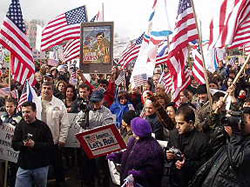



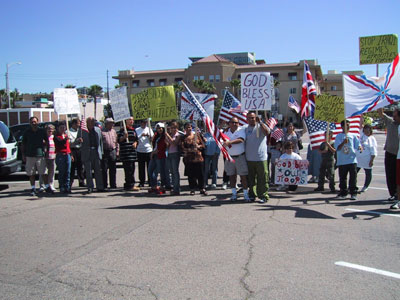 PRO-U.S.
TROOPS RALLY IN SAN DIEGO
PRO-U.S.
TROOPS RALLY IN SAN DIEGO (ZNDA: Kalamazoo)
The gravity of world events has thrust Emanuel Kamber, a professor
of physics at Western Michigan University, into a new dimension.
(ZNDA: Kalamazoo)
The gravity of world events has thrust Emanuel Kamber, a professor
of physics at Western Michigan University, into a new dimension.