|
||||||||||||||||
Click on Blue Links in the left column to jump to that section within this issue. Most blue links are hyperlinked to other sections or URLs. |
||||||||||||||||
|
||||||||||||||||||||
|
On His Holiness Mar Dinkha IV's Trip to Iraq Guest Opinion Youel A Baaba His Holiness Mar Dinkha IV, Patriarch of the Assyrian Church of the East fulfilled the primary Kurdish requirement of citizenship for Assyrians in Kurdistan. The requirement simply stated says that all Assyrians, Chaldeans, and Syrians may live in Kurdistan and be treated equally to the Kurdish residents as long as they drop their national identity, stop demanding national rights, and abandoning all political parties. They will be identified as Kurdish Christians, no more and no less. Assyria has now been renamed Kurdistan, Assyrian Church of the East will be known as the Kurdistan Church of the East, and Assyrians will be known as Kurdish Christians. After 2,600 years of struggle and sacrifices to retain our national identity, the Patriarch has closed the curtain on the Assyrian struggle and wiped out in one brief moment all that we have hoped for as he did in 1994 when he signed the ill-omened Christological Declaration recognizing Mary as “Mother of God”. In his speech after landing in Arbil, the Patriarch called for all Christians to live in peace with their neighbors, love them and respect them as Jesus Christ has commanded. Not once did he dare to mention the word Assyrian, or refer to his Assyrian nationality or even to his own church which he has added the word Assyrian to its name. He stressed the fact (his own fact) that Assyrians and Kurds have lived together for a long time in peace and harmony and that we should continue that relationship. The Patriarch knows very well that for centuries we have been oppressed, massacred, robbed, and ultimately thrown out of our ancestral home by force at the hands of our loving neighbors. The decisions for these acts may have been taken by the Ottoman Sultans or the conspiracies hatched in Tabriz or other cities, but Kurds were the ones who executed these policies and savaged our nation. Has the Patriarch forgotten the assassination of Patriarch Mar Benyamin Shimun at the hands of Simko, a Kurdish Agha? Has he forgotten the atrocities committed against his people in the great genocide of 1914-1918? Has he forgotten the massacres of Badr Khan Beg who ravaged Tiari and Thkhoma? Calling for peaceful coexistence is a noble call but that does not mean that we should surrender our heritage, our villages, our language, or our rights to develop political parties just to pretend that we are living in peace with our neighbors. We are glad to see that finally the Kurds have gained for themselves a homeland and want to live in a democratic society and in peace. However, that does not mean denying Assyrians to return to their villages, or denying their equitable share of the income that Kurdistan is obtaining from the Unites States and other countries. Let Mar Dinkha recognize and his Kurdish allies know that rebuilding churches in abandoned Assyrian villages is not an acceptable price for our surrender. Just as the Kurdish villages need to rebuild their homes, schools, roads, and irrigation canals so do the Assyrian villages. Empty churches in abandoned villages have no value for Assyrians. Instead, building ‘schools’ in the re-inhabited Assyrian villages, where our language would be taught and heritages preserved, are the ideal alternative. If Mar Dinkha was interested in improving the economic and political status of Assyrians in Iraq, he should have first visited Mr. Talabani, the President of Iraq and Mr. Malaki, the Prime Minister and then gone to see his friends in the north. Let us remember one fact that all Iraqis including Assyrians can live in peace and security only when Iraq is one united democratic country free of foreign domination and violence. For the years that he has been a Patriarch, Mar Dinkha has declared publicly and privately that he is not a politician and that he is not interested to have the church or his office become the leader of Assyrians. As a matter of fact, on many occasions he has stated that Assyrians should develop their own national leadership starting with the establishment of national assemblies in the cities that they live in. What was the motivation for the Patriarch that suddenly he became political and assumed the leadership of his nation? Dear Patriarch, the notion and practice of the Patriarch being both the religious and temporal leader of Assyrians died back in the 1940’s when the late Mar Eshai Shimun abandoned his struggle for a home for Assyrians after his petition was not recognized at the opening assembly of the United Nations in San Francisco. My fellow Assyrians, let us remember that for almost 2,000 years we have been a passive and peaceful nation living to the rule of turning the other cheek. That practice enhanced by our religious leaders destroyed the national aspirations in our people. We are grateful to a few Assyrians who revived patriotism among us during the last century. We should build on that and not go back. We should demand our human and political rights in every country that we reside. Let us not ask for them as if we are seeking charity. Today, all people are entitled to these rights and we should be willing to pay the price for them. Let us keep all our religious leaders of all denominations out of our national affairs. Let us remember that we were Assyrians before we became Christians. And I for one would rather live and die as an Assyrian rather than a Christian.
|
|||
Iraq’s Anti-Christian Pogroms Charles Tannock Iraq’s Christian communities are among the world’s most ancient, practicing their faith in Mesopotamia almost since the time of Christ. The Assyrian Apostolic Church, for instance, traces its foundation back to 34 A.D. and St. Peter. Likewise, the Assyrian Church of the East dates to 33 A.D. and St. Thomas. The Aramaic that many of Iraq’s Christians still speak is the language of those apostles – and of Christ. When tolerated by their Muslim rulers, Assyrian Christians contributed much to the societies in which they lived. Their scholars helped usher in the “Golden Age” of the Arab world by translating important works into Arabic from Greek and Syriac. But in recent times, toleration has scarcely existed. In the Armenian Genocide of 1914-1918, 750,000 Assyrians – roughly two-thirds of their number at the time – were massacred by the Ottoman Turks with the help of the Kurds. Under the Iraqi Hashemite monarchy, the Assyrians faced persecution for co-operating with the British during the First World War. Many fled to the West, among them the Church’s Patriarch. During Saddam’s wars with the Kurds, hundreds of Assyrian villages were destroyed, their inhabitants rendered homeless, and dozens of ancient churches were bombed. The teaching of the Syriac language was prohibited and Assyrians were forced to give their children Arabic names in an effort to undermine their Christian identity. Those who wished to hold government jobs had to declare Arab ethnicity. In 1987, the Iraqi census listed 1.4 million Christians. Today, only about 600,000 to 800,000 remain in the country, most on the Nineveh plain. As many as 60,000, and perhaps even more, have fled since the beginning of the insurgency that followed the United States-led invasion in 2003. Their exodus accelerated in August 2004, after the start of the terrorist bombing campaign against Christian churches by Islamists who accuse them of collaboration with the allies by virtue of their faith. A recent UN report states that religious minorities in Iraq “have become the regular victims of discrimination, harassment, and, at times, persecution, with incidents ranging from intimidation to murder,” and that “members of the Christian minority appear to be particularly targeted.” Indeed, there are widespread reports of Christians fleeing the country as a result of threats being made to their women for not adhering to strict Islamic dress codes. Christian women are said to have had acid thrown in their faces. Some have been killed for wearing jeans or not wearing the veil. This type of violence is particularly acute in the area around Mosul. High-ranking clergy there claim that priests in Iraq can no longer wear their clerical robes in public for fear of being attacked by Islamists. Last January, coordinated car-bomb attacks were carried out on six churches in Baghdad and Kirkuk; on another occasion, six churches were simultaneously bombed in Baghdad and Mosul. Over the past two years, 27 Assyrian churches have reportedly been attacked for the sole reason that they were Christian places of worship. These attacks go beyond targeting physical manifestations of the faith. Christian-owned small businesses, particularly those selling alcohol, have been attacked, and many shopkeepers murdered. The director of the Iraqi Museum, Donny George, a respected Assyrian, says that he was forced to flee Iraq to Syria in fear of his life, and that Islamic fundamentalists obstructed all of his work that was not focused on Islamic artifacts. Assyrian leaders also complain of deliberate discrimination in the January 2005 elections. In some cases, they claim, ballot boxes did not arrive in Assyrian towns and villages, voting officials failed to show up, or ballot boxes were stolen. They also cite the intimidating presence of Kurdish militia and secret police near polling stations. Recently, however, there are signs the Iraqi Kurdish authorities are being more protective of their Christian communities. Sadly, the plight of Iraq’s Christians is not an isolated one in the Middle East. In Iran, the population as a whole has nearly doubled since the 1979 revolution; but, under a hostile regime, the number of Christians in the country has fallen from roughly 300,000 to 100,000. In 1948, Christians accounted for roughly 20% of the population of what was then Palestine; since then, their numbers have roughly halved. In Egypt, emigration among Coptic Christians is disproportionately high; many convert to Islam under pressure, and over the past few years violence perpetrated against the Christian community has taken many lives. The persecution of these ancient and unique Christian communities, in Iraq and in the Middle East as a whole, is deeply disturbing. Last April, the European Parliament voted virtually unanimously for the Assyrians to be allowed to establish (on the basis of section 5 of the Iraqi Constitution) a federal region where they can be free from outside interference to practice their own way of life. It is high time now that the West paid more attention, and took forceful action to secure the future of Iraq’s embattled Christians.
 Charles Tannock is Vice-President of the Human Rights Subcommittee of the European Parliament and UK Conservative foreign affairs spokesman. Mr. Tannock's article appears on Project Syndicate's website. Project Syndicate is an association of world's newspapers currently consisting of 290 newspapers in 115 countries, with a total circulation of 42,893,253 copies. Project Syndicate is a not-for-profit institution. Financial contributions from member papers in developed countries support the services provided free by Project Syndicate to members in less advanced economies. Additional support comes from the Open Society Institute, Politiken Foundation and Die Zeit Ebelin und Gerd Bucerius Foundation. Charles Tannock is Vice-President of the Human Rights Subcommittee of the European Parliament and UK Conservative foreign affairs spokesman. Mr. Tannock's article appears on Project Syndicate's website. Project Syndicate is an association of world's newspapers currently consisting of 290 newspapers in 115 countries, with a total circulation of 42,893,253 copies. Project Syndicate is a not-for-profit institution. Financial contributions from member papers in developed countries support the services provided free by Project Syndicate to members in less advanced economies. Additional support comes from the Open Society Institute, Politiken Foundation and Die Zeit Ebelin und Gerd Bucerius Foundation.
Islam and Assyria: an Impossible Coexistence Peter BetBasoo Islam proclaims that once a territory is conquered by Muslims it can never revert to non-Muslim rule. It is this law that even today grieves Muslims for having lost Spain. Very few conquered territories have regained their independence from Islam since the beginning of the Muslim war on the world in 630 A.D.. Those that have succeeded have often faced intense pressure from surrounding Muslim states. New non-Muslim states that have sprung in the heart of "Islamic territory" -- Israel, for example -- have been perennially at defensive war with the surrounding Muslim states. Israel's case is instructive. With significant military and monetary support from the Jewish Diaspora and friendly nations, Israel still finds itself in a precarious position. Even the threat of its nuclear arsenal cannot guarantee that a nuclear Muslim state, such as Iran, would be deterred from using such weapons of mass destruction. Because in Islam the Shari'a is the supreme law that cannot be superceded by any other law, be it civil, international or religious, and because the Shari'a does not distinguish between church and state, any land ruled by Shari'a must ipso facto be Islamic in identity and nature. The Shari'a effectively and unambiguously defines the political State as Islam and Islam as the political State. There is no distinction between Caesar and God in Islam. Assyria, the homeland of the Assyrians, has been under Muslim rule for fourteen centuries. Beginning in 630 A.D., when Assyrians comprised 95% of the population in their homelands, until the present, where the population is 6-8% and dwindling, Assyria has been transformed into a Muslim territory. The heritage, culture and civilization of Assyrians have been systematically destroyed by violence, oppression, and apostasy forced by the sword and jizya. At present Assyrians cannot hope to establish a free Assyria even if the opportunity presented itself, for they are too few, divided, powerless and in a state of Diaspora. With a population of 3.5 million in the world, half of which living outside the Assyrian homeland, Assyrians cannot muster the economic, political and military resources to establish a free Assyria, and even if they could, such a state would come under immediate attack from its Muslim neighbors, the Kurds, Turks, Arabs and Iranians, and likely would not survive a few days beyond its declaration of independence. Islam will not allow Muslim territory to be lost. Why, then, do Assyrians fight for an Assyrian state when -- knowing full well -- this cannot be accomplished in an Islamic Middle East? There can never be a free Assyria so long as Muslims rule our lands. It is time for Assyrian nationalists to wake up from their dogmatic slumber, to shed their delusions, and to realistically reassess and reappraise their national movement. The Assyrian movement to-date has failed to unite the Syriac speaking peoples under one banner. It is now time to retreat from Assyrianism and address fundamental issues that divide our people and threaten the very existence of our nation, to wit: Church fragmentation and Islam. The Assyrian nation is divided into three main sectarian groups, controlled by three theocratic despots who prefer the preservation of their power to the preservation of their nation. They are a far cry from the days of Patriarch Yabalaha, a Mongolian who sacrificed himself for the greater good of the body of Christ. Given the division these Patriarchs are purposely sewing into the Assyrian nation, there is very little hope that Assyrians can unite in pursuit of their dream of Establishing a free Assyria. The Assyrian masses understand at a basic level, perhaps better than most intellectuals and nationalists, that the dream of a free Assyria is just that, a dream, given the Islamic reality on the Assyrian grounds and the reality of a divided and bereft Assyrian nation. In this regard, Assyrian nationalists have set unrealistic goals and expectations and as a result have inadvertently caused damage to their cause by failing to present to the common Assyrian man a realistic political agenda. It is telling that the number of Assyrian political parties is almost equal to the number of their members. The Assyrian movement, whose goal is to establish a free Assyria, cannot defeat Muslims, and so long as this is so Assyria can never rise. But Assyrians can defeat Islam, and they can do this with their greatest weapon: the Bible, which for Assyrians is more powerful than any weapon made by man because it gives us the ideas of universal love, of peace and charity, of mercy and compassion, of forgiveness. These ideas cannot be defeated by anything that Islam can muster. Christ’s salvation and redemption of man is a pull that cannot be resisted by anyone to which it is applied. I admonish the leaders of our churches to live the Word of Christ and stop dividing the Assyrians along sectarian lines, for in doing so they are dividing the Body of Christ and not following His message. We cannot fully unite our people under the Assyrian banner, and continuing the attempt only further divides our people along the denominational fault lines. But why continue the attempt at political unification when, even if it succeeds, nothing can come of it so long as Muslims rule our lands? Those of us who live in the West do not live under the Muslim yoke, but we face another danger: the disappearing Christianity in the West, which renders the West vulnerable to Muslim conversion. It is projected that Spain, Sweden and Italy will be majority Muslim within this century. I ask you: did we escape from our Muslim occupied lands into the Christian West only to witness the dying faith of our coreligionists, and to see Islam ascendant? Do we as Christians and disciples of Christ not have a duty to re-evangelize the secular West, to bring the Word once again to the people? The only way the West can repel the Islamic Jihad is to have deep religious conviction, to make Christ again an active part of the everyday life of the men of the West. If the West falls to Islam, to what safe harbors can Assyrians sail? We have twice in our 6756 year history changed the face of the world, the first time with our civilization, which was the highest at its time, and which we brought to the barbarians. The second time -- and even bigger -- was with the Word of Christ, which we brought from Cyprus to Mongolia, China, Korea, Japan and the Philippines. When Assyrian missionaries traveled the Old Silk Road on their way to China, they embarked in groups which included Jacobites and Nestorians, but they did not travel as Jacobites or Nestorians, they traveled as Christians, and in their evangelical activities they did not distinguish themselves denominationally. It is time for the Assyrian nation to bring the Word of God to the West, because we must save the West for Christ and for us, because we cannot survive if the West falls to Islam. I challenge our Church leaders, our intellectuals, our nationalists, to set aside the political struggle and to apply the full resources of the Assyrian nation to the Christianization of the West. This means that we must not only evangelize the West, but we must fully apply ourselves in defeating Islam, not by the sword, but by the power of Christ’s words. We do so to bring genuine salvation to Muslims, to bring them to the light of Christ. No Assyrian, regardless of denomination, can resist this calling. This is what we must do to unite Jacobites and Nestorians and Chaldeans and Arameans and Maronites. Forget Assyria for now, it is now time to work for Christ. We must do this because it is our duty to God, for it says in Matthew 12:41, “The men of Nineveh shall rise in judgment with this generation, and shall condemn it: because they repented at the preaching of Jonas; and, behold, a greater than Jonas [is] here.” I ask you my brothers and sisters, how can the men of Nineveh rise in judgment if there is no Assyria? And how can there be an Assyria so long as Muslims rule our lands?
Organisation and Subsititutionism Nineb Lamassu “A government or a party gets the people it deserves and sooner or later a people gets the government it deserves”. Frantz Fanon In a recent exchange of emails between a friend and I, he wrote, “Everyone is born patriotic (Umtanaya) and then one joins a political party to become a partisan (Gabbaya), and only then one becomes a politician.” I was bewildered as to how can my friend’s conclusions lead to such a linear evolution, one that would make Khalti Khinzada – if a party member - a world class politician and Noam Chomsky an apolitical patriotic. Since this anonymous friend of mine holds certain political weight in a leading Assyrian political entity, I felt it necessary to reduce my two cents on this subject to writing. It is my hope that this humble attempt will initiate a necessary discussion on organisation, its role and necessity within our community. What is an organisation? This question would appear to be very simple and amongst the readers there will be without a doubt many members of various organisations, who will perceive this question an idle one. But this is not so at all. As Zinoviev correctly noted, “When we are dealing with scientific definitions in those fields where masses of people are involved in a living way – this is entirely applicable to social organisations – then you will nearly always see that the representatives of different classes and world-outlooks define differently the essence of this or that social organisation.”[1] For example the initial wave of Assyrian Diaspora that has by now semi-assimilated – if not fully - within the western societies and succeeded in forming a special Assyrian bourgeois class, may perceive the Assyrian American National Federation (AANF) to be a platform to socialise and sometimes render petty deeds to feel good about ones self, while the capitalist among them see it as a waste of time or as an exploitative medium to maximise profit. But the wretched Assyrian in today’s Iraq may expect the organisation to offer relief, and better ones status by advocating and securing Assyrian rights in the new Iraq. Despite this the fact remains that a group of conscious Assyrians established the AANF as a desperate attempt to attend to the plight of the Assyrians immediately after the Semele massacre of 1933. This the AANF clarifies in the following words, “Historically, the Federation, as the Assyrian National Federation, had its birth in the fateful year of 1933, and was inspired by the merciless massacres of the Assyrians in Iraq.”[2] The AANF believed that this can only be achieved if all the Assyrian association of America worked in concert, “Pride and glory in the ancient dignity of our ancestors entail the assumption of certain obligations towards the remnant of our race, the numerous unrelated and disconnected associations, no matter how great or useful individually, cannot fulfil such obligations. The essential nature of the Assyrian American National Federation, Inc., is to assure functionally unity among Assyrian organizations.”[3] Therefore the need of establishing an organisation advocating the rights of the Assyrians through unity was deemed necessary, and AANF was to fill that void. Why do we need organisations? In an ideal world the people are capable of changing their situation, yet most of our people do not perceive themselves to be able to change their deplorable conditions. If our people were conscious of their capabilities then change would have been very simple. Since our nation has lost power for a while now and has been under the yoke of foreign rule, our people have been forced to hold all sorts of different ideas inside their heads, and the level of consciousness among our people is never uniform. My late father used to remark, “Our people carry a foreign head on their shoulders”. Therefore, we maybe able to think more like Arabs, Turks, Kurds and westerners rather than think Assyrian. Consequently our people can be segregated into three different categories. Some – usually a relatively small minority – accept nearly all the values of the powers ruling over them. Others – again a usually small minority – reject the dominant view put forward by the media, education system and other major institutions of the ruling power. Instead they develop a view which challenges those ideas and present an alternative. But the majority of the people most of the time hold to neither of these total views. They reject some ideas of the ruling powers while accepting others. They tend to accept the basic organisation of society as it is, but want to alleviate its worst effects. It is precisely due to this that we need an organised group of people. History has shown that people need a coherent theory and organisation to chart their way from oppression to emancipation. An organised leadership homogenised in thought, in touch with its people, and capable to lead must provide this theory and organisation. But this leadership must come from the people and not be imposed. It is this fact that Frantz Fanon warns against, “If the building of a bridge does not enrich the awareness of those who work on it, then that bridge ought not to be built and the citizens can go swimming across the river or going by boat. The bridge should not be ‘parachuted down’ from above; it should not be imposed by a dues ex machine upon the social scene; on the contrary it should come from the muscles and the brains of the citizens.”[4] Why do we need leadership? Leadership is necessary precisely because of the unevenness in thought and stance among our people, and because the dominant ideas in our society are those of a foreign culture and people. But every member of the community has to regard him or herself a leader. Leadership has to exist at all levels – local and international – and stems naturally from democratic centralism. It means that those building the organisation fight for their ideas and tactics within the organisation and within the community. So an organisation does not consist of a fixed leadership which always knows best. Thus, although leadership is necessary, we must however, be vigilant not to substitute leadership for a leader; again, Frantz Fanon warns against this by saying, “We ought not to cultivate the exceptional or to seek for a hero, who is another form of leader. We ought to uplift the people; we must develop their brains, fill them with ideas, change them and make them into human beings.”[5] Any successful organisation presents a special programme upon its inception. Through this programme the organisation analyses a phenomenon and offers an alternative and means to achieve this proposed alternative, i.e. set some objectives for itself as the representative of the people.
The leadership of the organisation must be in touch with its people and their needs, otherwise it will remain a small utopian minority. For the organisation to maintain a strong bond with the people and be in touch with its needs it is necessary to recruit individuals into its ranks and turn them in to cadres. Thus defining what constitutes a member is a necessity. The organisation is not to be made up of just anybody wishing to belong to it, but only those willing to accept the discipline of the organisation. In normal times the numbers of these will be only a relatively small percentage of the people but in periods of upsurge they will grow immeasurably. For example, the Assyrian Democratic Movement (ADM) had relatively small followers during the eighties but this fundamentally changed in the nineties after the UK and US imposed a “Save Haven” policed by the “no-fly zone”. Thus an upsurge naturally leads to an increase in membership. This membership or base growth is usually referred to as horizontal expansion which must be paralleled with vertical growth i.e. the organisational education of the new members. The education of the cadre is of pivotal importance and if not implemented it would result in opportunism and other negative manifestations. Therefore any horizontal growth without its vertical counterpart will naturally lead to an organisational imbalance, one that would either produce divergence from the proclaimed objectives, partisanism, subsititutionism, divisions and/or even coup de grace. On this momentous task of the leadership educating the cadres, Lenin remarks, “To forget the distinction between the vanguard and the whole of the masses gravitating towards it, to forget the vanguard’s constant duty of raising ever wider sections to its own advanced level, means simply to deceive oneself, to shut one’s eyes to the immensity of our task, and narrow down these tasks.”[6] So how do we end up with subsititutionism? The horizontal growth without its vertical partner, the leadership’s inability to educate its cadres who in turn are responsible to educate the masses through agitation, produces an organisation where differences are covered and the undisciplined cadres are unable to weigh the importance or unimportance of these differences and to determine where, how and on whose part inconsistency is shown. This would lead to a state of affairs in which – as Trotsky puts it – “the organisation of the party substitutes itself for the party as a whole; then the central committee substitutes itself for the organisation; and finally the “dictator” substitutes himself for the central committee.”[7] This is clearly demonstrated in a letter written by the legendary Agha Pitrus in 1922. In this letter Agha Pitrus paraphrases an Assyrian leader (one which he has kept anonymous) as saying, “two Assyrians under my control is better than a million; each with his respective direction”.[8] What is meant by subsititutionism in other words is when a potentially capable organisation seeks to put itself in place of the people it represents and seeks to take and hold power in its name, which usually results in a confusion between the organisation and what it represents. For example, until this very day many western Assyrians would construe “I am Assyrian” as being a member of Assyrian Democratic Organisation (ADO) and the reverse is also true. To avoid this calamity the leadership must promote a discipline that exposes differences existing within the organisation to the full light of day so as to argue them out. Only in this way can the mass of members make scientific evaluation. The organ of the organisation must be open to the opinion of those it considers inconsistent. Instead of substitutionism the task of the leadership is to connect with the problems and experiences of its members and sympathisers in such a way as to achieve a synthesis that is both a practical guide to action and a springboard for further advance. Such a syntheses is meaningful to the extent that it actually guides the activities of participants and is modified in the light of practice and that changes in circumstances which it itself produces. In conclusion, do we need organisations? Yes, as much as we need the masses: together, the people and the organisation represent a complete whole. As Trotsky puts it, “Without a guiding organisation, the energy of the masses would dissipate like steam not enclosed in a piston box. But nevertheless what moves things is not the piston or the box, but the steam”.[9] In light of all that has been said in this article, does my friend’s equation of patriotism = partisanism = politician hold any ground? Well, that depends on the organisation and its leadership. Do we currently as Assyrians have such an organisation that could put my friend’s theory into practice and prove it correct? If there is one I am completely ignorant of it! Despite this, the need is still to build an organisation of conscious activists that will subject their situation and that of their people as a whole to scientific scrutiny, will ruthlessly criticise their own mistakes, and will, while engaging in everyday struggles of the masses, attempt to increase their independent self activity by unremittingly opposing their ideological and practical subservience to tyranny. Do such activists exist among us Assyrians? My recent trip to the USA lecturing for the Annual Assyrian American Convention, and my travels among the European Assyrians, and my observation through these travels allow me to hold an affirmative answer. Having said this, it is important though not to judge the capabilities of our people through individuals. That would lead to complete demoralisation because none of us is perfect. We must seek the positive in each individual, perceived as an inseparable particle of the community as a whole. Then, one would see a collective goodness worthy of ones sacrifice. Notes:
|
||||||||||
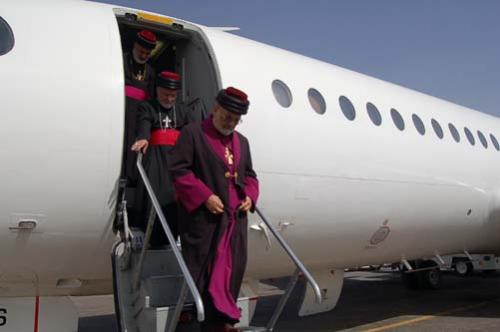
Assyrians Left Out of Federalism Talks (ZNDA: Baghdad) After yielding to several demands from Sunni Arab parties, Iraqi political leaders agreed on Sunday to start debate on a bill that could eventually allow the country to be broken into autonomous states. Autonomous states are allowed by the new Iraqi Constitution, but the charter requires that Parliament first pass a bill defining how that would occur. A powerful faction of Shiites and Kurds tried to pass such a proposal three weeks ago. But their move angered Sunni Arabs and some Shiite and secular lawmakers, who united to block the bill. Sunni parties and other critics won two major concessions during a meeting of political leaders Sunday in return for allowing the proposal to be debated in Parliament. The Shiite faction agreed that Parliament will immediately form a committee to consider amendments to the constitution that include Sunni proposals that would restrict autonomous states. It also agreed that any move for areas to break off would be delayed until 2008, at the earliest, easing fears that the Shiites would quickly split from the rest of Iraq into one large confederation stretching from Kut to Basra. The discussions surrounding the "Nineveh Plain Administrative Region" around Mosul heated up in Iraq during the Parliamentary debates as the Patriarch of the Assyrian Church of the East was visiting the churches in North Iraq. Reliable sources to Zinda Magazine in north Iraq indicate that high-level talks by the Assyrians, Shabaks, and Yezidis are underway with the Kurdish and Shi'ai leadership in Arbil and Baghdad, respectively. His Holiness Mar Dinkha IV Visits Iraq Courtesy of the Assyrian Church News (ZNDA: Sydney) His Holiness Mar Dinkha IV, the Patriarch of the Holy Apostolic Catholic Assyrian Church of the East, accompanied by His Beatitude Mar Narsai Debaz, His Beatitude Mr Gewargis Slewa, His Grace Mar Emanuel and His Grace Mar Aprim Nathniel, arrived on Sunday 17 September, 2006 at Ankawa, on an official visit to Kurdistan region to open new churches and other religious projects. His Holiness was received at Mar Eliya Church by Mr Sadad Barzani , brother of the President of Kurdistan Region Mr Masoud Barzani; Mr Sargis Aghajan, Deputy Prime Minister and other ministers, Arbil Governor and Mar Raban, the Chaldean Archbishop of Ankawa. Warm welcoming speeches were presented by His Grace Mar Iskhaq Yousep, Bishop of Arbil, Dohuk and Russia, and the Kurdistan Minister for Religious Affairs. In addressing the gathering, His Holiness stressed the importance of developing and maintaining friendly relationship between all Christians and their neighbours.
Mar Dinkha Meets President Barzani, Discuss Family Ties Courtesy of Kurdistan Satellite TV in Arbil The Iraqi Kurdistan Region president, Mas'ud Barzani, received His Holiness Patriarch of Assyrian Church of the East, Mar Dinkhaa IV and his delegation, which included Archbishops of Beirut, Iraq, Canada, Syria, north Iraq and Russia. Barzani agreed to open a Christian school in Arbil, Iraqi Kurdistan Democratic Party (KDP) satellite TV reported in its 1030 gmt bulletin on 20 September. The TV said that His Holiness Mar Dinha thanked Barzani for the meeting and spoke about his historical ties with the Barzani family. Barzani said that the Kurdistan Region would never allow discrimination against any faction in the region. Barzani welcomed the suggestion by the Patriarch of Assyrian Church of the East on opening a Christian school in Arbil.
8 Assyrians Killed in Baghdad Bombings, Many Injured (ZNDA: Baghdad) According to a report in New York Times and Ankawa.com, a series of bomb explosions on 4 October left 12 people dead and 56 wounded in the shopping district of Camp Sarah in Baghdad, a mainly Christian neighborhood. The following is a list of nine identified Assyrians and an Armenian killed in this attack:
Explosion Near Assyrian Church Kills 4, Wounds 14 Courtesy of the Deutsche Presse Agentur
(ZNDA: Baghdad) A car bomb blast near a Christian church in Baghdad early Sunday, September 24, killed four civilians and wounded 14 others including four Iraqi policemen, witnesses said. The explosion, apparently detonated via remote control, occurred while worshippers in the Church of the Virgin Mary attended Sunday mass. The policemen who were killed were members of a security patrol, employed to guard the church. No information was available as to the condition of the wounded, or whether the church was the primary target of the attack. Earlier Sunday, two Iraqi soldiers were killed and two wounded in a suicide car bombing in Talafar, 450 kilometres north of Baghdad. Police sources told Deutsche Presse-Agentur dpa that the bomber detonated his explosives-laden vehicle at an Iraqi army checkpoint.
Chaldean Church in Mosul Attacked Twice in 3 Days Courtesy of the Asia News
For months, tensions have been rising in Mosul, a Sunni stronghold. Some people have suggested that the anti-Christian attacks are linked to the controversy caused by the Pope’s speech in Regensburg, Germany. In fact, some flyers making anti-Christian threats were distributed around town, calling on Christians to condemn the Pope’s remarks or be killed and see their churches burnt down. Mgr Raho, Mosul’s Chaldean bishop, had posters pasted on walls saying that “neither Iraqi Christians, nor the Pope, want to destroy the relationship with Muslims.” But his action did not prevent violence from happening again. It is likely that in this as in previous cases, religion is being used for political purposes. In fact Iraqi Muslim leaders, including grand ayatollah Ali al-Sistani, have expressed solidarity and understanding towards the Vatican. A representative of al-Sistani, who is Shia Islam’s highest authority in Iraq, has said that he wants to visit the Pope. In August 2004, the Church of the Holy Spirit was the target of another attack that injured the younger sister of its young parish priest, Fr Ragheed Gani. Two weeks earlier, His Beatitude Mar Emmanuel Delly, Patriarch of the Chaldean Catholic Church confirmed that Father Hanna Saad Sirop, kidnapped in Baghdad on Aug. 15, was released. Father Sirop, 34, was returning home after celebrating Mass in St. Jacob's Church in the Al Dora district of Baghdad, when he was seized by three gunmen. Days later, Benedict XVI expressed his closeness to the suffering of Iraqi victims and appealed to the kidnappers for the priest's release. Father Sirop is responsible for the theological section of Babel College, run by the Catholic Church in Baghdad. Pope Benedict XVI met Saturday with Mar Delly at the pope's summer residence in Castel Gandolfo, on the hills south of Rome, and the Vatican did not release any details. According to Aswat al-Iraq (Voices of Iraq), 30 Christian families received threats on Friday September 29 to leave Mosul in 72 hours or be killed. Terror Campaign Targets Chaldean Church in Iraq Courtesy of the AsiaNews Blatant persecution Car bombs, artillery fire, and handmade explosives are the most commonly used tools in terrorist operations that have struck Christian targets so far. Apart from the attacks on the Church of the Holy Spirit (24, 25 September and 4,5 October), a convent of Iraqi Dominican Sisters in Mosul was also recently attacked. On 2 October, the building came under a burst of bullets that did not injure anyone. The garden of the convent, however, was burned. In the most ferocious attack this year, on Sunday 29 January, a series of coordinated blasts near churches and Christian buildings in Kirkuk and Baghdad killed three people and injured nine. Car bombs struck the Catholic Church dedicated to the Blessed Virgin in Kirkuk, the Catholic Church of St Joseph in the capital and the Anglican Church in the area of Nidhal. Then too, the attacks were seen as a Muslim reaction to the "offensive" Muhammad cartoons. The people claim that the police and national army have never conducted adequate investigations or found the culprits of the violence against Iraqi churches. So communities must defend themselves: now practically every church has at least one guard, usually a young volunteer posted outside the building to watch for the arrival of possible attackers while mass goes on within. "Hidden" persecution A recent UN report denounced that religious minorities in Iraq "have become regular victims of violence and discrimination, with acts ranging from intimidation to murder." The document said: "Members of the Christian minority are particularly targeted." This is because they are more vulnerable than other communities, without an internal or external political force to defend them. Persecution is carried out not only through strong-armed or symbolic actions. AsiaNews sources have claimed that often, in Iraq, "at work and for public administration purposes, Christians are considered as second-class citizens: it always takes much longer than it would a Muslim to get a document, for example." In Baghdad, Christian government officials have not left their homes for months after they received heavy threats. Fear reigns in Basra too, in the south, as it does in Mosul in the north. Fundamentalists also target women, who are threatened or even killed for not respecting the Islamic dress code. Kidnapping of lay people and priests is on the rise, and the enormous ransoms requested bring families and entire communities to their knees. "Christians are held to be more well-off than other communities," said Yousef Lalo, assistant to the governor of Mosul. "So people seek to extort as much money from them as possible." Christians themselves say they have now become used to accusations dubbing them as "infidel crusaders" that "echo" throughout cities and towns. The emigration problem Out of a population of 27 million Iraqis, Christians account for around 800,000 (3%), divided into various rites and denominations. A 1987 census estimated that members of Christian communities amounted to 1.4 million. The drop is mainly due to growing emigration: around 100,000 have left since the start of the Iraq war in March 2003. Many go to Jordan. According to UNHCR estimates, in the first four months of 2006, Christians were the largest group of new refugees in Amman. The United Nations High Commissioner for Refugees estimates that 44% of Iraqis seeking asylum in Syria are Christians. There is also much migration to Turkey, Sweden and Australia. Internal displacement towards the more peaceful Kurdistan is also widespread. Qaraqosh, 67 km from Arbil, until recently had 30,000 residents, more than 90% of them Catholics. Now population figures have climbed to 50,000 following the arrival of many families from Baghdad and Mosul. Security remains a problem: Sarkis Aghajan, a Christian who is the Finance Minister of Kurdistan’s regional government, said more than 30 Christian villages had been rebuilt, "but people do not want to return until they feel safe". Aghajan said: "If our friends do not help us now, their friendship will not be worth anything in the future. If things continue like this, Baghdad and Mosul will be emptied of Christians." Even if in different dimensions, the tragedy facing Iraqi Christians is the same as that afflicting Sunnis and Kurds as well as the Shiite majority. There is no let up in sectarian violence like attacks on mosques. Iraq’s Migration Minister said the number of Muslims fleeing Baquba in Diyala province was "on the rise". This is the area hardest hit by clashes after Baghdad.
|
||||||||
Assyrians, Assyria, and the Rise of Islam The first week of Ramadan this year saw the highest rise in suicide bombings in Iraq in one week’s time. Reaction to the Pope’s quote about Mohammed bringing only violence with his religion sent a wave of violent reaction throughout the Muslim world, some threatening the murder of every Christian within their borders until the Pope apologized. They didn’t retract the statement once the Pope apologized. Recently declassified U.S. intelligence reports indicate a massive rise in jihadism in Iraq and throughout the Muslim world, which the war in Iraq is helping facilitate. A French philosophy teacher, Robert Redeker, was forced into hiding after receiving death threats for writing a critical article about Islam last week – one such criticism being that Mohammed was a “merciless war leader”. The list continues. While Assyrians in the Diaspora continue to cry for their civil rights in Iraq, Syria, Iran, and Turkey, Islamism is on the rise and Christians are their primary target. The world is rarely a black and white place. Shades of gray rule the earth, and variables ad infinitum contribute to the philosophical ponderings that usually precede a final conclusion. There are many reasons Muslims behave more violently toward their religious and ethnic minorities, their women, and even each other, than others on earth: poor socioeconomic factors are usual contributors to violence, colonialism fuels fury against oppressors, and Eastern male egos are typically chauvinistic against women.
But, as Persian writer Amir Teheri said after September 11, 2001, there is a reason that out of 30 or so conflicts in the world, 28 of them involve Muslims on at least one side. Basically, it isn’t coincidence. Actually, many Muslim writers attribute more specific reasons than mere economics and politics for the violence that exists in Islamic societies, most being the Koranic interpretations themselves. There are about 160 verses in the Koran that preach jihad – the violent kind, not the self-spiritual struggle kind – that writers like Irshad Manji argue fuel violence, while other verses of peace – of which there are also many – go virtually ignored. The only problem with this reasoning is that if the Suras of violence against Christians, Jews, unbelievers, and women exist – and they do – then it is just as unreasonable to ask Muslims to ignore those and follow the peace loving ones than it is to ignore the peace-loving ones and follow the violent ones. And if there’s doubt as to the ultimate message of Allah and His Prophet Mohammed, then the default is to look at Mohammed’s own actions and how he lived Islam, which was anything but peaceful. So let’s call a spade a spade. While some Islamic scholars have managed to convince the West that Islam is basically love and peace, Assyrians have lived among Islam for over 1400 years and have barely survived. Their population in the Middle East would likely be in the tens of millions, if not more, were it not for Islam spreading itself by the sword. Assyrians live amongst Muslims today. On the one hand their real-life experience makes them wonder how the West can befriend such people, and on the other, for fear of retaliation, don’t speak up about what their daily lives are like in those countries. To be fair, Assyrians in Iraq have likely had the most “pleasant” experience, as many Iraqi Arabs became communists after World War II, and Ba’athists are not Islamists, but rather Arab nationalists, and persecute on political ideology or ethnic orientations rather than religious ones. But that did not mean being a Christian in Iraq was easy, or that they enjoyed first-class citizenship – communism and Ba’athism may have saved them from Islamic fundamentalism, but the rules of life as a Christian living in a Muslim country still prevailed. While Islamic apologists and progressives insist to the Western world that people like bin Laden have “hijacked” the religion, and that Islam is inherently peaceful, there is as of yet a single Muslim country that lives out this theory in practice. If a religion is only as good as how it is practiced, then academic discussions about the “true peaceful nature” of Islam are meaningless until it actually exists somewhere on earth. And while it is appreciated that scholars wish to change the perception of Islam in the West, they would better spend their time changing the practice of Islam in many of those countries. That would be much more helpful, and would do the job itself of changing the perception the world has of this religion. While I don’t argue that most Muslims are an inherently violent people (quite to the contrary, many choose to follow the peaceful aspects of the Koran – “choose” being the operative word), I do not pretend that Islam is an inherently peaceful religion. So what does this have to do with Assyrians and Assyria? Well, everything. The new Iraqi Constitution is inspired by Islamic law, and it states that no law shall be passed that is in conflict with Shariya. This is inherently un-democratic, as Islamic law is inherently un-democratic in nature. Islam is not just a religion – it is a political and social structure that dictates the lives of those who live under it. And for Assyrians, who are not Muslim, this means disaster. If Assyrians (or Shabaks, or Yezidis, or even secular Arabs and Kurds) wish to live their lives in Iraq outside of Islam, an Islamic inspired Constitution does not allow for it. Women, in particular, will suffer the most, as Shariya law is harshest against them. If Assyrians want to face reality, one of two things MUST happen: Either the Iraqi Constitution erases references to Islam, or Assyrians live outside of the reach of the Iraqi Constitution. Frankly, enough is enough. No one, not even Iraqis, are sure of how the Iraqi constitution will be implemented. Many Iraqi Members of Parliament – Muslim and non-Muslim – want a secular government, while others do not. The language of the constitution is so vague that even in practice it is difficult to ascertain how to interpret it. A recent example of this is the “war of words” between Nechirvan Barzani, Prime Minister of the Kurdish north of Iraq, and Iraqi Oil Minister Hussein Shahristani; they are arguing over how the constitution defines oil ownership, distribution, and who exactly can sign and enforce oil contracts. With the vague definition of “inspiration” of Shariya law in the constitution, Shariya can either be implemented lightly, or forced upon the population heavily. To the Christians of Iraq, mainly the Assyrians, this is not only wildly unfair, but also dangerous to their security and safety. Recently, a Member of Parliament in the Kurdish occupied north of Iraq, Sarkis Aghajan, who is an Assyrian, states his dissatisfaction with the Kurdish draft constitution for the Kurdish occupied areas of Northern Iraq. Whether or not this constitution will actually be used, he argued it did not guarantee the national rights of the Assyrian/Chaldean/Syriac people (who this author prefers to call “Assyrians of different religious orientations”, but I digress). In Islamic countries – however secular – there must also be a heavily enforced stipulation: that all religious groups, whether Shia, Sunni, Catholic or Protestant, enjoy full rights of their faith, are not subject to each other’s rules, and will enjoy safety and security and full practice of their religion. This may sound like the ultimate “good feeling” answer, but there is a monster behind those words: Muslims, by dictation of Islamic law, cannot live under non-Islamic law. And since Islamic law calls for either forced conversion or a heavy tax of non-Muslims (jizya), this presents an inherent problem. After all, men like bin Laden don’t only want to destroy the U.S. and Israel – high on their hit-list is “secular” Turkey, a Muslim country who defies, for the most part, Islamic laws. So how does this become reconciled?
The immediate answer is enforcement: Since the U.S. and Europe have decided to engage themselves in Middle Eastern affairs, and the U.S. specifically in Iraq, then it is their burden to ensure that their budding “democracies” are enforced. Do not go halfway. There is an ugly truth to Islamism that Westerners are uncomfortable with – you either surrender to it, or you destroy it. There is no middle ground. The long term answer is ensuring security to those surrounded by Islamism and who will be at its mercy. Israelis enjoy their full rights as Jews because they are protected with two fierce militaries – theirs and the U.S.’s. If Assyrians are granted their own governed area – which they have more right to than ANY group in the Middle East, be they Kurd, Arab, Turk, or Jew – then they must be allowed to have their own security force and be protected under international jurisdiction. Kurds, Arabs, Turks, Persians, Jews – all have their own security, while the most vulnerable AND OLDEST population goes un-protected, left to fend for themselves, or, even more sadly, FORCED to put hope in the success of “Kurdistan” so they may go like beggars from one Muslim group, the Arabs, to another, for their livelihood. Without these things, only a strong central Iraq, with secured borders, able to throw off the burden that Islamists are putting on them to make an “Islamic Iraq”, can Assyrians maybe hope to live in peace, finally free of persecution. Assyrians have been able to adapt and live among the Muslims, but living freely, comfortable, and happily are different than “learning to survive among them” by keeping low heads and profiles. So until a guarantee is given, by the U.S. and by the Iraqi government, Assyrians don’t want to hear the scholarly debate on how Shariya and democracy are reconcilable, they don’t care if the Koran is actually “misinterpreted by opportunists”, and they laugh off the academic deliberations over the true peaceful and equal nature of Islam. Islam has had 1400 years to show different, so until they start showing and stop talking, action is necessary to prevent this vulnerable Assyrian population long-term survival in a Muslim Middle East. |
|||
European Parliament Report Drops Assyrian Genocide Clause Courtesy of Zaman International (ZNDA: Strasbourg) The Turkey report prepared by Dutch parliamentarian Camiel Eurlings was adopted Wednesday at a European Parliament (EP) meeting, but it included revisions. There were 429 ‘yes’ votes, 71 ‘no’ votes, and 125 abstained. A clause that would have set the recognition of the alleged Armenian genocide as a pre-condition for Turkey’s EU membership and the proposal on a privileged partnership for Turkey, rather than full EU membership, were rejected. The non-binding report called on Ankara to accelerate its reform process. Before the vote, the majority of Socialist, Liberal and Green Party MPs asked for the withdrawal of the paragraph on genocide. The proposal demanding the withdrawal of the genocide clause was adopted with 320 ‘yes’ votes against 282 ‘no’ votes. The report, referred to by some parliamentarians as “a lobby report,” also called for the indirect recognition of the Assyrian and Pontus Greek genocides. By adopting the report, the EP aims to influence the content of the progress report to be released on Nov. 8.
It is the first time an EP report referred to the Greek Pontus and Assyrian “genocides,” as well as to the headscarf issue. The impact of the efforts to make the document on the Cyprus issue more balanced was limited. The ruling Justice and Development Party (AKP) deputies, who went to the EP to hold meetings, noted that while the revised report was more positive, the genocide paragraph was disturbing. Rapparteur Eurlings, who cited the report as “balanced” was asked a number of questions on the subject. Asserting that the report’s references to the Pontus and Assyrian “genocides” were not calls for genocide recognition, Eurlings stated that they were meant to encourage Turkey to face its past. Paragraph 50 of the report calling for recognition of the purported Armenian genocide urges Turkey to open its Armenian border, improve its bilateral relations and establish diplomatic relations with Armenia. The same paragraph also proposes the investigation of the “genocide” issue by a commission to be established under the auspices of the United Nations The conclusion of the paragraph urges the adoption of the same approach with regard to the “other minorities,” in reference to the Greek Pontians and Assyrians. The paragraph, which lacks quality and coherence, calls for the establishment of diplomatic relations with Pontians and Assyrians, for whom no state exists.. The report, which rejects the clause that would set the recognition of the Armenian genocide by Turkey as a membership pre-condition, implies that Pontians and Assyrians were subjected to “genocide,” just like the Armenians. Even though the amendment proposal submitted by Greek MPs to recognize the Greek Pontus “genocide” was rejected, the last two expressions in the report disturbed Turkey’s delegation. The references made to those three “genocides” spurred a new debate on how to read the report. Joost Lagendijk, the Turkey-EU Joint Parliamentary Commission co-chairman, and Eurlings said that the report did not make a call for the recognition of Pontus and Assyrian “genocides,” but aimed instead at encouraging Turkey to discuss its past. Vural, an EP member of Turkish origin, strongly condemned the expressions on “genocides.” Because the report made indirect references to the “genocides,” it is most likely that the upcoming EP reports will contain similar expressions. Watson: Turkey Deserves Better Report Speaking to Zaman immediately after the vote, Liberal Party leader Graham Watson said that he preferred to abstain from voting since he did not approve the report. Noting that Turkey deserved a more embracing and positive report, Watson further said that the majority of the Liberal group abstained in the voting session based on its unbalanced content. Citing its unbalanced approach with regard to the Cyprus issue and references made to the Assyrian and Pontus “genocides” as the most disturbing aspects of the report, Watson noted that the European Union should help Turkish society discuss the issue of the alleged Armenian genocide. Southern California Assyrian Indicted on Charges of Spying for Saddam Hussein in the 1990s Courtesy of the Los Angeles Times William Shaoul Benjamin was arrested Sept. 14 for allegedly acting as a foreign agent without registering with the attorney general, as required by law. He also was charged with lying under oath to immigration officials. Benjamin pleaded not guilty on Sept 18 and was released on a $500,000 bond. At his ranch-style home in West Hills, California Benjamin declined to comment. He referred questions to his attorney, James Blatt, who did not return several phone calls. According to the federal grand jury indictment, returned in June and unsealed Sept. 14, Benjamin is accused of working for the Iraqi Intelligence Service from 1993 to 2001, under the codename "9211." The indictment alleges that Benjamin met with intelligence service officers in Iraq and Tunisia, and received three payments totaling $8,500, as well as two bottles of whiskey. The indictment reveals only this about what Benjamin allegedly did for the Iraqi government: "Defendant Benjamin would infiltrate groups and organizations located in the United States that were considered by the Iraqi Intelligence Service to be hostile to the government of Iraq under the leadership of Saddam Hussein. [He] would collect information regarding these groups and organizations, and the individuals in them, and provide this information to co-conspirators who were Iraqi Intelligence Service officers." The indictment did not say which groups were allegedly infiltrated. Several local Muslim leaders with ties to the Iraqi community said they had never heard of Benjamin. Assistant U.S. Atty. Judith Heinz, who is prosecuting the case, would not comment. If convicted on all counts, Benjamin faces a maximum of 20 years in prison. Assyrian Congress of Georgia Statement on Boris Ivanov Press Release Assyrian International Congress of Georgia The false accusations against General Boris Ivanov in Georgia has become top news all around the World. We, the members of the Assyrian International Congress of Georgia, urge you to pay attention to this case, an example of violation of civil and human rights. On the 27th of July 2006 a group of armed Special Police Force officers broke into the house of General Boris Ivanov, locked the house gate, rounded him off and planted a small bag of unknown substance in his pocket.
More than two months have passed since the arrest of General Boris Ivanov. In the initial round of judicial examination of this case, General Ivanov was accused of possessing drugs . Several witnesses can testify against these accusations. General Boris Ivanov did not possess any drugs when he was arrested. A small bag was placed in his pocket to plant false evidence. The arrest of Boris Ivanov has shocked not only people of Georgia (Assyrians and members of other ethnic groups), but also members of the Assyrian Diaspora elsewhere. Many have expressed their solidarity by sending signing petitions in support of General Boris Ivanov. Ivanov’s life, as recalled by members of his community, is full of countless stories of his altruism and generosity. He is remembered as a citizen who dedicated his entire life fighting crime and battling drug trade. He has always served his country of Georgia with pride. Boris Ivanov was also one of the founders of the Assyrian International Congress of Georgia and the first president of this organization. He was an honorable member of many Assyrian Organizations such as the Assyrian Universal Alliance (UNPO member), Assyrian Council of Illinois, Assyrian Organization “Khayadta”, Assyrian American National Federation. This case is at the centre of attention in the Assyrian Diaspora communities. Assyrian organizations, such as the Assyrian American National Federation have written letters of protest to the Georgian government demanding proper investigation in this case and the immediate release of General Ivanov; because he is innocent. The Assyrian TV and media from around the world have shed light on Boris Ivanov’s case. Suroyo TV which reaches 52 countries has mentioned General Ivanov's case on several news editions. Mr. Nuri Kino, the Swedish Assyrian investigative journalist (one of Europe’s most awarded) visited Georgia in September to investigate this case. According to the newspaper “Georgian Times” and the TV news “Imedi” Nuri Kino has met many eyewitnesses, representatives of the authorities and the government. The outcome of Nuri Kino’s investigation is that Boris Ivanov under no circumstances could have possessed any drugs on him when he was arrested. Assyrians have held several meetings to express their objection at the Georgian embassies in Moscow and Washington. Presently, there are many letters in support of General Boris Ivanov from US Senator John Nimrod, the President of the Assyrian Universal Alliance Foundation (AUAF); Ms. Attiya Gamri, the Assyrian Dutch politician; The Assyrian Universal Alliance (AUA), Assyrian National Council of Illinois, Assyrian American National Federation (AANF), Assyrian Organization “Khayadta” in Moscow; AUA chapter in Australia, Assyrian Academic Society (USA), “Open Heart Society” (USA), and the Assyrian International Congress of Georgia. We hope that the arrest of and accusation against Mr. Boris Ivanov is deemed a misunderstanding and that justice and fair resolution will prevail in this case. AUA Annual Conference Press Release
Assyrian Elected to Winnetka Neighborhood Council
(ZNDA: Los Angeles) Mrs. Nina Fomaeva Essavi has been elected for a two year term on the Winnetka Neighborhood Council in Southern California. She overcame 12 other candidates to win a seat out of four available. She will join her husband Jozef Thomas Essavi, who has been on the Council Board since last year when he ran as an independent against a well organized slate. A neighborhood council is a non-political organization that allows each neighborhood to influence decision-making at the City-Hall. Mrs. Essavi ran on the platform of reform, financial transparency and term limits and promises to be be a crucial vote towards reform. Both Husband and wife are proud of their Assyrian American Heritage. Stolen Aramaic Incantation Bowl Returned to Iraq Courtesy of BBC News It came to police attention when a man attempted to sell it to a London auction house in August 2003. The man was arrested in November 2003 and although there was insufficient evidence to charge him, he chose to disclaim the item. Detectives were unable to establish where the manuscript was prior to 2003. A second artefact was also returned - an ancient Aramaic incantation bowl believed to have been illegally looted from an unknown area of Iraq and worth about £1,000 to £2,000. Det Sgt Vernon Ripley who heads the Arts and Antiques Unit said: "The return of these items demonstrates the success of our unit in raising awareness within the London arts market of the need to be aware of stolen artefacts being sold on." Both artefacts were received by the Iraqi Ambassador for London, Dr Salah Al-Shaikhly, after being handed over by Commander Sue Wilkinson. Assyrian Student Killed in Car Accident in California Courtesy of Mercury News Now, her Iraqi-born parents are left with a gaping void after Ms. Essa, 21, was killed in a Milpitas car accident last Friday afternoon on her way home from picking up her aunt in Fremont, California. Her aunt, Jini Essa, broke an arm in the accident. ``It's impossible to tell you how I feel,'' said her mother, Juliet Essa, who came to the United States in the 1970s. ``She was my best friend. My eyes. My life. Why did God take her? I wish he would take me soon, too.'' Milpitas police are investigating what led to Nenveh Essa's death. A 2004 Ford Escape driven by a 20-year-old Milpitas man, who wasn't identified, jumped a median on Abel Street and struck the Ford Escort Ms. Essa was driving about 3:30 p.m. Lt. Tom Borck said the preliminary investigation shows the man was not under the influence of alcohol or drugs, and he has not been arrested. Borck also said the man has cooperated with police. Ms. Essa borrowed the family car that day and was trying to avoid the busy freeway, deciding to take city streets home to Milpitas, her mother said. If it were the day before, Ms. Essa would have been at Santa Clara University, her mother said, where she was studying accounting and business -- even though her dream was to work in Hollywood. ``She said accountants make good money,'' Juliet Essa said. ``But she really wanted to be a director. But she said this way, `At least I have another choice.' ''
Nenveh Essa was born in San Jose and grew up in Milpitas. Juliet and Gabriel Essa consider themselves Assyrians from Iraq and are practicing Catholics. Juliet Essa said her father always dreamed of coming to the United States, but didn't achieve that goal before he died. Nenveh Essa was realizing the family dream. Her mother said she worked hard and earned good grades throughout school, attending Pearl Zanker Elementary School in Milpitas, St. John the Baptist Catholic School in Milpitas in junior high and Notre Dame High School San Jose. Many of those teachers and friends were visiting the Essa family at their home Tuesday, giving support to relatives, including cousin Elias Pera, 23, who flew in from Chicago and remembered Ms. Essa as a shy girl who grew into young woman who was ``talkative and joking.'' A receptionist who didn't give her name at St. John the Baptist said Ms. Essa was a ``wonderful'' student and that the school community was ``praying'' for her family. Whenever her parents needed help, especially when it involved navigating the English language, she was there. Juliet Essa works in the cafeteria at Zanker Elementary, and Gabriel Essa was laid off from an electronics company. ``She is the one who take care of us,'' said Juliet Essa, acknowledging that her English is shaky, as Assyrian and Arabic are her first languages. ``Since kindergarten, she has been doing all the homework herself. When I make credit card calls, you know, they have lots of messages, I always push the wrong number.'' Her daughter would always help. ``On my cell phone, I push the wrong buttons. `Mom, you have 17 messages. You have to learn. I can't be with you every minute to fix your telephone.' '' But her daughter never said no. Even if Nenveh Essa was at the movies with her friends, she'd always put her cell phone on vibrate and answer her mother's calls. On Friday, her mother called and called, terribly worried when her daughter didn't return her messages. She found out the reason why about 8 that night when two men from the coroner's office knocked on her door. Rev. Gabriel R. Brakhia (1951-2006) (ZNDA: Los Angeles) Reverend Gabriel R. Brakhia, 55, of Anaheim, California; former priest of St. Thomas Assyrian Church of the East in New Britain, died unexpectedly Tuesday (September 12, 2006) in California. Born in Beirut, Lebanon he was son of the late Rihan and Asiat Brakhia. He came to the United States in 1973 and resided in Yonkers, NY for eight years. He later moved to New Britain and then Newington before moving to California two years ago. He served as a Deacon at St. Thomas Assyrian Church for 11 years and was ordained a Priest on July 11, 1999. Father Brakhia served the St. Thomas Parish for five years before taking a church in California. Father Brakhia is survived by his wife Anna Maria (Elia) Brakhia; a daughter, Samara Brakhia in Anahiem, CA; two brothers and there wives, John and Romina Brakhia and Zaya and Victoria Brakhia, all of Yonkers; eight sisters and there spouses, Anna and Edmund Constantine and Jeanette and Robert Shononeskol all of Yonkers, NY; Almas and Egdar Zodo, Zelfa and Andre David, Mirna and Henry Abboud, Georgette and Serge Akiba, Asmar and Tony Gemayel and Juliette Brakhia, all of Chicago, IL; many nieces and nephews. Graveside services were held Monday 11:15 a.m. at St. Thomas Cemetery, New Britain. A procession to the cemetery was formed Monday morning 11 a.m. at St. Thomas Assyrian Church of the East, Cabot Street, New Britain. There were no calling hours. Memorial donations may be made to St. Thomas Assyrian Church of the East. Cynthia "Cindy" Besho (1951-2006) (ZNDA: New Britain) Cynthia "Cindy" Besho, 51, of New Britain, Connecticut, died Wednesday (September 20, 2006) at Hartford Hospital.
A native and lifelong New Britain resident, she was daughter of Rachel (Yohanan) Besho of New Britain and the late Matthew Besho. Cindy graduated from New Britain High School, Class of 1974 and attended the University of Connecticut. She was office manager of the Monroe Group Staffing Services in New Britain for the past six years. She was a member of South Church in New Britain and also attended St. Thomas Assyrian Church of the East. Besides her mother Rachel, she leaves a brother, Mark Besho of New Britain; an uncle, Ernest Yohanan and an aunt, Mary David, both of New Britain; and four cousins, Barbara David and Marlene Whitsett, both of Windsor; Julie David of New York City and Mary David of Malibu, CA. A memorial service was held Tuesday 1 p.m. at South Church, 90 Main Street, New Britain, CT 06051. Burial was at the convenience of the family in St. Mary Cemetery. There were no calling hours. Memorial donations may be made to the South Church or to St. Thomas Assyrian Church of the East, Cabot Street, New Britain, CT 06051. |
||||||||||||||||
|
Did Zinda Forget September 11 ? Ashour Lazar
It saddens me to read your September 11, 2006 issue of Zinda Magazine, not because of what was covered in the issue, but what was not covered. How can you publish your current issue on September 11, 2006 and not even mention the terrorist attacks the took place five years prior on September 11, 2001. There isn't a simple "We Remember" or "God Bless America ." The only picture of the American and Assyrian flags are in the picture of Mr. Aladdin Khamis, who was the main story in issue, standing in front of them. How could your crew not mention, not even a sentence of this tragedy when you are located in Washington , D.C. the function of the United States of America? While the AANF topic covered is important so is the mentioning of 9/11. As citizens of this country we must always respect and remember the tragedies of this great nation or whatever nation we (the Assyrian People) are living and when our resident country is having a celebration we must part take in that event. I hope that next time the Zinda Crew will take a moment to honor and remember what is happen in their country. Has Zinda Abandoned Ship? Albert Michael I feel deeply perplexed after reading the lead editorial in Zinda magazine’s issue 18, dated 11 September 2006. I am not one to neither speculate nor point fingers at anyone without just cause, particularly against our No.1 Assyrian publication Zinda magazine or it’s chief editor Mr Wilfred Bet-Alkhas. However, shortly after the last issue was published I was bombarded with comments by Assyrians from all over the world condemning the tone and nature of your editorial, and certainly their comments strikes a chord with me too, because this was a veiled attack against the movement of our people – the Assyrian Democratic Movement (Zowaa) and His Grace Bishop Mar Bawai Soro.
The journalistic attributes of Zinda magazine have always been exemplary, however this sudden switch from one extreme to another seems to a certain extent to be acutely sinister. For instance, your editorial blames Mr Alaidin Khamis and his supporters for foolishly encouraging and championing the unnecessary split in the Assyrian Church of the East (ACE). The truth however is that those that fashioned the split had conspired months before the Synod to oust His Grace Mar Bawai Soro from their midst, and despite our pleas for leniency to Patriarch Dinkha his response was one of complete denial that His Grace Mar Bawai would be reprimanded, in fact he had categorically stated that no such matter was on the agenda of the Synod meeting that took place on Halloweens day. However this gross lie was subsequently revealed inadvertently or even deliberately by none other than the corrupt bishop of Australia, Meelis Zaia who exposed the following in court under oath when questioned by his attorney Mr Robert Sturges: Pages 49 & 50 of the reporter’s transcript of proceedings in the superior court of Santa Clara held on 01 February 2006. (Question by Plaintiffs attorney Robert Sturges) Now that makes me ask the question, do you know what Bishop Soro was referring to when he uses the expression “of the opposition in San Jose”? (Answer by Bishop Meelis) Members of the congregation of Mar Yousip parish in San Jose. (Question R. Sturges) There were members of the Mar Yousip parish who, what about them? (Answer Bishop Meelis) They have written – they have met with the Patriarch on several occasions during his previous visits to San Jose parish. But finally they have written a submission to His Holiness disagreeing with the activities of their Bishop and requesting that their Bishop be removed or replaced. Not only the Bishop, but the priests also. (Question R. Sturges) This was a petition that was made and submitted to the Patriarch? (Answer Bishop Meelis) Yes (Question R. Sturges) Do you recall when that was? (Answer Bishop Meelis) I believe that was October 2005. (Answer Bishop Meelis) Yes. In essence bishop Meelis’s testimony had revealed that the prior denials of Patriarch Dinkha were lies and that he was indeed in cahoots with the parishioners of Mar Yousip Church all along. It doesn’t take a genius to figure out that Patriarch Dinkha devised this plot, together with a few of his bishops and the Kurdistan Democratic Party (KDP) which include members of the KAUA (KurdoAssyrian Universal Alliance). But the question remains, why? Many people believe that the conspiracy against His Grace Mar Bawai Soro stems back to the Synod meeting of 2001 when he refused to be part of the Synods violation of the canon laws of the Church in favour of bishop Aprim Khamis who had fornicated with a Pakistani woman, Yasmin Khan, who in turn had secretly recorded her sexual acts with bishop Khamis and then blackmailed him for tens of thousands of dollars. So I really don’t believe that His Grace Mar Bawai’s refusal to play ball with the Synod in 2001 had much bearing with the Synod’s decision to suspend him in 2005. They had lived with him for 4 years without much distress and would have continued with that trend had Saddam Hussein still been in power. But with downfall of Saddam came a transfer of power from Baghdad to Arbil and with that a new strategy on the part of ACE. The Synods unholy decision to suspend His Grace Mar Bawai was surreptitiously orchestrated by the KDP who deemed His Grace a threat to their total dominance of Northern Iraq and particularly the subordination of the Assyrians. With Zowaa gaining unprecedented ground in Iraq and Diaspora and a Bishop lending his unrelenting support for them, the ACE felt that the power and dominance they once held over the people was slowly diminishing in favour of Zowaa. I am adamant that the wheels of annihilation against our nationalistic overtures began to gain momentum in October 2003 during the Chaldean Assyrian Syriac General Conference hosted by both Zowaa and the Assyrian Democratic Organisation (Mtaqasta), held in Baghdad. I was overwhelmed to see all of our Church denominations represented during that conference, but sure enough what we have witnessed since is a reversal of attitude on the part of our Church leaders, abandoning the unity train and jumping on to the KDP anti-unity bandwagon, all bar one – His Grace Mar Bawai Soro. It was the speech made by His Grace on 22 August 2004 at the ChaldoAssyrian Community Centre in Chicago that finally determined his fate. During that speech, he alerted the audience that he had been informed by officials in the Vatican that a delegation of Iraq’s foreign ministry had voiced their objection to the unity of Assyrians and Chaldeans. Click here to listen to that speech and jump to 01:17:20 hours of the timeline. We’ve all heard Patriarch Dinkha say on many occasions that neither he nor his bishops get involved in politics, but many of us know that is a lie. On 29 October 2005, Zinda Magazine reported that Patriarch Dinkha accompanied by members of KAUA met with Mr Masoud Barzani (KDP) at the Ritz-Carlton hotel in Washington D.C. Sure, the Patriarch has the right to meet with anyone, but why did this tripartite meeting include the KAUA who do not have a single representative in Iraq, and yet members of Zowaa by far the largest and most influential political party were denied a meeting with Mr Barzani? This “I do not get involved in politics lark” is as I write walking around with the Patriarch in Arbil in the shape of Mr Praidon Darmo, deputy secretary-general of the KAUA, the Patriarch’s secretary and an arms dealer as reported by Amnesty International. I am not qualified to pass judgment on what took place during the AANF national convention and I hope that Zinda Magazine takes time to reflect about the recent past and understands that we can ill afford to bicker and fight amongst ourselves whilst the Kurds are killing and driving out our people from their lands and villages without recourse to justice. Constructive criticism is always welcomed, but I'm sad to say that on this occasion Zinda has ventured on a destructive and unjustified path. Distorted Facts Angie Toulakany I was very shocked, surprised and disappointed of your last issue, which I found it very one sided and bias. A Response to Zinda's September 11th Editorial Emanuel Kelaita The Zinda editorial of September 11, 2006 is most disturbing. I feel compelled to offer a vigorous rebuttal. It is my hope and expectation that you will adhere to the standards and recognized journalistic principals in publishing it, even if you find my response too distasteful. The tone of your editorial is full of anger and disrespectful. The use of abusive language and wholesale attacks on a broad spectrum of individuals and groups is undignified. We certainly expect better from Zinda and its editor. This letter is not in defense of Mr. Aladin Khamis or his associates. They can answer for themselves. However, your editorial, and the article by Ms. Janey Golani that you endorse and refer to, claim a struggle of epic proportions that took place between a small band of educated, honest and patriotic Assyrians burning with zeal to serve our people on the one side, and a group of hooligans of Zowaa and Mar Bawai zealots who used illegal and strong arm tactics to steal the election for the AANF President and the Executive Board. Is this really the truth, the whole truth and nothing but the truth, or are you and Ms. Golani cherry picking events to push your own agendas under the guise of a battle for honesty, truth and fair play? Those of us involved in the worldwide affairs of our communities, especially in Chicago, know that there has been a pointed struggle over the control of the AANF since the mid 80's between the Assyrian Universal Alliance (AUA), and others in the community who do not belong, or support the AUA. The AUA, being a political organization, has dominated the AANF presidency and executive board since the late 60's. Totally separate from this struggle within the AANF, a significant number of anti-AUA individuals and other factions have recently rallied politically around Zowaa, and around Mar Bawai in his disagreements with Mar Dinkha, though this was not necessarily always the case. Mr. Khamis being of the anti-AUA faction, who happened to be popular among the supporters of Zowaa and Mar Bawai was naturally opposed by AUA’s candidates. In this last election, Ms. Janey Golani was the AUA candidate, but it was announced in an interview published in Zinda's August 28th edition, right before the AANF elections, that she is not tied to AUA and that she is only running for AANF President out of her sheer love and respect for this oldest Assyrian organization. Yet, the same Ms. Golani, in a video meeting of AUA, held concurrent with the Assyrian State Convention in May 2006 in Turlock, was not only seated with the rest of the AUA Executive Board members and advisors, but interestingly introduced herself as, "Janey Golani, drafted (into the AUA) by her father, Aprim Rayis and her husband, Atour Golani.” The AUA members attending burst into applause at this point. I suppose that Ms. Golani is not unwilling to pull the wool over peoples eyes to achieve the aims of AUA. But this time it didn’t work, even with the final shedding of the crocodile tears! Her entire running mates made a laughing stock out of themselves, and that also goes to Atour Golani, Carlo Ganjeh, Ninos Bet-Ashour, and Yosip Bet-Yosip, who were desperately running up and down the corridors in their attempt to sway the votes. But perhaps the biggest regret is for Mr. Firas Jatou, who made the mistake of accepting to run for the position of Vice President along with Ms. Golani. Because of all the meaningless and dirty AUA games, he too has lost a great deal of credibility and support from our people. Your claim that "A few years back, supporters of ADM in the US determined that AANF ought to be dominated by the Zowaa sympathizers and substantial portions of its funds be transferred to Iraq for the humanitarian projects underway in the North." Do you have any tangible proof that Zowaa took a formal decision to do this, or is it your own assumption? You are free to suspect what you wish, but honesty requires you to inform the reader of such, rather than presenting it, as a fact. Also, until recently, you were yourself an ardent supporter of Zowaa. Zinda archives are full with your past glowing support of Zowaa and Zinda's numerous endorsements of Zowaa's many candidates during the last Iraqi elections. Were you in the past "few years" involved in these conspiracies to see that the AANF should be" dominated by the Zowaa sympathizers and substantial portions of its funds should be transferred to Iraq”? Even if what you claim is correct, why is it wrong for supporters of a political organization to wish to dominate an important civic organization? Zowaa is a political party that is actively involved in an intense nationalist struggle, including the offering of martyrs to the cause. We may disagree with them, and even be opposed to them. But how can we deny them the right to influence civic organizations of the very people they have devoted their life to serve? This is not only expected, but is legitimate and rational. Members of the political parties believe that their efforts and objectives serve the general good and advance the cause of their people. Hence, they have all the right to try to influence and even attempt to control organizations of their constituency. Do you condemn the Democratic Party in USA in attempting to dominate lab or unions or the Republican Party in USA in taking over chambers of commerce and Rotary Clubs? Nevertheless, for the record, and unlike the AUA, Zowaa has not run any of its members for AANF Presidency. You seem comfortable that the AANF is a "member" of the AUA (in reality the AANF is only an affiliate of the AUA and not a member). You further call on "the leadership of the AUA to negate or reverse the election results from the 73rd session". Do you seriously believe that the so-called members of AUA can attend any AANF meeting and dictate their conditions to everyone else? Do you not realize that under present structure, AUA is finished and cannot possibly exist? May we request your understanding as to how, when and why the AANF became an affiliate of AUA? Clearly, AANF did not have such affiliation when it was established in 1933 simply because the AUA was born in 1968. There are those of us who were around and remember how the AUA marched in and took over the AANF, changed its constitution to declare itself an AUA affiliate and then maintained its hold on its leadership exclusively for most of the past quarter of a century. Why is it acceptable for the AUA to take over the AANF, but wrong for Zowaa to seek influence, if that is what Zowaa has indeed attempted? You and Ms. Golani seem to insinuate that there has been some $25,000 misappropriated by the Khamis administration. You also state that it is Zowaa supporters aim to divert AANF money " to Iraq for the humanitarian projects underway in the North." If that be true, are you prepared to enlighten us as to what were the budgets of the AANF during the decades that it was controlled by the AUA and what happened to those monies? If you are not in a position to answer this question, then maybe Ms. Golani, as the wife of an AANF President, and a member of AUA and the daughter of an AUA's Secretary General can shed some light on that whole murky period in the annals of the AANF. Those of us who were around and remember those days are not impressed with AUA's stewardship of AANF's monies during that period. For Ms. Golani we say " those living in glass houses should not be throwing stones ," and for you Mr. Bet-Alkhas we say that making "what is good for the goose is not good for the gander" is not a hallmark of an impartial judge of fair play and honesty. Your editorial, and more so of Ms. Golani's article, catalogue and denounce in a most harsh manner the undemocratic, and possibly illegal, tactics used to win this election. But please do tell us if this is new in the corridors of AANF conventions. When was it that these, and worse, tactics were not used to "steal" elections of this organization. Certainly the records of the conventions under the auspices of the AUA haven’t been that perfect and fair in previous elections. Is it not true that the same Mr. William Youmaran, the main Villain in Ms. Golani's article, ran the campaign for her husband Mr. Atour Golani's first term? Is Ms. Golani not aware how the same illegal and unregistered organizations that are being referenced in your article voted for her husband a few years ago, and got him the Presidency? Does she not remember how on Election Day the same unregistered ladies organization that she calls "reputable" were being wheeled in to cast their votes for her husband, or is this another case of the kettle calling the pot black? Your editorial injects the name of His Grace Mar Bawai Soro into this case in a most bizarre and vicious manner. His Grace Mar Bawai is locked up in a significant dispute within the Church of the East with His Holiness Mar Dinkha over a wide range of church issues. Each has ardent and passionate supporters. It is very normal and expected that these two sides will compete and even face off in such occasions as the AANF convention. This is to be expected with or without directions from Mar Bawai or Mar Dinkha. Please offer us any proof you may have to the contrary. Your editorial states, "the radicals behind Khamis … foolishly encourage and champion the "unnecessary split" in the Assyrian Church of the East. " First of all, becoming a member for the sake of marriage does not qualify you as a true son or an expert in the affairs of the Church of the East. However, your arrogant attitude in dismissing this important issue as an "unnecessary split" the issues of faith and church organization and management that thousands of our church adherents on both sides are passionately struggling over is repugnant and unacceptable. If you will inject yourself into the affairs of churches other than your own, then you are obliged to have the common respect and courtesy to offer to us your understanding of the dispute and explain the bases that lead you to find the " split" as "unnecessary". Arrogance is not a virtue even for the esteemed editor and owner of Zinda. You end your unfortunate and pathetic editorial with perhaps the most revealing window into your secret agenda. You state, "With the support of the Bush administration in Washington, the Kurds' drive for independence may soon materialize in the fast week… Masoud Barazani banned the Iraqi flag to be flown atop any of the official buildings in the Kurdish-controlled areas. Where is the definitive voice of the Assyrian people in the U.S . that can effectively present the Assyrian case before the Bush Administration and Congress and initiate a series of talks directly with the Kurdish lobby in Washington?" The editorial now appears in a new light. You have concluded that our people in Iraq need to "initiate … talks directly with the Kurdish lobby in Washington." Knowing that Zowaa is being marginalized by the Kurdish leadership, particularly by the KDP, and given that (….) resides in Washington and may be willing to lead an effort to "initiate a series of talks directly with the Kurdish lobby in Washington," is it then surprising that (….) may decide this is not such a bad time to switch from a supporter of Zowaa to an antagonist, all the while in the robes of a crusader for clean elections, honesty and fair play. Also, since the AUA and Mar Dinkha have taken concrete steps to approach the Kurds and start a dialogue regarding (….), then why not also attack Mar Bawai and the anti-AUA candidate for AANF President to gain favor with them also. Thus in one throw one may hit many birds with one stone. Very clever indeed, but also very dangerous for our people worldwide, and in Bet-Nahrain in particular. Zowaa was established under the slogan of "Unified Democratic Iraq – Recognition of Assyrian National Existence." It is under this banner that our people have struggled and given precious blood on the alter of martyrdom. It is not that simple to switch today to support a program of dismemberment of Iraq and its establishment of "long-term American military bases" in North Iraq. It has taken our people 27 years of bitter struggle to integrate themselves into the Iraqi family, and get acceptance as patriots in our homeland. There was a time when we used to be labeled as British agents. Our people are not served well by armchair political "strategists" sending them to those dark days, not even if the "strategist" is the esteemed editor of Zinda. We believe that our people are in dire need of thoughtful and honest people. Keyboard strategists who switch sides, spreading half-truths and innuendos based on shallow personal opinions will not advance our cause.
AANF Election Raymond George It is very troublesome to me to see Zinda Magazine (a very reputable Assyrian media establishment) to label the new Executive Committee of the Assyrian American National Federation as “group of dishonest Assyrians”. The dishonesty comes when the facts are fabricated, twisted and manipulated. The individuals who won the election in this year’s convention are active, respectable Assyrians, highly educated with proven record of accomplishments in their life. Accountability: Zinda’s Counter-Investigative Report Joseph Danavi Another massacre has befallen our over-trusting yet constantly betrayed Nation. Ironically, it unraveled and was orchestrated on the fifth year anniversary of the horrendous September 11 terrorist attacks. This time instead of bloodshed and mass exodus as witnessed in the Simele massacres of 1933, a magazine that was our Nation's most trusted and credible news outlet participated in rhetorical genocide by the means of defaming and attempting to dismantle an all encompassing Assyrian umbrella organization—the Assyrian American National Federation (AANF)—and its popularly and democratically elected administration. The Editor-in-Chief, Wilfred Bet-Alkhas, who attempts to initiate mutiny in his past editorial, "From Half Full to Half Empty," not only relied heavily on lies and factual spin doctoring, but most unfortunate of all, derogatory language and labels which were puppeteered to produce rash emotional reactions. Such rampant disrespect sadly was even witnessed from the onset of downloading Zinda Magazine's main page; the badly distorted picture of AANF President Aladin Khamis coupled by a caption "NOT AGAIN!" mimicked that of supermarket tabloids. Sadly, this is only skimming the surface of Zinda Magazine's latest transition from credible and investigative news reporting to one that utilizes literary composographs in attacking a democratically elected Assyrian leader. Zinda's efforts to spoon-feed the Assyrian public this chaotic and tactfully fabricated picture of the AANF election must be combated not by literary tools, but by the plain and simple truth. I am contributing my time and efforts to remedy Zinda through a truthful and worthwhile investigation. To restore such realities, one must provide ample proof against the allegations. Although only a student, on a tight college budget and unable to hire a "California law firm," a quick online search of the Secretary of State’s cooperation records along with phone call inquiries provided much of the factual rebuttals and the crimping of the twists presented in the case against AANF and the baseless yet harmful pretext for AANF mutiny. Let me first direct you towards Bet-Alkhas’ major allegation of affiliate credential and registration fraud. First it must be noted, to provide sufficient background, that the AANF Constitution clearly defines the condition and status of membership. Not only must an affiliate be a paying member of AANF, but it must also have registered with its respective state of residence as accordance to Article 4, Section 1.
Utilizing the above information to discredit AANF, Bet-Alkhas falsely alleged that the Saint Mar Zaia Assyrian Organization and the Ishtar Ladies Foundation were “not registered as valid corporate entities within the State of Illinois.” However, a quick and free corporation search online produced a result different from his otherwise costly contention. An online snapshot of this proof and subsequent negation of such false allegations can be clearly witnessed in my citations below. Heed particularly to the annual report filling date, 08/23/2006, for both the valid and registered affiliates and be aware that this is a number of days before the commencement of both the convention and the election meetings. The crimping has begun. Carelessly, Bet-Alkhas designated per his “investigation” that the “Chaldean Assyrian American Association of San Diego” and “ChaldoAssyrian Association of San Diego” as two separate and invalid organizations. One must note that an eyewitness to this convention and election would have understood and learned that the Chaldean Assyrian American Association of San Diego underwent a title name change to Chaldo-Assyrian Association of San Diego. As a democratic entity, many inquiries were projected during the convention meeting regarding this transition and the subsequent ill effects it created when attempting to conduct a corporation search via the California Secretary of State. A representative of the Chaldo-Assyrian Association of San Diego informed those concerned as well as the general body that his organization would not be discernible if the hyphen within the entity name is excluded. It is ironic that Bet-Alkhas, self-acclaimed to be an eyewitness, made such a blunder and ferociously fabricated it as part of his case against President Khamis. A copy of the registration certificate and California online business search for the Chaldo-Assyrian Association of San Diego is available, respectively, in the below citations. Anon, please note the date of both documents in relation to the relative much later convention and election meeting date. Being present at the meeting, the other organizations implicated in the Bet-Alkhas’ attacks, were also duly and legally addressed, besides the Assyrian Community Center of San Francisco which neither paid its timely AANF dues nor was present at the 73rd Annual Assyrian Convention in its entirety, thus a non-issue. The Assyrian American Association of San Diego had filed its registration with its respective California Secretary of State on August 30th, 2006, two days before the convention meeting, and provided proof of payment to the credential chairman, William Youmaran. A simple and costless inquiry for these documents from Youmaran, which were analyzed by both the bipartisan Board of Advisors as well as Khamis’ opposition, provided supplementary yet substantial documentation for the case against the Bet-Alkhas AANF denigration. The Assyrian American Society of Las Vegas, also was under the limelight during the convention meetings, but once again it is quite coincidental that Bet-Alkhas also was absent during this probe as well. Evidence was provided that disclosed this organization’s registration filing date on August 27, 2006 and its subsequent proof of payment . According to the Board of Advisor rulings, these corporations were allowed to participate based on their form submission by the convention meeting. However, one major inconsistency is alarming in Bet-Alkhas’ report: there is no mention of the Assyrian American Association of Chicago and its major invalid status. Although a public supporter of Khamis’ opponents, the Assyrian American Association of Chicago did not file its registration credential requirements until September 1, 2006, where the “acceptance and filed date established only after review” is highlighted on their application . With surmountable evidence and constitutional right to prohibit the entry and participation of this “affiliate” within the convention and election meetings, the Board of Advisors drafted a reconciliatory decision with the approval of President Khamis for their inclusion and participation after much turmoil, pandemonium, and child-play was unraveled by the Khamis’ opposition. It is worthy to note, that to this day, the Assyrian American Association of Chicago is still under the dissolution status and thus a null affiliate of AANF. Where was the zeal of such legal investigations, as conducted by Bet-Alkhas, when it fell upon an ally of the opposition and its later pardoned admittance? With the use of emotional concoctions and referrals to the Assyrian Star, Bet-Alkhas made it a focal point to address the recent transition of responsibility as an unequivocal point for mutiny and rebellion. However, for a matter so dear to Bet-Alkhas, how can the elected position so sloppily and cunningly be branded as one that has been transferred? The Editor-in-Chief of the Assyrian Star is not a position that an administration appoints or transfers. It is an elected position that is entirely at the discretion of the voting AANF members. The result of such a democratic process was 75-52 in favor of Sam Darmo, our Assyrian Star Editor-in-Chief-elect. Following in familiar twisted footsteps, Bet-Alkhas continues to strike chords and blind allies with religious and political issues plaguing our community. Although, this guarantees sympathy support because of the use of such emotional labels, there shouldn’t be such rampant contradictions in an investigative report. If pro-Zowaa and pro-Mar Bawai Soro conspiracies are engaged, there should also be serious consideration and inclusion of pro-Mar Dinkha IV, pro-AUA, and pro-Barzani insignias as well. Following a phone interview with Khamis, it was riveting to uncover, amidst the vilifications, he is neither a member of the Assyrian Democratic Movement (Zowaa) nor any other political party. When asked for further clarification, he lucidly responded, “My allegiance is to Assyria, period.” This is a burning contrast to that of 2006 AANF presidential hopeful, Janey Golani, and the past AANF president, Atour Golani, legendary yet active Assyrian Universal Alliance (AUA) piety. The tone of Bet-Alkhas’ editorial, misleadingly, stigmatizes only a narrow and blurry view of the foreign party involvement. As if only one camp has such vital allegiances whereas the flip side is purely independent without political or religious fidelities. My tone is harshly critical and my metaphors for Bet-Alkhas’ latest stunt are alarming. However, one must understand the gravity and the betrayal Assyrian progressives underwent with Zinda's latest editorial. Wilfred Bet-Alkhas is an intellectual, a progressive, a distinguished and highly respected nationalist within our Nation. We are all indebted to his colossal contributions not only in the area of journalism, but also for his unrefined passion and support for this young uprising generation. It is completely different if one without his caliber participated in such a tirade, however, sadly, in this case it is to the contrary. Not only were truths and facts blatantly torched by Bet-Alkhas’ editorial on President Aladin Khamis, but the trust that our young uprising Nationalistic generation had with Zinda was backstabbed. The latest article caused unnecessary distress and heartache, for betraying one's trust and commitment to his and her Nation is a sight, unfortunately, too often witnessed and the main catalyst of roadblocks in our small Nation's path to success. However, we will never abandon our Wilfred, Zinda, or our Nation. There must be an apology and a retraction for the fallacies and twists published in the past edition of Zinda Magazine as well as for the notorious calls for mutiny. That is the path towards realignment and for the only continuation of fair and truthful reporting. I have very strong hope for this reconciliation; although we may have different perceptions of this growing movement; our goal is always the same. I stand firmly with the wisdom of our AANF President through his repeated calls for unity, togetherness, and progression—“Our door is wide open for those who want to promote our community, help our people, and build Assyria.” Let us, for once, walk through it together.
Journalistic Selective Memory Loss Carol Georges Being Assyrian encompasses many attributes and traits that have become synonymous with our ancient yet enduring identity. Nationalism, persistence, optimism, and honesty are among such familial and cultural instilled values. It is with grave disappointment that I, today, feel such values, such traits, our identity be betrayed for political and glory-seeking motives. An eyewitness account from our Nation's future and uprising generation regarding the ill-fated 2002 AANF Elections will highlight the partisan and skewed view Zinda has navigated towards in its past editorial. After reading Zinda's compilation of hearsay coupled with offensive vocabulary all directed maliciously towards fellow Assyrians to produce a so-called editorial, “From Half Full to Half Empty,” I was moved to restore truths and historical facts that were coercively shattered by the Editor-in-Chief, Mr Wilfred Bet-Alkhas. Much of his tabloid styled editorial was filled with fabrication after fabrication instilled with spiteful spin doctoring. As a youth and as an Assyrian leader of today and of tomorrow, it was most disappointing to see an article like Alkhas’ in a self-acclaimed "progressive" Assyrian magazine especially when partaking in selective memory loss of the infamous 2002 AANF Elections. The editor-in-chief of Zinda Magazine called the 2006 AANF election "unfair," with the current administration employing "asinine" tactics for the sake of a win. However, it never occurred to me that Alkhas had an acute issue with selective memory loss. To date, there has not been a more unfair and unjust AANF election than the one that took place in 2002. As an eyewitness to the election and the voting process, it is my duty to report the reality. The 2002 annual AANF Convention convened in Detroit, Michigan. It was my first time participating in the election process and the inner workings of the AANF. Sadly, what came next was not only appalling but also quite discouraging to an Assyrian youth hoping to make a difference in the community. The events leading up to the election were as bad as the outcome. Not only was the federation unproductive during that term, but the Vice President, Aladin Khamis, was publicly sidelined and threatened to be ousted, the epitome of the Mideast dictatorships, ironically mentioned by Alkhas in his editorial. Khamis had spent the majority of his term gridlocked and unable to work at his full potential, purposefully left out by the President Golani and his cohorts, who were following their own ulterior agenda. Frustrated and wanting to see change within the AANF, Khamis decided to run for the office of President. Almost immediately, there was an uproar of opposition, as well as plans to ensure an unsuccessful campaign from the side of the President towards Khamis. It is clear that this opposition came from one origin: fear. Khamis was, and is, a well respected and long time active member of the AANF. His opponents were aware that the supporters of Khamis were the majority, and that the current President was facing an inevitable loss. Thus, the scheme to ensure a win for Golani was conspired and the events to follow will forever go down as the worst and most unjust election in Federation history regardless if certain biased publications deem otherwise. On the day of elections, I took my seat with the Assyrian Ladies Foundation that I had been an active member of that year. After speeches were given from both sides, the doors to the room were closed and the elections were underway. Under the guidelines of the AANF, the doors should have remained shut--no one allowed in or out. Sadly, this was not the case. The President allowed a gentleman, an officer in AANF, to exit the room, only to re-enter just a few minutes later and cast not his designated one ballot, but three. His suspicious demeanor forced others to rightfully question his actions, at which time he confessed to having extra ballots--one of which was still in his coat pocket. Almost immediately, chaos erupted within the walls of the room. Heated, and almost violent exchanges occurred between the two sides, with Khamis supporters demanding a justified re-vote. It was only when Mr. Khamis, himself, called for order that the chaos subsided. Khamis spoke briefly and insisted that the outcome of the faulty election stay as it was: with Golani as the victor by only one vote. With unwavering decisiveness, he dismissed the request for a re-vote in order to subdue the chaos for the sake of unification and healing. He seceded to the President, offering his congratulations and best wishes for a successful second term based on the ideology that there is neither winner nor loser since we are all working together for the same goal--Assyria. The President, taken aback by Khamis’ reaction, extended the office of the Vice President to him once again, only for his offer to be declined by Khamis. The entire body of the AANF erupted into applause and cheer, giving Khamis a ten-minute standing ovation, and would not seize until Khamis reconsidered to accept the position. Moved by the unwavering support and tremendous amount of respect that was bestowed upon him, there was no choice for Khamis but to accept, fully aware of the roadblocks he would face throughout the new term. He remained a dedicated and active Vice President for the next two years only to be elected President in 2004 with overwhelming support. This is in no way meant to attack the previous administration nor bringing up and opening old wounds. Administrations make mistakes and in the heat of elections personal aspirations sometimes replace ethics. However there was no election fraud nor conspiracies in the past 2006 AANF elections as was eyewitnessed in 2002. It is unfortunate that a publication as reputable as Zinda participate in double standards and undergo convenient memory loss in order to push a personal agenda. One that promotes division over unity, animosity over good will, lies over truths, and rebellion over cooperation. A published retraction along with an apology is the only means to rectify and restore the reputation of Zinda and bring it back on the track towards Assyria. Zinda's Claims Have No Merit Margaret Khamoo My name is Margaret Khamoo, and I was heavily involved within the 2006 AANF Convention not only during the Election Meetings but also in registration. I was recently on the Zinda Magazine website, and I was appalled to see Mr. Aladdin Khamis' photo beneath a caption that read, "Not Again." I was curious to know why Mr. Khamis was the target of your article, so I proceeded to read. Unfortunately, it was yet another example of an Assyrian attacking the Assyrian community rather than aiding it. Mr. Bet-Alkhas, it is Assyrians such as yourself, that separate and divide our people into groups rather than uniting us into a nation. Your numerous words throughout the article describe a chaotic and violent street gang rather than an organized and collective group of hardworking nationalists. Words such as "hijacking," "hooligans," and "shindig," were used to describe the members of the federation, the convention, and most notoriously our own small community. Mr. Bet-Alkhas, are you aware that their were 4,000 people in attendance at this so called "shindig?" You also failed to mention, that the challenger's family, via AUA, have "hijacked" the federation for more than 20 years. Yet, after a mere two years, Mr. Aladdin Khamis' administration and re-election is under scrutiny and the focal point of all AANF problems and corruption. You make the claim that Mr. Aladdin Khamis and his cabinet members were elected in a corrupt manner. However, your claim has no merit. Mrs. Golani did not have enough supporters to win the election which is why she withdrew from the election and directly led to Mr. Khamis' re-election! You also claim that Mr. Khamis refused to reveal the credentials of the voting affiliates. If you were at the meetings you would have witnessed William Youmaran revealing the credentials to everyone in the meeting. Before you publicize information on your website, you should get the facts straight first. You also mention that there are various organizations that were not registered as valid corporate entities; then, how do you describe the fact that AAA and the Ladies AAA are both non-registered entities? Again, your claims are nitpicked and without merit! You mention that the members of the AANF have been dishonest with "shady intentions," how so? You mention that the AANF is hindering support for the teachers, security guards, etc. in Iraq. Again, your claims have no merit. Despite what you and your "cronies" think, the convention was a success! We had over 4000 people in attendance, and for the first time, a responsibility as great as the Youth Excellence Contest and registration was given to the Assyrian Youth! I believe we handled it well, considering, we awarded four outstanding and bright students and had to register 4000 guests. It was the most organized and well run convention we've had, and it is unfortunate that someone like yourself would try to make it look less than it was. I pray that someday we will be united to work for what's important. In the future, try to address your grievances so that we can work together to improve conditions within our community. National unity is not just an idea. Let us try to make it a reality!
Otherwise our Respect for Zinda will Fall Astray Peter Esho I developed mixed feelings at the Assyrian Convention this year. It was my first time attending and expected this year to be special due to the Renaissance Hotel currently underway within our community. My expectations were far from reality. I saw a community fearful of unity. Scared to come together because of political and personal emotion. A growing minority bravely promoted unity yet others rejected the notion because of preconceived beliefs. I met people from around the world with a common love for their heritage yet little acceptance towards Assyrian-Chaldeans-Syriacs as one. In this confusion and emotion I noticed a group of young and determined Assyrians and Chaldeans working side by side to organise the event. They didn't discriminate between church or language. They worked in harmony to make sure the registration function was carried out smoothly for the AANF. They weren't political, nor religious, just a group of university students dedicating time for a cause they believed in. Chaldean-Assyrian-Syriacs as one. That same group gave me encouragement and hope. If this was a microcosm of our community working together then I wanted to be part of it. I wanted to import the idea here in Australia since we lack a movement with such capability and passion. I came back and read your article on the AANF elections and supposed corruption at the convention. Not one positive. Nothing about the great work the organising committee done or the late hours put in by the community. My motivation dropped to a point where I almost wanted to forget everything. Sure we appreciate the fact that your editorial needs to be balanced, but the tone and content was both destructive and demoralising. Many others who supported Zinda in the past, because of its journalistic integrity, came together and collectively voiced their opinions. Names of those feeling this way are registered at http://assyrianyouth.petitiontime.com . We hope you will find this message constructive, without hostility. We love Zinda, that's why we put the time and effort into conveying our disappointment. Please take our concerns seriously otherwise our respect for Zinda will fall astray. Great job Mr. Aladin Khamis and the AANF board. ACANA's Support for Mr. Aladin Khamis Executive Committee On behalf of the Assyrian Chaldean Athletics of North America (ACANA); its committee, athletes, and teams’ members; we want to send our warmest congratulations and express our strongest support on being re-elected as President as well as the newly elected executive committee of the Assyrian American National Federation (AANF). As we ACANA inspire to unite athletes and sports teams, Mr. Khamis inspires to do the same for our people. We will be united and we will always be supportive for all efforts that Mr. Khamis desire to bring recognition and prosperity to all ChaldoAssyrian people. Again, our membership strongly supports Mr. Aladin Khamis and the new executive committee of the AANF. In the end, may God guide and bless all their efforts to do the best for the AANF and all ChaldoAssyrians as a whole. Assyrian American National Disappointment Inc. 'Clark' Sargis Georgese The 73 rd annual Convention of the Assyrian American National Federation took place. I have been attending all conventions for the most part of my life. I was born in the United States a long time ago. I am what you call an “Old Timer.” My parents taught me well. My participation in the Assyrian Community is very limited as I do not attend local events. At best my activity is and has been restricted to family functions such as birthdays, weddings, etc. So the highlight for me has always been the AANF’s annual gathering. At the national conventions I try to attend as many cultural programs as I can and I always sit in on the Federation meetings from start to finish because I want to see, in action, the organization, this Federation, that is representing my people, REPRESENTING ME in this country and the world. I thought long and hard about writing this piece. I was not sure if I wanted to. I was not sure if I could make a difference since I have never been personally active in the Assyrian Community. Who would listen to me? I finally decided that I AM AN ASSYRIAN AND THESE ORGANIZATIONS THAT REPRESENT ME, REPRESENT OUR PEOPLE SHOULD BE HELD ACCOUNTABLE AND FORCED TO REALIZE THAT THEY, OR, A FEW INDIVIDUALS WITHIN THESE ORGANIZATIONS CAN NOT DO AS THEY PLEASE WITHOUT ANSWERING TO THE PEOPLE!!! Attending the Conventions (and sitting in on meetings as an observer) over the years I have witnessed, first hand, the downward spiral of this once respectable institution. 2006, was the “straw that broke the camels back” as far as corruption, fraud, dirty politics, blatant obstruction of a democratic election process and finally, quality and qualifications of the Federation’s executive body. Former presidents of this Federation, Alexander Ameer, David Perley, Joseph Durna, Ronald Yonan, Karam Jacob, Darius Benjamin, Jacob Waldo, Malcolm Karam, Adam Benjamin, John Yohannan, William Yonan, Alex Evans, Ray Balley, Ike Sargiss, and Simon Kasha are turning over in their graves. The Federation these esteemed and accomplished men once served has become a mockery. I had the privilege of knowing some of these gentlemen personally and I am relieved that they are not alive to witness the decay of this organization.I am sorry to say that the Federation has turned into a beacon for the unqualified, self-centered, self-serving, short-sighted and uncouth. The meetings at this year’s convention were a farce. The Federation Constitution and By-Laws were not upheld, acknowledged or applied and Robert’s Rules of Order were non-existent. I have to correct myself here, the Constitution and By-Laws were upheld and applied but only to a select few benefiting one side, and admittedly Robert’s Rules of Order did majestically surface now and then, again, to benefit one side and that was the group/side supporting the then presidential candidate and now newly “elected” president, Mr. Aladin Khamis. Organizations and individuals that were not in support of Mr. Khamis were deemed “not in good standing” and prohibited from participating in the elections. Specifically, the AAA Ladies Organization of Chicago, an active affiliate and participant of the AANF for over 35 years, whose members dedicated 40+ years of their lives to the AANF and the Assyrian Community, was shamefully cast out due to administrative “technicalities.” Readers please note that these very “technicalities” were never an issue throughout all the years of this club’s affiliation with the Federation and that they were not brought up in the previous election by Mr. Khamis and his group for the simple fact that during that election year the AAA Ladies Organization of Chicago was voting for him. This year, however, they were not and Mr. Khamis and his group knew it. I wonder, what would Alexander Ameer,David Perley, Joseph Durna, Charles Dartley, George Mardinly, David Jacobs, Sam Aslan and John Ashji, the founders of the Assyrian American National Federation, say about all of that? As an observer I was disgusted. As a moral, ethical person I was appalled and as an Assyrian I was ashamed for what I witnessed during this “election” year. Anyone with half a mind sitting in the meetings could see what was happening. One thing in particular struck a cord with me. Aladin Khamis’s opponent, Mrs. Janey Golani, repeatedly asked to view the Credentials. Now, for those of you who do not know, Credentials basically are the names of all the individuals representing the various affiliates of the Federation at the meeting that are registered to vote. I have read the Federation’s constitution and by-laws. The Federation is a 501-C3 organization (not-for-profit), hence, ALL of its files, whether financial or administrative are OPEN, according to the laws of the U.S. Government, and must be made available at all times to the general public, let alone to the members themselves. The Credentials were never provided to Mrs Golani who had a legal right to view those documents. Furthermore, the Credentials Chairperson, Mr. William Youmaron, provided inconsistent numbers for registered voters in his reports to the body. His total of the number of votes were always incorrect and had to be corrected by the people he was reporting them to! When questioned and asked to clarify the inconsistency with his figures Mr. Youmaron said something to the effect of “I made a mistake, I am Human.” An individual charged with tallying and registering voters for a democratic election does not have the luxury for error and, simply put, must have the ability to solve the problem 1+1. Question, why refuse a member of the Federation his/her constitutional and legal right to view the Credentials if you do not have something to hide? In all of my years as an observer the issue regarding the validity of the Credentials was never questioned or brought up because the prior Credentials Chairpersons were qualified and more importantly, honest. I have to mention after witnessing all of this that my concern as a tax paying Assyrian-American is, will I be denied my legal right to AANF information that is, by law, supposed to be open to its membership and the general the public (Assyrian or not)? This is something all of us should think about. On Election Day, Sunday, September 3 rd, the election process did not take place as there was no actual voting for the executive positions. It was the fastest “election” I had ever witnessed. The major executive offices of the Federation were “won” by default by Mr. Aladin Khamis and his group following the withdrawal by Mrs. Janey Golani and her panel on grounds of fraud, blatant disregard of Federation rules and regulations, Credentials tampering, etc. In her speech Mrs. Golani stated that she and the individuals running on her panel can not and will not participate in a dishonest election. Yes, Mr. Khamis and his people “won,” but as an objective observer I sadly viewed it for what it was, a pathetic, empty, shallow victory and the nail-in-the-coffin of this fine organization.
Above, I present Article 5, Section 8 from the AANF Constitution (which is available to all at www.aanf.org) to bring the following to the public’s attention. A motion was made to change the name of next year’s AANF Convention along the lines of Chaldo-Assyrian National Convention. This was met with opposition in the meeting. Following a few inquiries on my part, as I was sitting in the back, I found out the gentleman who made this suggestion was a member of the Chaldean Assyrian American Association of San Diego, Shamasha Kalabat. Following some very heated discussion, wherein it was stated that themes can be applied but the actual name of the convention can not be changed, the Deacon corrected his statement and withdrew his motion and told the body that it was not the name but the theme. Then, in short, Mr. Khamis informed the Shamasha that next year’s convention committee had the right to impose a “theme” to the event. Now, I consider myself to be very perceptive and keen. My experience over the years working in the top levels of corporate America developed my ability to read people, conversations and scenarios. Once Shamasha Kalabat observed the negative reaction that was ignited he “clarified” and withdrew his statement that was in turn verbally supported by the President. However, as I mentioned earlier, anyone sitting in the meeting with half a mind would clearly see and understand the true intention and meaning whether it was stated outright or implied. The initial motion, hence the true intent, made by this representative from San Diego, who delivered it with absolute clarification, involved changing the actual name of next year’s convention itself in direct violation of Article V, Section 8. Question, if Shamasha Kalabat’s suggestion truly involved only the theme and not the official name of next year’s convention then there was no need to place it before the body as a motion, unless it involved something he knew was in violation of the AANF Constitution and By-Laws.
I believe that the honorable Shamasha knows the difference between the “theme” of an event as opposed to the “name” of an event. In effect the “withdrawn motion” was passed through a proverbial loophole. The annual conventions are organized by the Assyrian American National Federation, thus, the official name of these annual events must be the Assyrian American National Federation Convention. By changing the name of the event suggests the event in question is organized by a non-existent national entity other than the Assyrian American National Federation. This briefly touches upon the legality of this particular issue, but, what about the emotional aspects and ramifications? Earlier I had mentioned the names of the Federation founders, Alexander Ameer,David Perley, Joseph Durna, Charles Dartley, George Mardinly, David Jacobs, Sam Aslan and John Ashji. Ladies and gentlemen, brothers and sisters, these men were not Chaldean (or Catholic) nor did they belong to the Church of the East. These Assyrians all belonged to the Syriac Orthodox Church a.k.a. Jacobite. Despite their church affiliation they knew their history they took pride in it and honored it when establishing the AANF in 1933 as result of the Assyrian massacre in Simele, Iraq. Indeed if they did not, we all would be attending the Jacobite American National Federation Conventions. Furthermore, what of our martyrs who sacrificed their very lives to preserve and protect our Assyrian Heritage? What of Youbert, Yosip and Youkhana? Did they die in vain? They went to the gallows for and BECAUSE OF THEIR ASSYRIANISM -- NOT THEIR RELIGION!!! Is it not the duty of every Assyrian individual and organization to honor, preserve and not desecrate our heritage, our history, our identity, our Assyrianism?! I do not think Youbert, Yosip and Youkhana gave their lives for their Assyrian Nation so that their successors could guiltlessly push their nationality aside to give room for and slowly sub-plant it with religious affiliation. Additionally the Federation founders established this organization to represent and preserve the Assyrian Nation and not its church affiliations. Therefore, Shamasha Kalabat, who leaves me the impression that he knows very well the history of his nation, should take to teaching the Assyrians who belong to the Catholic Church (the Chaldeans) their history. Teach them that a little over 500 years ago a schism in the Church of the East caused a good portion of the Assyrian population to join the Roman Catholic Church whereby the Pope dubbed them “Chaldean” to differentiate them from the Assyrians who remained with the Church of the East. Do not insult the Federation, its memory and legacy. Do not insult our heritage -- your heritage. Do not insult me. Enlighten the “Chaldeans” who are ignorant, teach them and slowly cohesion will manifest as they begin to acknowledge and realize who they are on a national level. Another result of this year’s fixed elections was the ousting of the current Editor and Chief of the Assyrian Star, Andrew Bet-Shlimon. Mr. Bet-Shlimon worked hard to diligently resurrect the Star during the six years it was under his charge, prior to that the magazine was not even worth its subscription price. I say this from my own experience. I have always subscribed to the Assyrian Star, and, like the Federation I have been witness to its downward spiral as far as quality of literature by simply flipping through its pages. Mr. Bet-Shlimon dedicated six years to producing an exceptional product that the Federation and all Assyrians can be proud of. It promoted our culture, taught our history and gave hope and a voice to the younger generation and that made me want to read it over and over again. Libraries and universities from across the country and world subscribe to it as I and many of my non-Assyrian friends had discovered. Mr. Bet-Shlimon lost the position he responsibly held for six years to a Mr. Sam Darmo. I recognized Mr. Darmo from the cable T.V. show he hosts called “Assyrians for Justice.” He was of course Mr. Khamis’s pick for the position as Mr. William Youmaron and another gentleman who was the Chairman of the Federation’s Board of Advisors (I can not remember his name) declined their nomination to run for Editor in Chief by stating “I decline for Mr. Sam Darmo!” Note, at this point I discovered that Mr. William Youmaron was appointed Credentials Chairperson by the current President. Prior to the actual voting on this office (Editor and Chief) each candidate delivered a speech as to what qualifies them for the position and what they will do once in office. Mr. Bet-Shlimon made it very short saying the publication over the last six years speaks for itself and that through his and his staff’s efforts every major library (public or academic) receives the magazine (something we all knew and were proud of). Mr. Darmo blessed everyone with a vague and uninformative speech wherein he stated he had received the Star (once, twice, three times?) in Baghdad and that he would work hard to place the Assyrian Star in every library in the U.S. He did not mention his qualifications (if any) nor touch upon any experience in the field. How odd that an individual who is running for an office does not know the status of the very thing he will be taking over. It was very clear what was happening. There must be a re-vote with an outside third party auditing and taking charge of voters’ registration and ballot count as this year’s election was blatantly manipulated and pathetically far from democratic. It is unacceptable to witness events where even if Agha Petros was resurrected to run against Mr. Aladin Khamis and his group – the Honorable Agha Petros would lose abysmally. A few years ago amendments to the Federation were submitted to the National Executive Committee and all the affiliates of the AANF to change voting procedures whereby every individual Assyrian registered with the Federation would have the right to vote in every election. That means we, the public (not just the current 27 or so affiliates that do not even represent a cross-section of our population) would choose and vote for who will represent and serve us in the AANF. Of course, these amendments were forgotten as soon as Mr. Khamis commenced his first term in office. Ladies and gentleman it pained me to write this article but it was something that had to be done as a matter of ethics. As I stated a number of times throughout this piece, I have witnessed the downward spiral of this Federation over the years, but it was this year, 2006, that drove me to the point of no return pushing me to share what I witnessed with all of you. I sign off on behalf of all those who sacrificed their lives for the Assyrian Nation and their Assyrianism, irrespective of church affiliation, tribe or country of birth, Alexander Ameer, David Perley, Joseph Durna, Ronald Yonan, Karam Jacob, Darius Benjamin, Jacob Waldo, Malcolm Karam, Adam Benjamin, John Yohannan, William Yonan, Alex Evans, Ray Balley, Ike Sargiss, Simon Kasha, Charles Dartley, George Mardinly, David Jacobs, Sam Aslan, John Ashji, Youbert, Yosip, Youkhana, Agha Petros, Freydon Aturaiya, Ninos, Sargon, Shamiran, Nineweh, Ashur, All Assyrians of the Past, Present and Future, etc., etc., etc. I chose to conclude in this way so that you, President Khamis, realize this -- that you and the Federation ANSWER TO THE ASSYRIAN PEOPLE, ANSWER TO ME!!!! YOU ANSWER TO THE NATION YOU SERVE, PERIOD. Regretfully Yours. Our Energy Ought to be Spent on National Priorities Firas Jatou First, I would like thank you for tireless efforts in producing zinda magazine. I wish you and the magazine continued success and progress. I would appreciate it if you place the paragraph below in the next issue of Zinda. Iraq's Ambassador Visits Chicago Assyrians Helen Talia
(ZNDA: Chicago) Chicago hosted Iraqi Ambassador, Mr. Samir Sumaidaie, in a dinner banquet, followed by a rally, where approximately 500 guests were in attendance in the two-day event (12th & 13th September) at the Chaldo-Assyrian Center in Skokie, Illinois. In June of this year Mr. Sumaidaie was greeted by the Chaldo-Assyrian-Suryani community at the Iraqi Embassy as an angry crowd fired emotions and chants in Washington, D.C. in protest to the repercussion that the minorities of Iraq suffered after being reduced to a religious minority status. Finally, after a long absence of more than thirty years, the groundwork is laid for Iraq’s minority communities and the embassy, as the dialogue between the two is in its infancy stage. Iraq’s dark past during the Baathist regime, not only monopolized people’s lives and overshadowed every shade of color of Iraq’s identity; it left no room for a dialogue to ever take place between the ‘so-called’ government and the public. But on this day, Mr. Sumaidaie vowed to build bridges and form friendly ties between all Iraqis in the United States and the Iraqi embassy, in a hope to rebuild a new democratic society in Iraq. His enthusiasms and sadness were both apparent in his speech as he struggled to be both, presentable and fair to the public pleads and questions. Some showing approval, while others still in denial that any remedy could be faceted to rescue the identity of the many minorities of Iraq, who continue to live in fear and flee their homes by the thousands. At the end of the evening, it was noticeable that we are all struggling to get by, while salvaging emotions from a long and deep past that continues to haunt us as our emotions, from time to time, come charging to the surface – showing fear, anger, humility, and above all, love for Iraq. An Appeal to Amr Moussa, Arab League Secretary General Ashur Solomon
It is very essential that as Assyrians to express our views and feelings in a civilized manner, and not try to cover them with deception that doesn’t reflect our situation in any way, a case in point, when the Pope quoted the 14th Century emperor, most of our religious leaders came forward refuting that which doesn’t reflect the reality of our relation with Islam period. It is important to know that the first who criticized Islam was a Nestorian Patriarch from the late 7th century A.D. by the name Khnan-Eshu (684-690A.D.) during a visit by the Caliph Abdul-Malik) 684-705 A.D( who came to Mesopotamia in order to crush a rebellion , the Nestorian Patriarch paid a visit as it was a habit when dignitaries arrive , the Caliph asked him what he thinks about the Islamic religion, the Nestorian Patriarch replied without concealing his motives that it is , “ A political state which was created by the sword, and not a religion which is confirmed by miracles as it is the case with the Christianity and Judaism religions.” By such remarks, the Caliph was outraged and ordered someone to cut his tongue, but fortunately the interference of the Caliph‘s entourage spared the Patriarch tongue from such sever and savage punishment, according to Bar Hebrews quoted ‘by Joseph Nasrallah, Paulesian Press Library, Beirut, Lebanon 1991 that Sarjoon or the poet Al-Akhtal (Christian Arabs )were the one who interfered on behalf of the Nestorian Patriarch. No question, that the Assyrian power was in decline and never existed during the Arab Islamic invasion in the mid seventh century A.D., but the damages that such INVASION caused to the Christians and here the Assyrian people in particular in the area are beyond imagination to a point that it affected them even though that power i.e., the Arab Islamic hegemony came to an end in the middle of the 15th century A.D. or before , because such power came to an end at the hands of those who became MUSLIMS by themselves and carried the torch of Islam to name, the Turcomans, the Ottomans, the Qurds and the Persian Iranians. The Arab Islamic invasion affected the Assyrian a great deal and affected others as well, to name the Arameans, the Canaanites, the Eblaites and the Egyptians. It was crystal clear that our Assyrian people and others as well did to challenge occasionally such hegemony which transformed all these concurred people to be under the process of Arabization and Islamization. How ironic it is to see an Egyptian, a Syrian and an Iraqi /Mesopotamian try be proud Arab and erase that bright history and culture that stretches over 8000 years span to be replaced by a new Arab one, no matter how magnificent they were, because to us – as Assyrians – our history and heritage is the best as the Arabs think of themselves which we respect that. Sadly to say that an Egyptian intellectual by name ‘Professor Shouqi Dheif شوقي ضيف tried to defend the Arabic language and say how the Arabic language have superseded the Syriac language and proudly declared that the victory was to the Arabic the language of the noble QURA’N to eliminate our Syriac language in his writings (History of the Arabic literature, the Era of the Ignorance – العصر الجاهلي page 25). It is essential to be familiar with such religion or nationalism, i.e., the Arab / Islamic phenomenon , to read a very important book which is written by a revered Muslim and an Arab scholar by name ‘ Ibn Khaldun , in his Introduction/Moqaddemah المقدمة , where you will find why and what these new invaders from the Arabian peninsula did to change the demographic setting of the Middle East and especially how they were successful to erase two of the most advanced and civilized people , i.e., the Assyrians and the Egyptians. To become a Muslim writes ‘W. Montgomery Watt in his book ‘the Majesty that was Islam’ Sidgwick & Jackson, London, 1976: “One had to be attracted by Islam as a religion. To become a Muslim one had to become an Arab at least by client ship; and in addition one had to learn Arabic, since for centuries all religious thinking was in Arabic.” Page 260 By implementing such harsh policy, the Syriac Speaking people in the Fertile Crescent were almost Arabized and Islamized except in some degree in Assyria where a large of the Assyrian Christian pockets existed, but unfortunately the Ottomans policy during and after the WWI were slaughtered and murdered in cold blood by such inhumane GENOCIDE policy that the Assyrians paid a very heavy price to loose at least one million of the Assyrian population ( see Kak Bajalan, “ Kurdistan Times,” Vol I, No.2, Summer 1992, Fairfax, Va. 22030 ). In conclusion, let it be crystal clear that we respect the Arab nation and the Islamic religion, but we also need in return a mutual respect for our ethnicity, language and religion as well, because such respect never existed up to this time as we speak during the last 1400 years or less since the Arab Islamic invasion and incursion in our homeland. Today, as a result of such savage and inhumane policy, our population dwindled to a degree that in certain places never existed period and it is a tragedy that should be addressed , if such trend continues, in a very near future the only Assyrians will remain ,will be those monuments and artifacts in our homeland , and if such thing happen, then the history must reveal the truth and put the blame where it belongs , i.e., on those of the most savages with due respect , i.e., the Arabs who claim, “ that the history never knew conquerors more merciful than the Arabs!”. I think it is time to act and appeal to his Honorable Amr Moussa عمرو موسى, the Arab League Secretary General by voicing our concerns, opinions and demands to achieve at least the following:
In conclusion, we hope from his Excellency to challenge his preceding Arab and Muslim officials to implement justice and open a new era of reconciliation and understanding in our land that once was called the Cradle of Civilization. War of the Bishops: A Leadership Fiasco & Cause for Shame Voltaire E. Warda What was so desperately compelling for this matter to go to courts? Many are asking. Why couldn’t the Assyrian Church of the East leadership resolve this dispute in the true loving Christian manner? To learn the latest update on the court case and to learn about a proposal for resolving Searching for Assyrians who Passed through Angel Island Fred Aprim A researcher is interested in communicating with Assyrians (or their descendants) who immigrated to the United States through Angel Island Immigration Station. The researcher is writing a book about Angel Island Immigration Station. If you have any information on any of the following Assyrians, their descendants (or others) please contact me at fred.babylon@att.net
|
|
Lina Yacubova's "Ancestral Home" Debut in Chicago An invitation to every Assyrian who misses the "Homeland"
"Ancestral Home" comes to Chicago on Sunday, October 8, 2006. "Ancestral home" is a documentary film produced by Lina Yakubova, an Assyrian filmmaker from Armenia about the Assyrians of Syria. Lina Yakubova has produced several remarkable documentaries about the past and present history of our nation. Northeastern Illinois University auditorium
Gala Dinner 2006 to Benefit Mar Narsai Assyrian College TAAAS The Assyrian Australian Academic Society cordially invites you to our up and coming, major event for the year – a Gala Dinner aimed at raising funds for Mar Narsai Assyrian College. This College will ensure the survival of our culture, traditions and religion within our multicultural country all while our Assyrian youth are receiving their school education. Its completion will mark a momentous occasion for Assyrian history in Australia. By attending this Gala dinner you are becoming part of this proud history and helping to ensure that yet another dream of our community comes true.
Assyrian singers performing on the night include but not limited to: Please remember that ALL donations to the School Fund will be tax deductible. We will be accepting donations prior to the event as well as on the night. If you would like more information and for arranging table bookings, you may contact: Nabel Karim 0415 361 062 / Hanna Stephan 0401 915 142. Announcement from Gorgias Press In celebration of its five-year anniversary, Gorgias Press prepared a colorful catalogue with many new sections:
The catalog is available for download in PDF format (click here) - 2.3 MB. Order information: Gorgias Press LLC / Gorgias Digitization |
|||||||||||||||
We Want an Assyrian* Government before Iraq is Lost between the Shiite, Sunnis and Kurds Siduri Uruk The more I look at it I see Iraq being lost between the Arabs (Sunnis and Shiite) and the Kurdish brothers… That is they’re going to waste Iraq… Every one of you claims “I was first in Iraq”. “I am more entitled to the riches of Iraq”. “I love and adore Iraq”. “I recognize the interests of Iraq”. “I’m more loyal and faithful to Iraq”. However, what I know is that if some one loves he will offer his beloved a flower, or gold…He would built her a palace, guards her with his life and redeems her with his soul. You Iraqis have expressed well your love for Iraq. This kills and assassinates in the name of loyalty to Iraq and that plants explosives and kills in the name of protecting the interests of Iraq, while others rob, plunder, steal, and loot in the name of preserving Iraq’s riches… This is insanity, treachery and madness; this is not love and loyalty… What’s even worse is that there seems to be no end for all these calamities. The Sunnis are prepared to burn Iraq but not see a Shiite government, and the Shiite are saying enough to the Sunnis “You’ve had enough it’s our turn now and you can sit far away”. The Arabs say “why is our president a Kurd when we are an Arab state”? And the Kurds say “we’re in the land of Iraq before you”!!! “We are more Iraqis than you are”!!! O people come and solve this! Three years have passed by and we’re living in the same situation. The fear is that Iraq will be lost between this and that.
What’s overwhelming and troubling me causing my blood pressure to rise day and night is that those who didn’t kill, didn’t bomb, didn’t loot, didn’t steal, who pray for peace and are the indigenous people of Iraq and they have proved that they are the most loyal to Iraq, they are the ones paying the price daily for “our so-called loyalty to Iraq”. Those poor Assyrians who are being crushed, they are neither alive nor dead and not even mentioned”. “We are all aware of history, we know who their ancestors were and we know that Iraq is theirs as we know that they were the ones who were able to expand the borders of Iraq, protected Iraq and raised high the integrity of Iraq. They are the ones who wrote the first alphabet, they are the ones who built fortresses and citadels… They are the ones who set the first code of laws and regulations… They were the ones who dug the aqua-ducts and canals… They were the ones who fought the lions… They were the ones who established the first and most powerful civilization… They were the first and with our savagery we made them the last and we don’t feel shame calling them a minority when because of our idiotic wars they became a minority”… “They fled the country due to our wars and racism and the rest became a minority while we became the majority… We permitted every country in the world to humiliate and occupy Iraq: Mongols, Tatars, Persians, Ottomans, British and Americans, not even once we were able to protect Iraq’s borders. Read the history of the Assyrians whom we are calling a minority and see how they were able to defeat the Jews and here we are today more than twenty Arab countries who have become a joke for the Jews”. “Australia spends millions to protect the Koala and the Kangaroo, China spends millions to protect the Panda bear, and many other countries spend millions to protect a bird, a fish or an animal and we scorn the most indigenous people in the world, we force them to flee, we threaten and call them a minority… How could a majority be afraid of a minority”? “Watch the Assyrians and see how they cherish their history, how they protect and take pride in their heritage while we the Arabs attacked Ras-al-Mansour and bombed the tomb of Imam al-Hadi and the Malwiya and how we swear at the Caliphs. Read the history of the Assyrians and see the construction and victories then read our history, see the struggle over seats and all the conflicts… With all this we call them a minority and we brag that we are the majority… O God I’ve begun to feel ashamed of belonging to the majority… This time though I will cast my voice for the Assyrians and with a loud voice I’ll say it’s my honor to be a part of the minority…
The Road to Assyrian Autonomy in Iraq Part IV Sargon Sapper Democracy is the rule of a majority in accordance with a democratic constitution. But in order for a democracy to truly prevail, shouldn't elected officials be obligated to also recognize the existence of and protect the legitimate rights of minorities as well? After all, democracy is all about people. It is about the right of every individual to be treated justly and given an equal voice in the determination of his or her own country. Forget about one's religious beliefs, ethnic origin, or color of skin. It shouldn't matter whether a man has a beard and mustache, or whether a woman is covered with abaia and hijab. In Iraq we have a so-called democratic constitution, freely elected officials, a nationally unified government, and a national assembly. However, we still seem to desperately miss the kind of dynamic political leader who possesses the rare ability to connect with people of all sectors and awaken minds and senses. We miss that special politician who considers reconnecting with people a gift, who knows how vital it is the share the concerns of his constituents and strives to solve problems. Where is the person who can conjure the kind of enthusiasm and sense of urgency required for beginning a new era in Iraq?
For many years, I have been worried about the future of the Assyrian people throughout the region which we inherited from our ancestors. Looking back on the course of events that helped shape our Assyrian nation, from the particularly tragic events of World War I to the atrocities that continue today, I feel that it has become our national responsibility to ensure that future generations be spared such horrific suffering. I mention these hostilities not so that we may relive them, but merely to provide an example from which a lesson may be learned. In order to play a more effective role in the future of the next Assyrian generation living in our native lands, we ourselves must become better organized and prepared. Today's difficult conditions imposing upon Iraq as a whole, and Assyrians specifically, have impacted all citizens of Iraq. Hopes are frequently shattered, and although the prospect of securing a permanent peace and prosperous life seems more distant with each passing day, I personally believe in the possibility of achieving these ambitions sooner or later. Nonetheless, the fears we feel are more than a passing fantasy. They are the result of history. Factual conclusions based on actual events and measurable suffering already experienced by us as well as by our forefathers. For thousands of years the Iraqi ethnic factions (Arabs, Kurds, Assyrians, Turcoman, and Yezidis) and sectarian religious groups (Muslims, Christians, Shiia, Sunna,) have been unable to resolve their ideological differences. And as I said in The Road to Assyrian Autonomy, Part I, Assyrians believe in the unity of Iraq. We do not desire partition of Iraq's various factions or the division of Iraq along sectarian religious lines. But now after the limited civil war between Arabs, Shiia and Sunna, I now believe a comprehensive civil war will erupt in Iraq once U.S. occupation has ended. The Kurds probably will not take part in it. Instead they might use civil war in Iraq as an excuse to declare their own independence. Iraq will be ripped apart along the sectarian lines between its Shiia, Sunna and Kurds. It's the Assyrians however, that will pay the ultimate toll for U.S. occupation, and, once divided, we will find ourselves under the rules of hardhearted, merciless authorities. I believe the Assyrians' one and only hope for survival, saving us from the inhumane and unjust act of being Arabized or Kurdufied, is by having autonomy in their own province. It is the only way Assyrians will have justice in our homeland. The center of the Assyrian autonomy should be in the very heartland of the region of Nineveh., encompassing what is commonly known as The Assyrian Triangle. A portion of it lies in the Nineveh province, and another in Dahok. Any Assyrian settlements located outside the autonomous area ought to be looked upon as objects of negotiations with concerned sides (Arabs, Kurds, and Turks). Assyrians have always suggested that this region be the center of their autonomy. Why Nineveh? • From Nineveh the Assyrians assumed power and laid the foundation of their greatest empire. On the east bank of the Tigris River sits the holy city of Nineveh, the capital of our historical empire. On the west bank, one can find the modern city of Mosul. The latter is one of the most beautiful cities in modern Iraq. Some other historic sites occupy the same river banks. Just a short distance from Nineveh, for example, rest the ancient cities of Dursharrukin (the modern Khorssabad), Calah, Ashur, and Nimrod, the summer capital of the empire. • The vast majority of Assyrians, whether presently living inside Iraq or abroad, come from cities, settlements, and villages encompassed by Nineveh region. • The percentage of lands the Assyrians have passed, preserved and protected from generation to generation is located more so in this region than in any other place in Iraq. Our lands were lawfully left to each of us by our respective forefathers as inheritance, as we will similarly do for our own descendants some day. This intention should clearly indicate that regardless of whether all or some of us decide to actually live on those lands, we remain totally entitled to own them as we always have. • Along the south, the Nineveh region is adequately connected with the central government. From the other three sides it is well defined by geographical occurrences. The discernible natural frontiers of Nineveh region are considered an important factor in providing a safeguard for the region and helping maintain internal security within the Assyrian settlements. For example, in the northern Turkish border is lined by mountains, while the east is flanked by the great Zab River. Thirty kilometers east of the boundary of the Assyrian triangle, resides another prominent city of the golden age of the Assyrian empire, Erbil, Today it is the official capital of the Kurdistan regional government.
The Assyrian Aspirations for Justice David Oraha Freedom is the essence and flavor of life’s taste, from its start till its end ... The secret of secrets, and the secret presence of the human spirit. It is the spirit and soul which creates harmony in the body. Those who believed that any form of democracy in the new Iraq after its liberation, exceeds the rights of the indigenous Assyrians in their homeland, are steeped in the ignorance of our people’s struggle, the people who endured the genocides’ worst era, the people who endured oppression ever since the fall of its greatness in 612BC and in its modern history for the past 100 years at the hands of the Kurds in particular. In the greatness of our people lies the might in its ability and willingness. The struggle of the Assyrian nation is alive, because they cherish the dignity of peoples and human beings, The Assyrian aspirations for justice, democracy and a decent life; opposition to various types of injustice, exclusion, division and Kurdification in the new Iraq under different names will remain a feature in their lives and the lives of the next generation. How can we not stand against the currents of Kurdification policies and chauvinistic Kurds for the dignity, freedom and unity of the Iraqi society, especially the north of Iraq and the preservation of the Assyrian heritage and Assyrian occupied lands from injustice, unfairness and eradication? Marginalization and injustice towards the Assyrians in occupied Assyria and the theft of the people's livelihood, blackmailing others and stealing the property of the State of Iraq, whom the Assyrians are its indigenous people; such extraordinary times are difficult and decisive in determining the fate of all the Assyrians in occupied Assyria (North Iraq) and its surroundings. The persistence of injustice and the loss of equity, the absence of democracy, and the bounties of blackmailing people, standing in the way of advancement and development, generates undoubtedly reactions with severe disadvantages both in the near term perspective and the long-term. The Kurdification inspired policy remains the largest in the history of modern Assyrians. Assyria, this occupation (Kurdish leadership) style with racial chauvinism by implying their identity on the land of Assyria and its lawful owner the Assyrians must end. North Iraq is “Assyria” geographically and historically, its people have an identity and it is “Assyrian”. Assyrians must declare it to the world that Assyria is occupied, anything less than that will mean that the Assyrian cause and the Assyrians will remain hostages of what they have been enduring for the past centuries.
Indications and Lessons…Between the Past and the Present Majed Eshoo Seventy-three (73) years ago our people were massacred in the Assyrian village of Simel (Simeleh) and 4,000 innocent lives of women, children and unarmed men old and young were lost for no fault of their own except that they were Christian Assyrians, when the Royal Iraqi government declared Jihad (Islamic holy war) against the infidels and designated (1 £) English Pound for the head of every Assyrian to be delivered to the authorities dead or alive. Those calamities and barbaric crimes against our children and women are still very vivid in our memory that is why the 07 th of August was designated as the day of the Assyrian Martyr to be the symbol for the innocent blood which was shed on the land of Iraq, the land of our forefathers and fathers. The painful commemoration coincided this year (2006) with the second Kana massacre in Lebanon and the daily massacres of the Iraqi people which have been going on for the past three years without any hope for salvation looming in the horizon to end these ugly crimes against the innocent Iraqis. All epochs and wars have their personalities and laws, victims and middlemen, with some men remembered in history as heroes and middlemen who were spat at by generations; our history has its greats and middlemen, here and for several considerations we shall shed the light at the family of one Mallek Checo from the Koreh Kavana village, which is inhabited by some 20 Assyrian families from the Upper Tiari tribe, and the purpose isn’t to dig up the bitter past except that it’s related to the tragic present which is affecting the Iraqi people in general and the Assyrian people in particular and this figure’s attitude vis a vis the Simeleh massacres at the beginning of August 1933. Let’s begin with the word Mallek which means in Assyrian a prince or a lesser king, a title given to the heads of the independent tribes in Hakkari, which became an inherited title within these families, the Arabs use the title sheikh while it’s agha for the Kurds. This Checo character was never a head of a tribe or clan but he was the brother in law of Mallek Yaqou Mallek Ismael the head of the Upper Tiari tribe, the question here is how did Checo obtain the title Mallek? The answer is easy but the meaning lies within the act, attitude and stand which he took during the uprising of Mallek Yaqou against the Royal Iraqi government ((a situation which was imposed on our people by British colonialism as it’s imposed on us today by the Anglo-American policy)) Checo’s stand was that of a defeated traitor as he supported the Arabs, Kurds, and the Iraqi army which received the direct orders and was lead by Major General Bakir Sidqi (a Kurd) who lead and committed the Simeleh massacre against the unarmed Assyrian people. This treacherous position on the part of Checo against his relative, his people and the Assyrian Cause landed him the title Mallek which was the case of many figures who buried their heads in the sand as the ostriches do to avoid danger surrounding them. The question here is did this man deserve such a title? The answer is left for our people… The difference in attitude came with Checo’s youngest son Hermis Checo who had joined the movement in the north, and the Kurds in 1961 becoming very famous for his courage and bravery in battles which impressed his enemies before his friends and he was supported by Sheikh Ahmad Barzani the cousin of Mullah Mustafa Barzani. Hermis Chico had proved that the blood of his uncle Mallek Yaqou Mallek Ismael, who rejected bondage, humiliation and submissiveness, ran in his veins. It’s said that Mullah Mustafa Barzani tried secretly twice to get rid of him because he felt that Hermis was superior to all the Barzani fighters in his bravery and courage. Assyrians with their different denominations, some Yizidis and Turkmen formed the fighters group of Hermis Chico and were supported financially by the late Mallek Giwargis Mallek Zaia Shammisdin the head of the Lower Tiari tribe in addition to a great number of our Assyrian people. Hermis Checo was martyred in 1963 at the hands of the Syrian army forces near the area of Faida, and was buried in the village of Seena. His remains were transferred few years back in a formal ceremony paid for by the KDP to his village Koreh Kavana but the KDP prohibited the draping of his coffin with the Assyrian flag, and the ceremony was witnessed by his nephew Beito Giwargis Checo, who lives in the United States of America and is an opportunist and the beneficiary of his uncle’s strife, Beito is the exact image of his father and grand-father in bargaining with our Assyrian people’s Cause. Following the failure of the meeting between Mallek Yaqou and Mullah Mustafa Barzani in 1969 in regards to our Assyrian people’s rights, Mallek Yaqou decided to seek an agreement with the Iraqi government, thus he was received in the early 1970’s by the Iraqi President Ahmad Hassan al-Bakr who returned to him his Iraqi citizenship which the Iraqi Royal government had deprived him of in 1933, and formally recognized him as the head of the Assyrian nationality in Iraq with all its denominations. Meanwhile Mullah Mustafa Barzani contacted Giwargis Checo (the oldest brother of martyr Hermis Checo) who was an employee at the Kirkuk Oil company and asked him to join the Kurds, form and preside over the high committee for Christians’ affairs for 2000 Iraqi dinars a month, even then the Kurds never recognized the Assyrian people and their legitimate rights but the Kurds were able to exploit the energy and potential of the Assyrians to serve their plans and realize their dreams, thus scores of letters were being sent out to the governments, European parliaments, world Churches and different organizations in the name of “Kurdish Christians” to relief and help them, hence what’s taking place today on the Iraqi arena doesn’t differ much of what was happening then if it’s not even worse, because then our people were un-aware of what was taking place covertly but today we know what’s going on, yet we see many of our people throwing themselves in the lap of the KDP, like the grandson of Checo named Beito Giwargis Checo who isn’t different than his father and grand-father in betraying their people, rather he insists on following the same despicable path of betraying his people and their Cause, thus they deserve in this field the title of the descendants of treason. What we have missed to mention is the arrival to Dohuk (Nohadra) of Mr. Eshaya the son of the martyr Hermis Checo who has lived in the United States since he was a child and away from all the issues and complications concerning his people. He has returned to form the martyr Hermis force but practically the one forming that force is his cousin Beito Giwargis Checo with a direct order from Massoud Barzani and they are paying $600.00 U.S. dollars monthly for every Assyrian who joins that force; what’s the secret behind paying this kind of money when the Kurds only pay their fighters $200.00 U.S. dollars a month!!!??? The insight into the situation and the answer to the above question lies in my open letter to Mr. Eshaya Hermis Checo which may deter him from entering into this treacherous adventure against his people and their Cause… Mr. Eshaya Hermis Checo and before shaking the hands of the usurpers of his land should inquire first about his village Koreh Kavana which the Kurds are trespassing on and blockading as well as the neighboring Broshki the village of his uncle Mallek Yaqou which has been usurped and Kurdified since 1991, he should also ask about scores of Assyrian villages which have been Kurdified and made into Kurdish settlements. He shouldn’t be tempted with the building of few villages here and there when the matter of the fact is to throw dust in the eyes and improve the reputation of the Kurds before the European and Christian world in order to support their expansion and separatist projects just like they did in FishKhabor, Derabon, Mangish, Sarsink, and other villages where they kept their Kurdish settlements even though their propaganda was declaring the re-building of the Christian villages. This is what’s taking place to Kurdify the Assyrian villages and then in the future to eradicate our political and national rights. We have to take notice of what’s going on in Iraq today during this tragic and critical period of Iraq’s history, we can say that it’s a period of a difficult political tribulation going towards drawing new maps and creating a new Iraq where those in charge are trying to draw it according to their whims, this became clear to every one in the forged elections and the draft of the constitution which is nothing but a Kurdish-Shiite draft and has nothing to do with Iraq or its people, aiming in its essence at dividing Iraq into federal states with powers superior to those of the central government, and as our people are being exposed in different cities to all kinds of persecution, killing, forced displacement, theft, extortion, bombing stores and Churches with the government being un able to take any procedures in order to provide security for the citizens, thus the available solution became migration and hundreds of displaced families are living today in Syria, Jordan, the towns of the Plain of Nineveh, Dohuk (Nohadra) and Arbil, it became apparent that there was a need to have a secure area for our people, a demand which was adopted by some novice factions in the event that Iraq was divided then it would be better for us to have our own independent federal state but they want it to be a part of the racist Kurdish region and that’s why the Kurdish leadership is trying by all means to promote this direction through some factions which have begun to demand a self administration in the Plain of Nineveh within the Kurdish region, a matter which entails a real danger on the future of Iraq because of the Kurdish intentions of complete independence and establishing the so-called (Greater Kurdistan) a matter which is still on the agenda of the ruling Kurdish leaders. The other danger which will face the force being formed by the cousins Eshaya Hermis and Beito Checo is the matter of settling the Kurdish-Kurdish accounts which we can feel its heat like ember under the ashes. This force will surely enter the struggle on Barzani’s side with all his internal conflicts with the other Kurds and this is what concerns us and raises our fears because we will be caught in a situation which we have nothing to do with. I hope that this message will reach Mr. Eshaya the son of martyr Hermis and that its content would be enough to change his mind and deter him from forming an Assyrian force subordinate to Barzani who has persecuted our people, usurped and Kurdified our villages. The reason for writing this letter is because Mr. Eshaya is inexperienced, doesn’t have knowledge in the field of politics and is un aware of the reality of things or what’s taking place behind the scenes specially that he is surrounded by a group of mercenaries and opportunists headed by his cousin Beito Giwargis Checo who is fascinated by the word (Mallek). Lastly I call upon our Assyrian people to stand in solidarity for a common destiny and for a united democratic Iraq. Long live a united Iraq and long live its united people.
Can We Talk? Daniel Henninger Who says the world lacks leaders? After again expressing his "respect" for Islam, Pope Benedict XVI at his weekly Vatican audience two days ago moved one of his knights forward on the global chessboard of Islamic politics. Amid amped-up security in St. Peter's Square, the pope said: "I trust that after the initial reaction, my words at the University of Regensburg can constitute an impulse and encouragement toward positive, even self-critical dialogue both among religions and between modern reason and Christian faith." Setting aside the impeccable understatement of "the initial reaction” — churches torched world-wide — it is close to thrilling in a world of persistent confusion about the intentions of contemporary Islam to see the pope step forward, not back, and speak without apology on behalf of "modern reason." It is being widely said, mainly among his expectable Western critics, that the quotation from Manuel II Paleologus was a "mistake." Really? I'd say Benedict is right about where he hoped to be after Regensburg: The whole world saying that a serious conversation between the pope and Islam is necessary. My guess is Benedict would clear his calendar if the Muslim Arab leadership said it is ready to talk. And the talk won't be about who meant what in the 14th century. It will be about the here and now. The pope has a Muslim problem all right. It is the hammering that Christian communities have been taking for years and are getting now in Islamic countries all over the world, but especially in the Middle East. Across the region (with some exceptions), non-Islamic minorities — which by and large means Christian minorities — are being driven out through physical abuse, legal discrimination, murder and the destruction or confiscation of homes, businesses and churches. Call it religious cleansing. It is a political strategy that would eventually give Iran, Iraq, Egypt and the Holy Lands of Palestine a cultural homogeneity that has never existed in human history, before or after Christ. Chairing a congressional hearing on this subject in July, GOP Rep. Chris Smith of New Jersey described the problem in historic terms that are acutely immediate to Benedict XVI: "There are dozens of Christian groups with rich histories, ranging from the ancient Syriac and Syro-Chaldean churches, which still speak the (Aramaic) language of Jesus Christ, and Coptic churches in Egypt who preserve the language of the pharaohs. . . . There are followers of John the Baptist in Iraq and Iran. The Zoroastrians of Iran go back perhaps 3,000 years. It was under their power and influence that the great king of Persia, Cyrus, ended the Babylonian captivity of the children of Israel." Fundamentalist Islam is pressuring all of these. Many simply leave. Iran's population has doubled since the revolution of 1979, but its Christian population has fallen to 100,000 from 300,000. The war in Iraq (Mesopotamia was evangelized by St. Thomas) has accelerated the emigration of Chaldo-Assyrian Christians, but non-Muslims were leaving even before the U.S. invasion. In 2000, the U.N. estimated that Iraq was Europe's second source of refugees, after Yugoslavia. The oppression of Egypt's Coptic Christians, who are 10% of the population, is brutal. During Easter Week this April, knife-wielding Muslims in Alexandria attacked worshipers at several Coptic churches. Afterward, Copts shouted: "Hosni Mubarak, where are you?" Good question. Typically, local Egyptian officials prevent the Copts from rebuilding their churches. In August, a Coptic woman named Hala Helmy Botros started a blog to draw attention to such incidents. She was shut down and her father beaten: "This is a present from your daughter." In the holy land, the Christian populations of Bethlehem, Nazareth and Jerusalem have emigrated under duress in past decades. The U.S. State Department says the Palestinian government has colluded to extort property there from Christian landowners. The exodus (and falling birthrates) of Christians in the Middle East is a well-documented, much-analyzed phenomenon extending back into the last century. After Vatican II, Pope Paul VI created the Secretariat for the Non-Christian Religions to address these matters. In a dramatic attempt to heighten awareness, Pope John Paul II made a historic pilgrimage to Syria in 2001 and held some 60 meetings with Muslims. Observably little sustainable progress has resulted. If anything, Islamic fundamentalists have ramped up their anti-minority aggression and spread it--to Sudan, Somalia, Nigeria, Indonesia and Pakistan (where members of the Ahmadi Muslim minority have been gunned down as apostates). And so Pope Benedict has decided it is time to act, no matter that it may hurt the sensibilities of Islamic believers or Western elites ever alert to the delicacies of language. In this Benedict deserves the world's political support. The Middle East is being purged of a historically enriching diversity that will surely kill its ability to thrive. What will remain is a homogenous, self-proclaimed threat to the rest of the world. As Nina Shea of the Center for Religious Freedom argues, the pathologies and methods directed against unprotected minorities will be used next against other Muslims and governments. It is no exaggeration to suggest that the maltreatment of these local Christians is rightly seen as a proxy for the world. The world's standard political institutions have proved unable to address this problem. The U.N. is compromised and hapless. The U.S. is distrusted, Europe is supine, China is cynical. There would be no better venue for seeking a way out than the Vatican. The Vatican doesn't want oil. Hegemony is long gone from its vocabulary. The Vatican's only brief is a modus vivendi, a global reality Islam must eventually acknowledge. The governments of Egypt, Iraq and Saudi Arabia should open the dialogue Benedict XVI is seeking. In March, Egyptian President Hosni Mubarak met with Benedict at the Vatican. He would be the obvious choice to take the lead. More than these Arab governments realize, their future could use the support of the pope's famous divisions.
People Without a Country Ramond Takhsh I am an Assyrian from Iran. My parents left Iran in 1979, three years before I was born; and so I have never been there. Assyrians from Iran constituted a small percentage of the Iranian population before 1979: the 1976 census indicated the number at 32,000, although I can tell you this figure is mostly likely an underestimate (most likely, above 40,000). Most Assyrians have left Iran since the establishment of the IRI, leaving the estimated current population at around 10,000 – 15,000. Assyrians are easily the smallest religious minority in Iran, and so it is to no surprise that when I tell other Iranians that I am Assyrian or "Assuri", they elicit a dubious response of familiarity and ignorance in the sense that most of them have heard of Assyrians, but they do not know anything else. I don't blame people for not being familiar with Assyrians, but I do criticize those who make baseless, inflammatory remarks and criticisms on my people without possessing any knowledge about them or their rich yet sad history. I recently came across an article written a few months ago by Azam Nemmati entitled "Unworthy Iranians" that reflects this form of inflammatory ignorance. As an Assyrian, I was shocked and disgusted by her comments about the religious minorities (although she didn't specifically mention Assyrians, she lambasted all non-Muslim minorities in Iran). I was pleased to read the response by Mohammad R. Jahan-Parvar, and I appreciate that he recognizes the second-class treatment of religious minorities. As a member of a religious minority, I feel it is imperative that I add my own interpretation of her article, step by step.
Referring to non-Muslim Iranians, Nemmati writes that she is "devoid of any respect for these people who insisted in speaking their own language and acted as though they lived in another country." Let me ask you this: is it wrong for you to speak Farsi in the United States? Is it wrong for Latinos to speak Spanish on the streets and neighborhoods of Los Angeles? What many Iranians sometimes fail to understand is that Assyrians and Armenians have distinct cultural identities: we have our own languages, food, dances, religion, and other cultural aspects. While a part of their identity includes their Iranian nationality, it is not the dominant aspect that defines who we are. As a people without a country, Assyrians have kept their identity alive for thousands of years through one primary means: the Assyrian Aramaic language. The language is the heart that keeps the Assyrian nation pumping – a lifeline, if you will. Now this is not to say that Assyrians are insulting the Iranian identity by not speaking Farsi, as Ms. Nemmati clearly implies. However, Iranians must remember that tiny ethno-religious minorities like Assyrians have a special need to keep their unique cultural, linguistic, and religious identities in an ocean of Islam. Furthermore Ms. Nemmati, religious minorities have felt like foreigners in their own homeland for generations. I'll give an example: in my grandparents' neighborhood in Orumieyeh in the 1920s, Iranian Muslims would refer to them as "messiuer" and "madam" instead of "khanoom" or "agha". Now obviously, this is a very very minor, inconsequential act, but the underlying premise of distinction is clear. The terms "messiuer" and "madam" are foreign, European terms; and so they were used to differentiate between Iranian Muslims and non-Muslim "foreigners." There are unfortunately more devastating examples of murder, oppression, and discrimination, but I feel Mr. Jahan-Parvar has provided a solid explanation of some of these acts, and so I will not delve into this any further. In the third paragraph, Ms. Nemmati writes in referring to the Armenians: "They celebrated Christmas as their real holiday and that infuriated me." Once again, her ignorance of the Christian minorities in Iran is transparent. Assyrians celebrate their own new year called Akitu, which our ancestors of antiquity would hold on the first day of the ancient Assyrian calendar – Kha B'Nisan, which was the first day of the spring equinox. Nisan is the ancient Assyrian Akkadian word for "beginning"; and it is believed that the Persians adopted this celebration from the Assyrian-Babylonian people (please refer to "Akitu vs Newroz"). After the Assyrians adopted Christianity in the first century A.D, our people slowly abandoned much of their nationalistic customs in favor of religious ones. Christianity had interwoven so deeply in the fabric of the Assyrian identity, so much that Assyrians identified themselves more by their religious affiliations than by their nationalistic identity – Nestorian, Chaldean, Syriac. The late 19th century witnessed the rise of nationalist movements across the world; and Assyrians were not estranged to this phenomenon. A national consciousness began to emerge amongst the Assyrian populace, which subsequently garnered a resurrection of cultural customs such as the Assyrian New Year. Because Assyrians had long adopted the Gregorian calendar, we celebrate our new year on April 1st (Nisan now corresponds with April). This symbolizes an amalgamation of our cultural and religious traditions. Indeed, Assyrians never really celebrated the Persian New Year. It's not that we think less of Nowruz or Iranians in general, but rather we don't feel it is our holiday. I feel this is due primarily to two reasons: 1) as a tiny ethnic minority, it is essential that we withstand any assimilation into Iranian or Arab society as the only means to cultural survival; and 2) for generations, we have been treated as foreigners in our own home (does the word "najess" ring a bell?). This is a feeling I'm sure much of the Iranian Muslim population has rarely, if ever, experienced. In the next paragraph, Ms. Nemmati recounts the incident in which she called her friend a traitor for emphasizing her Armenian ethnicity above her Iranian nationality, and then proceeds to criticize those minorities that do not participate in Iranian events or causes. Here, I could not help but think of all the Iranians I know that consider me Iranian. I always tell them that I am an Assyrian first and foremost, and I have observed that a few of them take exception or feel a bit slighted that I emphasize the differentiation so much. It is as if I'm insulting them for emphasizing my Assyrian identity as paramount. The truth is I'm not at all attempting to insult, but the fact remains that I'm the first Assyrian each have met (understandably), and so they simply don't know or fathom why we find "being from Iran, or the term Iranian" a secondary distinction. While I recognize my parents' nationality is Iranian, since they were born and raised there, what then constitutes my nationality? There are two primary usages of the word nationality. One is the "the legal relationship between a person and a country", which is typically defined by place of birth and residence. The other applies to non-English speaking areas of the world as a synonym of ethnicity, because "the word nation can be defined as a grouping based on cultural self-determination rather than on relations with a state" (according to the wikipedia.com definition of nationality). Based on the first definition, I would be British. I was born in Great Britain and I lived there for 7 years, and so does this make me British? I don't feel British in any way, considering that I left so young. Since then, I have lived in the United States, and so does this make me American? I do feel more American than British, and I relate more with American culture, although I look at things mostly through an Assyrian or Middle Eastern lens. So what does this make me: an Assyrian/British/Iranian/American? To me, this is all a matter of semantics. In the end of the day, I must ask myself: what best defines who I am? Of all those names, I clearly define myself as an Assyrian. I do feel I possess attributes of American, British, and Iranian cultures, but at the same time when taken independently, these three names fail to encompass my ethnicity, culture, mentality, religion, and other things that define an identity. As I noted earlier, Assyrians are raised to socially and cultural self-segregate themselves, although of course not physically, from the more dominant populations of which they are a part of for two primary reasons: 1) as a defense against assimilation, and 2) we have been treated as foreigners in one way or another by others. Many Iranians have somehow deluded themselves to thinking that they have historically never discriminated against Jews, Christians, and others. It's about time Iranians recognize the abysmal treatment of non-Muslim minorities throughout the years. One can argue that the Iranian, Arab, and Ottoman-enforced segregation of religious minorities has been instrumental in helping Assyrians stem the tide of assimilation, but this topic is worthy of a separate, more substantial discussion. Later on in the article, Ms. Nemmati scolds religious minorities for not helping an Iranian cultural or humanitarian cause. I believe her point is somewhat valid, but she fails to appreciate that the reasons for this are understandable. As smaller religious minorities, it is imperative that we support our own causes because no one else will. I can't expect a Muslim, let alone any non-Assyrian, to help uprooted Assyrians in northern Iraq and northern Syria. I can't expect a Muslim to donate to Bahai charities. Hell, I can't expect an Armenian or Jew to help causes such as dispossessed Assyrians living in the slums of Jordan after fleeing Iraq. As religious minorities, we have relied on ourselves for survival, and this mentality remains as necessary today in diaspora as it did when we were in Iran. After all, religious minorities are second-class people according to many of your Iranian countrymen, although I believe many Iranians in diaspora such as the writers and readers of this website have abandoned this mentality to a large degree. However for the record, the Assyrian American Association of Southern California did donate more than $1000 to the Bam relief effort, which unfortunately is a significant sum for this organization. Thus there are some Assyrians that have helped Iranian causes, and I challenge you to find an Iranian group that has done the same for us. In conclusion, I recognize that I am British, Iranian, American, and Assyrian. I am British in the sense that I was born there and lived there for 7 years, and that I possess British citizenship. I am Iranian in that generations of my family have lived there for centuries, and that my entire family, with the exception of me and my sister, are Iranian nationals. I am also an American, considering that I have lived here for nearly 17 years. I have adopted many of the cultural attributes that define an American, and I do feel I am American. Finally, I am also Assyrian for reasons I have mentioned before. However, the word Assyrian best encompasses my identity, and so I place this moniker foremost way above the other three. Unfortunately, ignorant people like Ms. Nemmati cannot see why. Assyrian Haircut Mark Coppenger
Last week, while I was running my traps in downtown Evanston, Illinois, I stepped into an unfamiliar barbershop on impulse. I was rushed, and on foot, and my regular place was about a mile away, so I figured I’d give it a shot. I sensed something of a divine appointment immediately, for the young woman barber wore a T-shirt with the word, "Assyrian" above an image of a human-headed, winged bull. I told her I was the pastor of a Baptist church meeting in an office building a few doors down. She picked up on my Bible focus, reminding me that the world’s first man came from her region, modern-day Iraq. I assured her I knew that, and I added that one of my sons had served in Iraq, where he’d visited sites associated with the scriptural figures Abraham and Ezekiel. She was Orthodox, and we spent a little time talking about how difficult it can be for Christians in Muslim-majority lands. She spoke of Iraqi Christians who had been menaced and robbed by their Islamic neighbors and of her own experience in Syria, where her native tongue (Syriac, which is essentially Aramaic) had been suppressed. This wasn’t surprising, for Christians in Islamic regions are used to "dhimmi" status (second-class or worse) in one form or another. When I told her that Aramaic appeared in the English New Testament, she was surprised, even skeptical. So I tried "Abba" on her, and she was on board immediately. (She wasn’t familiar with "Eloi, Eloi, lama sabachthani?" and "Maranatha," so I began to plan a return with a marked New Testament.) She then asked if I’d seen "The Passion of The Christ" and she was happy to report that the film was full of her language. She even quoted some dialogue. I told her that I’d once happened into an Assyrian diner on Devon Street in Chicago, and they, too, had helped educate me. When they heard I was a pastor, they made sure I knew that Christianity had sprung from one of their own, Abraham. They also told me that Christian Iraqis identified themselves as "Assyrians" and "Chaldeans," but I didn’t get clear on the distinction between the two. No problem; my barber was happy to help. By her account, Khaldi and Asshur were brothers from which the two peoples sprang. Without my Bible dictionary handy, I wasn’t ready to evaluate that proposition, so I moved on to ask if the latter were connected with King Ashurbanipal of Assyria. Sure enough, she knew that one, but not King Tiglath-Pileser III of Assyria. We got back on track when I mentioned seeing King Sargon Drive in Chicago; she assured me that, yes, he was family. (By the way, the winged bull mentioned in the first paragraph came from the palace of Sargon II.) It was a good time, not unlike the one I had when I visited the Assyrian American Civic Club of Chicago. I was walking down Clark Street toward Wrigley Field when I saw their sign. Since my boy was in Iraq at the time, I particularly was interested in any background material they could give me. When I told them what he was doing, they expressed warm thanks for his service. John Nimrod (yes, Nimrod, as in Genesis 10 and Micah 5), who had served in the Illinois senate, gave me some colorful brochures to send to my Marine. Isn’t it amazing? For years, the Assyrians and Chaldeans were giving Jesus’ kinfolk the dickens, and now they claimed Jesus as their Lord. That could make for interesting study-Bible notes: II Kings 17:6: "In the ninth year of Hoshea the king of Assyria took Samaria and carried Israel away into Assyria ..." * II Kings 25:10: "And all the army of the Chaldees, that were with the captain of the guard, brake down the walls of Jerusalem round about." * * These invaders would later call themselves Christians. It makes you wonder what people groups now tormenting Christians might one day themselves be persecuted for identifying with the Lord.
|
||||||||||||||||||||||||||||||||||||
Mark Ashur Michael & SynapseLife.com On Sunday, October 1st 2006, SynapseLife.com launched a free set of collaborative software available to the general public. This new and refreshing product allows users to store and retrieve their important information from anywhere with an Internet connection, formatted and displayed on any Internet-ready device from a personal computer to a cell phone. The SynapseLife.com is fully interactive and can be easily customized to deliver the information needed, how and when it's needed. With its clean and easy to use interactive Web 2.0 interface, this product is destined to become a favorite among Internet users. SynapseLife.com has already been swamped with excited feedback from both the public and the press. Since launching the beta release sign up page on August 31, 2006 www.SynapseLife.com has received over 2600 email requests. The two young entrepreneurs and creators of the SynapseLife software, Mark Ashur Michael, an Assyrian, and his business partner, Daniel Rust, are not new to the web design and online software market. Synapse Corporate Solutions has been providing businesses with many of these powerful and dynamic collaboration tools for some time now. Much of the power they provide businesses in their innovative business applications - Synapse, SynapseWine, and BuyersVine.com - they will be making available to the public for free in SynapseLife, but with an inventive and entertaining twist. SynapseLife.com provides everyday users with a powerful set of Web 2.0 tools that will make it easy and fun to keep track of their favorite people and events with powerful contact management and calendar tools, dynamically broadcasting notices to friends and relatives, create “To Do Lists” and shopping lists, keep track of budgets and expenses, list and maintain login passwords, monitor important news and events through RSS feeds, and in general manage their everyday lives - And All for Free. “As we are constantly developing powerful tools for our business clients, we realized that many of these tools would make everyday life easier,” says Mark Michael. “It will be easy for anyone to use; they simply create a free account, enter their information, upload accepted file types, then have access to this information from virtually anywhere, using an internet-ready device.” “We are incorporating the same level of security to SynapseLife that we use for our business customers,” says Daniel Rust. “This way Users can trust that their information is and will remain secure.” About Mark Michael and Daniel Rust, Owners of SynapseCS, and the Synapse Team “When Mark and Daniel started Synapse,” says Annette Michaels, Marks mother and owner of TropicalTravel.net and OneTripOneCost.com, “they were unique with qualities of a cross between young rock n’roll stars and Bill Gates.” “They had the energy and rhythm of youth, while radiating an aura of trust, confidence, and good business sense.” “The Synapse Team has successfully built and launched complex projects in record time,” says Rodney Rust, Daniel’s father and Synapse’s Technical Writer. “Their recent success, Vinado.com, a large online wine store with over 1000 unique wine products, was completed in record time without a glitch,” “Their three month development of the site far exceeded the nearest competitor’s proposal of 9 to 12 months, and the final product more than exceeded Vinado.com’s expectations.” BuyersVine.com, a free online website dedicated to the winery industry and wine enthusiasts, has developed a life of its own since its launch at the end of July. According to Michael, BuyersVine.com has had over 10,000 consumers viewing wines, and over 60 wineries have listed wines on the site. Its success has even surpassed our highest expectations. Synapse Corporate Solutions has developed products for a broad range of industries, the winery, wine distribution, automotive, financial, education, and personal care, to name a few. Testimonials to the capabilities of this company are numerous and many can be viewed on their primary website, www.synapsecs.com . With this type of success, imagine what they can contribute to the online community with SynapseLife! With their dedication, focus and energy, we will be hearing a lot about Synapse and their products in the future. Unquestionably a Company Worth Watching! Mark Ashur Michael is the son of Ashur and Annette Michael. The Michaels live in Seattle, Washington. For more information you may write to Synapse Corporate Solutions at 2101 - 4th Avenue; Suite 1050, Seattle, Washington 98121. Drop a congratulatory note to Michael at michaelm@synapsecs.com. Phone: (206) 441.4399. Ancient Languages, Modern Strategies for Success: Courtesy of the PMA, the Independent Book Publishers Association You have Gorgias Press, a Piscataway, NJ, scholarly publisher that’s gone from zero publications and zero payroll to a backlist of 350 titles, 70 new publications a year, and a staff of 15—all since spring 2001. “Gorgias wasn’t born of a business plan, but out of our passion for exotic languages and the determination to disseminate them to the general public,” says Christine Altinis-Kiraz. She and husband George Kiraz took advantage of the high-tech implosion to follow a dream—building a business that publishes books on Arabic, Islamic, Jewish, and Syriac studies, archaeology, the Near East, the Middle East, classics, history, and religion. They called it Gorgias, Christine explains, because they wanted a name from classics (Gorgias was a Sophist philosopher and rhetorician credited with transplanting rhetoric to Greece), and they liked the fact that this one sounded a little like George’s name. With George’s severance check in the bank, he and Christine didn’t waste any time deciding what to do next. Already the author of 10 academic books, George went to Holland in the summer of 2001 for a Syriac conference. He came home with commitments from world-renowned scholars for two manuscripts. But the couple soon realized these manuscripts were years from completion. In the meantime, Gorgias had nothing to sell. To Build an Instant Backlist Like many other PMA members who want to build a catalog quickly, George did reprints. He selected a dozen titles from the collection of antique books he had started as a teenager and secured reprint rights. “Even in the book antiquarian market, it took me years to find these titles myself—but they were still very important both to scholars and to general readers interested in Syriac and the ancient Near East,” he explains. With this instant backlist, George created a shopping cart and a Web site, emailed his contacts, and rented email lists from the Syriac Institute and the University of Chicago Oriental Institute’s Ancient Near East email discussion group. Within hours—that’s right—within hours of sending out a few thousand emails, orders started to arrive. Two technologies made Gorgias viable at the outset: email and print-on-demand. Email made marketing almost cost-free. Even with list-rental payments, the cost was thousands of dollars less with email than it would have been with graphic design, printing, labeling, and postage. The big advantage, however, was print-on-demand. As Christine points out, “POD enabled us to build a backlist quickly, without high production and inventory costs, and to publish titles that would have been rejected by our competitors because of their highly specialized nature.” But, she cautions, POD is not cost-effective for every book. “It makes sense if the publisher has a limited budget, if the readership is a small niche market, and if the books can be priced higher than trade books.” Special Pricing and Promotion Print-on-demand did not guarantee instant financial success. Although the Kirazes, like many start-ups, were operating lean (the dining room table was the company headquarters), and response to their first books was enthusiastic, their original prices were very low. “We priced to reach every reader, not thinking about overhead costs,” Christine remembers. “Two years later—after we taught ourselves financial analysis—we realized that even if we were to sell books at 99 cents each, there is a maximum number of people who will purchase our books—and this maximum is in the hundreds, not the hundreds of thousands.” Price increases were a must. Determined to stay below the competition’s prices, Gorgias was still able to double and even triple the prices of its titles. “We saw a minor decrease in retail sales, but that was compensated for by library sales,” says Christine, who adds, “We don’t see the initial low prices as a loss. We gained customers who are still with us.” Because profit is not the Kirazes’ only goal, “assigning prices remains a challenge,” she explains, noting that they “hope to satisfy the poor graduate student and at the same time recognize value from institutional sales.” The means? Promotional campaigns far more innovative than you’d expect from a scholarly press. The most daring was April’s $1 sale. Other than a holiday sale at the end of each year and a special on a given book each month, Gorgias has no regular sales. Instead, to keep customers reading its frequent email announcements and returning to www.gorgiaspress.com, it holds sales at random intervals. In its April lottery-style promotion, every fifth order was charged only $1 for each title ordered—no matter how large the order or how expensive the titles. “It was a great idea that generated a spurt in sales (especially during a traditionally low-sales-volume period), but I’m not sure we’ll do it again because the discount had to be implemented manually,” says Christine. Messages That Sales Sent
After they launched their publishing company, the Kirazes took no salary for four years, did outside consulting to generate cash, and borrowed against their home to continue funding Gorgias after they exhausted the severance check. The response of their customers is what kept them energized. “We went to our first book exhibit with the initial 12 books within three months of launching the press. It was wonderful to be greeted by scholars and students who loved our books,” recalls Christine, who says some of those early customers acted like “kids in a candy store.” “For most of these people,” she explains, “owning copies of these rare books had never been a possibility. Some were lucky enough to have copies available on a reserve basis in their own university libraries, but most had only seen the books through interlibrary loans.” This experience underlined the importance of an extensive backlist. It also resulted in the Kirazes developing technical expertise that they are now marketing. A subsidiary launched in 2005, Gorgias Digitization Services, helps libraries and other publishers scan books and archival material. Luck—in the person of Mel Gibson—also played an important role in Gorgias’s early success. The 2004 release in Aramaic of Gibson’s movie, The Passion of the Christ, created awareness of Syriac, a dialect of Aramaic, and generated an unexpected number of sales for the publisher. A very close look at that sales data gave the Kirazes another surprise: it was Syriac titles that were their best selling and most profitable, not the ancient Near East titles and classics that they had assumed would be the most popular. This discovery changed the focus of the company, which significantly increased the number of new titles and reprints in Syriac studies. Treasure Trouble This does not mean that the Gorgias start-up was trouble-free. Aside from the usual new-business obstacles, the Kirazes faced challenges in obtaining physical copies of books it wanted to reprint. Its work on the 1905–1910 Bedjan edition of the five-volume Homilies of Jacob of Sarug provides one extreme example. Reprinting the books was a project conceived in 2001, but according to George, “There was one major problem: my library only held the first volume.” He’d searched unsuccessfully in the antiquarian market for an entire set for at least 20 years. Library copies were so tightly bound that pages could not be digitized. It was 2005 before Gorgias located the four additional volumes in the collections of two scholars in England. “But who would trust such treasures to a postal system?” asks George. Within a month, he’d found a solution. Both scholars were scheduled to attend a symposium at Princeton University and were willing to bring their volumes along so that the Gorgias crew, working around the clock, could digitize the hundreds of pages during the few days the books would be available. This wasn’t the end of the challenges, however. The owner of volumes 2 and 3 returned home to Oxford, forgetting to pack his books, and when they were sent with his colleague, and the colleague’s volumes 4 and 5, the airline managed to temporarily misplace them all. That crisis resolved itself after a few days, but the work for Gorgias was just beginning. Due to the length of the books—about 900 very thin pages per volume—and such technical reproduction problems as bleed-through, the homilies didn’t go to press for a full year. A Family Affair Like many other new publishers, the Kirazes did all the initial work themselves. George handled acquisitions, IT, and production, including digitization. A major challenge was building a software infrastructure. Aware that the commercially available workflow and fulfillment software was far too expensive for them, George developed a proprietary program they call FolioFlow. It handles order processing, accounting, acquisitions, and production workflow and also provides tools for email campaigns and newsletters. Eventually the company will license FolioFlow to other publishers. Christine, who had some experience in retail sales from her family’s jewelry store, took on sales and marketing, and taught herself Photoshop so she could produce the first book covers. She created the first 100 mostly in the wee hours, after a full day of teaching and lab work at Rutgers University and an evening with their daughter. Tabetha Kiraz, born a few months before Gorgias Press, played her own part in early sales efforts. Because the Kirazes had no family to leave her with when they attended conferences, she went along. “She was a friendly baby with no anxiety about strangers, and everyone was delighted with her presence,” Christine remembers. One year, while happily playing in her stroller at a conference as Dad handled acquisitions and Mom sold books, she attracted so many customers that another exhibitor teased Christine he needed to borrow the baby to increase traffic to his exhibit. Today, although Tabetha and her younger brother, Sebastian, now stay home when their parents travel, booth visitors continue to ask about the cheerful little girl. F. Murray Abraham has Assyrian & Italian Roots Courtesy of the Washington File
Actors can have a role in diplomacy, Oscar-winning actor F. (for Fahrid) Murray Abraham tells the Washington File. The physical presence of an actor, guided by a director, can spur viewers’ imaginations, challenging them to live or think in a completely different way. “The idea of putting yourself in someone else’s shoes is a good way to understand someone else,” he said. This works in film too, Abraham said, but even more so in live theater. “If they’re alive and onstage,” he said, actors enforce the audience’s identification with characters’ feelings of love and hate and stories about poverty, hunger and religious conflict. At 67, Abraham, raised in El Paso, Texas, by Syrian and Italian parents, is committed as an actor and a director to allow the world to stand in his shoes, to see what he sees when he looks around: “the humanity of Americans.” The changes in the attitudes toward Americans over the past five or six years at first were subtle, “but now there is just plain mistrust,” Abraham said. “People always seem surprised that I’m an American. They say, ‘you’re so nice, you’re so caring.’ I don’t know what they think we are, but the impression they have of us is that we’re insensitive.” When Abraham travels abroad, especially with film crews or while performing in live theater, he is grateful when locals “meet as many of us as they can, because it is a great way for people to find out that there are a lot of good people in this country.” They are surprised that Abraham cares as much about the same things they care about. “Both of my brothers are buried in a military cemetery in Texas,” Abraham said, “and my wife’s only brother was taken while in the service. I am very interested in doing anything I can to promote America and its humanity. “It has been years since I thought about how my parents suffered these losses. I pray for peace.” Abraham has appeared in nearly 60 films and 90 plays. He won an Academy Award for Best Actor for the 1984 film Amadeus. On Broadway, Abraham’s credits include Angels in America, A Month in the Country and Triumph of Love. In July 2004, Abraham was awarded the “Premio per gli Italiani nel Mondo” by the Marzio Tremaglia Foundation and the Italian government. The honor acknowledges Italian emigrants and their descendants who have distinguished themselves abroad. Abraham is proud of his heritage as an Assyrian and as an Italian, but Abraham is above all an American. Whether on stage or in film, Abraham strives in his work to show audiences the values of tolerance, humanity and peace. In September, Abraham traveled to Moscow to make the film Perestroika. Set in Soviet Russia during the 1950s to 1980s, Perestroika “is about freedom and human rights,” Abraham said. He plays the mentor of a brilliant Jewish astrophysicist who wants to emigrate. The film is written and directed by Russian émigré Slava Tsukerman. Although Abraham is best known for his Oscar-winning performance as the Italian composer and Mozart’s rival Antonio Salieri (1750-1825) in Amadeus, European audiences also remember Abraham in The Name of the Rose (1986), a thriller set in a medieval-era Benedictine Abbey. “Maybe Europeans are closer in their roots to the medieval period,” Abraham surmised. But audiences of all cultural backgrounds share the desire to live another person’s story for a few hours, he said. Fulfilling that desire by transporting audiences to another time and place is the responsibility of actors and directors. Abraham takes that responsibility seriously. In the past few years he has sought projects that enable actors to spread the message of peace. In 2003, Abraham guest-starred in a reading of Paul D’Andrea’s adaptation of Nathan the Wise by German playwright Gotthold Lessing in collaboration with Theater of the First Amendment at George Mason University in Fairfax, Virginia. Abraham said 18th century European audiences panned Lessing’s tale of religious tolerance in 12th century Jerusalem, but 21st century audiences warmly received the new version, which features a Jewish merchant, a Muslim leader and a Christian soldier in present-day Virginia. “Based in fact, the story was the gathering together of three great religions, and through a series of amazing coincidences and circumstances that the characters believed were guided by the hand of God, they were able to exist side by side,” Abraham said. Abraham’s current projects further his goal of spreading tolerance and understanding. He will reprise the roles of Shylock in William Shakespeare’s The Merchant of Venice and Barabas in Christopher Marlowe’s The Jew of Malta. The plays will be presented at the Duke Theater in New York City in January 2007 and February 2007, and in summer 2007 at the Royal Shakespeare Company’s Swan Theatre at Stratford-Upon-Avon in England. “The Merchant of Venice examines people’s intolerance of each other,” Abraham said. “The Christians don’t come off any better than Shylock [a Jew] does. And the idea that you can try to use your religion as a cudgel against someone else or to separate yourself by your religion is something that we try to examine in our production.” “It’s going to raise some hackles, but it’s an important piece,” said Abraham.
|
||||||||||||||||||||||||||||||||||||
|
||||||||||||||||||||||||||||||||||||
|
||||||||||||||||||||||||||||||||||||
ZINDA Magazine is published weekly. Views expressed in ZINDA do not necessarily represent those of the ZINDA editors, or any of our associated staff. This publication reserves the right, at its sole discretion, not to publish comments or articles previously printed in or submitted to other journals. ZINDA reserves the right to publish and republish your submission in any form or medium. All letters and messages require the name(s) of sender and/or author. All messages published in the SURFS UP! section must be in 500 words or less and bear the name of the author(s). Distribution of material featured in ZINDA is not restricted, but permission from ZINDA is required. This service is meant for the exchange of information, analyses and news. Any material published in Zinda Magazine will not be removed later at the request of the sender. For free subscription to Zinda Magazine, send e-mail with your name, address, telephone number to: zcrew@zindamagazine.com. ZINDA means "Spark of Fire" in modern Syriac (Assyrian); Zinda's Red Swoosh is a rendering of the seventh letter in the Assyrian alphabet, letter ZEN, and the first letter in the word "Zinda". For more information about the Assyrian culture and heritage write to Zinda Magazine. Zinda Magazine™ Copyright © Zinda Inc., 1994-2006 - All Rights Reserved - www.zindamagazine.com |