Kerburan
Nuri Kino
Sweden
Suroyo TV is currently running a series titled Dore u yawmotho, which loosely means ‘From Generation to Generation’. Its subject is towns and villages in Mesopotamia (Bethnahrin) and in every episode guests are invited to the studio, ranging from historians, craftsman, priests and former inhabitants. This past Sunday’s episode was about the village of Kerburan, where my mother was born. As small children my sister and I were brought up there by relatives as my mother left us to work in West Germany to put money aside for the family.
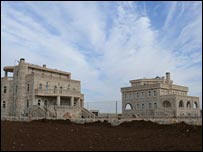
The program started with a beautiful, strong, rewarding and moving report regarding the town’s history, environment and architecture. Kerburan was beautifully surrounded with valleys and bodies of water, known for its figs, melons and grapes. Indeed my maternal grandmother’s father had one of the biggest vineyards. The town was also famous for its water, said to cure among other ailments, rheumatism. A town thousands of years old, is now empty of its original inhabitants, totally empty of Assyrians, also called Syriacs and Chaldeans.
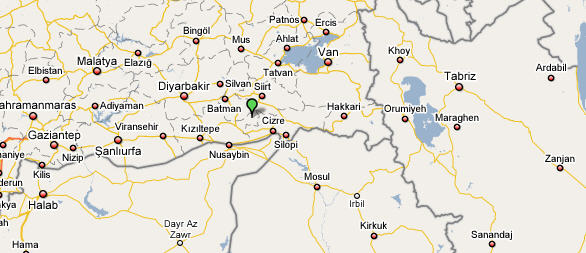 |
The green dot shows the approximate location of the town of Kerburon in southeast Turkey, the Tur-Abdin portion of the Assyrian territories in Mesopotamia. |
The TV studio was filled with faces I recognised, both from my childhood trips to Västerås, where a large portion of those from Kerburon live and from West Germany, where we, as children eventually joined our parents and had several neighbours who also came from the town of Kerburon
Josef Özer, who competed in the Swedish Eurovision Song Contest two years ago, has his origins in Kerburon too and has performed a song on the show which he dedicated to Kerburon
One of the program directors for Dore u yawmotho, Denho Özmen, is a resident of Södertälje. He is also the chairman for the educational society of Edessa. A few years ago I was employed by the society as one of two travel leaders for a group of youngsters from Sweden who wanted to learn about their roots. One of the youngsters was from Kerburon and we travelled there together. We first travelled to her family’s former home and later to my maternal grandmother’s as well as others we knew. All of the houses were now occupied by Kurds. Most of them treated us with respect, we were ‘children of Kerburon’ but some of them were cold and skeptical; were we there to try and take back our land?
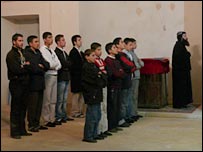
The biggest tragedy however, was the two churches, for both these holy buildings which had earlier been filled with happiness, love and wise words, were now used as stables. I can remember even today how the tears fell at seeing them.
When we were about to leave a group of curious Kurdish children gathered around us. The girl who originally came from Kerburon spoke a little Kurdish and could communicate with them. This made the children very happy, as we were exotic tourists, another culture, and another religion, on a trip in their hometown. She hugged them, gave out sweets and answered their questions politely.
The other members of the group had returned to the bus and the girl from Kerburon and I were the last to get on. Just as I was about to close the door to the bus a woman took my hand.
“I’m one of you”, she said with a lump in her throat. She was dressed as the other women, she looked like them, but she spoke our language.
When she was fourteen years old she had been kidnapped and forced to convert to Islam. She wanted to touch our hands, hold us and asked us to talk about her to her relatives in other parts of southeast Turkey. Kerburon wasn’t totally cleaned out; there was one of us still remaining, one who had been kidnapped, forced to covert her religion and marry one of theirs.
It was difficult not to feel anger when I, on Sunday’s program heard how everyone from Kerburon had suffered at the hands of their Moslem neighbours. I ignored the feelings and let sense take over, so that I could learn more about the fantastic historical town which my maternal grandmother was born in, where I, as a child, was taken to by my mother’s cousin, Mehbuba.
But then the feelings returned in the form of irritation. Denho Özmen asked Cemil Demir, also from Södertälje, why the Christians didn’t remain: “Why did they give up?”
“Due to the murders, one after another was killed. The last murder, that which became the final nail in the coffin, took place in 1978”, answered Demir.
I asked my parents if it was true, that I remember a memorial service for Endrawus Demir in Ronna. They answered that it was true and that his murder terrified us even here in Sweden.
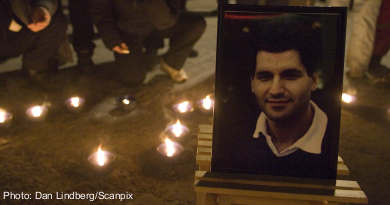
It is possible to send an SMS to Suryoyo TV, which is then shown in a bar at the bottom of the screen. Fuat Deniz, a relative of Endrawus Demir, murdered in Örebro a month ago, was also from Kerburon and many honour his memory. He was also mentioned in the program as one of the most well known exiles from Kerburon. It is difficult to hold back tears.
Singer Tomas Demir interrupted me in my dark thoughts. He is a divine singer and can make one forget their thoughts and immerse themselves in the music.
A very rewarding and important program finished with both program leaders and guests urging the older generation from Kerburon to teach the town’s history, culture and traditions for the next generation.
 Nuri Kino is an accomplished investigative journalist and film-maker, and Zinda Magazine's Person of the Year in 2006. Nuri Kino is an accomplished investigative journalist and film-maker, and Zinda Magazine's Person of the Year in 2006.
Sinan Antoon
Stan Shabaz
Washington D.C.
The novelist and poet, Sinan Antoon [1] recently visited Washington, D.C. to discuss his novel, “I’jaam: An Iraqi Rhapsody”. This highly acclaimed novel revolves around a fictional manuscript found in the files of an Iraqi prison. The genre of the “found” manuscript has a notable history in modern Near Eastern literature. Some examples include Ameen Rihani’s “The Book of Khalid” as well as Mikhail Naimy’s novels “The Book of Mirdad” and “Memoirs of a Vagrant Soul”. In “The Book of Khalid” the fictional manuscript which formed the basis of that book was “discovered” in the Khedivial Library of Cairo. In “Memoirs of a Vagrant Soul” the manuscript in question was a notebook found in a Syrian coffeehouse, while “The Book of Mirdad” was based around a manuscript discovered in a fictitious mountain-top monastery.
In the case of Antoon’s “I’jaam” the manuscript which forms the basis of the novel was said to be found in the files of the General Security Headquarters in Baghdad. It was written by a fictitious prisoner named Furat. It contains the thoughts and recollections of Furat, which he wrote while he was held prisoner during the late 1980s. It was written without any dots, in an attempt to make it less readable to his captors. Hence when it is discovered, the security official in charge sends it to a subordinate to render it legible. The novel is thus presented as this subordinate’s rendering of the manuscript.
Furat’s manuscript contains his recollections of his carefree pre-incarceration life as well as details of some of the gorier aspects of his captivity. Both past and present are woven together in a seamless way, incorporating remembrances of love and joy along with descriptions of torture and pain. Mixed in for good measure are hallucinations and nightmares produced by long periods of isolation interspersed with brutal interrogation sessions.
The manuscript describes the two most important people in Furat’s life: his grandmother and his girlfriend Areej. His grandmother, a devoutly religious woman, would go to church to pray everyday:
The history of the country lumbered forward while my grandmother attended church. When King Ghazi was killed, she was in Our Lady of Sorrows—because my grandfather’s house was in the Christian quarter at that time—and during the movement of Rashid ‘Ali al-Gaylani she was in Sacred Heart, and when the Ba’thists took power she was in Karradat Maryam. I used to tell her that she should go to church once a week on Sundays, like everyone else, and not every day. But the seven weekly meetings continued, leaving a clear mark in her white hair and weak constitution. [2]
In addition to being deeply religious, his grandmother was also very proud of her ancestry:
My grandmother always took pride in our Chaldean origins, and would get angry when I would try to convince her that, culturally, we were Arabs—or Arabized, at least, and not a separate ethnicity like the Armenians or Assyrians. Or when I would say that all that is left of Chaldea is the language used in Mass—the one she speaks with relatives of her generation or with me when she is angry—and even that is dying out. She would always refuse to discuss the subject and accuse me of abandoning my heritage.
“Shut your mouth! Now you’re not making any sense! How can you forget your roots?” [3]
Many readers would take issue with some of these ideas of Furat, but we should remember that Furat was someone who always spoke his mind, sometimes without thinking things through. Even his grandmother had to rebuke him here. In contrast to Furat’s youthful arrogance, the wisdom of his aged grandmother shines through in her simple admonition: “How can you forget your roots?”
She would also critique his skeptical view of religion:
‘Why don’t you come with me to church? Maybe God will enlighten you.’
‘I don’t want to be enlightened, bibi. I’m looking forward to hell. Leave me alone, please.” [4]
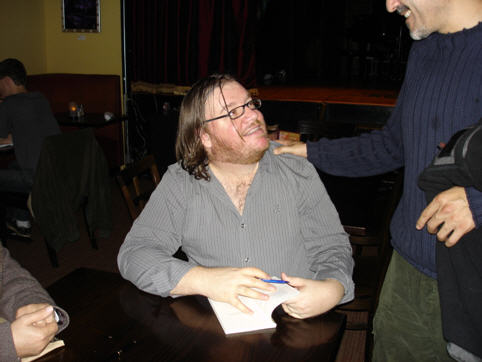 |
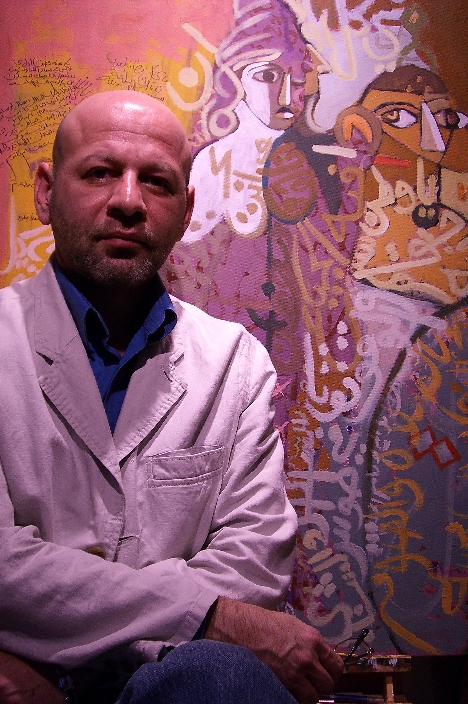
Novelist Sinan Antoon signing his latest book in Washington, D.C. (photo by Stan Shabaz) |
When a Ba’thi youth came to her home asking if there were Party members in her household she replied “I’m an old woman. […] do you mean to tell me that I should spend my last years going to meetings?” When the Ba’thi teenager said “Auntie, your people need to put a brick in this country’s edifice”, the grandmother aptly replies: “We’ve been in this country for thousands of years. Why should we have to put up a brick?” [5]
Furat’s grandmother was proud of her ancestry, her people, and her Christian faith. She lived a long life and learned much which she tried to impart to her headstrong grandson. She worried about him, for she knew he could be very stubborn and very outspoken on matters political. Her views on politics are best summarized in the following sentiment she expressed to Furat: “You think whoever comes next will be any better? These people need to be ruled with an iron hand.” [6]
Furat’s girlfriend, Areej, is the other major person in his life. She is a very sympathetic character. Their budding courtship and romance is told in fragments throughout the manuscript. Furat would always indulge Areej with his jokes making fun of the Party and the “great Leader”. He trusts her completely, and that somewhat disturbs her. In an effort to dissuade him from his impertinence she would tell him: “Be careful not to trust me too much. I am trouble.” [7] She felt that he was too outspoken for his own good. Areej, much like Furat’s grandmother, felt that his bluntness, stubbornness and irreverent attitude would one day get him into trouble. Well, eventually he did say the wrong thing to the wrong person, though he never does quite figure out what exactly he did wrong. Whatever the offending action or remark, it was enough to lead him to the General Security Headquarters where he is left to rot. The monotony and isolation of his imprisonment relieved only when he is given paper and pen to write with by a (sympathetic?) guard. It is through these writings that we are given a glimpse into Furat’s life: his thoughts, his memories, his dreams as well as his nightmares. “I’jaam” is an extremely well written and captivating book and I highly recommend it to anyone interested in the modern literature of the region.
The Baghdad Blues
Antoon is also the author of a book of poetry, “The Baghdad Blues”. It is a book of war poetry reminiscent of the war-literature of the World War I era. These poems reveal the horrors and tragedies unleashed by wars and sanctions of unimagined scope and brutality. The poems in this book are full of imageries of death and devastation. Take for example this extract from “When I was torn by war”:
I took a brush
Immersed in death
And drew a window
On war’s wall
I opened it
Searching
For something
But
I saw another war
And a mother
Weaving a shroud
For the dead man
Still in her womb [8]
A similar tone is also exhibited in this extract from “Wrinkles; on the Wind’s Forehead”
The child plays
In time’s garden
But war calls upon her
From inside:
Come on in!
The grave is a mirror
Into which the child looks
And dreams:
When will I grow up
And be like my father
….
Dead
The Tigris and Euphrates
Are two strings
In death’s lute
And we are songs
Or fingers strumming [9]
Yet even in this book of war poetry Antoon is still able to include some poems about love. For example in “Delving” he writes:
The sea is a lexicon
Of blueness
Assiduously read
By the sun
Your body, too
Is a lexicon
Of my desires
Its first letter will take a lifetime! [10]
It is noteworthy that in both books Antoon includes narratives and imageries of love, mixed in with the horrors of torture, imprisonment and war. I don’t think this is just a coincidence, for even in the darkest of circumstances, love is the eternal symbol of hope and life. And what our people need now, more than ever, is hope.
Notes
- Sinan Antoon is a poet, novelist and translator. He studied English literature at Baghdad University. He was co-producer of the 2003 documentary film “About Baghdad” and is contributing editor to Banipal magazine. He currently teaches Arabic literature and culture at New York University. Most recently he has contributed an essay on the work of poet Mahmoud Darwish in the newly published anthology “Mahmoud Darwish, Exile’s Poet: Critical Essays” edited by Hala Khamis Nassar and Najat Rahman.
- Antoon, Sinan. I’jaam: An Iraqi Rhapsody. San Francisco: City Lights Books, 2007, Sinan Antoon, pg. 76-77.
- Ibid. pg. 52.
- Ibid. pg. 51.
- Ibid. pg. 52.
- Ibid. pg. 77.
- Ibid. pg. 86.
- “When I was Torn by War” in “The Baghdad Blues”, pg 7.
- “Wrinkles; on the wind’s forehead” in “The Baghdad Blues”, pg. 26-27.
- “Delving” in “The Baghdad Blues”, pg. 13
A Genuine Consent to Pride
Shamirum Benjamin
Chicago
With every day of every month of every year of my life until this very moment, I have been learning. I may not remember everything I’ve “learned,” but knowledge does grow, and it grows within me. When I was quite young, I adored learning about my people’s history. With a name like “Shamirum,” and countless children and adults mispronouncing it and asking its meaning (not to mention mocking it), you will become prone to wanting to know the story behind the name. With parents like mine, you will have no choice but to know this story from beginning to end. And, due to my own inquisitiveness (which is natural to most children), at probably four years old, I learned the derivation of my given name. Through knowledge of my name came knowledge of my own origins: that of my parents and that of my ancestors; that of every single person, on this planet, who has ever been so blessed and so cursed to have been called “Assyrian.”
At five or six, I opened a book that described historical and geographical details of the Assyrian Empire; it included a map of the extensive reaches of the once powerful state. I had already been exposed to current maps of the world and I looked at the old maps and instinctively compared, present to past, and I cried. I cried, like a child who too quickly realized that dreams and reality are not one in the same, for a legend, for a people who were once great and shone like stars, and for the story of how they lost it all and plummeted toward darkness, a moonless sky. This was not the first sad story I had heard at that age, no, but it was the first one that belonged to me, was about me. I mourned a loss that I did not at that time understand, and still do not completely understand, but that I felt and continue to feel. This feeling only grows stronger and it heavies my already burdened heart. I feel that loss and all other Assyrian losses with every fiber of my being; I feel these losses as if they are traveling along with the blood in my veins. I was born with heartache for my people and I will die with it.
As a young girl embarking on her teenage years, I rebelled against the nationalism that was probably engrained in my DNA, because I began to feel uncomfortable with it; I felt guilt. I denied my pride because I began to see it as an insult to the rest of the human race. I considered myself a “citizen of the world,” a human being no better and no worse than any other human being. I still consider myself as such today, but since then, I have fortunately come to the realization that pride for your heritage and people doesn’t necessarily equate to an egotistical frame of mind. I am no longer rebelling or in denial, because I learned that true Assyrian pride equals true Assyrian love.
Is it wrong to love one human being more than another? Is it wrong of me to love my Assyrian brothers and sisters more than all of my other human relatives around the globe? I don’t think so. It’s natural to love your immediate family more than your distant family. No one, without being a hypocrite, could tell you that loving your sister more than your distant cousin (whom you’ve never met by the way) is a sin. We all have this amazingly human ability to love some more than others, and it’s actually a part of what has helped us survive on this planet for as long as we have. I’m not a goddess, I’m not all-encompassing and all-knowing, and so I am not equal and complete with my love, as might be expected of a god. My people encompass me most and I know them the best, those are facts I can’t and no longer wish to ignore. I eventually defied the once-enjoyed oblivion I had toward my own people, and so I don’t feel the need to justify, to myself, why I love them more.
I believe that love is unending and that it can never be depleted. But, in tune with my previous analogy: Assyrians are my immediate family and the rest of the world’s people are my distant cousins, while I love them all, Assyrians are my people in a way others are not, and so they are my responsibility. I must essentially love them completely, flaws and all, to feel such an obligation toward helping them. I will always value, and subsequently love, every person in this world, good or evil, ugly or beautiful, friend or foe, but I am not accountable to all of them, I simply can’t be without having some sort of hidden reserve of supernatural power (and we already talked about how I’m not a god). So, who holds me most accountable? The very same people who share my history, who have suffered my pain as I have suffered theirs, they all hold me accountable. I could not call myself an Assyrian without them; my identity would be meaningless and with no true anchor in this world. I am only Assyrian because they are Assyrian, too. Who else would recognize me and accept me as such? Only them. Only those who are proud enough to share this beautiful and glowing name with me: my beloved Assyrians.
With honest and sincere pride comes a love that is true and straight, and with love comes hope, but hope is not infinite and everlasting like love. Hope is dependent, and it survives only through perseverance, through our insistence that it continues to exist. Hope for our people, quite literally, depends on me and you. When I realized that hope was somehow born within me, and that I can keep it alive through my words and actions, I finally encountered a pride that was guiltless. I seized the happiness that comes from shamelessly cherishing your culture and heritage. It’s my heritage after all, and once I fully accepted it, nothing could break the pride that came with it, not even my own thinking and previous doubts, not even the voice that used to tell me that having pride was egocentric and arrogant … because that voice no longer speaks. Upon my shoulders I carry the weight of debt and duty for my Assyrian family, and it has stifled the sound of any insecurity that came with my young pride. Like mothers and fathers who will protect their children from harm, who will sacrifice themselves for their progeny before sacrificing themselves for others, my nation is my progeny, it is my family, it is my blood. Without defending it and caring for it, I myself can not live as who I claim to be, I lose the privilege that comes with my name. Consenting to my own pride was like me ultimately giving myself permission to love … me. When I nurture my people, I inevitably nurture myself, and that has to be one of the most beautifully selfish and, at the same time, unequivocally selfless things one can do.
Is Iraqi Kurdistan a Good Ally?
Michael Rubin
American Enterprise Institute
Washington, DC
On a strictly emotional level, U.S. support for Iraqi Kurdistan makes sense.[1] In the wake of World War I, the Kurds missed their opportunity for statehood when other peoples gained their independence. Today, they remain the largest ethnic group without a country. They have suffered greatly at the hands of others. But while Iraqi Kurdistan has come far, the unreliability of its leadership makes any long-term U.S.-Kurdish alliance unwise. Rather than become a beacon for democracy, the current Iraqi Kurdish leadership appears intent on replicating more autocratic models. Rather than become a regional Nelson Mandela, Iraqi Kurdish president Masud Barzani now charts a course to become a new Yasser Arafat. Despite lofty rhetoric about its suitability as an ally, Iraqi Kurdistan's actions suggest that it is far from trustworthy.
Iraqi Kurdistan has been, perhaps, the greatest beneficiary of Iraq's liberation. Today, Iraqi Kurds enjoy the country's highest living standard, level of foreign investment, and security. International isolation has ended. European air carriers bring travelers and even tourists from Munich and Vienna directly to Sulaymaniyah and Erbil. Multinational troops enjoy rest and relaxation in Duhok hotels and Dokan resorts. Oil executives from the United States and Europe jostle for Kurdish attention. Peter Galbraith, a Clinton-era ambassador retained by the Kurdistan Democratic Party (KDP) and the Patriotic Union of Kurdistan (PUK) to lobby on their behalf, even suggests constructing a U.S. military base in the region.[2]
Just five years ago, the situation was far different. While Iraqi Kurds have enjoyed de facto autonomy since 1991, uncertainty overshadowed their daily life. Among Iraqi Kurds, confidence was low that the United States or the United Nations (UN) would do more than condemn Baghdad or ratchet up sanctions should the Iraqi army move north. In 1975, Secretary of State Henry Kissinger sacrificed Iraqi Kurds to a realpolitik deal with Baghdad, already dominated by then-deputy president Saddam Hussein. The international community remained largely silent when the Iraqi government used chemical weapons to massacre Kurdish civilians in 1988. U.S. forces did little when Saddam ordered the Republican Guard to occupy Erbil in 1996. While the Clinton administration condemned the move, both allies and adversaries alike saw how muted the U.S. response was, even as the Guard detained, lined up, and summarily executed Iraqi oppositionists working with Washington. In 2000, Iraqi forces suffered little consequence when they crossed the thirty-sixth parallel to probe Kurdish defenses around the village of Baadre.[3]
Western states and international human rights organizations largely ignored the only relatively free area of Iraq as it suffered not only under UN sanctions but also under a separate embargo imposed by Saddam's regime in Baghdad, which UN Secretary General Boutros Boutros-Ghali empowered to allocate food and medicine to Iraqi Kurdistan under the UN Oil-for-Food Programme.[4] As late as 2001, the State Department maintained that it was illegal for U.S. citizens to travel to Iraqi Kurdistan on U.S. passports under terms of U.S. and UN sanctions.
Iraqi Kurdistan's Opportunity
The March 1, 2003, Turkish decision not to participate in Operation Iraqi Freedom gave the Kurdistan Regional Government (KRG) an unexpected strategic boost. While U.S. Special Forces and intelligence had partnered with the Kurdish peshmerga militia and the Kurdish political leadership in the months prior to the outbreak of hostilities, U.S. military planners had envisioned a far more robust partnership with Turkey. In February 2003, U.S. and Turkish diplomats and military officials hammered out an extensive memorandum of understanding outlining U.S.-Turkish cooperation in Iraq. So convinced were Iraqi Kurdish officials that the Turkish relationship with Washington would take precedence over their own concerns that they scrambled not to prevent Turkish involvement but to win an agreement that, first, the Pentagon would limit the Turkish presence in Iraq to certain supply corridors in northern Iraq, and, second, that any more substantive Turkish contingent would operate only in areas south or east of Tikrit--areas of operation that Erbil deemed to limit Turkish influence in the disputed city of Kirkuk.
 |
The Turkish parliament's refusal to join the U.S.-led coalition certainly undercut Turkish strategic leverage and bolstered the strategic importance of Iraqi Kurdish forces to U.S. goals. Rather than transit Turkey, U.S. forces parachuted into the Harir airfield, north of Erbil. The peshmerga may have done more looting than fighting in the first weeks of the war, but, symbolically, their participation cemented an enhanced relationship with a skeptical U.S. Central Command, more accustomed to the worldview of Arab leaders and their relatives among the general staffs than to Kurdish concerns. Romanticism also bolstered the U.S.-Kurdish relationship. It was hard for many in the U.S. military not to be sympathetic to the Iraqi Kurds: many had their first experience with Iraqi Kurds in 1991 when they helped stem mass migration and mass starvation with Operation Provide Comfort. Returning twelve years later, they found the region transformed, despite many obstacles, because of Kurdish leadership.
Local Kurdish culture also facilitated a relationship with the United States. Both Turkish diplomats and military officers often stand on ceremony, and rigid adherence to protocol undercuts rather than facilitates their relations.[5] Few American diplomats like their Turkish interlocutors. The Iraqi Kurds, in contrast, shower visiting U.S. officials with hospitality, arranging lavish banquets and, in a few cases, even facilitating liaisons with women. The KDP puts U.S. officials in its own guesthouse and offers both military and State Department officials gifts ranging from silk carpets to gold jewelry. While most U.S. officials refuse to take such gifts, during the Coalition Provisional Authority period, some U.S. civilian officials and military officers accepted them.
Also enhancing Kurdish influence in Washington has been the KRG's hiring of former U.S. military and political officials to represent them. The Kurdish leadership, for example, engaged a lobbying firm run by Robert D. Blackwill, a former deputy national security adviser, to represent Kurdish interests in Washington and to arrange meetings with administration officials.[6] Harry Schute, former commander of the 404th Civil Affairs Battalion stationed in Erbil, resigned his military commission to become a paid consultant to Kurdistan prime minister Nechervan Barzani. Both General Jay Garner (Ret.) and Colonel Dick Naab (Ret.), who led the postwar civilian administrations in Baghdad and Erbil, respectively, have returned to Iraqi Kurdistan in pursuit of contracts. Qubad Talabani, the son of the PUK leader, asked Kurds and friends of Iraqi Kurds to donate to the election campaigns of U.S. congressmen sympathetic to Kurdish independence.
The Kurdish participation alongside U.S. troops in Iraq's liberation, especially in contrast to Turkish actions, has led the Iraqi Kurdish leadership to express a sense of entitlement. In response to a 2003 interview question about what rewards Iraqi Kurds expected from their support of U.S. aims, Masud Barzani said, "Our basic demand from the United States and Britain . . . is support for our struggle to achieve our national rights."[7] In a 2005 essay making the same argument, Barzani pointed out, "After the U.S. armed forces, our peshmerga was the second-largest member of the coalition."[8]
A Beacon for Democracy?
The Bush Doctrine makes an alliance with Iraqi Kurdistan seem natural. Transformative diplomacy and democratization have been at the forefront, at least rhetorically, of White House policy. Here, Iraqi Kurdistan might seem a model. Two years before Saddam's fall, Carole O'Leary, a scholar in residence at the American University Center for Global Peace, described Iraqi Kurdistan as a "crucible for democracy and a model for post-Saddam Iraq."[9] Sverker Oredsson and Olle Schmidt, respectively a Lund University historian and a Swedish politician, called the Iraqi Kurdistan region "a Democratic beacon in the Middle East."[10] In 2006, the KRG-run Kurdistan Development Corporation aired television advertisements in the United States describing Iraqi Kurdistan as a "practicing democracy for over a decade."[11] While an exaggeration--neither the KDP nor the PUK allow any serious electoral challenge--relative to Saddam's rule in the rest of the country, the three provinces controlled by Masud Barzani and PUK leader Jalal Talabani were far freer.
But neither Barzani nor Talabani are democrats. During the 1994-97 intra-Kurdish civil war, both Kurdish leaders grossly violated human rights: opponents disappeared and Barzani and Talabani ordered the summary execution of prisoners. Today, Iraqi Kurdish activists in territories controlled by both political leaders estimate that three thousand Kurdish prisoners remain unaccounted for,[12] but regional human rights organizations say that the political leadership bans any advocacy on behalf of the missing families. During Saddam's 2006 trial, many Kurdish intellectuals in the region's universities and cafes noted with irony that the Iraqi Kurdish leadership had committed many of the same crimes--albeit without the scale or the use of chemicals--for which Saddam was tried.
Iraq has changed, but Iraqi Kurdistan has not. After Saddam's fall, many Iraqi Kurds expected that their region would liberalize and democratize. Rather than reform, however, regional politics have ossified. Barzani retains dictatorial control over the Duhok and Erbil governorates, and Talabani likewise dominates Sulaymaniyah. While it is inaccurate to describe the Kurdish leadership--at least the PUK half--as tribal, both parties rely on family members for control. Barzani appointed his nephew prime minister and assigned his thirty-five-year-old son to run the local intelligence service. Other relatives control the regional telephone company, newspapers, and media.
Talabani's wife, Hero Khan, likewise, runs the local satellite station. One son manages the PUK's intelligence operation, while the other represents the KRG in Washington. When it came time to divvy up ministerial portfolios in Baghdad, both Kurdish leaders turned to their families: Barzani gave his uncle the Foreign Ministry portfolio, while Talabani gave one brother-in-law the Ministry of Water Resources and his wife's brother-in-law the ambassadorship to China. To Talabani's credit, both men are professionally qualified.
Anti-Americanism has taken hold within Iraqi Kurdistan. Not recognizing it now and taking measures to correct it will negatively impact U.S. strategic opportunities down the line. |
Both Barzani and Talabani control holding companies, some attached to relatives and others to their political parties. Talabani, in his capacity as PUK head, has transferred government land to relatives to develop at a profit. In one ongoing case, he has used Nokan, his party's business conglomerate, as the intermediary to evict refugees from land his party wishes to develop for the patronage of its members. Because both the KDP and the PUK control judicial appointments, refugees and ordinary citizens without high-level contacts lack any real recourse for appeal. During routine prison visits, independent human rights monitors have discovered businessmen imprisoned without charge who say they were imprisoned on the order of one of Barzani's sons after spurning silent partnerships with Barzani family businessmen.
While in office, both Barzani and Talabani have amassed fortunes in excess of $2 billion and $400 million, respectively.[13] Whereas the Kurdish political leadership once squabbled over custom posts' revenue, today they conflate the regional treasury with party slush funds and personal pocketbooks. There is, in practice, little differentiation between the property of Barzani and Talabani as individuals and the holdings of their political parties and the KRG as a whole. Barzani transformed a public resort on Sari Rash into a personal compound, and his family members and ministers have built palatial houses on nearby public land.
Recent oil negotiations demonstrate the continued blurring of the Kurdish political and commercial spheres. To win oil exploration concessions and development contracts in Erbil and Duhok, companies must partner silently with a Barzani-appointed associate. Several officials close to various oil negotiations say Barzani's associates have requested that up to 10 percent of future revenue go to Barzani personally and an equal amount to Barzani's political party. The KRG's public treasury is a secondary concern, even if the oil, in theory, is a resource for the entire Kurdistan region, if not Iraq. Such conflicts of interest are not new. Documents seized after Saddam's fall discuss business dealings between Nechervan Barzani and Saddam's sons. Corruption increasingly filters downward. According to a local nongovernmental organization (NGO) in Halabja, in 2006, a suspicious fire destroyed the archives of the PUK's teachers' union after an audit was ordered concerning embezzlement of union funds. However, many Iraqi Kurds say they had hoped the U.S. presence would catalyze reform, transparency, and accountability.
Mechanisms of Control
Political control runs deep. In the case of a victim learning from his tormentor, both parties have replicated Baath Party mechanisms of control. Both the KDP and the PUK deputize representatives not only to college classes but also to high schools. In some cases, these student representatives who act as political commissars are fourteen- and fifteen-year-olds: they compile reports about both classroom and private discussions, which KDP and PUK intelligence collate. The intelligence apparatus runs deep, and torture is common.[14] Both Kurdish parties model themselves after the Baath Party. While neither party adheres to its founding ideologies (few PUK Politburo members, for example, take seriously the beliefs of the Socialist International, even though the PUK is a member organization), ambitious members still get ahead by informing on colleagues. Kurds treat foreigners well, but regard them with suspicion: taxi drivers stationed outside Sulaymaniyah hotels report to PUK intelligence. The KDP often houses foreigners in its Salahuddin guesthouse. While comfortable, the arrangement forces them to rely on party drivers (ordinary taxi drivers cannot approach the facility). KDP intelligence will often order taxi drivers not to transport Westerners who have not secured permission from the KDP intelligence chief to move between towns.
Staff in the leading Erbil, Duhok, and Sulaymaniyah hotels must be party members; many are affiliated with intelligence services and compile dossiers on guests and those with whom they meet. Duhok University has installed keystroke tracking software on computers used by foreign staff; it is likely that other regional colleges and universities do so as well.
The consequences of not towing the party line run deep: students who speak critically against either party or its leadership are blacklisted for employment and educational opportunities. At Salahuddin University, for example, students who have superior grades but are not affiliated with the KDP may see themselves disqualified from valedictorian status.
Barzani and Talabani enjoy other mechanisms of control. The peshmerga--literally, those who face death--serve less as an army for Iraqi Kurdistan than as a militia to enforce the wishes of the political party leaders. Tellingly, despite the nominal unification between the two Kurdish leaders' administrations, both parties' security services and militias remain distinct. Travelers arriving in Kuysanjaq, the first major town in PUK territory after leaving KDP territory, are questioned by PUK peshmerga and, on occasion, its intelligence service as well.
Peshmerga members are often above the law. In one recent case, a KDP peshmerga member shot a police officer during a routine traffic stop. The suspect's colleagues removed him from police custody in order to prevent the prosecutor's attempts to pursue charges against him.[15]
There are no checks and balances. Press freedom in Iraqi Kurdistan is in decline, even as it expands in non-Kurdish regions. Talabani's wife uses her control of both the local satellite station and a local magazine to target critics.
Although there are two independent newspapers in Iraqi Kurdistan--Awene and Hawlati--they are increasingly constrained. Both parties use their control over law courts to intimidate, bankrupt, and even imprison journalists who criticize ruling parties and officials. The PUK, for example, prosecuted Hawlati editors after the paper accused the PUK prime minister of abuse of power.[16] Nechervan Barzani's office has even threatened frivolous lawsuits against foreign writers and analysts who fail to adhere to his party's line.
Those who refuse to be co-opted or at least be silent face the Kurdish security services. In October 2006, the KDP's secret service abducted Austrian-Kurdish journalist Kamal Said Qadir after he wrote articles questioning corruption within the ruling Barzani clan and published documents demonstrating links between Mulla Mustafa Barzani--an important nationalist leader and Masud Barzani's father--and the Soviet KGB.[17] After a fifteen-minute trial, the KDP judge sentenced Kamal to thirty years in prison--a sentence commuted only after a campaign by international NGOs and condemnation from the State Department.[18]
The Kurdish administrations appear determined to retain tight political control over the press. Iraqi Kurdish law remains based on Iraqi law. Article 433 of the Iraqi Criminal Code--enacted by the Baath Party--equates almost all criticism with criminal defamation. Local journalist unions that have sought to change this artifact have faced Barzani's ire. On December 20, 2007, Barzani told the Kurdistan parliament to reconsider legislation that would overturn the Baath-era press law and legalize criticism of his government.[19]
Nor are NGOs an independent check. Most Kurdish NGOs operate under the patronage of the Kurdish political leadership. Kurdistan Save the Children, for example, relies upon the patronage of Talabani's wife and largely operates to further party aims. Foreign aid workers say that both the KDP and the PUK have insisted that they hire party members if they wish to operate in coordination with the local government. When independent Kurdish employees operating with the U.S. Agency for International Development refused to obey PUK instructions, PUK security officials filed reports about them and alleged security concerns with agency administrators, who promptly fired the independents and hired PUK apparatchiks. With very few exceptions, local human rights organizations--and a government-controlled Ministry of Human Rights--focus on atrocities committed against Kurds by Saddam's regime, rather than abuses by the current political leadership.
As the distance between the Kurdish leadership and the people they claim to represent grows deeper, antagonism grows. Many Kurds feel helpless. There is no accountability, even when the government makes such arrogant decisions as to provide twenty-four-hour electricity to light up the grave of Ibrahim Ahmad, Talabani's father-in-law, while cutting electricity to Kurdish refugees. The PUK and the KDP's decision to run on the same election list in public and divvy up positions in private has effectively disenfranchised the local population. When the Kurdistan Islamic Union--the nonviolent Muslim Brotherhood affiliate--began to make inroads, KDP-sponsored youth mobs set party headquarters on fire in several towns and murdered the party chief in Duhok.[20]
Even after they arranged to avoid competition, both U.S. diplomats and the Independent Election Commission of Iraq fingered the KDP as committing the most flagrant election fraud in the entire country, using the peshmerga to block voters and party supervisors to stuff ballot boxes. The fraud was pointless, given that without it the party machinery and resources were such to guarantee victory, even if not on the scale of regional dictators like Hosni Mubarak or Bashar al-Assad.
Rationalizing Kurdish Behavior
Iraqi Kurdistan may not be the beacon for democracy that its representatives claim, but realists within the U.S. foreign policy establishment may argue that its practices toward its population are immaterial to U.S. interests, especially given the Kurdistan region's continued pro-Americanism.
Such a calculation is shortsighted. Because the U.S. government has subsidized both Kurdish leaders, Kurds generally associate their leaders' misbehavior with U.S. policy. Murmurs of discontent grow when Kurds attribute the abuses by their leaders to U.S. interests: in 2006, for example, when the U.S. government requested space for offices in Sulaymaniyah, Talabani evicted a technical college without advance notice, let alone due process, angering a broad swath of the population. Kurds also accuse U.S. officials of complicity in torture at what they suspect is a center for rendition at a Saddam-era facility between Tasluja and Paramagrun. While Kurdish officials trumpet their public's pro-American outlook, such an orientation is fading fast. Anti-Americanism has taken hold within Iraqi Kurdistan. Not recognizing it now and taking measures to correct it will negatively impact U.S. strategic opportunities down the line.
Perhaps U.S. strategists might forgive this if the Iraqi Kurds demonstrated that they would advance U.S. regional interests. Unfortunately, they have not. While Iraqi Kurdistan did allow U.S. forces to assemble and joined the drive southward in April 2003, filling the vacuum left by the collapsing Iraqi army, subsequent Kurdish behavior leaves large questions about the reliability of Iraqi Kurdistan as a U.S. ally.
Barzani has, in effect, replicated the late Palestinian chairman Yasser Arafat's strategy: he denies complicity in terrorism but nevertheless seeks to leverage it into diplomatic gain. |
During the first week in July 2003, an American military unit patrolling the mountains of northeastern Iraq approximately thirty miles from the Iranian border came across an unauthorized KDP checkpoint from which they confiscated a cache of Iranian passports and money. KDP officials had used the checkpoint to facilitate Iranian infiltration--allowing Iranian operatives to swap Iranian passports for local Kurdish identity papers--in exchange for cash. Kurdish officials privately acknowledge that this case was not unique. At the beginning of the Iraqi insurgency in April 2004, Iraqi Kurdistan became a transit point for Ansar al-Sunna: its members entered Iraqi Kurdistan from Iran and received safe passage to Mosul in exchange for an agreement not to conduct operations in the three northern governorates--and perhaps payment as well.
Kurdish double dealing with Iran continues to the present. On January 11, 2007, and on September 20, 2007, U.S. forces raided facilities in Erbil and Sulaymaniyah, detaining six Iranian intelligence operatives. In each case, Kurdish officials protested the arrests. After the first episode, Barzani's office released a statement saying, "It is better to inform the Kurdistan government before taking actions against anybody;"[21] in the later case, the KRG called the arrest "illegitimate" and said that "actions like these serve no one."[22] The decision not to warn the Kurdish authorities was not diplomatic ineptitude but was the result of experience--U.S. policymakers no longer trust Iraqi Kurdish authorities not to reveal sensitive, operational information. Whether the Kurdish leadership or their subordinates in the peshmerga and security services do this to ingratiate themselves to regional powers or for reasons of personal enrichment is immaterial. The Kurdish authorities' subsequent refusal--both on the part of the KRG and Hoshyar Zebari, Iraq's foreign minister and both Barzani's uncle and appointee--to supply U.S. officials with a diplomatic list undercut the Multinational Forces' confidence in the Kurdish leadership. Such a list, over which there is no reason for secrecy, would enable U.S. authorities to determine diplomatic status prior to operations. The Kurdish refusal demonstrates unwillingness to assist U.S. efforts to counter Iranian Revolutionary Guard Corps infiltration.
Playing the Terror Card
Barzani's antagonism to Turkey also undercuts any possibility of a U.S. alliance. Many Kurdish officials look at U.S.-Turkish relations as a zero-sum game: either Washington pursues friendship with Erbil or allies itself with Ankara. Most Kurdish officials do not understand that the two relationships need not be mutually exclusive. Too often, Kurdish authorities tell visiting American officials that Iraqi Kurdistan would be a much better ally than Turkey. They understand neither the breadth of the U.S.-Turkish relationship nor how poorly received are Kurdish demands that Washington filter its alliances through the interests of any other state. Both Saudi Arabia and Israel, for example, may wish that Washington would scale back its relations with the other, but both accept that this will not happen. Barzani has no such sophistication and appears intent on forcing the White House to choose between Ankara and Erbil. Should it do so, the Iraqi Kurdish leadership will be disappointed.
There is absolutely no reason why Barzani should not advocate for Iraqi Kurdish interests, but his rhetoric often devolves into threats. In December 2005, for example, he declared that if the oil-rich city of Kirkuk did not join his administration by December 2007, he might spark civil war throughout Iraq.[23] Then, in April 2007, he threatened to sponsor insurgency in Turkey if Ankara did not comply with his demands over Kirkuk.[24] Media controlled by his party engages in the same types of incitement against Turkey that Palestinian media does against Israel. Maps sold in the shadow of the KRG parliament show a greater Kurdistan region stretching well into Turkey. Kurdish newspapers refer to Iraqi Kurdistan as South Kurdistan, implicitly laying claim to southeastern Turkey as North Kurdistan. Much as occurred with the Palestinian Authority, it is this tendency to exert populist claims across borders that makes Iraqi Kurdistan a force for instability, not an anchor for security.
It is in this context that Barzani's relations with the Kurdistan Workers Party (PKK) become so problematic. Barzani may be a nationalist, but he is also a realist. He dislikes a powerful PKK, not because its terrorism sullies the Kurdish nationalist cause but because it provides an alternative. Abdullah Öcalan, the group's leader, sought primacy over his Iraqi Kurdish competitors. "Barzani and Talabani are like feet or arms, but I am the main head or mind," Öcalan explained in a 1998 interview.[25] During the 1990s, both Barzani and Talabani ordered their respective peshmerga units to fight the PKK whenever they tried to establish a toehold in their territories. At the time, Barzani asked the Turkish government to subsidize his peshmerga and its fight against the terrorist group according to several Turkish diplomatic and intelligence officials. Barzani recognized that any PKK safe haven would be anathema to his interests and moved to prevent it. But with Öcalan in prison and the PKK no threat to his political supremacy, Barzani adopted the group to use as a lever against Turkey.
After the Turkish parliament's March 1, 2003, decision not to join the U.S.-led coalition against Saddam, Barzani grew overconfident in his assessment of Washington's friendship and took a hard line against Ankara. He welcomed PKK leaders to his territory--especially in the "triangle border" region of Iran, Iraq, and Turkey. While Barzani and KRG spokesmen have repeatedly promised to crack down, Barzani has, in effect, replicated the late Palestinian chairman Yasser Arafat's strategy: he denies complicity in terrorism but nevertheless seeks to leverage it into diplomatic gain.
He tells U.S. diplomats that the PKK threat would disappear if only Ankara offered greater concessions in terms of amnesty, broadcasting, and constitutional reforms, while at the same time encouraging PKK leaders to continue their attacks and, indeed, facilitating their terrorism.
Turkish authorities say they have photographs of senior PKK commanders receiving medical treatment in Erbil hospitals and meeting with Barzani allies in nearby restaurants. By selling food and supplies, Barzani turned a handsome profit, one to which family members involved in the trade have become addicted. Turkish officials suspect Barzani's son of selling weapons to the PKK. It is this knowledge that has forced Ankara to take such a hard line against Kurdistan and has convinced U.S. officials to support Ankara, even as Turkish warplanes bomb Iraqi Kurdish targets.
The Future of U.S.-Kurdish Relations
Iraqi Kurdistan is living in the past, coasting on a false reputation and insulated from reality by the praise of lobbyists and consultants. Both Talabani and Barzani have reason to be proud: throughout the late 1990s and prior to Saddam's overthrow, Iraqi Kurdistan was a success story, relatively democratic and thriving even under sanctions. Kurds might excuse their leaders' faults because of the larger crisis, but they had hope for the future.
The history of the Barzani family's relationship to the population it seeks to lead parallels the generational evolution of Saud rule in Saudi Arabia. Every generation grew more isolated and corrupt. |
Freed from the shadow of Saddam, however, Iraqi Kurdistan has slid backward. With the lifting of sanctions, corruption has grown rife. The history of the Barzani family's relationship to the population it seeks to lead parallels the generational evolution of Saud rule in Saudi Arabia: both Mullah Mustafa Barzani (1903-79) and King Abdul Aziz bin Saud (1876-1953) remained close to the tribal values of their society and were genuinely revered. Every generation, however, grew more isolated and corrupt.
While Barzani tells investors of his plans to transform the region into a new Dubai, he does not understand that his administration's corruption will retard such success. As the gap between the rich and poor increases, and as Barzani and Talabani use mechanisms of control to stifle dissent, Islamist parties will grow more popular--they have already made inroads, if not because of their religious views then because Kurds consider them the only "clean" alternative to the KDP and PUK's corruption. Many Kurds shy away from the Kurdistan Islamic Union's religious conservatism, but as the party becomes more popular, its heavy criticism of U.S. policy and its conspiracy theories about U.S. intentions will take deeper root.
Many Iraqi Kurdish officials and some U.S. commentators suggest that Iraqi Kurdistan could host a long-term U.S. military presence, which would enable U.S. forces to withdraw from the rest of Iraq, where they are less welcome. This may have once been an option, but Barzani's behavior has made it unwise. While a base in Iraqi Kurdistan might, on paper, appear to be a strategic asset for the Pentagon, in reality it would be a liability. Because Barzani enables--if not sponsors--PKK terrorism against Turkey, any U.S. presence would shield Iraqi Kurdistan from accountability. Barzani wants a U.S. base in his territory because it would immunize him from Turkish retaliation. Indeed, the establishment of any U.S. base in Iraqi Kurdistan, so long as Barzani remains in power, may lead to greater conflict. Barzani is not altruistic: hiding behind a permanent phalanx of U.S. troops would, in effect, grant him the immunity he wants. If the Pentagon were to establish a base in Iraqi Kurdistan, it must expect both the PKK problem and Barzani's provocation of neighboring states to increase. Barzani wants American forces stationed in his territory for the same reason Hamas and Fatah demand European monitors along Gaza's frontier with Israel, and Hezbollah embraces a UN Interim Force in Lebanon presence in southern Lebanon. Far from enabling a U.S. withdrawal, any base in Iraqi Kurdistan in the present circumstances guarantees an expansion of conflict. Regional dictators--especially those who refuse to divorce themselves from terrorism--make poor allies.
If Iraqi Kurdistan is to be a good ally, a force for stability, and a hedge against the corrosive ideologies of both Arab nationalism and Islamism, U.S. strategy must focus on long-term interests. Iraqi Kurdistan is strategically important. Federalism is the future of Iraq. While many pundits and, indeed, many Iraqis say they long for the return of the strongman, centralized model of government for Iraq, such a system never worked: Iraq was in a state of near-constant civil war between 1961 and 2003, as Iraqis resisted Baghdad's attempts to impose its dictatorial will. Strong leadership sounds good, but Iraq remains a country with one hundred prospective generals to each private.
Washington should take a zero tolerance approach to terrorism. Iraqi Kurdistan has made great strides--but Barzani risks everything Iraqi Kurds have gained by involving himself with the PKK. Both the KDP and the PUK have betrayed Washington's confidence in their dealings with Iran. While it is natural that both parties would have relations with their neighbors, selling information or facilitating infiltration is an unacceptable means of ingratiating themselves to a neighbor.
The responsibility of leadership is not optional. A responsible Iraqi Kurdish leadership would end incitement. Demagoguery may make good politics and may distract from issues of corruption and accountability that Barzani wishes to avoid, but incitement backfires. The Kurdish language broadcasts that the ruling parties control often inflame nationalist sentiment. By dedicating twenty-five minutes of a thirty-minute newscast to popular demands for independence--for example, interviewing school children and having them recite nationalist demands--Barzani brings himself and his region closer to conflict with his neighbors. The State Department ignored similar incitement in the early years of the Palestinian Authority only to have that entity disintegrate into chaos; it should not make the same mistake with what, for all practical purposes, is the Kurdistan Authority.
As Turkish warplanes bomb terrorist bases in Iraqi Kurdistan, it is time for both Washington and Erbil to reassess their policies. Washington has many cards to play. Sympathy to Kurdistan is understandable but is increasingly based on a myth. U.S. good will should never be an entitlement; Barzani may remain an ally, but he has disqualified himself from any substantive partnership. It is time to take a tough love approach to Iraqi Kurdistan. There should be no aid and no diplomatic legitimacy so long as Iraqi Kurdistan remains a PKK safe haven, sells U.S. security to the highest bidder, and leaves democratic reform stagnant.
Notes
-
For the best example of this argument, see Michael J. Totten, "No Friends But the Mountains," Azure 5768, no. 30 (Autumn 2007), available at www.azure.org.il/magazine/magazine.asp?id-407 (accessed January 2, 2008).
-
Peter W. Galbraith, "Iraq: The Way to Go," The New York Review of Books 54, no. 13 (August 16, 2007), available at www.nybooks.com/articles/20470 (accessed January 2, 2008); and Al Kamen, "Kurdish Connection?" Washington Post, January 15, 2007.
-
David Nissman, "Iraqi Troops Cross 36th Parallel," Iraq Report 3, no. 41 (December 8, 2000), Radio Free Europe/Radio Liberty, available at www.rferl.org/reports/iraq-report/2000/12/41-081200.asp (accessed January 2, 2008).
-
United Nations Treaty Series, no. 32851, "Memorandum of Understanding between the Secretariat of the United Nations and the Government of Iraq on the Implementation of Security Council Resolution 986 (1995)," May 20, 1996, available at http://untreaty.un.org/unts/120001_144071/25/7/00020981.pdf (accessed January 3, 2008).
-
Ilter Türkmen, "Protocol and Foreign Policy," Turkish Daily News, November 17, 2007.
-
U.S. Department of Justice, Report of the Attorney General to the Congress of the United States on the Administration of the Foreign Agents Registration Act of 1938, as Amended, for the Six Months Ending June 30, 2006, June 6, 2007, 101, available at www.usdoj.gov/criminal/fara/reports/June30-2006.pdf (accessed January 2, 2008).
-
"Barzani: Mosul and Kirkuk Are Kurdish Lands," Asharq Al-Awsat (London), April 7, 2003.
-
Masud Barzani, "A Kurdish Vision of Iraq," Gulf News (Dubai), October 30, 2005.
-
Carole O'Leary (presentation, Kuwait Information Office, July 6, 2001).
-
Sverker Oredsson and Olle Schmidt, "Kurdistan--A Democratic Beacon in the Middle East," Kurdistan Development Corporation, December 2004.
-
The Other Iraq Television Spots (script, "U.S. Spot #2: The Other Iraq"), available at http://theotheriraq.com/images/Advert2.pdf (accessed January 3, 2008).
-
UN General Assembly, Fifty-first Session, Agenda Item 110, Human Rights Questions: Human Rights Situations and Reports of Special Rapporteurs and Representatives--Situation of Human Rights in Iraq, prepared by Max van der Stoel, Special Rapporteur of the Commission on Human Rights, in accordance with Economic and Social Council decision 1996/277, A/51/496, October 15, 1996, par. 96, available at http://daccessdds.un.org/doc/UNDOC/GEN/N96/277/88/PDF/N9627788.pdf?OpenElement (accessed January 3, 2008); and Patrick Cockburn, "Kurdish Chief's Death Brings Civil War Nearer," Independent (London), July 6, 1996.
-
For background, see Michael Rubin, "The Middle East's Real Bane: Corruption," Daily Star (Beirut), November 15, 2005.
-
Human Rights Watch, Caught in the Whirlwind: Torture and Denial of Due Process by the Kurdistan Security Forces (July 2007), available at http://hrw.org/reports/2007/kurdistan0707/ (accessed January 3, 2008).
-
Kamal Said Qadir, "Iraqi Kurdistan's Downward Spiral," Middle East Quarterly 14, no. 3 (Summer 2007), available at www.meforum.org/article/1703 (accessed January 3, 2008).
-
Committee to Protect Journalists, "Iraq: Journalists from Kurdish Weekly Face Arrest, Trial," news alert, May 2, 2006, available at www.cpj.org/news/2006/mideast/iraq02may06na.html (accessed January 3, 2008).
-
Declassified Soviet papers document Barzani's interaction with the KGB. See, for example, Peter Ivashutin to the Central Committee of the Communist Party of the Soviet Union, September 27, 1961, as quoted in Kamal Said Qadir, "The Barzani Chameleon," Middle East Quarterly 14, no. 2 (Spring 2007), available at www.meforum.org/article/1681 (accessed January 3, 2008). \
-
See, for example, Cathy McCann, "Iraq: Writer Kamal Sayid Qadir Detained Incommunicado," International PEN, December 16, 2005; Reporters without Borders, "Cyberdissident Still in Prison despite Release Announcement," news release, February 2, 2006, available at www.rsf.org/article.php3?id_article=16104 (accessed January 3, 2008); and Kamal Said Qadir, "Iraqi Kurdistan's Downward Spiral."
-
Kurdistan Regional Government, "President Barzani to Ask Parliament to Reconsider Media Law," news release, December 20, 2007, available at www.krg.org/articles/detail.asp?lngnr=12&smap=02010100&rnr=223&anr=22047 (accessed January 3, 2008).
-
"Kurdistan Islamic Union Attacked," Reuters, December 6, 2005.
-
James Glanz, "G.I.'s in Iraq Raid Iranians' Offices," New York Times, January 12, 2007.
-
Jay Price and Yaseen Taha, "Kurds Denounce U.S. Detention of Iranians," McClatchy-Tribune News Service, September 20, 2007.
-
"Barzani: Kirkuk to Join Kurdistan," Turkish Daily News, December 2, 2005.
-
Masud Barzani, interview by Elie Nakuzi, Frankly Speaking, Al Arabiya TV, April 6, 2007.
-
Abdullah Öcalan, "We Are Fighting Turks Everywhere," Middle East Quarterly 5, no. 2 (June 1998), available at www.meforum.org/article/399 (accessed January 3, 2008).
Michael Rubin is a resident scholar at American Enterprise Institute in Washington, DC. AEI editorial assistant Christy Hall Robinson worked with Mr. Rubin to edit and produce this Middle Eastern Outlook, published on 7 January 2008. To view more of AEI articles visit AEI Middle Eastern Outlook.
Chaldean Immigrants, Asset to [Detroit] Metropolitan Area
An Opinion of the Oakland Press
20 January 2009
Michigan
An estimated 12,000 Chaldeans are expected to immigrate to Southeast Michigan this year.
e should welcome them with open arms.
The Catholic ethnic group, primarily from Iraq, has had more than its share of persecution thanks to the conflict in that nation.
And the group's members, who stress that they are not Arabs, have established strong ties to Oakland County and the metro area.
Most Chaldeans attend Eastern Rite Catholic churches. In the region, churches can be found in Troy, West Bloomfield Township, Oak Park, Southfield and Detroit. The St. George Catholic Chaldean Church in Shelby Township calls itself the "largest Chaldean church in the world."
In 2008, the cultural center on Walnut Lake Road east of Drake Road in West Bloomfield will be completely refurbished.
Chaldean spokesmen note, "We have been Christians since the first century," and that the group traditionally speaks Aramaic, the language spoken by Jesus.
An estimated 60,000 Chaldeans live in Oakland County out of between 120,000 and 150,000 in the metro area. It's considered the largest concentration of Chaldeans in the United States.
Both the Chaldean American Chamber of Commerce, formed in 2003, and the Chaldean Federation of America are based in Farmington Hills. The chamber attempts to strengthen Chaldean members' businesses, increase job opportunities, encourage expansion and promote Chaldean business and culture.
The federation was created to help refugees assimilate into America, yet be able to retain their cultural identity, according to Joseph T. Kassab, executive director of the federation.
The group's business acumen is unequaled. One published report said Chaldeans own 90 percent of Detroit's 600 party stores.
Chaldeans came to the Detroit area in the early part of the 20th century after hearing there was work in the auto factories and because a Lebanese Catholic church was here. Their culture originated some 4,000 years ago.
The Chaldean community says it will announce results of a demographic survey in February to have a more complete picture of the group's presence in the metro area.
Members of the Chaldean Federation recently have been devoting time to assisting the many Iraqis displaced by the Iraq war. But they also say they are willing to accommodate anyone who wishes to learn more about Chaldeans.
They have suffered from oppression. Kassab reports that 90 percent of Chaldeans in Iraq are victims of religious persecution, 40 percent have had a family member kidnapped for ransom or killed and 60 percent have been forced out of their homes. Those wishing to stay in Iraq must pay tribute to Sunni or Shiite militia.
As a group, Chaldeans are a close-knit, hardworking people. They have proved to be industrious entrepreneurs and an asset to any community in which they reside.
They are known to be very family-oriented and take care of their own. They would be model citizens and could provide a needed population shot in the arm for Southeast Michigan and the state.
The immigrants should be a welcome addition to any city in the region.
Chaldeans and Assyrians:
Reading the Compass
Bishop Sarhad Yawsip Jammo
St. Peter the Apostle Catholic Diocese for
Chaldeans and Assyrians
California
For Chaldeans and Assyrians, it is imperative that the year 2008 be a time for decisive orientation. These are the uncharted waters engulfing them:
An Apostolic Church Sailing through the Tempest
The results of the protracted agony of the Church in Iraq and the massive and continuous exodus of Christians for the last two decades have left their marks on all levels of ecclesiastic life: diocesan, parochial, monastic, educational, social,
economic…etc. The impact is so overwhelming that the survival of Christianity in the Arabic part of Iraq is a real issue for the whole civilized world to consider.
Is the ongoing persecution of Christians in most of Iraq--outside Kurdistan--a momentary outburst of fanatic fundamentalists, or is it a policy that the ruling forces of the New Iraq are adopting, or, at least, accepting implicitly? Despite the heroic attitude of the Chaldean Patriarch and of many of the Church hierarchs, who remain in their seats and continue to be faithful to their pastoral duties, their flocks, in massive numbers, have had no choice but to leave, with bitterness, their homes and country.
After years of wandering in adjacent countries, or running from land to land in search of settlement, hundreds of thousands of Iraqi Christians are now torn between going back to Iraq, hoping against hope for a tolerable future, and giving up definitely on the expectation of equal rights and decent life in their ancestral land, then proceeding though deeply wounded and empty-handed, towards the unknown. Visas, since the end of 2007, to some European countries and to the United States have alleviated the pains of many, but legions more are still waiting in desolated conditions.
Facing Destiny: Fragmented or Together?
The tempest has been fully raging for some decades now; its destructive force remains an ongoing tragedy. At this junction of history, it is incumbent on Chaldeans and Assyrians to face it and deal with it, on ecclesial terms as well as on civil ones - i.e. as a people with specific ethnicity and culture, and as a Church with its particular heritage, but most of all as leaders of both communities, they have two options: shall they face their destiny separately or together?
Deciding for a unified Church and people is a choice that entails challenging consequences on each sector of the matter, and triggers a movement on a course that Chaldeans & Assyrians must outline and tackle together. Throughout our history we have lost so many opportunities; will we now rise up to the challenge? Time, here, is of the essence. |