|
||||||||||||||||
Click on Blue Links in the left column to jump to that section within this issue. Most blue links are hyperlinked to other sections or URLs. |
||||||||||||||||
|
||||||||||||||||||||
|
Our Self-Inflicted Genocide A Guest Opinion Prof. Sargis Osipov, MD, PhD For a number of years now, I have been closely tracking copious literature in which Armenian and Assyrian scholars and organizations deal with the WWI-period Ottoman genocides of their peoples. I sincerely appreciate the Assyrian effort to gain a better insight into the matter. At the same time, I keep wondering whether this issue is all that important for the modern Assyrians. Indeed, how on earth can all this research help our self-assertion these days? In a recent paper, I argued that the Ottoman massacres of Armenians and Assyrians in the period from 1914 to 1918 are not the same thing as the Nazi Holocaust of the Jews. Unlike the WWII-period Jews, the WWI Armenians and Assyrians offered mass stiff resistance to their oppressors. The Armenian forces of General Agha Andranik and the Assyrian forces of General Agha Putrus actually killed or captured numerous Ottoman troops in battle. This means that the Armenians and the Assyrians were at de facto war with the Ottomans. A la guerre comme a la guerre …, but with a difference. In 1795, an invading army from Iran left no stone in place in the Georgian capital Tbilisi. Directed and led by the Iranian ruler at the time, the ugly beardless castrate Agha Magomet-Khan, Iranian soldiers ripped the abdomens of pregnant Georgian women and killed small Georgian children by smashing their heads against rocks. The story is the same with the Seljuq and the Ottoman Turks, wherever they sent their conquering hordes. Accounts of genocidal events in Simel in Iraq in 1933 spoke about similar cruelty by Arabs and Kurds. This is their culture, this is their mindset. Assyrians usually behaved very differently. Upon capturing Urmia early in 1918, the Assyrian General Agha Putrus Elov hanged a local Assyrian guerilla named Shamasha Farhad for arbitrarily executing a former Iranian governor of the area (the governor’s name was Sardar). After being disarmed, many of the Turkish soldiers captured by Putrus’s forces were expediently made free. This is our culture, this is our mindset. Last October, Parliament in France made it a criminal offence to even cast doubt on the genocide of Armenians by the Ottoman Turks. The Russian political analyst Dr Alexei Yeremenko saw this as the opening of Pandora’s Box. Poland and nations and peoples in the Caucasus are now welcome to heap blame on Russia, the Spanish-speaking nations in Latin America, draw the sword on Spain, and the United States, make all alien arrivals at entry ports put their right hands against the heart and loudly recite the Pledge of Allegiance. So, what is in store for us? The Assyrians are now on the verge of destroying themselves with their own hands. And it’s time I clearly wrote, or rather shouted at the top of my voice, about a self-inflicted genocide. Riveted to our tragic past, we fail to recognize what is happening to us in the present. Why do we stay so indifferent to endless tribulations that we create ourselves? We are actually in the process of carrying an unheard-of self-genocide from within. And this genocide from within is a hundred times more dangerous than the worst of genocides from without. The current self-treatment of the Assyrians, the Chaldeans and the Syriacs – or whatever else we may call ourselves – amounts to genocide with a vengeance. I want everyone to clearly understand the various aspects of this self-inflicted genocide. They are as follows:
This genocide must be brought to an end. Failure to stop it will make the living generation of the Assyrians their last in this world. And this, in turn, will be remembered on Doomsday. Unmasking A Political Crisis: Wilfred Bet-Alkhas As more priests are kidnapped and Assyrian students and politicians killed in Iraq and as the topic of the Nineveh Plain tingles the tip of every tongue from Mosul to Melbourne, at issue remains one fundamentally simple question: Where on earth is the Assyrian Democratic Movement and its illustrious leader Yonadam Kanna? To this candid question there is only one, even more candid answer: in North America ADM’s loose cannons are defending an Assyrian bishop in California, and in Iraq its Central Committee cadres are avoiding the press, the Kurds, and the government in Baghdad. In short, the Assyrian politics are forcibly transitioning from the Arab-dominated Baghdad to Kurdish-controlled Arbil, and there is no one over here in the west or out there in Iraq able or willing to stop this shift in policy. A vote for ADM in January was nothing more than a vote for the quashing of the independent Assyrian voices and now we are facing a serious political crisis. The ADM or Zowaa as most Assyrians commonly call their largest and the most successful political experiment in Iraq until the fall of Saddam leaped into public attention shortly after the establishment of the No-Fly-Zone in north Iraq in 1991. Its leaders, Yonadam Kanna, Yonan Hozaya, Nimrod Betyo, Pascale Warda, et al soon became household names and in a short few years, all other Assyrian political parties only fleetingly emerged from hiding in the shadow of “the Movement.” Ironically, the liberation ( or occupation of Iraq) in 2003 had a different effect on the popularity of the ADM. Smaller political parties previously ignored by the Assyrian majority aligned with the Kurdish groups and positioned themselves in more direct contact with Iraq’s powers-to-be. The ADM Central Committee in Iraq is now under fire for its continued silence in all matters concerning the welfare of the Assyrians in that country, while the less popular Assyrian groups backed by the Kurdistan Democratic Party (KDP) of Massoud Barzani and financed through the munificence of the KDP Finance Minister, Sarkis Aghajan, have become the new Assyrian political negotiators. Mr. Yonadam Kanna, a member of the Iraqi parliament and the head of the Assyrian Democratic Movement is quickly losing friends in the west who accuse him of drowning in the sea of his arrogance, avoiding any direct talks with other Assyrian and Christian groups and accepting no accountability for the continued deterioration of the Assyrians’ condition in Iraq. Whatever the perception of the multitudes in the west may be due to Mr. Kanna's creepy silence, it has far-reaching implications, placing the Assyrian politics in the hands of a few Zowaa-supporters in North America and England who continue to demonstrate their patriotism by building a bridge between their version of the ADM and the Assyrian church reformist, Bishop Bawai Soro. The ADM in Iraq has until now avoided the indirect “Zowaa-Bawai” alliance, simply because the Assyrians in Iraq show little curiosity about the questionable activities of the Zowaa-supporters in America, Australia, Canada and England. They care less whether in 2007 it is a bishop in California or a patriarch in Chicago who will own a few pieces of property in San Jose and Modesto. After all why should they? Yet, combined with a zealous anti-Zowaa rhetoric coming out of Sargon Dadesho’s mouthpieces on his television programs and the total evasion of any mention of Zowaa on the Kurdish-backed Ishtar TV, the anti-ADM elements are winning the support of the undecided majority. This is happening to the extend that some Zowaa voters in America are now speaking against Yonadam Kanna and the ADM and praising a new future under the leadership of Sarkis Aghajan and Massoud Barzani.
The single-party politics of the Assyrians in Iraq are over – as a result of the U.S.-led occupation of Iraq. Zowaa is no longer the darling of the Assyrian émigrés in America, Australia, and Europe. There are new kids on the political blocks of Mosul, Arbil, and Kirkuk and for every dollar sent from the west through hard-earned donations for Zowaa, Sarkis Aghajan has thousands of dollars to offer any Assyrian politician north of Baghdad, who would call Barzani, kaka. From this love feast emerges an entirely new political reality in the Assyrian politics of post-2003 occupation. I like to call it the Kaka Politics of North Iraq (kaka is the Kurdish word for brother). It goes something like this: The Kurds are preparing to declare independence in 2007-2008; when they will call three and up to five Northern provinces, Kurdistan. According to a “Three-State Plan” (decried by the Baker-Hamilton Plan) areas around Mosul – the Nineveh Plain – could go to either the Kurds or the Sunni Arabs. The KDP is diligently attempting to buy every Christian politician, patriarch, entertainer, journalist, artist, business-owner, and mass media voice to back them against either accession of Mosul to a Sunni majority or a “Fourth Column” solution. The agent of this endeavor is none other than the Assyrian political and financial advisor to Barzani, Mr. Sarkis Aghajan. The support for Sarkis Aghajan has reached legendary proportions. Three Assyrian patriarchs have awarded him with medals none of us ever knew existed. Assyrian entertainers are releasing songs in his name, and he is sometimes referred to as the “liberator of the Assyrians” While many Assyrians may call this a deceitful act, let us not forget that when the Christian West - has once again abandoned us in the East - what we need in every Moslem country is ten such “Assyrian Martin Luther Kings”. We need more such ministers in Arbil, Ankara, Damascus, Tehran, Amman, and Baghdad. More Aghajans mean more homes, churches, schools, social halls and TV stations. Mr. Aghajan has dedicated his life to uphold Kurdish nationalism first and above all other political yearnings. How different is that from Congresswoman Anna Eshoo’s goals in upholding the rights of every American and the national security of the United States of America above the security of every other nation and peoples – including the Assyrians in Baghdad? In fact, they are both either elected by a majority non-Assyrian population or appointed by non-Assyrian leaders. They are here today, gone tomorrow! But their congressional statements and votes, their housing projects and church buildings will stay longer than the memory of their oath in office. This was the reason why most Assyrians turned the other way when Zowaa joined the Kurdistan Parliament in the 1990s. Thereafter, they were free to build schools and even publish books and payroll hundreds of teachers. Remember the titans of Zowaa who occupied five seats in the Kurdish parliament until a year or two ago? Where are they now? Then what is all this hubbub over Aghajan’s uber-Zowaa leadership? At the heart of the trouble with the new Kaka Politics of North Iraq is the few Assyrian politicians (as Aghajan) and political groups’ (as APP – see last week’s issue) explicit acknowledgment of the Kurdish control of the Assyrian affairs in all of northern Iraq. The Americans have forever changed the Assyrian political vista. Whereas we had only Saddam Hussein to deal with before March 2003, now we require the strength of an independent Assyrian political power to conduct policy with the Sunnis, Shi’ais, Kurds, Turkomen, and who knows how many other voices in the mosaic of Iraqi politics. While Aghajan and our smaller political voices in the Kurdish-controlled provinces may help us conduct business in Arbil and Suleimaniya, we still need independent negotiators in Baghdad, Karbala, Basra, and Tikrit to carry on a “national plan” that echoes the voices of the Assyrians abroad. Aghajan’s influence does not go beyond the Kurdish provinces; a neutral Assyrian political “authority” in Iraq can. On the other hand, what does ADM think about all this? If the “Three-State Plan” is implemented, would they not work with the Kurds who may end up controlling most of the lands owned by Assyrians? We cannot function effectively if our largest political party in Iraq remains cloaked in secrecy. Perhaps there is nothing to tell and this silence is a symptom of utter hopelessness and insecurity felt by the ADM Central Committee. Whatever may be the reason, it is causing confusion and failure. ADM is quickly approaching the fate of the Assyrian Universal Alliance and the Bet-Nahrain Democratic Party – “briefcase political parties” whose pulses are measured by sporadic release of their statements after every unsuccessful conference. Here we reach a new realization in our fast-changing political paradigm-shift: in today’s Iraq the concept of a political party managing our national affairs is no longer valid. What we need is an “Assyrian Authority” that administers the affairs of the Assyrians in every one of the 18 provinces. The “Assyrian Authority”, consisting of political representations from all Assyrian groups in Iraq, must act as a national voice for all Assyrians – securing the rights of all Assyrians in all corners of Iraq. Aghajan, APP, ADM, Chaldean groups, Syriac Alliances, etc must all re-align to form this “Assyrian Authority” and influence regional powers with one single voice. Today, more than ever, it is the Assyrian Democratic Movement in Iraq that can help expedite this political shift, for it remains an independent expression of our general will in the homeland. ADM must be willing to work with all Assyrian groups, and conduct direct talks with all Kurdish and Arab leaders. ADM, much like other Assyrian political parties, has a long history of not facing up to its internal problems. Its leader, Yonadam Kanna, is notoriously unwilling to admit to his errors and the errors of his supporters in the west. Well, no more delays! To initiate the momentous transition from a political party system to an “Assyrian Authority” in Iraq, the ADM Central Committee must immediately enforce a shake-up of its structure, inject new blood and calmly retire the old guards. This can begin with a request for the resignation of Mr. Yonadam Kanna. A new ADM ought to be led by a new visionary who does not shrug off decisions in times of crisis. Kanna does and it is time for him to honorably exit the stage. Second, the Central Committee must also silence the loose cannons in America, Australia, Canada, and England – demanding their complete detachment from the Mar Bawai vs. the Holy Synod case in California. Their "personal" participation is not only hurting the image of Zowaa; it is politicizing Bishop Bawai Soro's struggle for reform in the Assyrian Church of the East. The Central Committee's directive must go as far as removing pictures of the reformist bishop alongside those of Yonadam Kanna on the web pages of the supporters of the ADM. No Assyrian political party members should engage in such religious discourses unless directly instructed by their political party’s central committees. Finally, ADM needs to invest in improving its “public relations” to ensure a persistent flow of information from its offices in Iraq to all corners where their friends and foes are engaged in healthy dialogue. What do the Assyrians in Iraq think of all this? What do they expect from their fellow Assyrians in the west? Does everyone in Iraq see today’s politics as Aghajan vs. Zowaa or is this only a Kurdish spin on reality that has caused so much misuse of our time and resources? New blood, new direction, and a new channel of communication are important steps to help ADM regain strength and confidence. If the ADM Central Committee shrugs off the gloomy perspective outlined here and dismiss the brouhaha surrounding Zowaa as immaterial to its day-to-day operations in Iraq, then the rapidly changing events in Iraq will necessitate a new course of action which may not include “the Movement”. The New Assyrianism (click here) is not about ADM alone. It’s about ADM, AUA, APP, BNDP, ADO, Aghajan, Kanna, and every other political, religious, civic leader that proudly calls himself/herself Assyrian. The Fourth Column is not a hallucination; it is the aspiration of a nation without friends, yet loved by its Creator. To move ahead, we must align all our resources and work with all our neighbors using a single national plan. The executors of this plan may have other ambitions to satisfy their non-Assyrian bosses; however, as long as our national agenda is executed according to the plan, their services must be rendered and their suits decorated with more exotic-sounding medals. Beyond the formation of an independent Assyria under Assyrian rule every other ambition – be it fashioned internally as with the ADM or peripherally as with the Kurdish-backed groups in Arbil - is secondary. A History of Secrecy & Cover-ups Wilfred Bet-Alkhas While the inter-church conflict continues between Bishop Mar Bawai Soro in San Jose, California challenging the Assyrian Church of the East's old guard headed by Bishop Mar Meelis Zaia, cracks are beginning to appear in the walls separating the Church and its trusting followers. The St Hurmizd Assyrian Primary School, the jewel in the crown of today’s Assyrian Church of the East, which had been previously lauded as synonymous with Bishop Mar Meelis Zaia's achievements appears to have hit a crucial stumbling block. Wayne Pettiford, its principal, was recently sacked after Fr. Genard Lazar allegedly discovered child pornography on his work computer. While we should thank Fr. Lazar for exposing this individual and looking out for the welfare of our precious Assyrian children this issue appears to have raised more questions than answers. Why were Assyrian parents, whose youngsters attend the school, not informed of this critical information? Why were Assyrian parents told that Wayne Pettiford was dismissed because of laziness? Why did it take the Sunday Telegraph to publicize this event and tell our community in Sydney the real reason for his dismissal? These self-evident questions then allow even further speculation regarding the Australian Diocese’s motives. Have any kids been abused by the principal? If such abuse does surface how legally liable is the school and hence the church for damages that may accrue? Perhaps we should pause to learn lessons from other churches. In late 2003 the Catholic Church's Boston Archdiocese agreed to pay $85 million to 552 people who claimed sexual abuse by Roman Catholic priests devastated their lives, giving victims long-awaited recognition of their pain. Church documents, official testimony, and victim interviews gathered over many years painted an extraordinary picture of secrecy and deception in the Boston Archdiocese; a culture in which top church officials coddled abusive priests and permitted them to molest again, while stonewalling or paying off the victims of that abuse. The atmosphere of cover up and hiding in Australia which had previously manifested itself in the infamous Karl Suleman Enterprizes affair appears to continue unabated. With Fred David, one of the KSE architects still acting as the church's lawyer and Mar Meelis Zaia and Fr Ashur Lazar not reprimanded for their part in the Ponzi scheme, an atmosphere of deceit and cover-up will continue to pervade the Australian Diocese until its members demand full transparency and fearlessly hold everyone to account. True reform will start not by pleading to the church hierarchy, but by continuing to initiate grass roots actions around the world that will eventually put enough pressure on our Church hierarchy to begin to finally reveal all that it had previously disclosed and expose all guilty parties.
|
|||
'We're Staying and We will Resist'
Jonathan Steele in Mosul According to the latest bimonthly report on human rights by the UN mission in Iraq, Baghdad churches put up banners dissociating themselves from the Pope's quotation in a speech in September of a medieval Byzantine emperor saying that Islam had brought the world no good.
Mosul contains Iraq's most ancient Christian churches, clustered close together in the old city on a cliff above the Tigris. They suffered the most violent reaction. Rockets were fired at the Chaldean church of the Holy Spirit and a bomb went off by its main door. Unknown gunmen fired at a convent of Dominican sisters and the church of al-Safena. Kidnappers seized Paulos Eskander, a Syriac Orthodox priest, in early October and demanded that his church put up posters denouncing the Pope's remarks as well as a ransom in cash. Although the church promptly complied with the poster demand, the priest's decapitated body was found two days later, showing signs of torture, before the money was paid. Christians in northern Iraq were under severe pressure even before the Pope's ill-considered comments. Thousands have fled in recent months to Syria or the autonomous Kurdish region of northern Iraq. Every Christian town and village on the Nineveh plain east of Mosul now has its own armed guards. "They are answerable to me", said Sarkis Aghajan, an Assyrian who is the Christians' main political leader in the north. Based in Irbil, he also serves as one of two finance ministers in the Kurdish regional government. "No one, neither the Kurds nor the Arabs can prevent us establishing these forces - not even the Americans. When they were killing and beheading us, no one came to our protection." The Assyrians count themselves as Iraq's original inhabitants. Their ancestors built Nineveh and Babylon and the other great cities of Mesopotamia. They were also the area's first converts to Christianity. Their language, even today, is Aramaic.
The latest wave of persecution follows a pattern that is all too familiar. "We have been massacred for two thousand years. They always say we're agents of the west", said Mr Aghajan. The current move to push them out of Mosul is the fifth time Christians have been under major threat in the region in less than a century, he added. Iraq's armed forces destroyed Christian villages in Kurdistan in 1933, forcing thousands to flee to Syria. Baghdad's war on the Kurds saw three more waves, culminating in the notorious Anfal campaign for which Saddam Hussein is currently on trial in Baghdad. This time, says Mr Aghajan, Christians are not going to be pushed out. Referring to the armed guards his churches have recruited - he does not like the word "militias" - he declares: "We've decided to stay and we will resist." His brave words come late in the day. Iraq's Christian community numbered 1.4 million in 1980 at the start of Iraq's war on Iran. By April 2003, when the US-led invasion toppled Saddam Hussein, it was down to 800,000, according to Mr Aghajan. Since then the lawlessness, car-bombings and sectarian conflict have cut it to 500,000, of whom 250,000 live in Baghdad. Christians often ran businesses selling alcohol. In Basra and other Shia cities of the south, as well as Shia suburbs of Baghdad where Islamist parties are strong, they have been forced to close. Many Christians worked on US bases as cleaners and laundry workers, often hired because the Americans felt non-Muslims were less of a security risk. This caused them to be targeted by insurgents as "collaborators". Like the Mosul Christians, many of those from Baghdad have fled to Kurdistan. At St Joseph's church in Irbil, which is packed for the weekly service on Friday evenings, few families are willing to talk. They shrink when a visitor introduces himself as a journalist. A car salesman from Mosul now runs a small clothing shop near the church. He agreed to speak but without giving his name. "We left our house in a hurry, and couldn't bring any of our furniture. A bomb had gone off right outside," he said. It was shortly before the Pope made his notorious comments. He is glad he got out in time. The Kurds and the Future of Nineveh Plain (Little Assyria) Fred Aprim It puzzles me how some of our people continue to misunderstand and misinterpret the simplest of behaviors or actions on the parts of Barazani's Kurdistan Democratic Party (KDP) and those few Assyrian individuals who unlawfully speak on behalf of the Assyrian nation. Two simple questions: 1. If Mas'aud Barazani and KDP really mean well towards Assyrians, why marginalize the biggest Assyrian political group by far, i.e., the Assyrian Democratic Movement (ADM) and exclude it from participating in the Kurdistan Regional Government (KRG) cabinet since the ADM has been in that government since 1992 and won the only elections in northern Iraq that took place in that year. If the KDP means well, why use its influence in order to control the sole Iraqi Central Government seat that is assigned for ChaldoAssyrian Christians by having Fawzi Hariri, a KPD associate, as a minister in it. Why not act democratically and yield to the ADM that won in two national elections of January and December 2005 to fill that position? Why is it so hard to understand that Barazani is doing all this to control the Assyrians' future and cause? 2. Do the five Christian political groups, supported by KDP and its strong man Sargis Aghajan, calling for the joining of the Nineveh plains to the KRG, namely: really think that they will secure the Assyrian rights by simply allowing Barazani to usurp the Nineveh Plain without serious guarantees recognized by the Iraqi government and international institutions. Do these five small groups have the support of the Assyrian people to be involved in such undertaking when the Assyrians gave them a clear thumb down in three elections (1992, January 2005, and December 2005)? Of course some of these groups did not exist during the 1992 northern Iraq regional elections. Who gave these five small groups the authority to ask the KRG and Kurdish lawmakers to join the Nineveh plain to the Kurdish region? Under what grounds do these five groups issue declarations to join the Nineveh plain to KRG and claim that such declarations are the voice of the people? Allow me to emphasize that when a nation marginalizes and undermines its own democratically elected individuals and parties, then that nation is inviting the enemy to meddle in its internal affairs. When this happens, the people will never get what they want but what the enemy wishes. Sargis Aghajan, Nimrod Baito Youkhana, Dr. Goriel Esho Khamis, Sa'eed Shamaya, Poulos Shamoun Ishaq, Romeo Hakkari, George Mansour, Fawzi Hariri, Abd al-Ahad Afram Sawa, Ninef Matran Hariri, etc., do not have real authority to negotiate on behalf of the people and for the people because they do not have the support and vote of the people and were not elected by the people. Barazani will tell these individual and dictate to them what to say and do; he will dictate to them when to say and do those things as, and when, needed.
I am not saying that as far as power is concerned the ADM is in par with the KDP, i.e., in position to dictate things; however, the ADM as the legitimate democratically elected party should be legally in the forefront position to negotiate. Should the ADM be alone at the negotiating table with other Iraqi and international groups? I am not suggesting that either, since the opinion of all groups is valuable. However, each group must understand where it belongs and every group must be reasonable with its own internal demands depending on its real power and representation in society. Furthermore, the real Aghajan has surfaced as we predicted in our previous article published in Zinda magazine couple of issues back. In an interview with Sargis Aghajan by Jonathan Steele for the Guardian Unlimited, Steele presented Aghajan as the Christians' main political leader in northern Iraq and the trustee of all churches and armed guards that protect those churches. In that interview, Aghajan declared that every Christian town and village on the Nineveh plain east of Mosul now has its own armed guards. Aghajan stated, "They are answerable to me." Who installed Aghajan as the Assyrians' "main leader," which it seems that he or his associates hinted to the reporter? Did the Assyrians voted for him in three elections? The answer is no! The fact remains that he is an official of a Kurdish national party, i.e., KDP that calls for the establishment of Kurdistan over historic Assyria since that is in the KDP bylaws and one generally must abide by the bylaws of the party he/she is a member in. On the other hand, the Iraqi National Assembly (Parliament) is discussing and deliberating the structure of Iraqi regions and governorates, including the Nineveh plain region, and then the people of the different governorates will decide their fate whether they want to be joined to other regions or governorates or be on their own. In the Interim, the KDP is promoting Aghajan and trying to sell him to the Assyrian people by making him in charge of building churches and halls in northern Iraq. Of course, the money spent is the Assyrians' share from the Iraq reconstruction fund; however, the donors insisted that only the central and regional governments in Baghdad and Arbil be in charge of the distribution and use of that money and not groups and parties. Thus the KRG, as in charge, did not allow the ADM to be part of the process of allocating and distributing the funds since that would have given the ADM additional power and popularity. As Aghajan became popular due to the awards bestowed upon by the various patriarchs and few institutions and due to the propaganda of his TV station Ishtar, it was time to use this now popular Aghajan to promote and facilitate the demands of joining the Nineveh Plain to KRG before the structure of the region is instituted. By promoting and using Aghajan and the other smaller parties the Kurds will kill many birds with one stone. First, they will expand the KRG borders to the Tigris River and there is nothing in their way but the last Assyrian strong stand, the Nineveh Plains. Second, they will look to the outside world as the protectors of the Christians. Third, they will rule over the Nineveh plain and control the Assyrian cause through their popular puppet. On March 11, 1970 and after years of fighting, the Iraqi government and the Kurds reached an agreement. The agreement called for the creation of a Kurdish Autonomous Region consisting of the three governorates (provinces) of Dohuk, Arbil, and Sulaimaniya. The agreement was to be implemented within four years. The heavily Assyrian populated Dohuk governorate was carved out of Nineveh (Mosul) Governorate and made a separate province for that purpose and handed to Kurds. The Kurdish autonomy, which provided for the Kurdish administration, was formally proclaimed in 1974. However, some Kurdish leaders did not accept it. Major war ensued in 1974/5 in which the Kurds received considerable Iranian, Israeli and American covert support. In March 1975, the Treaty of Algiers between Iraq and Iran ended the Iranian support for the Kurds. This led immediately to the collapse of the Kurdish armed rebellion and strength. However, the Iraqi government unilaterally carried out its part of the autonomy agreement. A regional parliament was established and Iraq had a Kurdish vice president. In early 1988, the Kurdish Autonomous Region was governed according to the stipulations of the March 11, 1970 Autonomy Agreement. It had a twelve-member executive council that exerted both legislative and executive powers and a legislative assembly that advised the council. The chairman of the executive council was appointed by Saddam Hussein and held cabinet rank; the other members of the council were chosen from among the deputies to the popularly elected legislative assembly. Despite all this, genuine self-rule did not exist in northern Iraq's Kurdish region. The Iraqi central government was running the show. Today, Barazani and KRG are playing the same game towards the Assyrians that Saddam and the Iraqi government played towards the Kurds in the 1970s. The Kurds want to usurp the Nineveh plain to the KRG, then create a phony Assyrian administrative region under their puppet Aghajan, rule over it and make all decisions for Assyrians from Arbil. I say no. Assyrians must say no to Aghajan and his master, Barazani. Assyrians do not want an administrative Assyrian region within the Kurdish region. Assyrians want to rule themselves through their democratically elected individuals and organizations. This is what democracy means. Are we seeking democracy or not? Assyrians want a region called by its historic name Assyria, in par with that of the Kurds and not to be part of the Kurdish region. Assyria must have its own security forces to protect the towns, villages, institutions, and the people. Other smaller Assyrian localities, such as Sapna, Nahla, Zakho, Barwar, etc. should have Assyrian administrative characteristics, even if limited. Later, when security and stability rule over Iraq, the people within the Nineveh plain (Little Assyria) should decide the fate and association of their region. We have witnessed what happened to the Assyrian regions in Hakkari (Turkey), Urmia (Iran), and many regions in northern Iraq. Who is controlling those Assyrians regions today other than Kurds? Do we really want to give the Kurds further powers to rule over the Nineveh plain too? When are we going to learn from our past? Lastly, but not least, we want Assyria to have its own secular constitution where all Assyrians, Yezidis, Shabaks, Turkomans, Bahais, etc. living within its domain to live free and equal under the rule of law. That federal Assyria region will be a model in the Middle East for a true democratic and open society. |
||||||||||
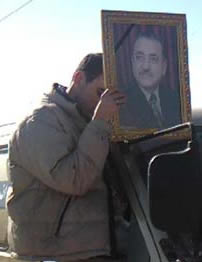
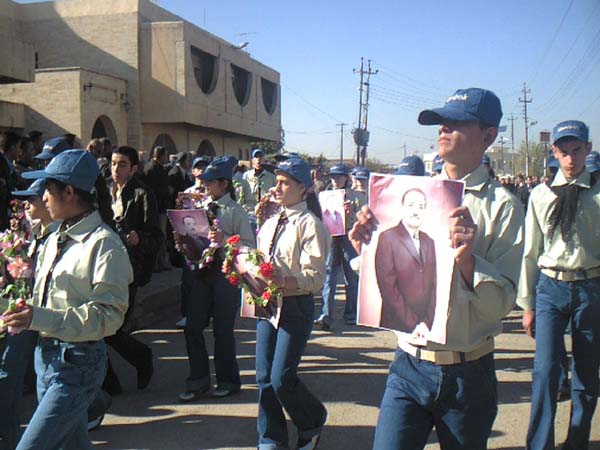
Yashua Hedaya Assassinated in Qaraqosh
(ZNDA: Mosul) On Wednesday evening, November 22, the Assyrian politician - Yashua Majeed Hedaya, was shot dead by unidentified militants in Mosul. Mr. Hedaya, 52, was the head of an independent Assyrian movement - the Syriac Independent Unified Movement. He was killed as he was leaving his political party headquarters in the mostly Christian town of Qaraqosh (Baghdede), north-east of Mosul. Masked gunmen riddled his body with bullets. Three weeks earlier, on 21 October Hedaya presented a demand for autonomy for the Assyrians in four districts of the Nineveh Plain. The demand was presented to the central government in Baghdad.
Two Chaldean Priests Released After Large Ransom Paid Courtesy of the Zenit News Agency (ZNDA: Baghdad) According to information obtained by Zinda Magazine, Father Sami Al-Rais, rector of the major Chaldean Seminary in Al Dora, Baghdad, who was kidnapped last Monday and Chaldean priest Douglas Yousef Al-Bazy who was last seen leaving his parish church by car after celebrating Sunday morning mass on Sunday, November 19th were released on Friday. A ransom of around $170,000.00 was paid for their release. Father Al-Rais was taken just a few steps from the Church of Mar Khorkhis, in Baghdad's Jadida. With the latest abduction, the number of kidnapped Chaldean priests in Baghdad has reaches six. Last October a Syriac Orthodox priest, Father Paul Iskandar, was murdered. Father Al-Rais, who is also pastor of the Church of St. Peter and St. Paul near the seminary, was supposed to be present at the opening of the academic year of Babel College, run by the Catholic Church in Baghdad. He teaches moral theology there. Given the unstable situation, the faculty has been moved from Al Dora to the Church of Mar Khorkhis. The ceremony to open the academic year at Babel College was postponed. Iraq's Chaldean patriarchate launched an appeal on its Web page to the kidnappers. "We beg you not to harm him, and to treat him well," it stated. "We place Father Sami in the Lord's and Providence's hands, asking him to help us save Iraq from these kidnappings that terrify everyone, adults and children." Al-Bazy, 34, is the parish priest at St. Elijah Church in Baghdad’s Naariya district.
He was released on November 28th in the evening after being kidnapped for nine days. The news, confirmed by local Church sources, was welcomed with rejoicing by the entire Iraqi Christian community at home and abroad, although the situation in Baghdad and the rest of the country continues to be “difficult”. The Chaldean Auxiliary Bishop of Baghdad, Mgr Shleman Warduni said that the released priest is “fine now, but sorely tried, especially psychologically... Fr Doglas thanks God for his salvation and has decided to resume a normal life.”Everyone suspected kidnapping when the young priest disappeared. His abduction came only a month after that of Fr Paul Iskandar, a Syriac Orthodox priest of Mosul who was found murdered and mutilated two days after he disappeared on 11 November. Reliable sources to Zinda Magazine in Baghdad explain that almost all 6 kidnapped priests were physically assaulted but then released after being ransomed. Iraqi Christians claim that kidnappings and forced donations to violent Islamic militias are a weekly occurrence for the country’s Christian community. “My cousin had to pay $10,000, my brother-in-law paid $20,000 and I paid $9,000,” one Chaldean source who requested anonymity recently told Compass in northern Iraq. “Last week the Islamic groups bombed three Christian houses because the owners refused to pay.” This past week, an Assyrian Church of the East priest from Mosul’s St. Mary Church was forced to flee to the Kurdish region because he was unable to continue paying the forced donations, Assyrian International News Agency reported. According to the agency, the church’s administrative director, Edward Enwiya, his brothers, and an Ancient Assyrian Church of the East priest from the neighboring village of Telkaif had been forced north for the same reason. Many of Iraq’s Chaldeans believe that attacks on Christians are not carried out randomly, according to Chaldean Auxiliary Bishop of Baghdad Shleman Warduni. Extremists “target those people who are most involved in the Christian community, the younger and more courageous ones,” the bishop told Catholic news service Asia News. It’s “as if to give a warning to those who persist in hoping that they will be able to continue living in the country.” In October an Islamic militant ring beheaded a Syrian Orthodox priest from Mosul, 59-year-old Boulos Iskander, after demanding that the city’s churches post signs denouncing a speech made by Pope Benedict XVI in which he implied that Islam was inherently violent. (See Compass Direct News, “Iraqi Kidnappers Behead Priest in Mosul,” October 12.) In September, Father Basil Yaldo, rector of St. Peter’s Seminary in Baghdad, was kidnapped and released only days later. In two other separate incidents, two young Chaldean priests were kidnapped and eventually released in July and September. Due to Iraq’s ongoing sectarian violence and attacks specifically targeting the Christian community, some groups estimate that the number of Christians in the country has dropped to 450,000 or fewer, down from 850,000 in 1991. Chaldean Catholics, an Eastern rite church in communion with Rome, are the largest Christian community in Iraq. Kidnappers Murder Church Elder in Mosul Courtesy of Journal Chretien (ZNDA: Mosul) Grieving Christians in Iraq’s northern city of Mosul completed three days of mourning for a murdered Presbyterian Church elder yesterday, only hours before another Iraqi clergyman was grabbed off the streets of Baghdad this morning. The martyred churchman, identified only as 69-year-old Elder Munthir, had been kidnapped after leading worship services at the National Evangelical Presbyterian Church in Mosul on November 26. His body was found four days later. He is the second Iraqi Christian clergyman to be murdered in Mosul within the past two months. Under mounting terrorist threats targeting all of Mosul’s Christian community, local sources only spoke to Compass under conditions of strict anonymity. According to eyewitnesses in Mosul, the Protestant church elder was cornered by two cars in front of his home at 11 a.m. as he returned from Sunday worship. “One of the passengers had a pistol, and we saw them taking him and putting him into the trunk of the car,” an observer told Compass. The captors contacted Elder Munthir’s family later that day, using his mobile telephone to confirm that they had kidnapped him. Initially demanding US$1 million in ransom, the kidnappers negotiated over the next three days with their captive’s relatives and friends. According to one Mosul source who described the kidnappers’ conversations, “They said, ‘We have him, and we will kill him. We will cut his throat. We will take revenge for the Pope’s words. We will take revenge on all of you. We will kill all the Christians, and we will start with him.’” The source said the kidnappers were “aggressive and mean,” but that “the people in these extreme Islamist groups do not represent true Islam.” Although the kidnappers told a negotiator on Wednesday afternoon that the elder’s safe return was “nearly solved,” they then cut off communication with anyone. On Thursday morning (November 30), the elder’s body was discovered thrown on a street in Mosul, killed by a single bullet to his head. Local forensic experts estimated the time of his death at 7 p.m. Wednesday evening (November 29). Since 1974, Elder Munthir had served in various ministries of the Presbyterian Church in Iraq, which named him an elder in 2000. He was the sixth generation of his family to serve in Mosul’s Presbyterian Church, established in 1840 by 10 local Christian families. Two months ago, he had been threatened by telephone that if he went to his church again he would be killed, local sources said. “Nobody on earth can prevent me from going to my church,” he told the anonymous caller before he hung up. The next day, he went back to church and preached a sermon on God’s love. “When he was kidnapped on Sunday, I was so terrified and troubled,” one member of Elder Munthir’s congregation said. “But then I opened my Bible to the book of Job, where the devil asked God to stop protecting Job. God allowed the devil to touch Job’s family, his money, his body and his health, but not his soul. I believe that Jesus died to protect [Munthir], so the devil couldn’t touch his soul.” The day after Elder Munthis was buried, one Mosul Christian told Compass that many of the church leader’s friends felt it was too dangerous to attend his funeral. “This is a very big tragedy for us,” the Christian source said. “It is really getting much worse here. We really need your prayers.” Several more Christians have been reported kidnapped in Mosul since his abduction and murder. “We will never just pray, ‘God, save us from this,’” one local Christian declared. “But we will pray also, ‘God, show us your will in this.’ “Munthir was an elder in our church, and he served God for 40 years. But God allowed him to be killed. If God wanted him to be alive, He was able to do it. It is not a matter of God’s protection.” An electrical engineer by profession, Elder Munthir is survived by his wife and four children. Priest Abducted Baghdad’s Chaldean Catholic Patriarchate confirmed that Father Samy Abdulahad was kidnapped this morning from his car as he left his church in the Al-Sinaa district of the capital, near the University of Technology. According to Ankawa.com, an Iraqi Christian news website, the patriarchate issued an appeal today to release the priest, a professor of theology at the Chaldean Babel Seminary. “It’s terrible,” Chaldean Archbishop Louis Sako said from Kirkuk. “Babel Seminary was supposed to open tomorrow.” The theological school had delayed its fall opening for several months due to Baghdad’s rising violence. “As Christians, we are giving a lot of martyrs, a lot of blood for Jesus’ name here in Iraq,” one Iraqi Christian told Compass over the weekend. Civilian casualties in Iraq jumped by 44 percent during November compared with the previous month, the Iraqi Interior Ministry reported on Friday (December 1). Although official data confirmed at least 1,850 Iraqi civilian deaths last month, U.N. calculations more than doubled that figure.
Sadr Followers Target Assyrian School Girls in Baghdad Courtesy of the Assyrian International News Agency (ZNDA: Baghdad) Followers of Moqtada al-Sadr have issued a fatwa1 concerning school girls, according to an Assyrian priest in Baghdad. The fatwa requires all girls to wear the veil while attending school. In an unusual twist of logic, the fatwa implies that failure to wear the veil would be tantamount on the girls' part to complicity in the death of the Imam Husayn ibn Ali (killed in 680 A.D. in Karbala in a battle with the army of the Caliphate.) The priest indicated the fatwa was at least for the New Baghdad neighborhood, where many Christians live, and that he feared for the safety of the Christian girls in the area. The fatwa appears to be an attempt by Sadr and his followers to establish a Taliban style Islamic theocracy in Iraq. According to an article in the Middle East Journal, "Muqtada called on May 2 [2003] for strict Islamic law to be applied to Iraq's Christians, as well, including the prohibition on bars and on allowing women to appear unveiled. This ruling appears to be a restatement of one of his father's fatwas, but this time the al-Sadr family had the authority to make it stick in some parts of Iraq. In contrast, Grand Ayatollah Sistani issued a statement saying that the Najaf establishment had not called for forcible veiling." Editor' note: AINA has withheld the name of the priest to ensure his safety. 1 . A fatwa is a Muslim pronouncement on a specific issue, issued by a Muslim cleric. Iraq's Vatican Ambassador Seeks More Help Courtesy of the Catholic News Service (ZNDA: Rome) The Iraqi ambassador to the Vatican, Mr. Albert Yelda - an Assyrian, acknowledged the increasing violence in his country, but issued a plea for international support to help stabilize the country. "We are very much concerned" about the increasing numbers of civilian deaths, said Albert Yelda. But implementing democratization and stability "is a long process" and "we need multinational forces" to help "because they are doing an excellent job." Yelda admitted ethnic cleansing is taking place in Iraq. "Christians are fearing for their lives like other minorities trapped in this policy of ethnic cleansing," he said. The "elements of instability" are people who "lost their influence" and "lost ground" when Saddam Hussein was overthrown in the U.S.-led 2003 invasion, Yelda said. Saddam's "regime of mass graves is still at work (though now it is) maybe behind religious dimensions," meaning that violence, killings and threats now are based on religious divisions rather than the personal whims of a dictator. It is "very important for us" that a program of national reconciliation be carried forward and that all factions and parties "become part of the political process," Yelda said. But "a democratic, federal and secular government" will take "a lot of time and a lot of different people's ideas," he added. Yelda also addressed the issue of internal displacement during the fighting. U.N. statistics show that at least 2,500 families have been displaced in 13 of Iraq's 18 provinces. "During the 35 years of the Saddam regime, 4 million Iraqis fled" Iraq, he said. "Now because of war and instability we can see assassinations and forces of darkness working 24 hours a day, working to destabilize and do as much damage" as possible in an effort to try "to get back power." "The presence of a military force is not the cause" of the violence in Iraq, Yelda said. "Certainly no Iraqi would like to see their country occupied by a foreign power and I believe many mistakes happened when Iraq was liberated," he added. "But we can always criticize about these mistakes and not achieve anything." Two U.S.-based Chaldean Catholic bishops took a dimmer view of the Iraqi situation.
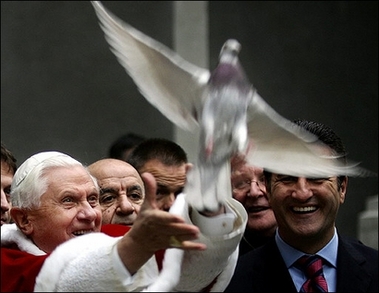
"The situation is by all means very bad. It is a civil war or we are about to start civil war," said Bishop Ibrahim N. Ibrahim of the Chaldean Eparchy of St. Thomas the Apostle, based in Southfield, Michigan, a Detroit suburb. "The whole country is in trouble. The whole country -- Muslim, Christian, Kurds. Everybody is really in trouble." Bishop Ibrahim confirmed that Iraqi Christians are leaving their neighborhoods and towns for Kurdistan -- Iraq's northern provinces -- and the Nineveh Plain. "They cannot go outside the country. They have not the means to travel to their neighbor's country," he said. The bishop said in a telephone interview that the U.S. government bears "the main responsibility for the deterioration of the situation." "They are in charge of the security. They should be in charge of building. They should be in charge of reform," he said. Under international law, Bishop Ibrahim added, "the occupying country has the responsibility for the (occupied) country. ... The Iraqis now are unable to take a decision for themselves, or even if they are able, they are not free to make their own decisions. We have to take the approval of the Americans. What does that mean? That means Americans have the upper hand on every decision." "It's very tragic, very painful," said Bishop Sarhad Y. Jammo of the Chaldean Eparchy of St. Peter the Apostle, based in El Cajon, California. Iraqi Christians "have no means to survive, even in Baghdad or other cities. They cannot go to work, they cannot go to school. They are threatened in their own neighborhoods, their own houses," Bishop Jammo said. "They are kidnapped, they are killed, they are kidnapped for ransom, they are kidnapped for torture, they are kidnapped to impose on them Islam. Sometimes they threaten them with killing, with execution, unless they accept Islam, or they have to pay to their neighbors sometimes taxes for being Christian." While "I don't think any observer would have objected to changing the regime," Bishop Jammo said, "I haven't seen any success after the collapse of the regime. I haven't seen anything really a success story. I don't know if the planning was totally inadequate, or badly designed. The Pope, Metropolitan Cetin Attend Rites in Istanbul Courtesy of the AsiaNews - Italy (ZNDA: Istanbul) The final message of the Pope during his trip to Turkey was another call for freedom for the Church and an exhortation to Turkey’s small Christian communities to live together in love. The message was delivered last Thursday to around 2,000 people who participated in mass celebrated by Benedict XVI in Istanbul, his last engagement before leaving for Rome. Young people stood in the small courtyard of the nineteenth-century church of the Holy Spirit, the Latin cathedral of Istanbul, cheering at the arrival of the Pope and Patriarch Bartholomew, chanting their names. On one wall, there was a poster with their images. There, upon his arrival, the Pope freed three white doves and then blessed a statue of John XXIII, the “Turkish Pope”, as Pope Roncalli was described when he was elected, in memory of the 10 years he spent in this country where he is still remembered with respect and affection. The statue, intended for the Church of St Anthony, stood not far from that of Benedict XV, erected by the Turks in 1919 in memory of his appeals against the World War, with the inscription: “To the great pontiff of the global tragedy, benefactor of all peoples, regardless of nation or creed, as a sign of gratitude, the East.” The Ecumenical Patriarch Bartholomew I, the Armenian Patriarch Mesrob II, and the Syriac Orthodox Church Metropolitan Yusuf Cetin, attended the religious rite; all met Benedict XVI yesterday. The meeting with Bartholomew, who entered the church by the Pope’s side – and who participated in three celebrations with Benedict XVI in two days – was the main reason for the voyage. This, however, did not stop public opinion from focusing above all on ties with Islam.
Benedict XVI dwelt upon these ties in the packed church. He said: “Your communities walk the humble path of daily companionship with those who do not share our faith, but who declare ‘to hold the faith of Abraham, along with us adore the one and merciful God’ (Lumen Gentium, n.16). You know well that the church wishes to impose nothing on anyone, and that she merely asks to live in freedom to reveal He who she cannot hide.” The celebration had an inter-ritual character, in that Catholic communities of different languages and rites took part. Monks with cowls and Metropolitans in their great mantles stood by the altar. For all of them, there was a papal exhortation to fraternity, which rounded up the homily: “Always be open to the spirit of Christ and hence be attentive to those who thirst for justice, peace, dignity, for consideration for themselves and for their brothers. Live among yourselves according to the word of the Lord: ‘by these they will know you are my disciples, if you love one another’.” Iraqi Catholic Asylum Seekers in Turkey Suffer Neglect & Poverty Courtesy of the Turkish Daily News (ZNDA: Ankara) Iraqi refugees live in Turkey for years while waiting to be resettled in other countries, yet they have no right to work and suffer social and psychological problems from being forced to live where the Turkish government directs them, often without community support. "Any door they knock on is closed in their faces," said Monsignor Francois Yakan, 48, who runs the Chaldean Catholic Church in Turkey from his office in Istanbul. "The former regime in Iraq was no good, but this situation is worse, and every day we learn of five or six people who have been killed in Iraq, relatives of the families in our Istanbul community." The monsignor was born in Hakkari and later went to school and seminary in France, returning to Turkey seven years ago as Chaldean patriarchal vicar. He ministers to his scattered flock from an office in Istanbul, where he also conducts masses at a small church, formerly Byzantine Catholic, opposite the British Consulate. The Chaldeans also worship at a larger chapel in the cellar of Saint Antoine Church on Istiklal Caddesi. “These refugees have social and psychological problems,” said Yakan. “They stay here from one to 11 years with no health care, no work permit and practically no schooling. The Europeans don't pay any attention to these people, yet they talk about human rights and being Christian.” Numbers game The United Nations High Commissioner for Refugees (UNHCR), which acts as the Turkish government's agent regarding refugees and asylum seekers, estimates that up to one million Iraqis have fled the war in Iraq.
While most of Iraqi refugees live in neighboring Syria and Jordan, those who come to Turkey are required by law to register with the police within 10 days of their arrival and also to apply to the UNHCR for a so-called refugee status determination. Up to that hearing they are asylum seekers, while those who do not register or apply are undocumented immigrants. Unfortunately, since the war began in 2003 the UNHCR has suspended normal processing of Iraqi asylum seekers. Gaining the right to be resettled in a third country was not too easy before then, but now it is practically impossible except in the most vulnerable cases, or in rare cases where humanitarian programs in countries such as the United States, Canada and Australia allow Iraqis to be reunited with family members in those countries. The Turkish Ministry of Interior estimates that some 90,000 people entered Turkey illegally last year, but it does not break down those figures by nationality. Through mid-September this year, 407 Iraqis in Turkey applied to the UNHCR for asylum. “We get applicants in all categories, but we don't break them down by religion,” said Metin Corabatir, UNHCR spokesman in Ankara. Thus no one knows how many Iraqis enter Turkey without permission, or what percentage of them is Christian and what percentage Muslim. Community support The most visible Iraqi refugees in Istanbul are the Christians, mainly Chaldean Catholics. Like other refugees, asylum seekers and undocumented immigrants, they have been uprooted from their homes and must make do in a strange land. Those who must live outside Istanbul must live without the communal support that is central to a person's welfare. The Vatican's relief agency Caritas runs a few social support programs and also helps support a school for Iraqi children here in Istanbul, next door to its office in Harbiye. "We focus on Iraqi asylum seekers who knock on our door," said Caritas spokeswoman Tülin Türkcan. "It's a very small operation and we're limited by our capacity. I can talk about Assyrians and Chaldeans, for they're the Christian Iraqis who come to us, not the Kurds or Turkmen. Sometimes individual Africans come for clothes or one-time medical care. Ignorance is a problem, for a Bangladeshi usually doesn't know what asylum is, so it's a big issue to talk about." Pope John Paul II in 1991 ordered the Caritas office in Istanbul set up to coordinate aid for the half-million Iraqi refugees who had fled across the Turkish border to escape the Persian Gulf War. “Caritas only knows of the 500 people they've registered,” said Yakan. “We had 3,800 people here as of last month. As the war in Iraq intensifies, the numbers here go up...” Neediest cases Caritas has no official status, but the organization Yakan set up six months ago -- the Chaldean-Assyrian Refugee Aid Association -- has the legal identity needed to support the community of Iraqi Christian refugees. Yakan receives no money from either the Turkish government or the Vatican. “What we do need is a state agency responsible for the refugee community in Istanbul, [whether they are] Christian, Muslim [or] Buddhist -- whatever faith,” said Yakan. “I make pastoral visits to Konya, Kayseri, Burdur, Isparta -- wherever the people are sent -- but there's only me in all of Turkey. Through the church foundation we help widows and other people in truly dire straits, but as for going back to Iraq, that's simply impossible.” The Christians have no district or region of their own in Iraq, as do Sunni, Shiite and Kurdish people, he said. Many of these people left a bad situation years ago and would return to find other people living in their houses, other people tending their orchards. “If each of the 25 countries in the European Union would take 10 families -- voila -- the problem would be solved and we wouldn't have any Iraqi Christian refugees left,” said Yakan. “If 10 is too much, they can take five -- that would help.” In Turkey there is much pain because the U.N. says go to Isparta, or Kastamonu, places where no one speaks Arabic, where there are no Christians, according to Monsignor Yusuf Sağ, 68, patriarchal vicar of the Syrian Catholic Church in Turkey. “One woman told me that she had to imitate a chicken laying an egg in order to get one,” said Sağ. “In Burdur, for example, I bet you could not find even one person who speaks Arabic and certainly not Asuri. It's hard enough on a single man, but imagine having a family.” Asuri is a modern variant of Aramaic, the same language spoken by Jesus Christ. Open arms Sağ has 174 families in his congregation at the Sacred Heart Church in Gumussuyu, all Turkish citizens, but refugees from Iraq and other Arabic-speaking countries come to him because he speaks their language. A native of Mardin, Sağ speaks fluent Arabic. “Muslim Iraqis come to me, too, and I treat them, also Somalis, Sudanese and Palestinians,” he said. “Three Egyptians came here just last week, for example. I know their troubles and we do our best to help with clothing in winter, basic food such as cooking oil, rice and beans, but it's not enough. Some of these families have been here for six years, even nine years.” Forget religion, it's a matter of human rights, according to Monsignor Sağ. “And the children do not get schooling, though they do here in Istanbul, from Caritas,” he said. “I thank the United States and the U.N., but Iraqi refugees in Turkey have much more pain than they do in Jordan and Syria, where at least they speak the language, and they have more churches. Here they don't send them to Mardin, which would be logical, they send them to places like Isparta and Burdur.” The churches send the Iraqi women out to clean houses in Istanbul for 50 lira a day, maybe 100 if someone is feeling generous, but it is very difficult to live here without any right to work. “What is the Turkish government thinking? These people are humans in pain and suffering,” said the monsignor. “The children get into trouble, into heroin or gangs. We don't want anything for ourselves, but these people need help. I tell them to keep asking God. Maybe they get fed up, but He will provide. We talk of faith, Jesus, the Bible, but humans have limits to their faith. Not everyone is capable of the faith of Job, and even he had doubts.” To let these people stay in Istanbul would be a big service, according to all the people interviewed. Here they can have a community, get aid from the church, see doctors. Thus Monsignor Sağ cries the opposite of Moses: Let my people stay! “I want this not as a priest or father figure, but as a fellow human being,” he said. “And I don't want money from the state, but here these refugees can learn Arabic and English, while outside Istanbul there is no emotional and material support. These are the tenets of Islam, but they just say it, in fact the Turkish government doesn't differentiate between Christian and Muslim refugees, they both get the same bad and inhumane treatment. We can only do so much, and it's a human tragedy.” Turkish President Vetoes Property Rights for Christians Courtesy of Reuters
(ZNDA: Ankara) President Ahmet Necdet Sezer has vetoed a law that would have improved the property rights of non-Muslim religious minorities, the president's office said on Wednesday. Sezer sent the law back to Parliament for the review of nine articles, the president's office said. The ruling came on the day the European Commission recommended suspending some parts of Turkey's accession talks because of its failure to open its ports to EU member Cyprus. The so-called foundations law, which fell short of European Union expectations, affects Greek Orthodox, Assyrian (Syriac) and Armenian communities and was approved after months of fierce debate in officially secular but predominantly Muslim Turkey. Nationalists were concerned the law would give non-Muslim minorities -- seen by some as foreign, such as in the case of the Greek Orthodox Church -- more influence in Turkey. Sezer, who is sometimes wary of EU-inspired reforms, which he fears could weaken the state or its secular structure, often vetoes legislation. However, these vetoes can be overturned by the Justice and Development Party (AKP) dominated Parliament. Foundations Law Parliament approved the law on foundations allowing properties confiscated by the state to be returned to Christian and Jewish minority foundations earlier this month, shortly after the European Union urged Ankara to improve rights of religious minorities. The law would allow foundations to reacquire confiscated properties, but it was not clear if they would be allowed to reclaim property that has since been sold to third parties. It also allows foundations to reclaim property registered under the names of saints. A committee will be established to decide which properties should be returned. Turkish Converts to Christianity Stand Trial for Insulting Turkishness Courtesy of the Associated Press The trial opened just days before a visit to Turkey by Roman Catholic Pope Benedict, during which the pontiff was expected to discuss improved religious rights for the country's tiny Christian minority who complain of discrimination. Hakan Tastan, 37, and Turan Topal, 46, are accused of making the insults and of inciting hate while allegedly trying to convert other Turks to Christianity. The men were charged under Turkey's notorious Article 301, which has been used to bring charges against dozens of intellectuals - including Nobel prize-winning author Orhan Pamuk. The law has widely been condemned for severely limiting free expression and European officials have demanded that Turkey change the law as part of its bid to join the European Union. Prosecutors accused the two of allegedly telling possible converts that Islam was "a primitive and fabricated" religion and that Turks would remain "barbarians" as long they remained Muslims, Anatolia reported. The prosecutors also accused them of speaking out against the country's compulsory military service, and compiling databases on possible converts. Tastan and Topal, who could face up to nine years in prison, denied the accusations in court. "I am a Turk, I am a Turkish citizen. I don't accept the accusations of insulting 'Turkishness,' " Anatolia quoted Tastan as telling the court. "I am a Christian, that's true. I explain the Bible ... to people who want to learn. I am innocent." "I am a Turk, I am a Turkish citizen, it is impossible for me to insult 'Turkishness,"' echoed Topal, according to Anatolia. Sweden to Investigate Assyrian Mass Graves in Turkey Courtesy of the Assyrian International News Agency (ZNDA: Stockholm) The finding of a mass grave in southeastern Turkey, believed to date from the 1915 genocide of Assyrians and Armenians, and the Turkish government's silence in this matter has prompted a debate in the Swedish parliament. On October 17 villagers from Xirabebaba (Kuru) in southeastern Turkey came across a mass grave when digging a grave for one of their deceased. The villagers took pictures of the skulls and bones in the mass grave before Turkish military came and blocked the site. The villagers were certain that they had found remains of victims of the 1915 genocide. The military personnel forbade the villagers to tell anyone about the site and then closed it. Some of the villagers chose not to follow the orders of the military and told the story to a local newspaper who followed up on the story. As soon as the military learned that news of this finding has been leaked to the press, it pressed the villagers to give the names of whisteblowers. Journalists have since been denied access by the military. Turkey continues to deny that its Christian population of Assyrians, Greeks and Armenians were subjected to genocides. But now one of Turkey's most popular weekly magazines, Nokta, has highlighted the mass grave finding with a cover story in the latest issue with the main heading "Again the Three Monkeys- a mass grave found a month ago in Nusaybin, the Judicial, Executive and Legislature as well as the media remain silent." The writer, Talin Suciyan, accuses the Turkish state of turning a deaf ear to the mass grave finding. "None of the three 'powers' of our democracy, have made a move to deal with the issue. And when the fourth power - the media - swept the bones under the carpet (the Turkish) public remained completely unaware of the issue." she writes. In fact, the only Turkish group that has reacted to the finding is the Turkish Human Rights Association which sent an open letter to the Ministry of Interior calling for an investigation into the matter. The mass grave finding has yet to enter Turkish politics but in Sweden the matter has stirred up a debate in the highest levels, much due to the efforts of the Assyrian Chaldean Syriac Association (ACSA). The news about the mass finding was distributed by Tidningarnas Telegrambyrå (TT), Sweden's top news agency and was thereafter published in several Swedish media, including the two leading morning papers Dagens Nyheter (DN) and Svenska Dagbladet (Svd). As a result the mass grave issue has now entered Swedish politics as MP Hans Linde from the left party recently submitted an interpellation to the Swedish foreign minister Carl Bildt, asking for an independent commission of scientists and historians to examine the findings. The foreign minister must now ask the foreign ministry to launch an investigation into the matter before he can respond to MP Hans Linde. The response of the foreign minister on this issue is due to be presented on 12 December before the Parliament.
David Adamov Visits Iraq as a Member of Georgian Delegation Assyrian International Congress of Georgia Vice President of the Assyrian International Congress of Georgia, Mr. David Adamov visited North Iraq, Erbil, as a member of the Georgian delegation from 28th – 30th November 2006. The delegation consisted of members of Georgian authorities, business and non governmental organizations. During his visit Mr. Adamov had official meetings with Mr. Nimrud Beito, Minister of Tourism and Mr. George Mansour, Minister of Civil Society Affairs in the Regional Government of Kurdistan. He also met the Minister of Culture and Minister of Internal Affairs. During the meetings the socio-economic, cultural and political situation of Assyrians in the region was discussed. Mr. Adamov had an opportunity to meet the Assyrian community in Ankawa. He visited the Chaldean Culture Society and Ankawa Youth Center. He also visited churches and met the Chaldean Bishop of Ankawa.
Assyrian Cuneiform Inscription Discovered in Iran Courtesy of Iran's Cultural Heritage News Agency
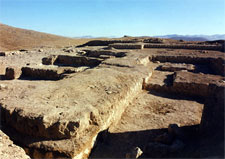
(ZNDA: Tehran) The first brick inscription written in cuneiform to be discovered at Rabat Tepe 2 was recently unearthed during the second phase of excavations at the ancient site, the Persian service of CHN reported on Tuesday. A team of archaeologists working at the ancient mound said that the inscription may be in the Assyrian language, adding that the discovery is one of the most important keys for the study of the Mannai and Assyrian city-states in the region, which is located near the town of Sardasht in Iran's West Azarbaijan Province.
“This is the first time excavations in northwestern Iran have resulted in the discovery of a brick inscription in cuneiform. It has been written with white glaze on the shorter end of the brick,” team director Reza Heidari said. “The discovery of script at an ancient site is one of the major indicators for study and dating of the region. Thus, the discovery of the inscription will be very helpful for gaining greater understanding of the Mannai and Urartian city-states in the region and the relations of Assyria with the city-states,” he added. The team began the second phase of excavations of Rabat Tepe in late October with the aim of proving the site was the capital of the Musasir state about 3000 years ago. Musasir was a semi-independent buffer state bordering Mannai between Assyria and Urartu. It was a vassal state of Assyria yet Urartu had some claim over it. According to one of the inscriptions previously discovered in the region, Assyrian king Sargon II plundered the palace and storerooms that belonged to Urzana, the king of Musasir, and then seized the even richer contents of the temple of Haldi, the god of the ancient kingdom of Urartu, in the eighth century BC. After occupying the land, Sargon took 6110 people captive, and collected 1250 heads of ship, 45 tons of gold, 400 pieces of jewelry, 44 swords and daggers as his booty. All these are evidence of the existence of a great government in the area 3000 years ago. The archaeologists have also started new efforts to find evidence of Sargon II’s battle in the region. Unique cobblestones as well as bricks bearing bas-reliefs of naked winged goddesses have been discovered during the previous excavations of Rabat Tepe. Theology Courses for Lay People in Mosul Resume despite Violence Courtesy of the Asia News - Italy (ZNDA: Mosul) Insecurity prevailing in Iraq in recent months has not prevented, as feared, this year’s resumption of theology courses for lay people in Mosul. Lessons have already been under way for a month. The “good news”, as a Chaldean priest in Rome described it, was reported on the site ankawa.com. On 28 October, the 2006-2007 academic year was inaugurated at the monastery of Mar Gewargiz of Mosul, with three-year courses for all interested students. There are three classes and in all, 75 men and women have enrolled. Theology lessons have been held regularly every year in Mosul since 1983. One lecturer said: “Usually, we have up to 200 students. However this year the difficult situation we are passing through has led to a drop in registrations.” Lecturers of all kinds, from bishops to priests and male and female members of religious orders, teach subjects like sacred scripture, patristics, moral, dogmatic and pastoral theology, church history, canon law and philosophy. This year, for the first time, even smaller villages will have their own theology course. Those who find it difficult to go to Mosul will be able to go to Karamles, where first year classes are being provided for Catholic and Orthodox students coming from Qaraqosh and Bartella.
|
|||||||||||||||||||||
Knee Deep and Selective Memories “The greatest trick the devil ever pulled was convincing the world he did not exist. And like that... he is gone.” - Quote by Verbal (Keyser Soze ) in “The Usual Suspects” Reading an interview last week with Mr. Nimrod Baito of the APP, it was refreshing to hear such openness and candor regarding their political platform and desires for Assyrians in Iraq. It is a habit I wish other Assyrian political parties - mainly the ADM - would form. I appreciate the candor so much, in fact, I feel I should return the openness: upon finishing the interview, I felt about knee-deep in rubbish. It was hard to walk around afterwards, actually. There is nothing wrong with advocating for the rights of the people in the Nineveh Plains, or in using the combined "Assyrian/Chaldean/Syriac" name - (something I might add, these Assyrians were loathe to do before they picked up the ADM's cue and realized using "Assyrian" only would get them nowhere fast) - and there is nothing wrong with toeing the "Kurdish policy" line, if your party believes this is certainly the best thing for Assyrians. In 2002, we read that "While duplicitously presenting a pro-western, secular, and democratic image externally in order to attract international sympathy-internally, Mr. Barzani continues to use fundamentalist terror tactics to intimidate Assyrians in a bid to consolidate illegally expropriated Assyrian lands." Sound familiar? This is from a story outlining how Kurdish Islamic Fundamentalism is on the rise in Northern Iraq through the top Islamic Party, run by Sheikh Mohammed Barzani – Massoud Barzani's father-in-law. The KDP uses Islamic Fundamentalism when necessary to wield power. Much like Saddam Hussein used to do. Again in 2002, we learned about institutional and deliberate religious discrimination by KDP officials, not allowing Assyrians to build a new church as it would be too "close to mosques" and "Shariya law does not justify the creation of a church in an Islamic country". But they have changed, right? They are building many churches for Assyrians now, in the Nineveh Plains. I wonder why the sudden religious tolerance? Could it be they want something from the Assyrians of the Nineveh Plains? In October of 2002, the KRG passed a new law that allowed Kurdish squatters in over 200 Assyrian village to "buy the land" from the Kurdish Government. The land was seized by Kurds with no compensation. In 2005, leading up to the Iraqi elections, we heard: "Recently, Kurdish attackers have grown emboldened. In the past, attackers had strained to remain anonymous. The series of beheadings, mutilations, burnings, and shootings of innocent civilians in Mosul and the surrounding Nineveh Plain were usually carried out in isolated areas or under cover of darkness in order to conceal the identity of the perpetrators. In the most recent attacks, the assailants have been clearly identified as KDP members from nearby surrounding areas. As one Assyrian villager noted ‘They seemed to want us to know they were with the KDP in order to cause greater fear.’ Another noted that the ‘KDP now seemed to be advertising their involvement in the attacks.’” The KDP seems to have such respect for the Assyrians that they did everything they could to scare the hell out of them in order for their voices NOT to be heard during the Iraqi elections – knowing full well with an ADM representative in Baghdad, the journey for an autonomous Nineveh Plains would begin. But I am sure they have changed, and will allow Assyrians free and fair elections once they have the Nineveh Plains, right? And in January 2005, who can forget election time? To quote: "…the KDP effectively blocked the delivery of ballot boxes to six major Assyrian towns and villages in the Plains around Mosul including Baghdeda, Bartilla, Karemlesh, Shekhan, Ain Sifne and Bahzan. Thousands of would be voters were left stranded outside polling places awaiting an opportunity to cast their ballots. Inquiries to voting authorities brought frequent promises that the ballot boxes were en route only to result in a series of disappointments throughout the day. Infuriated Assyrians filled the streets of Baghdeda- the largest Assyrian town in the Nineveh Plains -and demonstrated against the KDP's overt disenfranchisement of Assyrians." But this will change once they have the Nineveh Plains, right? They have changed, in the words of Mr. Baito, because they want to prove to the world that they are democratic and secular and once we give them what they are courting Assyrians for, the Nineveh Plains, they will suddenly allow them representatives and free and secure voting. Right? In the words of an Assyrian activist living in Iraq said shortly after the elections in 2005, when Barzani installed his "Christian Representatives" to control Assyrian political destiny: "Mr. Barzani can add as many Christians to his list as he likes. These so called leaders are Barzani's representatives, not ours. They don't have the backing of the community and are widely known to be there simply to subvert our genuine and legitimate aspirations as a people." In August of 2005, hundreds of Iraqi Assyrians protested the Iraqi Constitution for separating them into "Assyrian" and "Chaldean", when the Transitional Administrative Law had referred to them as one group: ChaldoAssyrian. The result was the murder of Assyrian men two days later, one while he was pumping gas. In May of 2006, we learned that the KRG hired contractors to detonate parts of the 2600 year old Khinnis Site (about 30 miles Northeast of Nineveh), a site built by King Sennachrib, to create shade for Kurdish picnickers. This brought to mind the destruction of the Buddha statues in Afghanistan in 2002. In June of 2006, the ADM successfully gained permission from the Iraqi government for a mostly Assyrian police force in the Nineveh Plains – where the current security forces are KDP (which, by the way, they will remain should the Nineveh Plains go to " Kurdistan"). The Nineveh Provincial Council, dominated by Kurds, blocked the effort, to maintain Kurdish control of the Nineveh Plains. I will let this gem speak for itself, July, 2006: "Increasingly, especially over the past week, Kurdish forces as well as Iraqi police have begun a policy of harassment and intimidation of local civilians. Referring to the Arab and KDP police, one local Assyrian noted "they share one thing in common: they don't live here. They don't belong here." Another bitterly complained that "they don't come to provide security; they come to terrorize Christians and extract profits from the area for their personal gains." And of course, Summer of 2006, in the Barwari village of Mize – already in the heart of Kurdish controlled Iraq – Assyrians went into their old village to work with contractors to rebuild their homes. The KDP showed up and threatened to kill any worker who put together even a brick. They told the Assyrians they could "buy their own village back" for 3 billion dinars. Please keep in mind – this is about Assyrians already living in Kurdish Iraq. A little insight into the future. But I suppose all of the above could be ADM propaganda in order to wield their oh-so-tight power and control over the Assyrian people. Occam’s Razor is an apt theory here: The simplest explanation tends to be the correct one. The simplest explanation, as we see from the brief history lesson above, is that the KRG is manipulating the truth in order to promote their propaganda against the ADM, and to promote their own Kurdistani Assyrians. The audacity of Mr. Baito to ask us to believe all of this, and much much more, are fabrications by a political party with 1/10000 th the resources the KRG has is ludicrous and insulting to our intelligence. I am not making a comparison between Baghdad, Basra, and the North – Assyrians are physically safer in the North than anywhere else in Iraq, and that is why they are fleeing to the Nineveh Plains and other parts of Northern Iraq. But to use the idea that it is “safer” to push for annexing into Kurdish territories is not only foolish and untimely, it is politically un-savvy and unnecessary. If Assyrians are safer in the North than in Baghdad, they are safer in the Nineveh Plains among Assyrians, in charge of their own security, than they are in “ Kurdistan”. In a letter to the KRG regarding the KRG Constitution dated October 2, 2006, the ADM makes the following declarations among several others (which, when one reads the original, is reflected in most of the subsequent letter written and signed by the APP, BNDP, et.al):
The second article of the draft constitution has included Tall Kayf, Qarah Qush, Ba'shiqah within the Kurdish Territory. We believe that these are in the Nineveh Plains… and our people could and should exercise their rights in accordance with the management-rights, included in the Iraqi Federal constitution (Article 125) and we are in the process of local-governance project in the Nineveh Plains. The adoption of regional-owning will be implemented later through a referendum as a special constitutional context (normalization and Statistics, followed by the referendum, according to Article 140 of the Constitution of the Federal Iraq).” The full letter discloses all demands that the ones from other parties do, with one important exception – that the Kurds let their quest for the Nineveh Plains go and allow the Assyrians to decide for themselves their own fate. And regardless of how Assyrians feel personally about the ADM, it should be very, very suspect that the KRG deliberately marginalizes the only legitimate political representatives for Assyrians, voted in by the Assyrians, recognized nationally and internationally, in order to work with Assyrians they instead handpicked. Again – regardless of whether one supports the ADM or not, to purposefully go around them is a deliberate attempt to control the Assyrian national agenda. It is like the Republicans of the U.S. working with the Green Party on their Iraq policy, just to leave the Democrats out of it. Deliberate and suspicious. People really dislike Yonadim Kanna. Big deal. He has less than a year left as General Secretary. The ADM does not die with him. The fact is, most of the Nineveh Plains are Chaldean Catholics and Syrian Orthodox. They have never lived with Kurds like other Assyrians have. They don't speak Kurdish like other Assyrian tribes can. They are, in fact, loyal Iraqis, and have absolutely no relationship – in the past or the present – with Kurds the way some Assyrians do. So I would like to know where Mr. Baito gets his “80% of Assyrians in the Nineveh Plains want to join Kurdistan” fact from. Other than thin air. When everything is said and done, if Iraq falls into civil war or breaks apart, we may have no choice but to join with Kurds. It is an unfortunate lesser of two evils. I don't know what the fate of Assyrians will be after that, it is simply too hard to venture a guess. I will, however, be so bold as to say this: The Kurds of Iraq have a vested interest in what they refer to as "Kurdistan", and there are two things – other than Turkey, Iran, Syria, and the U.S. - that produce bumps in the road: First, their (lack of) history and indigeneity in Iraq, and second, that within recent memory, most of "Kurdish Iraq" belonged to and was inhabited fully by the true indigenous people, the Assyrians: and if Kurds demand Southeast Turkey as their true ancestral homeland, how can they then in turn stop the Assyrians from reclaiming theirs? There are two ways around this for the Kurds: Either make Assyrians “Kurd-friendly” so they conveniently forget to reclaim what was lost, eventually; or wipe the Assyrians out, culturally or physically. They have been fortunate to find some Assyrians to help them with the former. Regardless of the massacres of Assyrians committed by Kurds through their coexistence, in recent history Assyrians have fought side by side with Kurds. Assyrians suffered alongside Kurds through Anfal and Saddam Hussein. Assyrians have even supported Kurdish autonomy. Assyrians and Kurds have been allies against common enemies. Assyrians have sacrificed for Kurds. Assyrians should expect that now, the Kurds return the favor and support the Assyrian quest for land, instead of using their money, power, and influence to annex and swallow up even more Assyrian land then they have already. Assyrians have given enough. It is time for Kurds to give back. |
|||
Assyrians Demonstrate in Washington to Highlight Persecutions, 'Most Vulnerable Population' in Iraq Courtesy of the Christian Post
(ZNDA: Washington) Assyrians were joined by faith-based leaders and religious freedom activists on Monday in a White House rally to call U.S. political leaders to "save" Iraq’s "most vulnerable population."
"This should be a priority because Assyrian Christians are the indigenous people of Iraq and many people don’t know that," explained Paul Isaac, one of the rally’s organizers. "Because of their small population, weak status, and lack of regional support they have no one to protect them from all the violence."
Isaac pointed to the UNHCR (United Nations High Commissioner for Refugees) report statistic that although Assyrians comprise only five percent of Iraq’s population, they make up nearly 40 percent of the refugees fleeing Iraq. He said that although all the ethnic and religious groups are suffering in Iraq, "it is clear that the Assyrian Christians are suffering by far the most…and they really have no one to protect them…" In addition to the troubling Assyrian refugee statistic, there has been a rise in reports of persecution of Assyrian Christians in Iraq. Recently, in October, a 14-year-old boy near Mosul died by a crucifixion-murder. In the same month, Father Paulis Iskander was beheaded in Mosul. "Christians in Iraq and elsewhere in the Middle East are an inconvenient minority," said the Rev. Keith Roderick, Christian Solidarity International’s Washington representative. "Even though they are indigenous they are made to feel as they are interlopers." Roderick added that 27 churches in Iraq have been attacked or bombed in the past two years and 13 Christian Assyrian women were kidnapped and murdered in August. CAI’s solution is the formation of an autonomous zone in Iraq for Assyrians and other Christians. The zone, called the Nineveh Plains Administrative Unit, is likened to a state where Assyrians and Christians can practice their faith, speak and teach their language, and work without fear of persecution. Demonstrators at 1600 Pennsylvania Ave. Tell of 'Ethnic Cleansing' Courtesy of WorldNetDaily.com (ZNDA: Washington) Faced with growing repression by Muslims, Christians from an ancient tradition in Iraq are calling on American political leaders for help before their entire community is extinguished.
One of the speakers at the rally, Nina Shea of Freedom House's Center for Religious Freedom in D.C., told WND that because of the "ethnic cleansing," the Christians want an autonomous district in Iraq they can administrate. The zone, called the Nineveh Plains Administrative Unit, would allow Assyrians and other Christians to practice their faith, speak and teach their language, and work their land without fear of persecution. Unlike the Sunnis and Shiites, the Christians have no militia and are completely defenseless, Shea said. "They need to administrate their own governmental unit to protect themselves," she said. "Otherwise, with the chaos and violence and persecution targeting Christians for religious reasons, which the U.N. has documented, they will disappear. Shea insisted it's in the interest of the U.S. to take a stand. With the loss of the highly educated and skilled Christians, she argued, Iraq is "experiencing a brain drain as well as sane drain – a force of moderation and a bridge to the West." "They have served the U.S. in Iraq nobly, and they will leave a real vacuum," said Shea. While the Christians in Iraq have been repressed for decades, Shea pointed out, they have suffered more since the war began, with kidnappings, crucifixions and dozen of churches bombed by jihadist terror. Among the atrocities documented this year:
Shea said she has been raising the plight of the Iraqi Christians with the U.S. government for several years, including in a face-to-face meeting with President Bush in her role as a member of the U.S. Commission on International Religious Freedom. She has not received a positive response. "One of the issues here is that the Christians don't create trouble, they are just victims," she said. "They don't blow up things, so they don't get attention. Some have told her the U.S. government doesn't want to establish a precedent of favoritism, by responding to special pleadings. But Shea argues, "It's not favoring one group to make sure they get their fair share of U.S. construction aid. The White House did not respond to WND's request for comment. Baker Commission Iraq Report: Not Much for Assyrians Assyrian International News Agency The Baker Commission published its widely anticipated report on Iraq today (full text). Saying there is no "magic formula to solve the problems of Iraq" but "there are actions that can be taken to improve the situation and protect American interests," the report:
Only two places refer to Assyrians/Christians: RECOMMENDATION 27: De-Baathification. Political reconciliation requires the reintegration of Baathists and Arab nationalists into national life, with the leading figures of Saddam Hussein’s regime excluded. The United States should encourage the return of qualified Iraqi professionals—Sunni or Shia, nationalist or ex-Baathist, Kurd or Turkmen or Christian or Arab—into the government. RECOMMENDATION 32: Minorities. The rights of women and the rights of all minority communities in Iraq, including Turkmen, Chaldeans, Assyrians, Yazidis, Sabeans, and Armenians, must be protected. Assyrian Delegation at the European Parliament Report prepared by Ms. Nicme Seven from Germany
(ZNDA: Brussels) On the initiative of the Assyrian magazine, Funoyo, a meeting took place at the European Union's Parliament in Brussels on Wednesday, November 29. At the invitation of Mechthild Rothe (Social Democratic Party, Germany) an official gathering was organized to include other members of the European Parliament joined. These included the delegates from the Mixed Parliamentarian Committee of EU-Turkey, such as Cem Özdemir (The Greens, Germany), Vural Öger (Social Democratic Party, Germany), Hannes Swoboda (SPÖ, Social Democratic Party Austria) and Jan Marinus Wiersma (Partij van de Arbeid, Netherlands). At the same time as this meeting, European Parliamentary hearings with the members of the Commissions of Romania and Bulgaria were also held; therefore, Camiel Eurlings (Christian Democrat, Netherlands and a reporter on Turkey’s progress toward accession into EU) could not join the assembly. The Assyrian delegation was represented by Sait Demir (ZAVD, Central Federation of all Assyrian Associations in Germany and European Sections), Nicme Seven (AJM, Assyrian Youth Federation Middle Europe), Sabri Atman (Seyfo Center, Institute on Genocide Studies), Nuri Ayaz (Funoyo, Assyrian Magazine) and Kuryo Meytap (Funoyo, Assyrian Magazine). Under the heading of EU-Turkey and the Assyrians, the situation of the Assyrians both in the Diaspora and especially in Turkey was discussed. The assembled group pointed out the current conditions and the slow progress made according to the initiated law reforms of the accession negotiations. The attacks on the Assyrians in the past months, the right of ownership and other difficulties were also issues discussed at the meeting. The delegation also met prior to the official meeting in the EU-Parliament with Christos Makridis, Principal Administrator on Turkey’s Enlargement Directorate-General of the European Commission, to talk about the recently published report of the EC and the role of the Assyrians. In the coming week he will be visiting Turkey to meet with Turkish ministers to discuss the developments in that country. Focus of his work will be the improvement in human rights, education and security within the Republic of Turkey. Lazar: From Capitol Page to Turlock's Mayor Elect Courtesy of the Turlock Journal (ZNDA: Turlock) Staying in Turlock was the last thing on John Lazar's mind in June of 1977 when he walked across the stage to receive his diploma at Turlock High. I thought I'd end up living in the Bay Area, become a teacher and raise a family, the soft spoken 47-year-old Lazar said. It would be hard, of course, to keep Lazar down on the farm he lived on one near Keyes until the eighth grade at least after he had a taste of the world. That taste was a semester stint as a Congressional page in Washington, D.C., his junior year. It was a heady time along the Potomac. Richard Nixon had resigned, Carl Albert was speaker of the House. Congressional giants such as Tip O Neill, Barry Goldwater, and Ron Dellums were beneath the dome. And Lazar was in the middle of it all as a page getting up at 5 a.m. to head to the second floor of the Library of Congress for school from 6 to 9:30 a.m. before heading to work the House floor by 10 a.m. He was on the job serving members of Congress until 8 p.m. and then it was back to a boarding house pages shared at the time with FBI agents. The political/public service bug obviously bit Lazar who still remembers the terrifying moment as a shy teen he stood up to speak before a group at the Assyrian American Club. Lazar has served the past 16 years as a Turlock City Councilman prior to his election Tuesday to a four-year term of mayor. In D.C, as a teen, Lazar had worked as a page for then Congressman B.F. Sisk. But one semester was enough. He wanted to return to Turlock to finish his high school career. But it wasn't long before he was back in the nation's capitol. Tony Coelho who had worked with Sisk had been elected to Congress. He offered the then California State University, Stanislaus freshman a chance he couldn't refuse working on his capitol staff. Lazar was back in D.C. as a 19 year-old. Even though he was enthralled with the process, he eventually decided it wasn't what he should be doing at that point in his life. I was a young guy and wanted to experience the things someone that age would, Lazar recalled. So he told Coelho he was going home. Coelho tried to talk him out of it. When he couldn't, he offered him a job working in his district office. Lazar did that while getting his degree at CSUS. Lazar's father gets credit for getting him the chance to go to Washington, D.C., as a page. I came home from school one day and he wanted to know if I wanted to go to Washington, D.C., Lazar recalled. I thought he meant on a family vacation. Lazar's father who has the same first name had been approached by a Sisk aide about the opportunity. Reapportionment had added Turlock to Sisk's district and the congressman wanted to establish a foothold. Lazar's father was the best bet. The elder Lazar is credited with bringing the Department of Motor Vehicles first office to Turlock. Lazar had been taking tolls on the Bay Bridge after he moved his family to Turlock from the Bay Area. Like many modern-day Turlock commuters, he started looking for a job closer to home. The Modesto DMV was the answer. He was assigned as a traveling employee who went to the outlying towns such as Keyes and Turlock to conduct DMV business. Eventually he convinced his bosses to establish a Turlock DMV office. Everyone in town knew my Dad, Lazar said. I think everyone has a story about Mr. Lazar giving them a behind-the-wheel driver's test. Lazar's first job at Rudy's Market as a teen was just a block from where he works today as an agent at Bob Endsley's Coldwell Banker Real Estate office on Main Street. His office also happens to be within a few blocks of city hall as well as one of his favorite places in Turlock Latif's that he says has the best hamburger and fries in town. I like being able to go down the street and see people who you know and be able to (strike up) conversations, Lazar said. He credits real estate or more appropriately a matchmaker who worked for a title company for getting him and his wife together. Nellie worked for Century 21 Real Estate at the time and Lazar for a different Coldwell Banker Real Estate office. The blind date was arranged for a real estate dinner in Los Banos. The end result was a deal maker. John and Nellie have three boys Nicolaus, 12; Alexander, 8; and Christopher, 5. Spending time with his family is how Lazar relaxes. When I got out of high school, I didn't think I'd be living in Turlock, Lazar said. But I have lived away from Turlock five times in my life and each time I came back. This is a wonderful place to raise a family.
Assyrian School Principal Fired after Police Pornography Raid Courtesy of Sunday Telegraph (ZNDA: Sydney) The principal of the Assyrian Church of the East's St. Hurmizd Assyrian Primary School in Sydney, Australia was sacked and police asked to investigate child pornography allegedly found on his office computer.
Detectives attached to Wetherill Park police station executed a search warrant at the principal's office at St Hurmizd's Assyrian Primary School, a senior officer confirmed last week. Detectives seized the computer hard drive there and a computer at the principal's Smithfield home. Principal Wayne Pettiford, who denies the allegations, told he had been dismissed by the school. "It didn't work out," he commented on Friday. Police experts were forensically examining the computers to ascertain the source and nature of images found on the hard drive, one officer said. A priest of the Assyrian Church of the East, Fr. Genard Lazar, contacted police over his concerns several weeks ago, according to parents of children at the school. The Greenfield Park school is operated by the church, which is located alongside it. Both cater for Sydney's 40,000-strong Assyrian population. Mr Pettiford a former Catholic school teacher and principal, was the school's inaugural headmaster when it opened four years ago. "There've been no findings yet from our technicians," Inspector Bailey said on Monday. "They initially said they'll have reports in February but we're trying to get them quicker. At least we're trying to get preliminary findings this week." Mr Pettiford said he knew police had taken his home computer, but he was not aware his school computer had also been seized. Some parents of pupils were concerned and disappointed the first time they heard of the allegation was when it was published in the Telegraph on November 28. One church member said parents are "freaking out" over the issue and said parents believe that Father Lazar knew about the situation "weeks ago". "Parents are scared to leave their children at the school and some parents fear to ask for information as they believe their child will be picked on if they make it an issue." Mr Pettiford denied any knowledge of child pornography on his office computer. "You've got to be kidding," he said. "It's disgusting." Karl Suleman Dreamt of FLoating His Way Out Courtesy of Fairfax Digital (ZNDA: Sydney) At the time police swooped on his ponzi scheme, convicted fraudster Karl Suleman had grand plans to hit the internet jackpot which he hoped could have allowed him to repay investors their missing $138 million.
Suleman's lawyers claim that if only the Froggy internet service provider business had been able to float on the stock exchange, it could have rivalled the $500 million industry darling Ozemail. But they glossed over the fact yesterday that Ozemail was sold two years before Froggy's collapse and that the stockmarket internet bubble had burst six months earlier. Instead, the lawyers argued that publicity of police searches of his home and offices in November 2001 scared off potential buyers and his pyramid scheme was dismantled. A subsequent investigation by the Australian Securities and Investments Commission found the director of Karl Suleman Enterprises and all the companies in the Froggy group that went into liquidation at the end of 2001 was running an unregistered managed investment scheme. The 46-year-old former Ferrari driver was in the Downing Centre District Court yesterday where his lawyers argued Judge John Nield should afford Suleman a lenient sentence because he had not sought to run off with the money belonging to 2062 investors. He is awaiting a determination of how long he will spend behind bars after pleading guilty to dozens of charges related to deceiving investors and using false contracts to encourage one woman to hand over $1 million. Former NSW police minister Terry Griffiths, who advised Suleman as a management consultant in the four months before the companies were placed into administration, yesterday gave character evidence for Suleman. Mr Griffiths said he was advising Suleman on a possible stockmarket listing amid the hype of the dotcom boom. Suleman had hoped to ride the internet wave in order to repay the investors, Mr Griffiths said. He described Suleman as practically illiterate and said he was not capable enough to act as director of his companies. "I had serious doubts that Mr Suleman could read and comprehend … never in my presence would he read documents," Mr Griffiths said. Liquidator of Suleman's companies, Paul Weston, told the court that the bankrupt businessman believed the Froggy ISP was potentially worth $300 million. Mr Weston agreed that it would be "wildly optmistic" to have valued the float so high. An independent valuation for the business valued it at between $1.4 million and $1.6 million but he agreed he had sold the ISP at the virtual fire sale price of $2.1 million in January 2002 when competitors were poaching subscribers. Mr Weston said he had recouped total funds of just under $13 million but the total value of admitted creditor claims was in the order of $60 million.
Opening Eyes to Plight of Assyrians Courtesy of the Hartford Courant (ZNDA: New Britain) Growing up in Iran, Sharokin Betgevargiz remembers diving into ditches at the sound of approaching MiGs during the Iran/Iraq War. In the apartment she shared with her parents in a Tehran suburb, shelter was found under beds and in doorways. Black tape crisscrossed the windows in case of flying glass. Now 36, Betgevargiz lives in New Britain and teaches the history of graphic design at Central Connecticut State University. She has not forgotten her childhood terror, nor how she says it felt growing up as a Christian in a mostly Muslim world.
That is how she explains her passion for calling attention to the plight of Assyrians: a less visible, seldom mentioned group than the Sunnis, Shiites and Kurds now caught up in the bloodshed ravaging Iraq. Yet these mostly Christian descendants of the ancient Mesopotamians are frequent targets of fundamentalist Islamists who see them as the face of the West. Abductions and beheadings are common, she says. Men go to work and never return. Women are terrified to leave their homes. "We equal George Bush" in the eyes of the enemies, said Betgevargiz. She and other Assyrian Americans living in New Britain have organized events on Sunday and Monday to highlight the struggles of Assyrians in Iraq. Both events will feature films by Lina Yakubova, an Assyrian ethnographer and documentary filmmaker living in Armenia. The first, scheduled Sunday at 12:30 p.m., is at the Assyrian St. Thomas Cultural Center, 92 McClintock St., New Britain. The second is set for Monday at 7 p.m. at the Torp Theater at Davidson Hall at CCSU. New Britain has one of the largest Assyrian communities in the Northeast, with 250 households. In Connecticut there are about 5,000 Assyrians, representing about 10,000 estimated to be living in the region, according to the Assyrian National News Agency. Nationwide, there are an estimated 300,000 Assyrians, the agency says. Most are concentrated in Chicago, Detroit and California. Many are doctors, lawyers, engineers and other professionals who have fled the numerous conflicts in the Middle East since World War II. Atrocities against Assyrians in the latest Iraq war include the decapitation of a priest last month, the abduction and murder of 15 women and the crucifixion of a 14-year-old boy, according to news reports and local Assyrians. The origin of the community in New Britain dates to the arrival of 70 Assyrian families sponsored by Presbyterian missionaries at South Church in 1904, Betgevarigiz and others say. Today, this thriving but low-profile community boasts a church, St. Thomas Church of the East, and its own cemetery. The events Sunday and Monday are part of an effort to establish a safe zone in northern Iraq. A march in Washington is planned Dec. 4; Assyrians from throughout the U.S. are expected. "When you talk about Iraq, it's not just Muslims," Betgevargiz said. "These are real people with real differences. I don't just want Assyrians to come to these talks. I want everyone." Chaldean & Assyrian Bishops and Clergy Discuss Church Unity Courtesy of St. Peter Catholic Diocese for Chaldeans & Assyrians (ZNDA: San Diego) His Excellency Mar Sarhad Yawsip Jammo, the Chaldean Bishop of Saint Peter the Apostle Diocese for Chaldeans and Assyrians in Western United States invited His Grace Mar Bawai Soro, the Assyrian Bishop of Diocese of Western California and the priests of his diocese to attend the quarterly Chaldean Clergy Diocesan Meeting held in San Diego, CA from 5 to 7 December 2006. The following priests participated in this historic meeting: (Chaldeans)
Mar Sarhad Yawsip Jammo (Assyrians) His Grace Mar Bawai Soro, Motivated by the love of Christ and their Church of the East Tradition, both Bishops and participant priests thank the Lord for granting them this fraternal and historic opportunity, despite other surrounding difficulties, to come together in prayer and mutual respect in the context of their common ecclesial tradition. Plans to increase collaboration and cooperation between the faithful and clergy of both churches were presented and discussed. The purpose of such plans is to achieve church unity between all branches of the Church of the East. The participants also decided to repeat this encounter again during the next Diocesan Clergy Meeting in April 2007. Former Leader of Assyrian Levy Army Passed Away in Canada
(ZNDA: British Columbia) John Guy Trelawny B.Sc., LLD. an advocate of the Assyrian cause passed away on 1 December, 2006 in Victoria (Vancouver Island), British Columbia, Canada. During the Second World War, Mr. Trelawny served as a captain in the British Army leading Assyrian Levy Army in Habbaniya, Iraq. John was a loving, father, grandfather and great grand father. He was a true gentleman, and had so much love and admirations to Assyrian people. From his birth in Roorkee, India in 1919 to his final resting place at Deep Cove, Sidney, John enthusiastically pursued adventure throughout his life. Raised in Devon, the Isle of Jura, Scotland and Phillimore Gardens, London, educated at Bradfield School and Sandhurst College, John served with the British Eighth Army in the Second World War in Iraq, leading Assyrian levy troops, before entering the Italian campaign where he was seriously wounded and spent two years as a prisoner of war. Never one to avoid a challenge, he assumed many roles throughout his life including Master of the Hounds, Sandhurst; Captain in the Duke of Cornwall's Light Infantry; farm hand at Oyster River; bulb farmer at Cobble Hill; lighthouse keeper at Race Rocks; author; botanist; tour guide and gardener. John was an instructor in the Faculty of Biology at the University of Victoria for 18 years where he thrived on sharing his lifelong love of plants. He edited Wildflowers of the Pacific Northwest and authored Wildflowers of the Yukon and Alaska before retiring to develop, with his wife Ruth, his garden at Deep Cove. John was happiest showing friends and visitors his beautiful and ever-expanding garden. He also enjoyed participating in the development of the Finnerty Gardens at the University of Victoria and his commitment to learning culminated in the award of an honorary doctorate from the University of Victoria in 1992. Funeral service were held at Holy Trinity Church, West Saanich Road, Pat Bay on Saturday, December 9th, 2006 at 2.00 p.m. In lieu of flowers, donations may be made to the Saanich Penninsula Hospital Foundation or the Finnerty Gardens, University of Victoria Foundation. 321471 Ricky Martin's New Aramaic Tattoo
(ZNDA: New York) Ricky Martin, a major star in the Latin Pop music category and the performer of such hits as "Livin' La Vida Loca" has created quite a stir by brandishing his new tattoo on his right arm. The tattoo, the Lord's Prayer in Aramaic, was done during a recent visit to his home country, Puerto Rico. It’s a series of symbols in Assyrian Aramaic in spiral form.
In a recent interview Mr. Martin comments: "I have three tattoos and this (pointing to his right arm) is the Our Father in Aramaic. The other (pointing to the left) represents the four elements, fire, air, land and water. The first one that I got is a flower and is in a somewhat concealed area. If you want to see it... you just have to show me the money!" he joked. Ricky Martin was honored as the 2006 Latin Recording Academy Person of the Year, by The Latin Recording Academy® on November 1, 2006. Martin was chosen for his accomplishments as a world renowned entertainer, consummate performer and passionate humanitarian. A portion of the proceeds from the evening's tribute dinner will benefit Ricky Martin's charitable efforts. "Ricky Martin MTV Unplugged" released worldwide on CD and DVD by Sony BMG in November of 2006. The first single of the album "Tu Recuerdo", featuring La Mari from Chambao, reached #3 on the US Latin Charts. The Album debuted at #1 on the US Latin Charts and #38 on Billboard 200. |
|||||||||||||||||||||||||||
|
Letter of Condolence from Assyrian Democratic Organization Assyrian Democratic Organization Dear Brothers in the Independent Syriac Assembly, With great sorrow and shock we have received the news of Mr. Majid Hedaya's heinous and cowardly assassination in the hands of forces of evil and darkness who aimed at destroying the will and determination of our people to protect its identity and attain its national rights on the lands of his ancestor . By committing this despicable crime and selecting one of important symbols of our people, particularly in the town of Baghdede and Nineveh Plain in general, they have sought to terrorize, intimidate and weaken the resistance and struggle of our people in a brazen and open conspiracy. We are confident that our people in the Nineveh Plain, in Baghdede in the Independent Syriac Assembly and in Iraq as a whole will keep on carrying the banner that Mr. Hedaya has sacrificed his life for with stronger determination and resolution, and would further follow the same path that he has chosen, on the same land that he has irrigated with his innocent blood. We shall never allow the forces of darkness to terrorize us and weaken our determination to fulfill our rights in living and existing honorably in our homeland. The Assyrian Democratic Organization while strongly condemning this cowardly crime confirms its complete support and solidarity with our people, with the family of the deceased, with you as an Assembly and through you with the people of Baghdede, stressing at the same time, the importance of unity of stance and word in the face of great challenges and confrontations facing our people , meanwhile , emphasizing the need for setting aside all political differences. Finally, we wish to express our heartfelt sympathy and condolences at this great loss. Our only consolation is that the martyr's name and memory will remain forever vivid and alive in the hearts of his people, and as Malfan Naoum said: "Everyone who works for the cause of his people, his memory will pass on from generation to another even after death. Long live our just struggle Coptic & Syriac Orthodox Church Leaders Meet in Egypt Guirgis Ibrahim Saleh H.H. Pope Schenouda II, Head of the Coptic Orthodox Church, H. H. Patriarch Zakka Iwas, Head of the Syriac Orthodox Church held their annual meeting from November 22-24, 2006, at the St. Mark Center, Nasr City, Cairo. H.H. Catholicos Aram I, Head of the Armenian Orthodox Church canceled his scheduled trip to Egypt for the meeting due to the latest events in Lebanon. However, the two spiritual leaders remained in contact with H.H. Aram I throughout the meeting, exchanging views on a variety of issues. At the end of the meeting, the three Heads of Churches condemned the ordination of an individual as bishop by schismatic and non-canonical bishops who claim to be Orthodox and emphasized the necessity of strengthening cooperation between primates and communities of the three Oriental Orthodox churches. On the agenda, the Middle East Council of Churches, which called for the presence of Mr. Guirgis Saleh, MECC General Secretary, who joined the meeting at a later stage. ACSSU Career Night 2006 Alhan Oraha, Making career decisions can be the most difficult choice high school students face today. The options are boundless and there is a great deal of information available making it all the more confusing. This decision-making stage is even more challenging for most of our students who are first-generation Canadians and whose parents are not familiar with the Canadian education system. Inspired by the need of our Assyrian students, the Assyrian Chaldean Syriac Student Union (ACSSU) of Canada decided to organize Career Night 2006. This unique and first of its kind event brought together Assyrian professionals with Assyrian students to help them with career-related questions. The best advice comes from those who have travelled the long road standing before these students and ACSSU wanted to take this approach as much as possible. ACSSU Career Night 2006 was held on November 26, 2006 at Samiramis Banquet Hall (Assyrian Society of Canada, Mississauga). The night started out with a short welcoming speech by ACSSU of Canada’s president Alda Benjamen who thanked our professionals for taking the time to give back to their community. This was followed by a another short speech by Ashorina Shamoun, ACSSU of Canada’s Vice President, who stressed that no student should be stopped from pursuing education due to financial difficulties. She went on to invite all high school students to explore the opportunities available through volunteering in ACSSU’s events.
One of the main issues postsecondary students should be familiar with is financial aid. ACSSU of Canada invited Mr. David Sidebottom, Manager of Financial Aid Services at the University of Toronto to shed light on the options available to students. Mr. Sidebottom gave an informative speech about OSAP (Ontario Student Assistance Program), scholarships, Work-Study programs, grants/bursaries, loans, and financial planning. He advised students to explore all the financial options available by consulting their institution’s financial aid office. Eighteen Assyrian professionals participated in ACSSU Career Night 2006. We were overwhelmed by the positive response and cooperation of all participants and very proud to see their willingness to mentor high school student in our community. Our professionals shared with us ACSSU’s vision in investing in our community’s most essential resource: our future generation. They were asked to fill out a short survey outlining highlights about their careers along with their contact information. These surveys will be available shortly on our website for students’ reference. Professionals in attendance were as follows (in random order): 1) George Warda (Dentistry) Students were given the opportunity to talk to our professionals one on one in an informal environment and some professionals were very creative in bringing interactive displays including boards, brochures, and textbooks for demonstration. We were glad to see high numbers of high school students in attendance, which were transported by bus from three separate locations within the Greater Toronto Area. It reinforced the need to constantly have such events in our community. The successful turnout is also a promising sign of the elevated interest in pursuing careers based on college/university education in our community. All attending high school students’ names were entered in a draw for a free Rogers Cellular mobile phone, generously provided by Mr. Nabil Hanna. Congratulations to the lucky winner. ACSSU of Canada would like to thank the Assyrian Society of Canada for its continual support and for offering the hall as a home for our events. In addition, special thanks goes to all who helped us post and distribute our flyer and get the word out there to interested students to benefit from such event. Thanks to all who worked so hard and believed in our students!
In Defense of the Honorable Malik Chiko Family Afram Marcous I was shocked and outraged to read the letter by Majed Eshoo posted on October 6, 2006, titled “Indications and Lessons…Between the Past and the Present.” Who is this man and why would he tell such outrageous lies about this noble family? For a moment after reading Eshoo’s article, I recalled similar tactics used during Saddam Hussein’s era by his thugs and cronies. Eshoo’s false accusations reminded me of the politics of hate, the politics of fear, and the politics of treachery from that horrible regime. We, the Assyrian people, have come so far and have suffered too much to allow individuals such as Eshoo to engage in such filthy and dishonest campaigns. The letter by Eshoo attempts to denigrate the contributions of three generations of the Malik Chiko family. We cannot allow cowards to discredit our people as they attempt to divide us. I implore all good people of Assyrian blood to condemn such treachery! Please know that I am a modest person and unaccustomed to writing for public discourse. Realizing that no Malik Chiko family member would step down to Eshoo’s level and respond to his lies and accusations, however, I cannot remain silent and permit such vicious allegations to go unchallenged. Knowing the depth of this family's devotion to the Assyrian nation — and being well aware of the hardships they have endured to defend it — I feel compelled to speak out publicly. I wish to accomplish two things with this letter. First, I must set the record straight about this noble family. Second, I must challenge the motives of the man who makes these baseless accusations. The Truth about the Chiko Family I have known this family for over sixty-five years, basically all my life. I knew Malik Chiko personally, and I knew his sons well. I fought in battles alongside Martyr Hormiz Malik Chiko, and I was close to his brother Gewargis Malik Chiko. These brave men are no longer alive to defend their honor. I also know their sons, Eshaya Hormiz Malik Chiko and Beito Malik Chiko, both of whom are presently in Iraq. Let me tell you a few things that I know to be the truth about this family.
Who is Majed Eshoo and What are His Motives? I have never heard of Majed Eshoo. Since Eshoo has the audacity to attack a good family, it is only fair to question his credentials. Therefore, I suggest that before readers accept his incorrect version of history, they seek answers to the following questions:
In this letter, I have only touched upon a few details about the Malik Chiko family. Much more can and should be said about the heroic deeds of this family. Because the truth is this: in our recent history, very few Assyrian families, if any, have sacrificed, suffered and endured hardship as much as this family has for the sake of the Assyrian nation. The story of the Malik Chiko family is clear and deep, well known to many honest, pure and sincere Assyrians, to be a history full of bravery and amazing courage displayed in the face of our nation’s enemies. The story of the Malik Chiko family is one of which all Assyrians can be proud. It is one story in a long line of stories, part of the ever evolving legacy of a great people. For we are all the living descendents of heroic men and women who over thousands of years have prevailed in the face of great trials and tribulations. And it is through our common strength and courage that we, the Assyrian people, endure. Need Information on Military Units in Urmia During WWI Brad Stock In Zinda 15 March 2004, in his article on Patriarch Mar Binyamin Shimmun, Vasily Shumanov writes of General Chernozubov in 1916. This was the general in charge of the Russian troops at Ruwandiz. I can find references to this fact, but nothing about the overall troops themselves. I am creating a wargame/simulation of all of the Ottoman Fronts during the First World War. It even includes a unit for Urmia, the Police of the North, which I understand was a largely Assyrian unit. I am having a great deal of trouble finding out the size and type of units the Russians brought into Ruwandiz through Bane. I wish to make this game accurate historically. If anyone has this information, I would appreciate any details. I have found it very interesting and inspiring to learn more about this region, including the troubles at and near Urmia, of which I had not known before. When I was displaying this game last June at a game conference, one gentleman came up to look at it and told me that he was Assyrian. I think he was very touched and impressed to see that I had a unit already in the game for the people of Urmia. Thank you in advance for your kindness.
|
|
Lamassu Productions Releases Movie Teaser for “Assyrian – The Struggle for Identity” André N. Anton DETROIT, MI, Dec 05, 2006 /Lamassu Productions/ -- A culture so distinct and relevant in modern civilization is on the verge of extinction. Thousands of years of rich culture and tradition, including a nation and its people are set to disappear into the annals of history. This culture under duress is that of the Assyrians, the first people to officially recognize and accept Christianity. Today, Lamassu Productions reveals the movie teaser for their film, “Assyrian – The Struggle for Identity,” a documentary about the plight of the Assyrian people. “My churches are being bombed. My elders are being killed. My young brothers are being assaulted and kidnapped. My fellow students are being harassed and beaten. My children and neighbors are being beheaded. If my sister refuses to wear a Muslim hijab, she is raped or tortured by having acid thrown in her face. And yes, the majority of these incidents have gone unreported in the western media. These atrocities are occurring right under the watchful eyes of my American government since the ‘liberation’ of Iraq,” said Rosie Malek-Yonan, a renowned Assyrian author who recently spoke of these crimes to the United States Congress. The upcoming film, “Assyrian – The Struggle for Identity,” is a factual and heavily researched documentary about the lethal problems facing the Assyrian people. The first problem deals with ignorance, apathy, and a generally uneducated understanding of Assyrians. This issue naturally leads to divisions within the Assyrian people, creating disunity among them. This disunity coupled with intolerance and violence is crippling. In the Assyrians’ ancestral homeland of Iraq, intolerance by Islamic Fundamentalists both Kurdish and Arab, has led to genocide and a resulting exodus of Assyrians. This in turn highlights the diaspora facing Assyrians as they leave Iraq and head to countries like Syria, Jordan, Greece, Canada, and the United States, where assimilation threatens their culture. It is the goal of Lamassu Productions to bring these crimes and issues to the mainstream media through the means of film. Also, the aims of this documentary include bringing international awareness about the Assyrian culture, both past and present, and to make the public conscious of the detrimental effects of separation in the Assyrian people. Its purpose also includes gaining emotional, political, and economic help from those with the ability to provide it for the Assyrian people, specifically those in their ancestral homeland. The importance of this project cannot be stressed enough. A production of this sort has never been attempted, and in some ways, the salvation of the Assyrian people may very well depend on its success.
Lecture Series by Prof. Gaunt in the United States Christine Altinis Kiraz, PhD Dr. David Gaunt, Professor of History at Södertörn University College, Stockholm, Sweden, will be giving a series of lectures about the massacres of various Christian minorities including Syriac speaking Christian groups (Assyrians, Chaldeans, Syriac Orthodox and Catholics) and Armenians detailed in his new book Massacres, Resistance, Protectors: Muslim-Christian Relations in Eastern Anatolia During World War I available from Gorgias Press (http://www.gorgiaspress.com). Groundbreaking Archival Research In his lectures, Dr. Gaunt will detail how the persecution of Christian minorities was organized on the national and local levels. Case studies involve the Turkish occupation of Urmia and its surrounding villages, the Assyrian tribes in Hakkari, the massacres of Armenians in Diyarbekir and Mardin, the massacres of Syriacs in the hundreds of villages in Tur Abdin, the successful armed resistance mounted by the villagers of Azakh and Ayn Wardo, and the victory of Antranik’s Armenian and Assyrian volunteers at the battle of Dilman. Gaunt’s work is based on unique access to hundreds of documents in the Ottoman archives of Istanbul and Ankara, as well as documents of Iranian, Russian, Arabic, Armenian, Assyrian, French, and German origin. Most of these documents have never been published before. In addition, experiences of forty people during the war period are documented in this most complete study into the massacres of the Christian minorities. These documents in some ways fill in the blank spaces in the history of the controversial massacres that the Turkish government does not recognize. David Gaunt was born in · Thursday, December 7, 2006 - 8:00 p.m., NAASR Center, 395 Concord Ave., Belmont, MA sponsored by The National Association for Armenian Studies and Research & The United Assyrian Association of Massachusetts, Book signing reception to follow · Saturday, December 9, 2006 – 8:00 PM Assyrian Orthodox Church of the Virgin Mary, 644 Paramus Rd., Paramus, NJ sponsored by H.H. Moy Cyrill Aphram Karim, Church of the Virgin Mary, Aramaic American Association, and American Foundation for Syriac Studies. Book signing reception with refreshments to follow. · Sunday, December 10, 2006– 4:00 PM The Mesopotamian Museum, 6301 N. Pulaski, Chicago, IL sponsored by the Assyrian Academic Society. Book signing session to follow. More information about the lectures is available at www.gorgiaspress.com or by calling 732-699-0343, faxing 732-699-0342 and via email at info@gorgiaspress.com.
|
An Interview with Bachir Issac Saadi Chairman of the Assyrian Democratic Organization's (ADO)
Interview carried out by ankawa.com in November 2006 in Arbil, Iraq What is the purpose and agenda of your tour in Iraq?
Following the issuing of Iraqi Kurdistan Region's draft constitution for general discussion; it kicked off active political discussions amongst our people with regard to claims of amendments to the draft constitution in terms of the rights of our people within the clauses of this draft constitution. Most of our people's parties and organizations in Iraq have expressed their views towards this draft through a memorandum containing their remarks, submitted to the drafting committee. These five parties and organizations that have joined together in the Work-Coordination Committee are : National Assyrian Party, Beit-Nahrein Democratic Party, Chaldo-Assyrian Organization of Kurdistan Communist Party, Chaldean Cultural Association and the Chaldean Democratic Forum. Our Organization too has issued a statement containing its stance as well as remarks on the draft constitution and they were to a large extent consistent with the a/m memorandum. Most of the remarks made by our institutions were very similar, particularly those concerning claims of a unified designation (naming) for our people and explicit demand for the guarantee of his political, cultural and administrative rights including his right of self rule in the Nineveh Plain, as well as claims pertaining amendments to preamble of the constitution, the flag, the anthem that would reflect the reality and the deep-rooted history of our people in the area, in addition to the inclusion of all the a/m demands in the Iraqi Federal Constitution as well. Only the views of a minority of our people did not agree with this orientation and regrettably this might cause confusion and greatly undermine the general national stance. In view of this critical phase in the life of our people, the Organization thought it very important to make this tour so that to get to know closely the satiation here through directly communicating with our people's parties and institutions and secondly, to try to contribute to the efforts made to unify their position towards this important event. We put forward to all the patties we have met the idea of convening a general national conference in order to reach a national consensus on the demands reflecting the will of our people, something that would protect and safeguard their rights in the Iraqi Kurdistan's constitution. We made contacts with most parties and organizations and independent national figures of our people and exchanged views about the efforts that can be done in this connection in the future and there was agreement on most of the issues. Further, we held meetings with Kurdish officials and party member and conveyed to them, directly and plainly, our remarks on the draft constitution made in the Assyrian Democratic Organization's statement to which they responded with understanding and sympathy and promised to work in order to implement these amendments according to the legal procedures. Your last statement on the Kurdistan region's draft constitution included autonomy for our people in the Nineveh Plain. Does this mean you are in favor of annexing Nineveh Plain to the region? If the Kurdish leadership responds positively to the demands and remarks made in the Organization's statement. If the rights of our people are consolidated in the Region's constitution, our people in the Nineveh Plain will be in this case in front of two Iraqi options they will have to choose one of them. The first one will give them their right of self-rule and the other will deny them this right. Certainly, they will choose the former, because it is the choice that fulfills their ambitions and national rights and secondly, because it does not contradict with their Iraqi national stance, simply because the Region too is a part of Iraq . What is the Organization's position in the Syrian political area, particularly amid these very delicate circumstances? The Organization, since its inception on 15 July 1957, has been in the heart of the political arena in Syria. It has called since then for the establishment of a democratic secular system based on the principles of justice, equality and law of human rights as well as guarantee of the rights of all the ethnic minorities within the framework of a unity of the country and society under the umbrella of one Syrian national identity that would contain all the national, religious and political diversities, in addition to the recognition of our people as an indigenous one and the Syriac culture and language as a national culture. Our Organization, throughout its history, has suffered a lot, very much like other national forces, from repression, imprisonment, detention and oppression. Then, starting from the nineties and following it's transition to the phase of semi-open political activity as the result of the changes in the objective and subjective circumstances in Syria, it started to take part in the political activities like the parliamentary, local councils and syndicates elections, as a national patriotic force reflecting the aspirations of our Chaldo –Assyrian- Syriac people and striving to gain constitutional recognition of its national existence and its political, cultural and administrative rights. The Organization is now an opposition force working within the framework of "Damascus Declaration for National Democratic change " and struggling in a democratic political way, far from any forms of extremism, side by side with the other opposition forces. Besides, we have forged good relationships based on mutual respect and understanding, with these forces with their various political and national spectrum and were able to win their sympathy and recognition with regard to the cause of our people in Syria and its national rights alongside the other partners in the homeland such as the Arabs, Kurds and others within the unity of the Syrian country and society and under the wing of one Syrian national identity. These rights and certainties have been stressed through statements and announcements issued by Damascus Declaration on various occasions . How do you assess your relations with the Syrian government and the ruling alBaath party? The Syrian government and the ruling alBaath party have no relationship neither with ADO nor with any other Syrian opposition party, because both the government and alBaath party do not recognize even the existence of these parties. Our Organization, as well as the other opposition parties, are not legal and there is no law for parties in Syria so far. One of your ex-comrades accuses you of maintaining relationship with alBaath party and the Syrian intelligence (Mukhabarat ) .What do you have to say about that? We have become used to such kinds of falsifications. Everybody knows and the spreader of these fabrication himself knows more than anybody else that these lies are the creation of his own sick imagination and are not worthy of any refutation . How is your relationship with the Kurdish parties in Syria? Is there any coordination among you ? We have good relationships with most of the Kurdish parties in Syria, especially those working within the structure of " Democratic Kurdish Alliance " and "Democratic Kurdish Front ". Besides, we work together within the Syrian national opposition movement framework called "Damascus Declaration for National Democratic change " and these good relations ,based on mutual respect between us, is reflected positively in the relationship between our two people . Is the Joint Cooperation Act between Assyrian Democratic Organization and the Assyrian Democratic Movement still working ? What do you say about lukewarm the relations now prevailing between you? The Joint Cooperation Act is still present, and we admit that there was a state of tepidity and coolness in the relationship throughout this year. As for us in the ADO, we are determined to leave behind this negative status and reestablish strong relations between us benefiting from our past experience. A meeting will soon be held on the leader's level to bypass the existing coolness and to further reinforce and strengthen our bonds. Would you like to say something to our people through ankawa.com? Yes. We would like to reaffirm that all the forces of our people at this very delicate period in our history in Iraq are in utmost need for unity and harmony in order to forge a strong unified position in the face of the great challenges and upcoming constitutional elections putting our national interest above all other things. Finally, we would like further to extend ,through you, our sincerest thanks to all our people's parties, organizations and figures that we have met in Iraq, for their hospitality warm welcome and cooperation, especially our host, the National Assyrian Party. Our best wishes to all of them. The Road to Assyrian Autonomy in Iraq Part V Sargon Sapper Will future generations of Assyrians live in peace and freedom, have equal human rights and opportunities, and be justly treated? Will the world's first civilization and its earliest Christians even survive? Consider the fact that our country sits on the brink of a civil war that threatens to dissolve Iraq into sectarian regions and wipe the Assyrian people from the land we call home. To be certain, survival is possible, as we like those before us will show our determination and resolve. But our struggle can not be for survival alone. We must, too, fight for the national rights we so richly deserve. However, true Assyrian autonomy can, and will, only be accomplished when we unify in one fate, organize our effort, and finally overcome the obstacles in our path. Assyrians are not separatists. Nor should we be unfairly labeled sectarians or racists, and our desire for autonomy should not be confused as such. Our quest for national rights is a direct outcome of the suffering, oppression, and ethnic cleansing we have been subjected to in all aspects of daily life for far too long. Assyrians, like the Kurds before us, deserve protections from inhumane and unjust acts directed toward us. And, the very best way to change our fate is to preserve our nation and identity by congregating into our forefathers region of the Nineveh province with the sole authority to govern and protect ourselves. I hope you will all join me in looking optimistically forward to a time when all Iraqis can live in peace, security, safety, and in a politically stable country of different sectors, each empowered to determine its own future, while being responsibly overseen by a democratic, lawful, and legitimate central Iraqi government. An upside down governing system, one that puts people first and values public interests should be the best approach. Each branch of our people needs to be proactive and understanding of what Assyrian autonomy is all about, and what it means to the future of Assyrians in Iraq. We must pursue this goal with a sense of urgency, standing up for the future destiny of our people, their peace and security, to preserve and improve the region that was entrusted to us so long ago. The rich land, lined with mountains, respected for its defensive and protective barriers, represented to our forefathers a symbol of their nation's power, a reason for their presence, and a purpose for their progress in life. We must seek to reclaim the region our ancestors called home, defend it from those who wish to claim it as their own, and ensure that we may pass it along to the next generation of Assyrians. The type of autonomy the Assyrians should aim to obtain, to be most successful, may be best defined by a mixture of general and specific characteristics, such as:
Presently, it gives me great pride and honor to witness a united stand between the branches of our Assyrian nation, their parties, organizations, churches, and distinguished individuals in support of such a just cause in our homeland. I am confident that every man, woman, and child is doing his or her best to protect Assyrians in Iraq, secure the national rights of our people, and hold on to what remains of the land we inherited from our great ancestry. But let us combine our efforts in a more focused and organized way by forming a United College Leadership with the goal of carefully planning and executing our collective agenda in order to achieve our objectives. We can forever refer to this agenda as The Action and Destiny Agenda, a united stand of the Assyrian people to secure the futures of our children and preserve the legacy of our forefathers in the land once known as Assyria. To deviate from this route will undoubtedly mean the loss of another golden opportunity, as any disorganization or perceived dissention will only feed the temptation of those who covet our prosperous land. But, with a United College Leadership in place, we can show the people of the world that we are a force to be recognized, and provide Assyrians everywhere the confidence in knowing that human rights, prosperity, and true autonomy are within our reach. Note: Preceding parts of this series can be found in the Archive link of Zinda Magazine. Part I of this manuscript (Zinda Magazine, May 13th 2006; Vol. XII- Issue 10) I would like to express my sincere thanks to Zinda magazine for giving me such an opportunity to present my opinions behind this ambitious task. I am certain that many of you are capable of strengthening this idea further through rational and intuitive thinking. I welcome any correspondence regarding this matter at the following email address: sargonsapper@comcast.net
In Court, Saddam Criticizes Kurdish Treatment of Assyrians Courtesy of the
Assyrian International News Agency
On Wednesday, November 8, 2006, at the trial proceedings of Saddam Hussein, one Kurdish witness, answering a question from his lawyer, testified that the villages destroyed during the Anfal operation of 1988 were not necessarily all Kurdish. Speaking in Kurdish, the witness admitted that one particular village destroyed (that he personally is familiar with and mentioned by name) was predominantly inhabited by "fala" (Christians) while others were inhabited by "fala and Musilman" (Christians and Muslims). The official certified translator, who was under oath, and who happened to be a Kurd too, translated the statement of the witness as "one particular destroyed village was predominantly inhabited by Christians while others were inhabited by Christians and Kurds." Additionally, the witness's personal attorney, who was also a Kurd, insisted on portraying all the Christians who were affected by the Anfal as Kurds. Ironically, Saddam Hussein in his statement stressed that the Christian Chaldean Assyrians are the descendents of those who built Iraq thousands of years earlier. He stated that they are the real history of Iraq. Saddam then asked: "Why are the Kurds Kurdifying them forcefully? Why not give them [Assyrians] the freedom and opportunity to express and be who they really are." Saddam's statement in this regard is important to Assyrians. As the former president of Iraq, his statement seems a gesture of reparation. Was Saddam apologizing for all the damage he had inflicted on the Assyrians? The other important question is: Why did the certified and official translator translate the word "Musilman" (meaning "Muslims" in Kurdish language) into Kurds but did not translate the word "fala" (meaning "Christians" in Kurdish language) to Assyrians? Why is the supposedly independent court so careless and where was the judge as he was listening to this attempt by the translator and attorney to undermine and marginalize the Assyrians in the court? Is the court only about defending Kurdish rights and making Anfal a solely Kurdish tragedy when other Iraqis, including Assyrians, suffered by it as well? Our Most Precious Resource isn't Oil Diane Steen On dusty plains in northern Iraq lie remains of an ancient water-delivery system. Predating Roman aqueducts by about 400 years, this open channel transferred water from the foothills of the Zagros Mountains to the Assyrian city of Nineveh, now in ruins near Mosul on the Tigris River. Like Los Angeles, Denver and Boise, Nineveh received marginal rainfall and depended on imported water to make the otherwise harsh landscape come alive.
However, unlike most water-delivery systems created to quench the thirst of city residents, this one began as part of an elaborate urban planning project to make the city more beautiful. When Assyrian king Sennacherib (who reigned from 705 to 681 B.C.) created a new capital in Nineveh, he found the barren surroundings along the upper Tigris too desolate. Wanting something more verdant, he began a number of ambitious water-transfer projects to satisfy his sense of aesthetics. His love of nature and delight in parks and gardens inspired efforts that brought water from the hills to provide trees and greenery for the city. Beginning in 703, Sennecherib and his team of engineers tapped the Khosr River about 10 miles from his new city and channelized enough water to supply an abundance of orchards. In 694, when he wanted to expand the city and plant even more, he went into the hills east of the city and created another channel, adding its flow to the Khosr. Four years later, he went farther afield, nearly 45 miles from the city, where he again directed workers to divert several more mountain streams. By cutting into solid rock and in at least one place tunneling under it, his team created a channel that followed the contours of the hills at a 1:80 incline. Along the way, the route had to cross a small valley, at the low point of which was a stream. Here his engineers met the topographic challenge by building a structure nearly three football fields in length and as wide as a four-lane highway to convey water across the depression. With a massive causeway of roughly 2 million carved limestone blocks, each weighing roughly a quarter of a ton, this bridge crossed the stream with a kind of sturdy elegance. We have no record of the volume of water delivered, but it was all built, Sennecherib tells us, in a year and three months. "To open that canal I sent a priest and carnelian, lapis lazuli, fish, gold, herbs and choice oil. The sluice gate was forced open and let in the waters of abundance. Sennecheribs's Canal I call it." Only the causeway and a few traces of the upper course remain. Elsewhere, 2,700 years of weathering and farming have obliterated further traces. A team of archaeologists pieced together the route in the early 1930s, translating inscriptions on the stones and bringing the world's attention to this treasure of engineering. Without their efforts, it would have been forgotten. The water is gone now and so is the city -- the two go hand in hand. The remaining stones remind us of the vital importance of water. Turmoil over oil in the Middle East may someday resolve itself, but by then the real turmoil will have begun: over water. All of us must realize our most precious resource isn't oil.
|
||||||||||||||||||||||||||
Assyrian Sisters Compete at Asian Games in Doha
(ZNDA: Baghdad) Assyrian-Iraqi sisters, Lida Aghasi, 18, and Liza Aghasi, 20, are competing at the 15th Asian Games' Beach Volleyball competitions against held between December 1 and 15 in Doha, Qatar. The Aghassi sisters played against Japan on Saturday, Dec. 2 and later against Sri Lanka. They were defeated in both matches. Beach volleyball's penchant for bikinis touched off a bit of a cultural clash in the conservative Muslim city of Doha which by hosting the Asian Games, is trying to bolster its bid to bring the 2016 Summer Olympics to the Middle East. Though 16 Muslim nations are represented at the Asian Games, only one, Iraq, is competing in women's beach volleyball, and its team, sisters Lisa and Lida are Christians. Female beach volleyball players in the Asian Games have been asked to cover up after their matches - out of respect to local culture. |
||||||||||||||||||||||||||
|
||||||||||||||||||||||||||
|
||||||||||||||||||||||||||
ZINDA Magazine is published on Mondays. Views expressed in ZINDA do not necessarily represent those of the ZINDA editors, or any of our associated staff. This publication reserves the right, at its sole discretion, not to publish comments or articles previously printed in or submitted to other journals. ZINDA reserves the right to publish and republish your submission in any form or medium. All letters and messages require the name(s) of sender and/or author. All messages published in the SURFS UP! section must be in 500 words or less and bear the name of the author(s). Distribution of material featured in ZINDA is not restricted, but permission from ZINDA is required. This service is meant for the exchange of information, analyses and news. Any material published in Zinda Magazine will not be removed later at the request of the sender. For free subscription to Zinda Magazine, send e-mail with your name, address, telephone number to: zcrew@zindamagazine.com. ZINDA means "Spark of Fire" in modern Syriac (Assyrian); Zinda's Red Swoosh is a rendering of the seventh letter in the Assyrian alphabet, letter ZEN, and the first letter in the word "Zinda". For more information about the Assyrian culture and heritage write to Zinda Magazine. Zinda Magazine™ Copyright © Zinda Inc., 1994-2006 - All Rights Reserved - www.zindamagazine.com |