|
||||
|
||||
|
|
|
|

Operation TammuzIn our last editorial ( 12 January 2004 ), Zinda Magazine asked for immediate action from our political leaders to “clearly express their demands for political and administrative autonomy under the regulation of a central government in Iraq between now and 1 Neesan 6754 ( 21 March 2004 ).” The Editorial ended by saying: “An immediate response to this editorial from all political parties in the Middle East , Europe , and North America is expected by 15 February 2004 .” Two weeks ago a series of important meetings in Baghdad and North Iraq rekindled our hope for a united political front in Iraq and abroad. A few national and international political figures, led by Ret. Sen. John Nimrod representing the Assyrian Universal Alliance and the Amsterdam Conference Committee met with the leadership of the Assyrian Democratic Movement in Iraq and agreed on closer relations in the near future. Zinda Magazine published the AUA-ADM Declaration in the previous issue; a move that we hope will realign the three major Assyrian political parties – ADM, ADO , and AUA – closer to creating a strong political front in representing the Assyrian agenda in Iraq and elsewhere. It is expected that other political parties will soon join this accord and strengthen this unity.
We must now move to a different group of movers and shakers: the people who are often not directly represented by these political movements. In the next four months the political landscape of the Assyrian nation will be decided by the United States and its administrators in Baghdad and Washington . It is up to the Assyrian people (Madinkhaye, Chaldeans, Orthodox, or any other denominational affiliations) to set aside their differences and work on a common agenda to raise the North American, Australian, and the European public's awareness between now and June 30th. This is a formidable challenge which requires planning, organization, consistency, and support from all facets of the Syriac-speaking groups around the world. The good news is that it can be done. Let us begin by assessing the outcome of our efforts. To facilitate this, we list seven important issues and events facing the “Chaldo-Assyrians” in Iraq and the Assyrians around the world. We first state a factual piece of information and follow that by a desired outcome of our collaborative efforts:
There are individuals working day and night to push a consistent agenda in Washington , London , and Baghdad at this time. They attend press conferences, interviews, and write Op-Ed articles for national newspapers. But we must do more. Much more. No task is complete unless it produces desirable results. In order to achieve quick results the challenges listed above must be carried on by several teams around the world and their activities monitored for consistency and continuity. A couple of house-cleaning points:
Now let's get to the good stuff! Zinda Magazine needs 12 teams of volunteers from every country to help in the implementation of an extensive public relations campaign beginning 1 March 2004 . The U.S. Administration in Iraq will on the last day of June hand over the government of the State of Iraq to its people. Operation Tammuz (summer month of July) includes three tiers of campaign volunteers (named after 3 Mesopotamian cities): Frontline ( Nineveh ), Support ( Babylon ), and Infrastructure ( Ur ). Each tier is further divided into four “Teams” of volunteers as shown below. Teams Babylon provide professional advice and counsel the volunteers within Teams Nineveh. Teams Ur assist Teams Babylon and Nineveh in achieving immediate action in dealing with the media, the public, and other grass-root campaigns.
Enough critiquing the past and the present, those in power, and those who think they are in power. Without the power of the people, we are all powerless. Everyone, young or old, Chaldean or Protestant, from Sweden or South Africa , practically anyone who cares for the struggle of the Syriac-speaking people in the Middle East must join. There are only a little more than 120 days before the return of power to the people of Iraq . If we do nothing, all future generations can and should ridicule us for our apathy and ineptitude. But we must and we shall make the greatest contribution to the future of our children. A free and democratic Iraq belongs to the Assyrians, Kurds, Arabs, and the Turkomen alike. No one's right can be denied and all God's children must live in Bet-Nahrain in peace and harmony. Assyrians were in Mesopotamia from the first days of the recorded history – now no one can deny our rights to our ancestral homeland.
Next week, Zinda Magazine will introduce two giant steps in expanding its communications and journalistic endeavors. This week we introduced the precepts of Operation Tammuz, which we hope our readers will discuss at length with family and friends and help us enlist more volunteers. On 1 March the greatest international quest for the recognition of the rights of the only indigenous people in Iraq will begin. Be a part of it! To learn more about Operation Tammuz and to join any of the above 12 teams stay tune for further information in the coming days.
|
|||||||||||||||||||||||||||||||
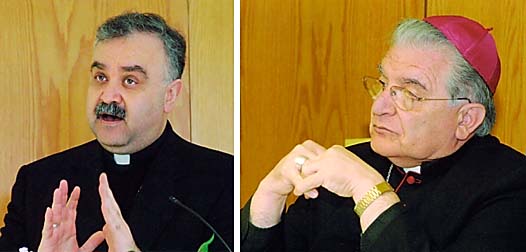
Unity Crucial to Iraqi BishopsTwo Iraqi bishops — leaders of two faith communities — have joined together on an uncommon mission. Bishops Mar Sarhad Yawsip Jammo and Mar Bawai Soro not only share a common vision of a reunified church of the East, but see that unification as vital to preserving the rich spiritual history of Iraq . The church leaders discussed the topic, “Christianity in Mesopotamia from Evangelization to the 21st Century,” during the annual meeting of the Eastern Catholic Pastoral Association held Jan. 20 at the Diocesan Pastoral Center in Sacramento . They also discussed their personal experiences of growing up in Iraq and the present situation in that country in an interview with The Herald. Bishop Jammo is head of the Chaldean Catholic Diocese of the Western United States (Eparchy of St. Peter the Apostle), based in El Cajon, California, and Bishop Soro leads the Christian Assyrian Church of the East (Diocese of Western California), based in San Jose.
“This is a very special church we are talking about,” Bishop Jammo said, referring to the church of the East. “On a faith level we are the same. We've got to come together again.” Echoing that sentiment, Bishop Soro spoke of the spiritual bond uniting the two faith communities. “We realize our mission is really to love one another,” he said. “When we begin the process of imitating God,...we can become real Christians who find themselves united in so many different ways.” The Assyrian Church , which is rooted in the missionary preaching of the apostles Thomas and Bartholomew, became isolated from other Christians following the Council of Ephesus in 431. The Chaldean Catholic Church was formed in the mid-16th century by a group of bishops who separated from the Assyrian Church to enter into union with Rome . “This is a church that has biblical footing; this is a church that is apostolic, where spiritually there is a beginning of humankind,” said Bishop Jammo, as he discussed the history of Mesopotamia, the site of the world's first civilization and land that includes the present-day Iraq. “We have to keep it for all Christianity.” Bishops Jammo and Soro have played a prominent role in efforts to reestablish full ecclesial unity between the Chaldean Catholic and Assyrian churches. Both contributed significantly toward the signing by Pope John Paul II in 1994 of the Common Christological Declaration with the Patriarch of the Assyrian Church of the East. The religious leaders were both born and raised in Iraq . Bishop Jammo was born in Baghdad and Bishop Soro in Kirkuk . Bishop Jammo said as a Christian growing up in the Islamic state of Iraq , where he lived until he moved to Rome in 1958 at age 17, he lived within a definite framework of restrictions. “Freedom of religion was not freedom of religion — it was freedom of worship,” said Bishop Jammo, clarifying the distinction between the two. “The media was dominated by Muslim culture. A Christian could become a Christian but a Muslim was not allowed to become a Christian.” Bishop Soro left Iraq in his late 20s for the United States to serve as a priest in the Assyrian Church . He said living in the United States reshaped his perception that he lived a “normal life” growing up. “Assyrians come from a context of isolation. People labored hard,” he said. “Coming to the West...there is an added value to individual liberties and respect for various aspects of our humanity.” The bishops spoke movingly of the humanitarian crisis the Iraqi people have suffered for decades and the need to rebuild a culture that has long been suppressed. Bishop Soro said the rise of Islam in 630 under the leadership of the prophet Mohammed “at a time when Christians were killing one another in the absence of a Catholic and general Christianity,” would ultimately prove to be “a most influential factor in shaping the history of humanity today.” He discussed the impact of the terror and persecution that defined the reign of former Iraqi President Saddam Hussein. “Nobody knew about the atrocities this guy for 35 years had been inflicting,” he said, recalling the amazement several American priests expressed when he talked with them several years ago about Hussein's oppression of non-Arab ethnicities in Iraq . “Now everybody knows, but really the reality hasn't changed. We are still suffering.” As U.S. officials move through the transition from war to determining the form Iraq 's new government will take, the bishops expressed grave concerns about the violence being inflicted on the Iraqi people. Thousands of prisoners released by Hussein before he was overthrown now kill, steal, rape and kidnap, they said, and churches have not been spared this violence. Bishop Jammo reported that Christmas night Masses were canceled this year because of the lack of security and many churches are canceling first Communion classes for the same reason. “People cannot go into the streets or to churches for fear of being kidnapped or attacked, not only because they are Christians,” he said. Bishop Soro believes the war itself was a positive exercise because it removed oppression. He identified, however, the dissolution by U.S. administrators of the Iraqi army and police force as two mistakes made early on during the occupation. “As a consequence, there was a huge amount of unemployment, an increase in crime and a gap in security,” Bishop Soro said. “Iraqis know how to handle Iraqis — they know the language and they know the culture.” He pointed out that Christians and ethnic minorities have always played a “significant and civilized role in progressing the affairs of Iraq ,” and sees the unification of Christians as even more crucial today. Currently there are about 700,000 Chaldean Catholics and more than a million Assyrian Christians in Iraq . Other Christians in Iraq include Syriac Catholics and members of the Syriac Orthodox and Protestant churches. But the fact remains, Bishop Soro hastened to add, that the Chaldean and Assyrian population in Iraq is dwindling. Following World War I, about 90 percent of this population lived in Iraq with the balance in other countries in the Middle East and a few in the United States. By World War II, about 70 percent lived in Iraq and the other 30 percent had moved to Western Europe and the United States . By 2003, only about 40 percent of the Eastern Christian population remained in Iraq . “At this rate by 2010 there will be only 20 percent Assyrians and Chaldeans remaining in Iraq ,” Bishop Soro said. “We have been living in a very dynamic reality for 2,000 years and now need to rethink our differences.” Whether the United Nations or NATO should take a leadership role in shaping the new government in Iraq is the only matter related to these issues on which the two bishops do not agree. “For me the United States is a major player, but you need some international global reference (to preserve) the balance of ethnicities,” Bishop Jammo said. “If you don't preserve that, Christianity and freedom will be compromised.” It is Bishop Soro's opinion, however, that if the United Nations is involved, the struggle of power between “the rising superiority of Europe and the existing superiority of the United States ” could be a negative factor in determining the democratic process in Iraq .
|

|

|
Joseph K. Grieboski |
Janice Shaw Crouse, Ph.D. |
Donna M. Hughes, PhD |
Most Reverend Ibrahim M. Ibrahim |
Fred Dallmayr |
Leon E. Irish |
Claudia Barlow |
Derek Davis, Ph.D., JD |
Daniel Kennelly |
Gary Bauer |
Rabbi Allen I. Freehling |
Phyllis Kilbourn, |
Ann Buwalda |
Charles Haynes |
Nicholas P. Miller, Esq. |
Bruce J. Casino, Esquire |
Bishop Clyde M. Hughes |
William J Murray |
Cliff Kincaid |
Faith J. H. McDonnell |
David W. New |
His Beatitude, Timothy Paul |
Tony Perkins |
Amy Ridenour |
Sandy Rios |
Reverend Rob Schenck |
Lew Uhler |
Harry Valentine |
Paul M. Weyrich |
|
(ZNDA: Tehran ) The Guardian Council has approved qualification of 5,625 candidates for the 7th Majlis elections (Iranian Parliament), slated for 20 February. More than 2400 were disqualified. Reformers, including President Mohammad Khatami, strongly criticized the disqualifications, and a government survey forecast that only about 30 percent of the electorate will vote.
The Guardian Council reports in its website that 12 of those branded as competent for the elections are religious minorities, who will run the campaign for winning five seats at the 290-seat Majlis. The GC said that 24 people, representing religious minority, had turned up volunteers for the process but the council had approved qualifications of only 12 people.
Based on the report four Assyrians will run for the “Assyrian and Chaldean” seat in the Majlis this year. They are the incumbent, Mr. Yonatan Bet-Kolia; Mr. Fereydoun Bet-Yonan, Mr. Yonatan Bileh Khanshan, and Dr. Shemiran Davoodpourian.
Religious minorities will have separate balloting stations, including 15 fixed and three mobile ones for Assyrians.
(ZNDA: Vatican ) John Paul II met Iran 's Foreign Minister Kamal Kharrazi and in the context of the 50th anniversary of diplomatic relations, made an examination of the present relations between the Holy See and Iran .
During the audience with the Pope, as well as in Kharrazi's subsequent meeting with Vatican Secretary of State Cardinal Angelo Sodano, reference was made "to the situation of the Catholic Church" in the Islamic republic.
Special attention also was paid to "collaboration between the Holy See and Iran in the realm of interreligious dialogue, the promotion of peace and other international questions on which there is a coincidence of points of view."
The Holy Father told his Iranian visitor: "Your presence here is a sign of the cooperation that, for more than 50 years now, has marked the official relations between the Holy See and your country."
"I am confident that this spirit of collaboration will continue to grow ever stronger as we address issues of mutual concern to us," he said.
Among these issues is the "ongoing commitment to safeguard the inalienable rights and dignity of the human person, especially in efforts aimed at promoting greater understanding among peoples of different religions, cultural and ethnic backgrounds," the Pontiff added.
The 4th Islamic-Christian Colloquium took place at the Vatican on Nov. 29-Dec. 2, with the participation of eight delegates from Iran , including Ayatollah Mahmud Mohammadi Araghi, president of the Organization for Islamic Culture and Communication.
The participants were received by John Paul II, who said at the time: "The holy name of God must never be used to incite violence or terrorism, to promote hatred or exclusion."
[Z-info: Here is the address John Paul II when he received in audience Kamal Kharrazi, Iran 's Minister of Foreign Affairs.]
Your Excellency,
I am pleased to welcome you today to the Vatican . Your presence here is a sign of the cooperation that, for more than 50 years now, has marked the official relations between the Holy See and your country. I am confident that this spirit of collaboration will continue to grow ever stronger as we address issues of mutual concern to us.
Not least in this regard is the ongoing commitment to safeguard the inalienable rights and dignity of the human person, especially in efforts aimed at promoting greater understanding among peoples of different religious, cultural and ethnic backgrounds.
Mr. Minister, I assure you of my good wishes for your stay in Rome and I invoke upon you the blessings of Almighty God.
(ZNDA: Turlock ) President William Julian, along with the new officers and board of directors for the Assyrian American Civic Club, have a new focus for their new administration: Less bingo and more openness with a desire to include the burgeoning youth of the Assyrian community.
According to Julian, the new administration is looking to make a complete change in the way that it relates to the more than 10,000 Assyrians in the Turlock area.
“Our youth are growing up and finishing college now. We have to respect their intelligence and ideas,” Julian said. “They are our future. It is very important to include them in the club.”
Julian, the officers and the board plan to attach a youth center to the current club building, a place where young Assyrians can come together to play sports, eat, and hold events like parties or dances.
“They will be able to come and play basketball or volleyball and get something to eat. And if they want to have a DJ party, they can have a DJ party,” he said.
The president also said that the club will encourage Assyrian involvement in elections and local events.
“We are going to open up the walls, talk with our neighbors, register to vote and perhaps run for office,” he said. “We are all good citizens who value hard work and our families. It is important for us to be involved in the community.”
One of the more significant changes to the club will be a possible end to the long-standing Sunday-night bingo program.
“We have been losing about $5,000 dollars a month at bingo,” said Julian. “We like to run bingo, but we cannot continue to lose this money. We know this might hurt some citizens, but unless something changes we will be stopping bingo.”
The matter is not yet set in stone however. It will be put to a vote among the general members of the club at the next meeting on March fifth.
The newly elected officers of the Assyrian American Civic Club are:
President.....................................................William Julian
Vice President.............................................Sam David
Recording Secretary....................................Mary Agassi
Correspondence Secretary..........................Monica Sliva
Assyrian Secretary......................................Bella Oshana
Treasurer....................................................Robert Aziz
Financial Secretary......................................Isho Hermiz
Bingo Director............................................Valodia Jacobs
Ladies Auxiliary President...........................Maggie Synstad.
The directors of the board are:
..................................................................Ashour Yonan
..................................................................Edison David
..................................................................Sargon Hakimi
.................................................................Walter Mansoor
..................................................................Zaya Sargis
..................................................................Youash Stepans

|
ACCR Presents: Meet the Candidates ForumAssyrian Committee for Civic Responsibility (“ACCR”) is proudly hosting: "Meet the Candidates Forum" Assyria may not be a country right now, but it can have a voice. If you get involved in politics, Assyria will have a strong voice. Now More Than Ever… Be Seen. Date: Sunday, February 22nd Time: 1:30 p.m. – 3:30 p.m. Place: Ramada Plaza Hotel, corner of Touhy and Lincoln Ave. , Admission Is Free!!!! Refreshments Provided!!!! The Forum will be an opportunity for all U.S. Senate candidates from Illinois to personally state to the Assyrian community where they stand on important issues. In addition, the candidates will gain direct knowledge about the concerns and preferences of the Assyrian community. Calling for Survivors of Assyrian Massacres, Their ExperiencesFellow Assyrians, I am in the final stages of finishing my second book. My first book is with the publisher at this time and will be coming out this spring. The second book is about the Assyrians in the last 150 years. A special chapter in the second book will include transcripts of interviews conducted with elderly Assyrians (known also as Chaldeans, Nestorians, Jacobites, Suryan). These are persons who witnessed or were personally affected by one of the following: the genocide during World War I and its aftermath in modern Turkey and Iran; Simmel massacre in Assyria (modern north of Iraq); personal persecution in any period in any country in the Middle East; or events related to any of the above periods that changed their lives. If you are interested in having your accounts (or the accounts of someone you know) being part of this book, please e-mail me first at fred.babylon@att.net to arrange for transfer of material. You need to include:
Thank you.
|
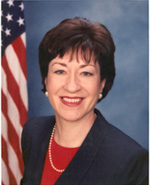
Protecting the Rights of Women and Minorities in IraqLast July, I had the opportunity to visit Iraq , and during my trip I was able to talk with some Iraqis about their hopes for their country's future. The work of transitioning to a democratic society is a Herculanean task. Nevertheless, after years of repression and war, most Iraqis are eager to begin to enjoy the peace and freedom that they deserve.
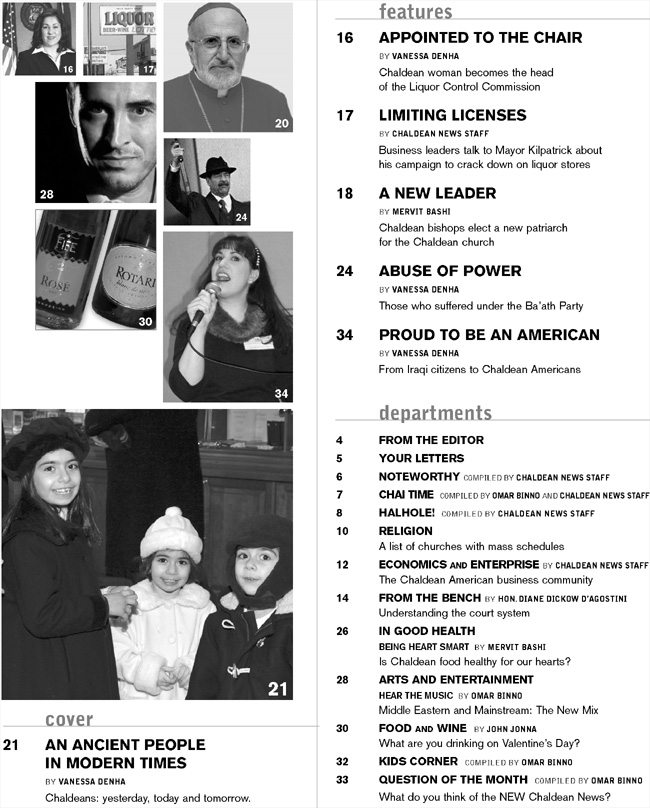
Our goal is to help the Iraqi people move toward a free and democratic society where diverse populations are respected, individuals are guaranteed freedom of religion, and where men and women are treated equally. Iraq is home to many religious and ethnic groups, and it has historically treated women far better than many of its neighbors in the region. We must be vigilant in these early days of rebuilding to ensure that women and other groups are not left behind as the nation moves forward. Why are freedom of religion and equal rights for women so important to the future of Iraq ? A constitution that embraces diversity, religious freedom, and women's rights makes civil unrest and sectarian strife less likely and increases the likelihood of a unified country. Without a basic respect for all people, the ideals that are the key to establishing a healthy and open society can never fully be realized. It is crucial that the right of religious freedom be explicitly guaranteed for individuals of all religions. Whether a Shiite or Sunni Muslim, a Kurd, an Assyrian or Chaldean Christian, every Iraqi's rights to practice religion according to his or her conscience should be protected. Regardless of ethnic or religious origin, it should be the goal of the Iraqi Governing Council to strive for a society where all men and all women can expect equal protection under the law. For that reason, I am concerned that Iraqi Governing Council Resolution 137, which was approved on December 29, will not accomplish two vital components of a democratic form of government—religious freedom and the rights of women. Resolution 137 would place Iraq 's female citizens under Islamic Shari'a law, removing secular protections that adopted during Saddam Hussein's regime. Ironically, Saddam Hussein was an equal opportunity oppressor. While there are many different interpretations of Shari'a law, most encourage discrimination against women. Instead of passing such a resolution, the Iraqi Governing Council should be promoting a society in which educational, political, and economic opportunities for women are protected and allowed to flourish. This resolution cannot stand. The passage of this resolution would incorporate Shari'a law into the civil code, thereby affecting inheritance law, domestic law, and marginalizing women. Furthermore, some Islamic interpretations would prohibit women from taking part in public life as equal citizens. As interpreted by some Islamic clerics, Shari'a law commonly forces women to cover themselves with a veil and to marry early. It legalizes polygamy, denies women child custody rights, and permits a husband to divorce a wife immediately and with no cause while granting a woman no divorce rights whatsoever. Worse yet, it sanctions execution by stoning as punishment for female adultery – and “adultery” could simply mean being in the presence of a man who is not a family member. It is critical that Iraqis are able to enjoy real freedom, and in order to spotlight this issue, I recently joined in a press conference to discuss the urgency of protecting the rights of all Iraqis. We were joined by representatives of Iraq 's ethnic and religious minorities and women's advocacy organizations, and we stood together in calling on the Iraqi Governing Council to ensure that the new constitution includes the protection of the rights of women. Religious freedom requires that a woman have the choice to wear a veil or not, depending on her beliefs. Freedom demands that women be treated equally to their male counterparts in matters of law. And it requires that obscure and barbaric practices intended to intimidate the female half of the population be kept out of a country's system of laws. I am hopeful that, with enough attention to this issue, we can ensure that a critical mistake is avoided in the earliest days of the new, free Iraq . In the months and years to come, Iraqi women will play a large role in creating a strong and prosperous nation, but only if their rights are guaranteed by the Iraqi Constitution. [Z-info: Senator Collins was elected to represent the State of Maine in the United States Senate in 1996, and was reelected to a second term in 2002. For more information visit Sen. Collins' website at http://collins.senate.gov.] An Ancient People in Modern TimesChaldeans: Yesterday, Today, and Tomorrow [A new publication hit the newsstands this month. The Chaldean Times is a monthly magazine for individuals, organizations and businesses interested in working with the Chaldean community. The objective of this magazine is to increase the public's awareness of the achievements, heritage, concerns and interests of the Chaldean Catholic communities around the world. Zinda Magazine congratulates the staff of the Chaldean Times on this bold and important step. The following is an article published in the first (current) issue of this magazine. To subscribe please visit: http://www.chaldeannews.com/Subscribe.htm.] It's a critical time for the Chaldean community, both in Iraq and the United States . The sweeping changes that have taken place since the onset of the war present us with an opportunity to step back and reflect on the cultural climate. Saddam Hussein is no longer in power. Iraq is being rebuilt. The Chaldean church has a new patriarch. In order to try to predict the future, one must study the past and understand how we got to this point in time. Who are the Chaldeans?
“The Chaldeans of Beth Nahreen, once known as Mesopotamia, present day Iraq, east Syria, and south east Turkey, are a living continuation of all the indigenous people of that region, regardless of their tribal names,” explained Mar (Bishop) Sarhad Jammo, in an extensive essay about Chaldeans printed in several publications. Mar Sarhad, a known historian with a doctorate degree, teaches that today's Chaldeans have a heritage that spans the tribal groups once referred to as the Sumarians, Akkadians, Amorites, Babylonians, Assyrians and Arameans, in addition, the Chaldeans of today speak Aramaic, a dialect of the language spoken by Jesus Christ. When these people embraced Christianity, they were known officially as the “Church of the East.” This church split from the rest of the Christian World (including Rome ) in the 5th century. It was not until 1552 that a large number of people came back to union with Rome . In order to distinguish them from the rest of the church that remained separate, the term “Chaldean Catholic Church” was given. These Catholics, along with their non-Catholic brothers, spoke Aramaic. They were not Romans, Medes, Turks, Mongols, or Macedonians. Therefore, the name Chaldean has come to bear national significance with its linguistic, cultural and religious connections. Today the Chaldean Church consists of Middle Eastern Christians and is one of the 18 Eastern Rites recognized by the Vatican in Rome as being Catholic. Throughout the world, there are more than one million Chaldeans with the greatest concentration in Iraq . At the turn of the 20th century, a few Chaldean families began to emigrate from Iraq, but it wasn't until the 1960s that a large flux of Chaldean families left their hometowns of Alqosh and Telkaif (where most Chaldeans came from) and settled primarily in Detroit and San Diego. They have been moving to the United States at a steady pace for many reasons. Some wanted to pursue economic opportunities in the U.S, others wanted to experience the “new world”, some wanted to be near family and some people were trying to escape the Ba'ath Party regime. In 1958, Ba'ath officers in the army seized power in Baghdad by overthrowing King Faisal II. The first attempted assassination was preempted by a coup led by General Abdul Karim Qassim, who was later killed by the vengeful Ba'ath party. His torture and execution was shown on television. They had originally selected an assassin by the name of Saddam Hussein. The ambush didn't go as planned and Hussein failed to hit the general and was injured himself. Hussein then fled to Egypt , where he went to law school but never graduated. When he returned to Iraq , he again joined the Ba'ath party and quickly rose in rank to become the chief torturer in the basement of a former royal palace. He spent his days as the interrogator at an infamous dungeon called the “Palace of the End.” By 1973, Hussein was vice president of Iraq under General Ahmad Hassan al-Bakr. In 1979, Hussein became the Iraqi dictator and head of the Ba'ath Party, after President Bakr resigned under pressure from Hussein. He ruled the country until recently when the U. S. military captured the dictator eight months after its mission, Iraqi Freedom, began. “Saddam's Capture was a relief to everyone,” said Rev. Manuel Boji,, pastor of Mother of God Church in Southfield . “Now, he should be tried by the Iraqis. Unless there are evident crimes internationally, his crimes should be judged by those in Iraq .” However, what to do with Hussein is not the focus of the Chaldean church or their mission of spreading God's word and preserving the Chaldean culture. The future of the Chaldeans is dependent on many factors including whether Chaldeans will continue to emigrate to the U.S. or move back to Iraq . “It depends on what will develop over the next five years,” said Rev. Boji. “People in Iraq are hoping life will get better. However, there is still a lack of security. Chaldeans business owners who sell liquor at their establishments are still targets for criminals. It is a Muslim dominated country and liquor is against their religion. There still isn't a strong safety net for Chaldeans in Iraq .” A local professor who has studied the Chaldean culture agrees with Rev. Boji. “I think they are reserving judgment about the stability of whatever is likely to develop in Iraq ,” said Mary C. Sengstock, Ph.D professor of sociology, Wayne State University and author of two books on Chaldeans. * “I don't think any Chaldeans are likely to decide to return to Iraq until they are certain that the situation is safe,” she continued. “In addition, most Chaldeans in the Detroit area have become quite comfortable in the U.S. ” Here in the U.S. many Chaldeans are prospering. Most are entrepreneurs and professionals raising their families in middle class suburbia. Over the years, Chaldeans have adapted to the American way. In Iraq , life is different. However, Chaldeans will be an influence in the Iraqi government. There is a committee now working to establish a fair constitution for all religions in Iraq . “Life is much better in Alqosh now,” said Sabiha Barno, a 64-year- old woman who was born and raised in the northern Iraqi town. “The Americans are doing everything for us. They are providing running water, they are fixing our roads and our schools and they are bringing medicine.” The historical town of nearly 7,000 people is tucked away in the mountains, and is known for religious miracles having been performed over the centuries — stories that have been passed on to every new generation. It's a life foreign to the more than 30 American soldiers stationed there, including a military physician and a minister, and Barno is surprised at how well they have adapted to the Chaldean culture. “They all come to our weddings and parties bringing gifts,” Barno said of the soldiers. “They come knocking on our doors trying to see who is making dolma (stuffed grape leaves) for the day. They have fallen in love with our food and culture and some of them have asked to marry some of the young girls from Alqosh.” The soldiers live in a monastery built centuries ago. Its name, when translated into English, is “Our Lady of Crops”. Barno said that for the first time in years, people feel safe in her town. However, not everyone in Iraq lives freely. As widely reported, there are tensions, attacks and suicide bombings in Mosul and Baghdad . Barno's daughter narrowly escaped death while leaving church one Sunday. She was just a few feet away from a car bomb that killed 10 people in Baghdad . The mother of 10 children and 17 grandchildren is hopeful that life will only get better in her hometown. She believes that Alqosh will be one of the most traveled tourist attractions, and become known for its lavish landscape, historical buildings, biblical stories and churches. Although an ancient people, Rev. Boji said we must work diligently to preserve our culture, religion, language and history. The first generation is the link that will keep the chain strong. “The Church is doing the best we can to preserve our heritage but our number one focus is religion. It is up to the community to keep the culture prospering.” Not only does the church teach Aramaic every year, Mar (Bishop) Ibrahim Ibrahim has incorporated a series of lectures on the history of the Chaldean church. “We come to this country bringing our rich flavors, but if we don't preserve them by teaching our children the language and history, the community won't continue to grow,” said Rev. Boji. Dr. Sengstock's books are Chaldean Americans: Changing Conceptions of Ethnic Identity (Published By Center for Migration Studies, New York -- 1st Ed 1982; 2nd Ed, 1999) and Detroit Chaldean Community: An ancient people in modern America (Published by Michigan State University Press, 2004.) Five Essays by Rev. Ken Joseph
A Day in Baghdad People often ask `what exactly do you do in Iraq `! Probably the best thing to do would be to do a quick summary of a typical 24 hour period. The morning starts with two Assyrian women at the door of the Church facility asking for urgent help. The son has been arrested by the Americans mistakenly and has been in prison for three months. He was simply a the wrong place at the wrong time can we help? We sit down with the Priest and discuss the situation. Track down what prison they are in and begin the process of making the necessary arrangements with the US officials to get the son out of prison. We pause and pray together that God will help us. Next stop the airport to check on the 14 Assyrians working at new jobs. Are they ok? Are they working hard? The US Official in charge says `They are great! They work hard and are always on time!` Then back to the Convention Center which houses part of the US Administration to get information on other Jobs for the Assyrians and to get information to help the missing. A shouting match with one of the Coalition Provisional Authority Officials working on the Constitution `Dont even think of trying to turn Iraq into an Islamic Country - we will not allow you to do it. We are Assyrians and Christians and we will fight you if you try! Dont take us as easy!!` `OK, ok. Don`t worry. We will!` he replies. Another trip to the airport, this time taking two Assyrian women to apply for new jobs through one of our friends at the airport. We go through the interview. One is hired on the spot - for $600 a month - over ten times her current salary and enough to support a family and more and the other a job in a week. A quick check to see that our security is ok, the machine gun and pistol in place, our telephones working and back to work again. Interviews with Assyrians getting down their condemnation of the change in the Civil Registration Law replacing the secular system with an Islamic one and their opinions on different topics. Then a series of interviews with Iraqis asking them what they think of a muslim constitution for use by Foxnews and CNN. They all say regardless of whether they are Shia, Sunni or nothing that they do not want an islamic constitution. A quick stop to see our friends at the CNN Bureau to pick up some previous tapes, a visit to a Japanese News Network. The guy at Foxnews laughs and says `Ok, I have to mention the Assyrians, right? Got it!! Get out of here! And it is a day! 24 hours a day working to help meet the daily needs of the Assyrians in Iraq and fighting not for a compromise but for victory that results in for now, a secular constitution, autonomy in Nineveh and Dohuk provinces, elections with special rights for Assyrians and no turnover of Government until that is accomplished and after the dust has settled - a nation of our own - Assyria, Independent, free and strong! Not begging for crumbs off the tables of the muslims or hoping agains hope that something good will happen but working 24 hours a day for three things - the daily needs of the Assyrians, jobs so they can support their families and fighting, not negotiating, talking, hoping but FIGHTING with the authorities demanding - not negotiating, talking, hoping but DEMANDING that the minimal rights of the Assyrians be given . . . or else. Tough? Yup! Worth it? Double Yup! Since when were the Assyrians quiet, obedient and settled for the crumbs off the table! Not these! We are not nice, able to be entreated nor rational when it comes to the demands and will never, never, never settle for anything less than the simple, clear and easy to understand demands that we make. Some may serve parties, some governments others organizations but we serve God and hold His power in one hand and His promises in the other! At the end of the day, curled up in a nice, warm, Assyrian bed after a dinner of Assyrian Chicken and rice suddenly the room is especially warm, the tears start to trickle down the cheeks and somebody is clearly in the room. You cant see Him, you usually miss his presence but once in a while you truly know He is there. His quiet voice says the one thing that makes it all worthwhile. `Good job`. And then quietly in the sweet presence of Jesus sleep comes! A Genuine Assyrian Hero These days it is hard to find an Assyrian Hero. For whatever the reasons precious few have risen to the challenge of a millennium, the best chance to achieve what has always only been a dream - a country of our own. One of the favorite movies of the Assyrians in Iraq - I saw it the other night on Ashur TV complete with Arabic Subtitles is the movie Braveheart. For those who have seen the movie the question is always `Where is William!`. William was the hero of the story which is of the fight for independence of Scotland . William gives his life for the independence of his country ending it moments before his death by shouting `Freedom`! The other protagonist is Robert, the always compromising, always cautious Noble Lord. In the end, though because of Williams example of courage he changes and stands up for once in his life and leads his people to freedom. One line in the movie stays with you for life. `Men dont follow title - they follow courage!`. If there ever was someone who exemplifies that phrase it is Mar Gewargis Sliwa. Unassuming when you meet him, he is in fact a quiet `William`! During the terrible reign of Sadaam he staunchly refused any mention of the Dictator in his services even as others considered this normal. He constantly fought the fine line of working with and not giving in to for his people, carefully negotiating agreements to keep the Churches free, print Bibles and Books and run the schools. A huge achievement under such terrible conditions. I first met Mar Gewargis years ago in the US and we began a long correspondence concerning our mutual interest in the great exploits of The Assyrian Church of the East in China , Japan and throughout Asia . Over the years we shared the excitement of new discoveries of the Church in China and Japan and one of the daily nightmares of my life was having to look at a passionate fax from Mar Gewargis to hurry and come to Baghdad so we could continue our work on the Church in Asia. The war stopped all that and I finally made it to Baghdad weeks before the beginning of the war. I found a strong, uncompressing Mar Gewargis with a staff that was equally so. Many begged Mar Gewargis to leave before the war. While many did, he was uncompromising in his clear desire to stay. I remember him saying `I must stay with my people. They need me.`. Even as the war became closer and closer he did not change his position and stayed in central Baghdad fearless in the fact of the attack and final fall of the city. When I returned days after the war having left with the United Nations on the last day, this time with a truckload of supplies there he was with a chipper `Why didnt you call! What are we going to do with 20 tons of water and supplies! You could have at least called` he said with a smile! We all laughed! The telephones still do not work! I found an equally defiant Mar Gewargis, none the worse for the wear now in a position to lead his people in the new situation. Just as he had been uncompromising in the face of the all powerful Sadaam he was and is equally so towards the Americans, the Chaldeans or anyone that stands in the way of the freedom of the Assyrian people. In a powerful letter addressed to Ambassador Paul Bremer he outlines the situation developing between the two Churches and uncompromisingly states `None of them (Chaldeans) can prove that the designation `Chaldean` ever existed before their conversation to Catholicism in the middle of the 16h Century. I wonder if anyone is reasonable to alter his nationality according the the faith he is proselytized to or it is possible for an Assyrian father to beget two children one Assyrian and the second Chaldean or whether it is permissible for a person to change his national identity in accordance with circumstances.`1 These days, Mar Gewargis runs a very tight schedule with meetings with various leaders, performing the duties of the Church at all hours of the day and night and teaching his people that courage counts. The other day we couldnt see him because a delegation of Muslim Mullahs were there to pay their respects. Problems? There are many. Much like happened following the fall of Communism in Russia there is a growth in many new Churches in Iraq who take the easy way out in building their churches and instead of making new converts as they are biblically supposed to, they `steal` them from the Church of the East. Mar Gewargis answer? Just keep going! He puts it this way `It is time we desist from cedings and dissimulations that do not accord without our Christian Doctrines and at the expense of the nation. and let us proclaim `We are Christians and member s of the Apostolic Church of the East in which we all pride ourselves and we are Iraqis and we have the honor of being the legitimate heirs of the greet, deep rooted civilization and we are Assyrians, the descendents of those noble ancestors, the men of Nineveh who believe in God and proclaimed a fast for which our Lord Jesus Christ Blessed us.`2 In a time when the Assyrian Nation desperately needs heroes, there is one! Quiet, humble but with the fire of God on him - Mar Gewargis Sliwa, Archbishop of Iraq, The Church of the East! Mel Gibson in the Movie Braveheart has his hero `William Wallace say `Men don't follow Title; they follow Courage`. Once in a great while God puts the two together and you have a man with both title and courage! Mar Gewargis, all his priests scattered throughout Iraq and the precious Assyrians here in Iraq deserve our prayers and support. Thank you, God for Mar Gewargis! Give him even more courage and may he be one to lead our people to independence! US Taxpayer Funded TV Station Propagates Islam! You would think it was Sunday Morning! It is 11:00 and the Televangelist is preaching. Today`s topic - `Repent of Your Sins!`. Reading from scripture, the text he is speaking from flashes across the screen, followed by a dramatization of the scripture passage, complete with period costumes and sets involving well known actors. The `Televangelist` comes back on the screen and begins to preach, scripture in hand with all the `hell and brimstone` fervor of a Southern preacher. Sunday morning TV in America ? No the name of the program is `Morals And Islam` and it is on Al Iraquia - the American Taxpayer funded Television Network in Iraq . `Morals and Islam` is followed by `The Door of Hope`, a more contemporary, visual oriented program, again propagating islam Following that is the five time daily `Call To Prayer` featuring footage from the Grand Mosque in Mecca urging all Iraqis to pray! Shortly after this is the next program entitled `The Good Names of God` - another high pitched, sing song chant of `Allah is the one, the good, the powerful, the forgiver etc. etc` accompanied by unusual video - the faithful filing the mosque! Following this another islamic televangelist reads the koran and name by name begins to offer commentary on the various names of Allah - again at American taxpayers expense! Watching in disgust is 27 year old Assyrian Christian, Remon Lazarus. `We were used to this - under Sadaam! Everybody knows Al Iraqia is funded by the Americans so we are very, very dissapointed to see this. A government station should not be proselytizing for one religion. We did not think this was what the Americans were going to do. We thought they were going to help us develop a normal country.` `As Christians, it is particularly difficult for us because the message it gives is that even the Americans are supporting an islamic government in Iraq . What can we do? We are deeply disappointed and angry, but also afraid for our future. We feel as if one dictatorship will now be replaced by another - this time islamic which will be eve worse for all Iraqis and in particular for Christians.. As if that was not bad enough, the five time daily `Call To Prayer`, one of the key factors in the intimidation of the people is broadcast. Sitting in a house in downtown Baghdad it comes in stereo - one side from the Television and the other from the local mosques massive speakers blaring outside. Five times a day words from the Koran flash across the screen in a clear message to a public yearning to be free from intimidation that one form of totalitarian government is slowly replacing another. 23 year old Venus William, an Assyrian Christian too interjects `It makes me angry! We are not muslims. We respect other faiths but it is wrong for one religion to be forced on the Iraqi people. It is not democracy nor is it the rule of law. Why is this happening even after Sadaam is gone? We want the Americans to help us build a normal, free country so there will be a future for our children and not another dictatorship. I think the American people will understand our plight and help us.` Ambassador Paul Bremer, the much respected American administrator of Iraq, ruling through the American installed Coalition Provisional Authority reacts to the growing `islamization` of Iraq with a naive `Well, the Iraqis are all muslim aren't they?.` Ask an Iraqi and you will find near unaninimity on one very crucial point - they are adamant that they do not want to become an Islamic state like neighboring Iran . Hayder Mousa, 33 and a Shiite Muslim says clearly `we do no want to become an islamic country like Iran . We just want to be a normal country like others where government and religion are separate. Why cant the Americans understand this.` When pressed on the subject `Ambassador, are you aware that the Iraqis do no want an islamic government` he appears puzzled and again replies `But they are all muslim?` This is where the crux of the problem lies. There is a grave lack of understanding of what is lumped together as `islam`. In clear violation of the Koran which teaches `Religion shall not under compulsion` the whole notion of `islam` is a myth perpetuated by those simply using it to stay in power. The reality is very different on the ground. Simply put what is referred to as `islam` collectively is simply a system kept in place by intimidation and the use of `islam` as a cover. In a little known `dark side` of the whole operation is the power of what is nothing less than a police state. A quick check around at one of the five time daily `Calls to prayer` and you will find two, three people pausing to pray, near empty mosques and with a few exceptions literally nobody doing it all. The five `Pillars` of islam that define a persons faith - the five times daily prayer, giving to the needy, the month of fasting, the once in a lifetime trip to Mecca are near completely ignored. Ramadan the month of supposed fasting is the one time of the year when people party and ironically gain weight as they are not allowed to eat during the day so compensate by overeating after dark. Ask Ali Hussein, 56, if he prayed today. His answer a confident `no`. `Do you ever pray`. Again `Maybe two or three times a year`. More enlightening is the question of why you dont want an Islamic government. His His answer is quick. `Because I love to drink and play with the women!` Once born into a `muslim` family one`s religion is put on an identity card, passport or other registration and may not be changed. Even more unbelievably only three religions are allowed - islam, Christianity and Judaism - believing in Buddhism, Hinduism, any other religion or nothing is not allowed by government fiat. Denying the most basic of human freedoms - the freedom of thought an belief so called `islamic` countries force those under their control to live double lives. Since they are not legally allowed to change their registration from `muslim` to the reality which would be `none` for most people create double lives - the public life and the private one of who they really are. People bring up the case of Saad, born to a Christian mother and Muslim father. The father left the family and the son, raised a Christian in secret has to come to church and practice his faith in fear because born in a muslim family he is not allowed by law to change from a religion he never accepted in the first place. The totalitarian state even involves itself in the daily lives of the citizens and in a major step backward the Civil Registration Law in Iraq which since 1958 had been completely secular was recently overturned by the US appointed Iraqi Governing Council and replaced by the much feared islamic Sharia law which makes all laws subject to the Koran. The one lone buddhist in Iraq sends frantic email messages `Help me. I am afraid for my life. As the only buddhist in the country as far as I know I am in constant hiding. Can you help me get out of the country. The `dirty little secret` of what is ostensibly called `islam` is that it does not exist. An Imam, or muslim priest speaking on condition of anonymity puts it more succinctly `Islam has failed because it is forced. Less than 10% of the people - maybe only 2 or 3 percent of the people actually believe. The rest are `muslim` simply because they are not allowed by law to change their registration and do not do any of what is consider the bare minimum to be a muslim.` Is it not time for the community of nations to recognize `islam` for what it is. A totalitarian political system that is used to abuse, intimidate and enslave millions of people worldwide? Is it not time to call the bluff and demand that it stop. A first major step? Stop funding it with American Tax dollars in Iraq . An incredible irony - while in the US the Ten Commencements is not allowed on public property American taxpayers fund Islami Televangelists in Iraq . The time has come to say `the buck stops here` to the totalitarian political system that uses the name of `islam` as a cover to keep power in the hands of `thugs` and return it to the poor people suffering under its control. If freedom is good enough for Americans it should be good enough for Iraqis, Iranians, Syrians and a host of other peoples living in `islamic` totalitarianism. `We just want to be normal. We just want a chance for normal, civilized lives. Our faith and religion should be private and free. We want religion out of government!` says `Shia muslim` `Mustafa Sadaam 23. After 35 years of the terror and intimidation of Sadaam and various predecessors the Iraqi people should not have another totalitarian state forced on them this time funded by the American taxpayer. A Governing Council funded by American Taxpayers overturning secular law and replacing it with the much feared sharia law! A Television Network and islamic televangelists funded, again by American Taxpayers proselytizing for Islam? Enough is enough! Worldwide Day of Prayer for Persecuted Church in Iraq ! The Assyrian Christian Community - the oldest Christian community in the world - is putting out a call to the worldwide Christian community for a day of prayer and fasting to beseech God to intervene on behalf of the community in Iraq . The Assyrian Christians are the indigenous or original people of Iraq . They were the people Jonah came to in Nineveh (Present day Mosul), the first people to accept Christianity following the death of Christ and the greatest missionary sending people in history bringing the Gospel first to China, Japan and India and all of the east! The Community is asking specific prayer for the following: Civil Law – The Secular Civil Law was replaced with Muslim Law – pray that this will overturned! This law regulates the daily life of all Iraqis! February 28 – A seriously flawed, Muslim temporary constitution is scheduled to be announced on February 28. Pray for its defeat! July 1 – Immediate repeal of the July 1 handover. If this premature handover goes forward there will be civil war and a massacre of the Christians. Constitution – A secular constitution with a bill of rights and no religion or ideology as demanded by the Iraqi Constitutional Committee. Elections – Free and fair elections with provision for the persecuted minorities Autonomy – Autonomy and local self government for all with the provinces of Nineveh and Dohuk as the homeland of the Assyria Christians The community is asking for special prayer for the above that God will intervene on their behalf and the oldest Christian community in the world and the Community with the largest sending of missionaries in history be preserved and allowed o live in peace and freedom after long persecution. Those joining in prayer are asked to send a message to pray@assyrianchristians.com or www.assyrianchristians.com The Assyrian Christian Community – the indigenous, original people of Iraq are asking the Christian Community worldwide to join with them in prayer one week before the scheduled announcement of the temporary constitution to beseech God for the following: • July 1 handover stopped – It is the conclusion of the community that the July 1 handover of power is to early and is in agreement with analysis privately of both he Coalition Provisional Authority and the Goernmegin Council that it will reaulst in Civil War and the massacre of the Christian community with word of such lists already being prepared. • Secular Constitution – There must be in place a secular constitution which the Constitutional Committee has recommended shall contain no words relating to any religion, idealogy, fair and free electons based on this constitution, seated government – only then can there be a handover of sovertignity. • Autonomy – There must be local autonomy and self government for the minority and long-persecuted Assyrian Christians in the Province of Nineveh (Currently Nineveh and Dohuk). Without this local, state government rights Contact: 1-646-785-0907 or pray@assyrianchristians.com or www.assyrianchristians.com Civil War , Iraq and the Election! The Al Jaiha Ice Cream Parlor in Baghdad is booming! The TV Monitors blare Egyptian Music Videos while a line is developing at the counter for the house favorite - a huge Ice Cream Sundae and customers are talking at a steady buzz! Ice Cream in Baghdad ? The news from Baghdad is bombing, terror and all bad these days but one must be careful to make a distinction. For the foreign journalist, soldier and others targeted by the non-Iraqi terrorists who are determined to block any progress in Iraq it may be dangerous. But for the average Iraqi hope is in the air! The two William sisters - Vinos 23 and Florence 21, the two Lazar brothers - Remon and Simon, 25 and 21 and Robert George, 25 are digging in. To the question `how does Al Jaiha compare to when Sadaam was in power` thy are quick to respond. `When Sadaam was in power we would be watching one of the three Sadaam TV Channels with him on TV or some old, boring black and white movie. Nobody would be talking freely and we would quietly eat and leave`. says Remon. `We lived in constant fear` continues Robert George. `You never knew when someone would be taken away for saying the wrong thing. It was a constant state of low level terror` he continues as he shares the story of his dear friend, Amir who was imprisoned for 3 years for simply trying to assert he was an Assyrian and promote the use of the language of the indigenous people.`. The Al Jaiha Ice Cream Parlor is a good barometer of how things are in Iraq . Ignored by the international media who for some reason, at least according to the regular Iraqi have a bias towards any good news from Iraq , Iraq is doing just fine, thank you! Ice Cream is not exactly a staple, and when people have enough extra money and hope to be packing out the Ice Cream Parlor on a Sunday night things must not be too bad. A quick look outside the window shows the real problem in Baghdad these days - massive, hour long traffic jams, crammed stores overflowing with everything imaginable for the Iraqis finally freed from decade long pariah status. And the future? `We are getting married in July!` chimes in Remon and Venos. `Everything is completely better` continues Robert George. `For the first time in our lives we have hope! We are getting jobs - not for $60 a month that would be the regular but for $600 and more. It is because the Americans cared for the people of Iraq and were the only ones with the courage to set us free.` `For the first time we can travel overseas, we can watch Satellite TV, we can surf the internet freely, we can buy cars and things from all over the world. Most of all, though the best is we no longer live in fear.` Prices are booming and the value of the Iraqi dinar is rising. A house that would go for 30,000 $ months ago is nearing $100,000. The Iraqi dinar which before the war fluctuated in the 2500 to 3,000 to the dollar range is now nearing 1200. For the average Iraqi it is the best of times. Something they never even dreamed of.. 27 year old Weena Aref, a Kurd agrees. She is the manager of an Internet Shop. `Business is booming. On a recent afternoon all the terminals were occupied with paying customers paying $3 to get online! `It is wonderful Sadaam is gone. We always lived in fear` she says. `As Kurds we were always persecuted and although we had our own relative autonomy in the North it was difficult for those of us living in Iraq. ` `The best part is that we no longer live in terror! We do not fear somebody taken away` she says, echoing other Iraqis. It is the best of times, but at the same time the worst of times The `bad`? It is the deep, palpable, undercurrent of fear that is gnawing at everybody, although few will speak of it. It is the planned July 1 handover of power in Iraq . While the original plan was to as in Japan and Germany, have a constitution, elections and a government in place, due, the Iraqis say to fears of the impact of Iraq on the upcoming US Presidential election the schedule was suddenly changed. `If the current plan goes forward there will be civil war in Iraq beginning on July 1` says an American official asking to be anonymous. `I have been told privately by both senior officials of the Coalition Provisional Authority as well as the Iraqi Governing Council this. In addition, the airport will close as no airline will fly into an airport without a government in charge` he continues. `I do not understand why the United States, the champion of freedom and democracy wants to leave Iraq before her job is finished - before a secular constitution, elections, government and local autonomy are in place and risk undoing all the good she has done in liberating Iraq` says Hekmat Hakem, a member of the Constitutional Committee charged with drafting Iraq's constitution. `The members of our committee do not want a muslim government. We do not understand this at all.` Robert George goes further. `I am an Assyrian. The Assyrians are Christians and we are the original people of Iraq . If the July 1 schedule goes forward we will be massacred. The last time this happened 2/3rds of the Christians of Iraq were slaughtered in the Assyrian Holocaust. We will not allow it to happen again. We cannot understand why the Christians of the world do not support us and demand that Iraq be free, democratic and secular.` A trip south shows the reality on the ground. Town after town in southern Iraq does not fly the Iraqi flag over government buildings, but the green flag of Sistani, the Iranian leader of the Shiites. `Why does the American Government talk to this man`. Robert George continues. `He is not even an Iraqi - he is an Iranian. The Americans should simply say that only Iraqis can have a say in the future of Iraq and send him back to Iran where he came from.`. Few in the rest of the world seem to realize this little known fact - the main source of trouble to the US authorities is in fact not an Iraqi but an Iranian. `We do not want to become like Iran . We do not want a muslim government.` echoes Shiite muslim Sadek Tarik, 36. We just want to be normal. We are finally free.` Sunni Muslim, Ahmed Tarik, 23, joins in `We just want to be left alone. Sadaam was terrible, but becoming like Iran would be worse.`. As the July 1 date nears a sense of doom is quietly growing underneath the outward sense of optimism, hope and joy that one sees everyday living outside the elite hotels where the foreign journalists are. `Did the United States go to war and lose so many lives to create an Islamic Government of Iraq` says Robert George? `I do not think the American people would ever agree to that. I think they want for us what they have - freedom, opportunity and a better life. As Christians we get along good with our muslim neighbors and as the original people of Iraq we pray for autonomy in our homeland in Nineveh and Dohuk provinces so like the American Indians we can administer our local affairs.`` It took the United States seven years to move Japan from a police state to a free and democratic society. The outbreak of civil war on July 1 would seem to even the most casual observer to have a far greater negative impact on the November elections than the improving situation in Iraq . For a first hand look, the Al Jaha Ice Cream Parlor is living testimony to the fact that the war was worth it, that good times are truly around the corner and the worst possible thing for Iraq would be a premature handover of power. Will there be the political will and the commitment to the values that launched `Operation Iraqi Freedom` in the first place or will as happened in China over 50 years ago the question `Who Lost Iraq` be the buzzword of the 2004 election? The next few weeks may very well decide the fate not only of Iraq but of January 2005! [Z-info: Rev. Ken Joseph Jr. known as `God`s man in Baghdad` is an Assyrian, directs www.Assyrianchristians.com, brought the first relief truck into Iraq following the end of the war an and is completing a book about his time in Iraq entitled `I Was Wrong`. Rev. Joseph is also directoring the new Assyrian Assistance Center Hotline at 079 0132 4721. Assyrians in need anywhere in Iraq can call 24 hours a day and assistance will be immediately forthcoming through their closest Assyrian Church of the East. To make a donation toward Rev. Joseph's mission in Iraq , the hotline or any other such activities, visit www.assyrianchristians.com/donate.htm. ]
|
NPR Segment on Esho Joseph: The Translator's Tale[Z-info: NPR Senior Correspondent Jacki Lyden was part of the team of NPR journalists covering the 1991 Gulf War. Over her career, she has reported for NPR from Afghanistan , Iran , Jordan , Iraq , Egypt , Lebanon , Syria , and many ports of call in the U.S. and Europe . In this essay Lyden reflects on the talented people who help journalists understand new cultures -- and one man in Iraq who risked the wrath of Saddam, and became a lifelong friend.] In the early 1980s, Iraq 's Ministry of Information and Culture began educating selected men as simultaneous interpreters. Only a handful of men did this in English for the inner circle around Saddam Hussein and his top government officials. Esho Joseph was one of them. For eight years, he translated for Saddam and other high-ranking officials. Despite his status, he was a target of abuse and harassment by Saddam's security forces.
Not long after National Public Radio's Jacki Lyden met Joseph in Baghdad in 1991, he fled the country. Joseph had been warned that he was marked for execution, so in August of that year, Joseph took his wife and drove over the border to defect to Jordan . He left behind his family, colleagues and country. Since 1992, he's lived in the United States and teaches Arabic at the Defense Languages Institute in California . He had always hoped to return to an Iraq free of Saddam Hussein, and in November of last year, he did. Lyden accompanied him on his journey back. They visited sites of his torture in Baghdad , his birthplace in the north, and his family. Stopping by his mother's grave in a Baghdad cemetery, Joseph fulfilled a vow he'd made when he left to confront the demons who gave him what he called a bitter life. Joseph says life is sweeter in the United States , but his children won't speak his native language -- Chaldean -- or grow up with their cousins speaking a common language. Joseph says the cost of his freedom was the loss of a culture. His most ardent hope is that his former countrymen won't have to make that choice. [Z-info: To listen to the 22-minute NPR Audio program on Esho Joseph visit: http://www.npr.org/features/feature.php?wfId=1675473 . Be sure to allow pop-ups in your Internet browser during the audio session. If you have a Google Bar, click the button which allows pop-ups.] Esho Joseph My Iraqi friend Esho Joseph helped translate Salman Rushdie's book The Satanic Verses for Saddam. It was his telling of that an ecd ote, and others like it, that drew me to him in Baghdad in the summer of 1991. "I did not want to do it," Esho said of the translation work. "I did not think it was possible, but Saddam wanted to know why the Ayatollah Khomeini had issued a fatwa (death threat) against Salman Rushdie. He wanted to see what all the fuss was about. And I had no choice. I was told that in the world of Saddam, nothing is impossible." So each translator spent a week translating one half of a chapter. In Esho's half, the protagonist Gibreel is still falling from the sky. When the translators were finished, having stayed up night and day and day and night, the translated manuscript was given to Saddam. "This man took it, Jacki," Esho said, "and flung it across the room after he read one sentence. 'Garbage,' he said." Esho is one of the people who seldom are acknowledged in a correspondent's dispatches. Yet someone like him, who translates not only a language but the context of history, is invaluable for foreign journalists. We ask these people to trust us with some of their stories. And very often, by telling their narratives, our own lives are entwined and changed. At least mine was. It is the official decree in Iraq that foreign journalists do not travel about without "minders" from the government. My first minder, in the fall of 1990, was a man named Amer who told me that the year before he had been a sports journalist, traveling with Iraq's soccer (or football) team to Bulgaria. Clearly, shepherding people like me around was a comedown in the world. Of course, like every journalist, I felt a certain amount of trepidation at crossing into Iraq . But it was clear from the first night that this was a two-way street. Amer took me to a nightclub, then later knocked on my door and proposed marriage, a fifth of Johnny Walker Red Label in hand. "I have seen by your passport that you are over 30 and do not have a husband yet," he explained, truthfully enough. He also added, "you would probably like to take back to America a husband who can talk about manly things such as sports." It's true my father's a sports fan, but I passed. Esho was in no way like Amer. He was a professional translator trained in London ; he spoke Chaldean and Aramaic, the ancient languages of the region. He was Christian, and from the north of Iraq . I knew he wanted to take his wife and leave Iraq , but I did not know how desperate he was. On a trip back from Basra , Iraq 's major port city, he gave an interview in the car in which we were traveling in the company of two Italian television journalists. While camera lights rolled, he was asked if thought the invasion of Kuwait was "a good thing." I could not believe the Italian television journalists were putting him on the spot like this, and I was even more alarmed when he answered them. "Of course not," he said. "Saddam is untrustworthy." It was a glove thrown down. He had been asking me to help him; and now I felt I had no choice. And yet I did not think there was much I could do. In the days that followed, I would meet with him sometimes in the courtyard of the Church of the Virgin Mary in Kerrada, in Baghdad . He told me of the threats to his life when he returned to Iraq from London -- of his time in prison where he had been explicitly threatened with physical and sexual degradation. (Much later, he told me of a night in which one of his translation notebooks was missing from an important Iraqi government meeting with Kurd leaders. The secret police, the Mukaharabat, showed up at his door. He was taken to an old villa, blindfolded and handcuffed behind his back and thrown in a pool where he had to stand on tiptoe or drown.) I did not know all that in the summer of 1991. But I did know that he was in danger. He had been imprisoned in the 1980s, and now, since the war against Iraq had been portrayed as a war between believers and infidels, the million-and-a-half strong Christian community in Iraq began to see the signs of purges. Esho's wife lost her job, another family member lost his home. I did a story on the growing dangers to the Christian community. When I returned to Jordan I made appointments with both the American and British ambassadors. I had other things to discuss with them anyway, but one of the things I wanted to talk about was Esho. As I had expected, neither country was interested in having him, and I felt dispirited. I figured that Esho would leave Iraq and wind up in Jordan, one of the many refugees there who continue to live in fear of the Iraqi secret police. I got a letter from Esho in the fall -- they were in Jordan and his wife had had their first baby. That winter I got a call from the United Nations High Commission on Refugees. Esho had told them of his conversation the summer before traveling from Basra in front of the Italian journalists, and I confirmed it. He will be killed if he returns to Iraq ,” I said. "Alright," the woman said, calling from London . "We can use that. We will send him to Sweden ." Esho's force majeur had nearly worked; but I couldn't believe they were sending him to Sweden . "He's an English translator," I pointed out. " Sweden will take him," the UNHCR woman said. "And the United States won't." I was ready to write whomever I could about Esho, but at this point I started to lose track of him. Months passed -- it was late spring. I was on a leave of absence at the University of Chicago , studying Arabic and Middle Eastern Studies. One day the phone rang at home. "Jacki, it is Esho... and I am standing on Michigan Avenue ." I couldn't believe it. He was living in Chicago . World Catholic Relief had brought him over, to a city where he knew exactly one person -- me. Esho was always his own man, always working the jobs that came his way through the refugee organizations. Today Esho is one of the top Arabic experts at a language institute in Northern California , where he lives with his wife and two children. We have never lost touch. His views of Saddam have always intrigued me, and never more so than now, when we are waiting to see what will happen in Iraq . I am hesitant -- but Esho is not. Like many exiles, he wants Saddam out and if it means a U.S. attack, then so be it. When I point out that many members of his extended family could die, he says, "We are dying anyway." I will be in Iran during this war, and very likely in occupied Iraq at some point. I intend to track down the many members of Esho and Tanya's family. But what it makes me think of most of all -- whether it is this story from Iraq or another part of the region -- is that the places which are hardest for journalists to get to are the places where we are most dependent on the tale-tellers. To a Western eye, perhaps Esho in some way looked dependent on me, on what I might be able to do to help him. I would suggest that it is we journalists who are dependent on the Eshos of this world -- the people who are our eyes, and ears, and tongues in this foreign culture. They are the stuff of our narratives, which we offer to our listeners -- and I for one am proud to be part of that chain in the story. Whatever happens, I know we journalists can come and go. The people we talk to seldom have that privilege. I will keep that in mind during any conflict with Iraq . And I am glad that when so many people are left behind in the advance-and-retreat of journalism, Esho is still my friend, and still a man who helps translate his culture for the world. [ Zinda Magazine urges its readers to email Ms. Jackie Lyden and thank her for completing her assignment to bring greater recognition to Mr. Joseph'work and the Chaldean-Assyrian community in general. Ms. Lyden can be reached at jlyden@npr.org.]
|
Visit the Zinda Magazine Calendar at http://www.zindamagazine.com/calendar
|
|


ZINDA Magazine is published weekly. Views expressed in ZINDA do not necessarily represent those of the ZINDA editors, or any of our associated staff. This publication reserves the right, at its sole discretion, not to publish comments or articles previously printed in or submitted to other journals. ZINDA reserves the right to publish and republish your submission in any form or medium. All letters and messages require the name(s) of sender and/or author. All messages published in the SURFS UP! section must be in 500 words or less and bear the name of the author(s). Distribution of material featured in ZINDA is not restricted, but permission from ZINDA is required. This service is meant for the exchange of information, analyses and news. To subscribe, send e-mail to: z_info@zindamagazine.com.
Zinda Magazine™ Copyright © Zinda Inc., 1994-2004 - All Rights Reserved - http://www.zindamagazine.com