|
|||||
 |
101
San Fernando Street, Suite 552
San Jose, CA 95112 U.S. Voice (408) 918-9200 Fax (208) 723-1240 |
||||
|
|||||
|
|||||||||||
|
|

| THE NEXT CHALDEAN CATHOLIC PATRIRACH The exalted role of the patriarch of the Chaldean Catholic Church is without question one of the most influential positions in the Assyrian churches, politics, and Christian world in general. Let’s face it: a Chaldean-Assyrian is more likely to obey the wishes of her patriarch on issues concerning the political welfare of her people than the compromises made by any other Syriac-speaking political or civic leader. As press time a synod of twenty one Chaldean Catholic Church bishops is discussing the election of the next Patriarch in Baghdad. One from among these heads of the Chaldean diocese will be elected as the successor of Patriarch Raphael Bidawid. Each bishop is an accomplished scholar and is deeply committed to the Church. Of course some already feel that the mantle should go to them. One in particular has been aggressively campaigning for this position since the death of Mar Bidawid on July 9. Still many will be quite content to pass on the accountability to another fellow bishop. The election of a patriarch has never been an act of furthering spiritual awakening of the people. As in all important church affairs, this one is the most notable political act undertaken by its leaders. Indeed, the first Chaldean patriarch of the 21st century will have very big shoes to fill, succeeding the ever-popular Mar Bidawid. Firstly, the next father of the Chaldean Catholic Church ought to be a powerful communicator and be able to both spiritually and politically commune with every segment of his world-wide congregation. Consequently, Archbishop Jacques Ishaq, the current director of the Babylon College in Baghdad may not be able to serve his Church as well as a few other senior bishops on our list (see Group 1). Only one bishop escapes our predicament, namely Archbishop Dalley who is also born in Telkaif, and is thus moved to Group 5. The bishops whose jurisdiction or authority reside outside
of Iraq may not be as desirable for the conduct of the
Church in lieu of the current situation in Iraq. The two
bishops who successfully broke off from this list are
the Telkaif and Baghdadi born bishops in America (see
Group 2).
The next patriarch should have a mastery of the Syriac language to fully represent the Chaldean intellectual tradition. This quickly eliminates Bishop Antoine Audo, an Aleppo, Syria-born bishop (see Group 3). The birthplace of the next patriarch is an important political factor in this year’s election process and the town of Telkaif is most likely the location of choice. The reason is purely political again. It is as important as electing a non-Italian pope in 1981 from the former Communist nations to help destroy Communism in his homeland and in Russia. The non-Telkaifi bishops are isolated in Group 4, which leaves us with Archbishop Emmanuel-Karim Delly and Bishop Ibrahim Namo Ibrahim, Archbishop Djibrail Kassab, and Bishop Jammo. The seniority of a bishop as an act of respect within the holy circle may play an influential role. Two bishops, Bishop Sarhad Yawsip Hermiz Jammo and Bishop Shlemon Warduni have less than 2 years of experience as bishops of this Church (see Group 5). But perhaps the most important responsibility of the next Patriarch will be to offer a strong moral stand on defending the rights of the Assyrian-Chaldeans and all other Assyrian denominations in Iraq and the rest of the Middle East. The next Patriarch should be committed to Chaldean-Church of the East ecumenism and work extensively in uniting the three segments of the Church of the East, prior to the 16th century breakup. The future Patriarch must also stress the Syriac identity of the Church, while detaching the Chaldean Catholic Church from an Arab Christian character promoted by the Baathists in the past 30 years. Bishop Kassab of Basra may be seen as a liability due to his close relation with the previous regime in Baghdad. Furthermore, he has never defended the rights of the Assyrian people, either in the context of the Christians of Iraq or as a Syriac Oriente Church. Bishop Ibrahim Ibrahim is considered a controversial figure in America, yet he may be one of the two strongest contenders for the position of the Patriarch of the Chaldean Catholic Church. However, his jurisdiction is outside of Iraq and the likely person to be elected to the Patriarchy may be Archbishop Delly in Baghdad. He was born in Telkaif, is the least controversial figure in the Church today, and is liked by the Vatican and other Iraqi bishops alike. Should Archbishop Delly be consecrated as the next Patriarch of the Chaldean Catholic Church, due to His Eminence’ old age a successor may be elected again within a short few years. At that point, the Chaldean faithfuls may look outside of Iraq, to the U.S. and the West for guidance. The Vatican-ordained Bishops Jammo and Abouna and surely Bishop Ibrahim will offer their bishopric colleagues in the Middle East a formidable challenge. The next Patriarch should have a proven record of activity
in support of the Syriac-speaking people of the world.
His vision of the Chaldean Church should be global, multi-cultural,
and he should strive for unity within all Syriac-speaking
churches. Social justice and human dignity for the Christian
minorities in the Middle East must be on top of the next
patriarch’s agenda. Both Bishop Ibrahim from the
United States and Archbishop Delly are likely to be asked
this week to fill Mar Bidawid’s big shoes. The challenges
put forth before them are daunting. Let us hope that the
election of the next Patriarch is not so much a political
act, as it is an act of solemn desire for divine guidance.
WHY MEET IN THE MIDDLE OF A WAR ZONE? This week the top United Nations envoy in Iraq, Sergio Vieira de Mello, was killed when terrorists blew up the UN headquarters in Baghdad, killing at least 19 others and injuring dozens more. The 55-year-old UN envoy was also the High Commissioner for Human Rights. Among others killed were Rick Hooper of the United States, Ranillo Buenaventura and Marilyn Manuel of the Philippines, Jean-Selim Kanaan of Egypt and Fiona Watson of the United Kingdom. The Programme Coordinator for the UN Children’s Fund (UNICEF) in Iraq, the 32-year-old Canadian Christopher Klein-Beekman, also died. Iraq and Baghdad in particular are not a safe and secure place, unlike what the Assyrians returning from their brief visitations claim. Every day one or more U.S. soldier is killed on the streets of Baghdad and even the Assyrian military personnel are not immune from the wrath of Saddam’s faithful hired guns. Presently the anti-American assassins are targeting civilians. At a meeting last Friday in San Jose, California, the Assyrian Democratic Movement’s representative in North America, Mr. Rommel Eliah confirmed that very soon invitations for an important conference in Baghdad will be extended to all major Assyrian organizations. The date of this meeting is set for September 20th. In less than a month every major Assyrian political leader, possibly religious heads, and even media representatives are expected to come together in one place to discuss the current political and cultural climate in Iraq and agree on a single political name to identify the Syriac-speaking people in Iraq and possibly abroad. When not even the officers of the United Nations can expect decent security from the American military personnel present in Baghdad, should the Assyrians be hopeful of a better treatment? The confluence of our major political parties in such critical times is essential; however, the choice of location remains pithily undesirable. The Assyrian Democratic Movement and the Assyrian Democratic Organization are taking an important first step to bringing greater recognition for the Assyrian issues in Iraq by calling for this assembly of all Assyrian political, cultural, media, and religious groups. Their effort must be fully supported by maximizing the attendance of all invited participants. The September 20th meeting should be moved to a more benign spot outside of Iraq, possibly in Amman or Beirut, better yet in Europe. Four months have passed since the end of the war, yet electricity is available to less than 40 percent of Iraqi homes. Telephone communications are practically non-existent. There are 9 million unemployed Iraqis. That’s more than one-third of the entire population of this country. Economic constraints are forcing kidnappings and daylight muggings in the streets of Baghdad. The situation is so bad that people no longer venture out of their homes after evening hours and women stay off city streets. Every day we are reminded of the deplorable breakdown of law and order in Iraq when pictures of the dead U.S. soldiers and Iraqi civilians appear across our television screens. Unless the Assyrian Democratic Movement is hoping for minimal participation at this momentous meeting from outside of Iraq, it would be to the advantage of the organizers and all other invited parties to consider a more suitable location for the gathering on September 20th. Wilfred Bet-Alkhas
|
|||||||||||||||||||||||||||||||||||||||||||||||||||||||||||||||||||||||||||||||||||||||||||||||||||||||||||||||||||||||||||||||||||||||||||||

| THE CHALDU HOLOCAUST Historically we generally encounter the name of Chaldu in three areas: There are a few random indications as if a clan living in marshes of Southern Mesopotamia engaged in astrology and witchcraft. Also, indication is made that part of a group who dominated Babylon as a result of alliance with nomadic hordes of Medes in the East and the Scythian in the Northern boundaries, who by their sheer force of the number made a concerted fatal attack on Assyria. But there are not any academic historical documents to indicate that there has been the existence of a people who have been functioning like a nation state in the name of Chaldean. The second one is “Chaldu Made in Bible”, referred to as a nickname to indicate that the part of the dominating group of Babylon was a group of Chaldu witchcraft astrologists blamed for the deportation of the Jews to Babylon. The third is “Chaldu Made in Vatican”, to name the Assyrians who have been chopped away from their national body church tragically converted to Roman Catholic denomination. Then why did Vatican christen its spoil… Chaldu as witchcraft astrologers?! The chopping of the Assyrians did come when their “Cultural and Spiritual Empire” (ACSE) had its first fatal blow by the Turk and Mongol invasions of fourteenth century A.D; and later at the time when they were constantly under a series of attacks by Turks and Kurds, and the Roman Catholic on its expansion course along the general expansion of Europe and the East. The conversion of the determined faithful Assyrians, who had
demonstrated to be unbeatable and with unique characteristics
in their miraculous accomplishments, did never come that easily.
It took centuries, employing the cruelest tactics and atrocities
(such as throwing of clergymen in large frying pans), collaboration
with and instigating their adversaries for plundering and setting
them on fire. All these made in steps and in two major blows. In the second chopping, the attacker had been more experienced
in its tactics to convert and to secure its spoil. That is to
change the national name to Chaldean and to avoid the mistake
made in the first one who had left unchanged the name Syrian.
The attacker had concluded that the change name would make it
far difficult for the converted to revert to their original faith
in case of a coming opportunity. Moreover, to secure its spoil on one hand and to use it as a foot hold for further expansion upon their Muslim neighbors, the attacker used a double edged sword. The chopper squeezed its pray and put in a condition to change the national name and the language to one of their Muslim neighbors. To fulfill this devilish trick, as a prerequisite, they were stripped from their proud identity and self esteem. The image of an Assyrian was portrayed as a resentful idenity. Such was the process of reversing the inspiring message of the Assyrian national emblem, Lamassu or the Winged-Bull. It was stated that God loathed Assyrians and turned their king to a bull. It was also said that to marry a Muslim is better than to marry an Assyrian. The victims were told to keep away their cattle from those of the Assyrians to avoid blasphemy. The assimilation of name and language to that of the Muslim neighbors made it difficult to return to the past. It gave an impression to the Muslim neighbors that the Chaldu Catholics, ethnicwise are the same as themselves. The only difference then would be the religion. The Tragic Consequences of Chopping Along with the subsequent political, social and economic Chaldu holocausts, there is the “cultural and the identity holocaust.” Culture or identity (a product of the genetics and the environment), which is “a tool of how to survive plus how to benefit the best of life”, is different for each specific group and nation. Developing on its accomplishments, each nation can be specified by its own level of culture in pyramid of cultures. Starting from base for zero accomplishers, up to top for maximum one. The level of culture or identity is the most effective for each nation or parents to inspire their people or children to keep up to their standard for a successful fulfilling struggle. It is the decisive effect of the culture level, which makes the nations squabble hard to enhance their level in the cultural pyramid. And the longer the duration of their history the sounder and more unquestionable is their identity. Long duration means that your accomplishment s are not a product of chance, rather of varying circumstances. You have made your achievements regardless of varying conditions. Luckily, Assyrians are blessed with an academically proven endless list of accomplishments to inspire their people and children for highest achievements. Assyrians can tell their children about the immense written material left by their political empire to be unearthed and examined in the next four centuries! The exhilaration that they have created at academic level, summarized by Professor Kirk Grason, the Canadian world reknown Assyriologist, as “Resurrection of Ashur”! As if there is the Assyrian Empire present, doing its wonders shadowing every other matter. Assyrians can tell how their civilization made their language to be the lingua franca for couple of millennia since the late second millennium of B.C. Assryians can show how their miraculous “Cultural and Spiritual
Empire” of A.D. covered all of Asia, functioning like a
watch, dotted with educational centers, exactly with the same
characteristic of political Empire, accomplished a long list of
academic and spiritual wonders. Assyrians can also show that: That they did not stick to exploiting and taxing faithful to collect wealth, rather managed all their educational centers, monasteries all over the Asia to function self-sufficiently, and even to help those in financial need. That they did not have accomplice in slaughtering of people for political ends but saved Europe from eradication and numerous people from catastrophe through their cultural influence on Turk and Mongols in their volcanic eruption of early second millennium A.D. That they did not prevent literacy to succumb to dark ages but instead initiated an alphabet for many ethnicities and advanced literacy. When the Spanish ships arrived in the Philippines Islands, they found that the inhabitants were more literate than of their homeland, Spain, due to the Assyrian efforts as everywhere else. The three fundamental languages of written communication, the sounds of the alphabet; mathematics, musical notes were all created by the Assyrians without which there would not have existed at present the written material in alphabet, the science and music. The above are just a hint to endless list. What in face of just the above part of the our chopped brethren who had been kept unaware of their inspiring identity had their children to be inspired with? The Present Prickly Strikes of Chaldu Holocaust The chopping effects are almost negligible in the intelligentsia’s laity or clergy. As it has been an ongoing trauma for them, this has worked as a further incentive to be active in struggling for nationalism, such as Yousef Malik, a laity or Mar Tooma Odoo, a clergy who are of a long of activists which have had fundamental accomplishments. The same is at present who are part of forerunners, of our nationalism synergy power. Furthermore, part of this class for the emancipation of our people in opportunistic political circumstances, for the achievement of their objective did resort to Marxism Utopia, as it was one of three approaches (the two other being: nationalism and assimilation, where the nationalism approach did overcome the two other absurd ones) that the Jews had resorted to for the emancipation of their people in mid 19th century. Thanks God, in contrary to Marxism stricken people of Eastern Europe, the brilliance of our intelligentsia did make them long before the collapse of Communism, do realize the absurdity and uselessness of the ideology. At present, they are a big asset of our movement because of their political background. There is a small part of common people who have been kept unaware of the Chaldu Holocaust. They have now two huge motivating forces behind them. The tragic consequences of Chaldu holocaust stricken with and their unique proud inspiring Assyrian identity and standard. That shortly due to ongoing process of our nationalism movement we will see them constituting a major part of our enthusiastic movement core. Finally, there is a few of laity of clergy who are retained and supported by Baathists’ petrodollar, a few non-pragmatic Kurds’ smuggling funds, and as well as Vatican’s faithful taxing funds (my God, money flowing from three directions, very tempting ha?) who are commissioned in hampering in our movement. Few clergy promoted to higher positions, thorough their influential positions trying hard to strike, to create a brand new nation! There is the belief that God created nations with different languages and intelligence. And Assyrian as his rod to punish the guilty. Now it seems that few Chaldu holocaust refuse Jenie clergy can create nation! A few of laity, recently nationalist in disguise do strike in encouraging animosity between us and our neighbors, as well as among our organized bodies of Mesopotamia and of diaspora where all the original ones to follow the leadership of ADM; negating the opportunity arose for our people, obscuring our crystal clear goal of building the “Assyrian National Unity Synergy Power” to meet our triad needs: materialistic, intellectualistic as well as political security, whose political arm is run by ADM. The conspiracy is performed through publishing books, articles in personal name but originally prepared deftly by Baathists establishments, arranging conferences, generating multiple new names, organizations and parties. What Shall Be Done? 1. We must rehabilitate patiently the part of our chopped brethren who have been kept unaware of their cultural standard, to retrieve them from the level zero destructive identity of Chaldu and of their m…..and to raise them high up to their original proud inspiring Assyrian identity. For this, to concentrate to shower them through any possible means with endless academic factual list of our nation’s accomplishments. 2. All the civilization advancement bodies, Assyriology and ACSE’logy (the study of “Assyrian Cultural and Spiritual Empire” legacy) academic institutions, human sciences respective bodies to urge Vatican to take action urgently in following matters:
The civilization respective bodies are requested, as they have done in other wrong doings cases of Vatican: that is the obstruction of science development accomplice in slaughtering South Americans – the stopping the prevented action of Catholic priests (to present just 500 priests accused of sexual scandal), and as well in other matters, to follow up urgently the Assyrian Chaldu holocaust case because in addition to its harms in the past it is still and ongoing case destroying our people. The blessed Anglican Church, when it did find out about the history and unique accomplishments of our church, and distinctive characteristics of its people, its numerous scholars since mid 19th century on, did predict that this people will regain its glorious status. Thus in contrary to other missionaries they did not destroy our church, but did help in critical times. Assyrian do want that the Anglican Church in fulfillment of their scholars aspiration do urge their diplomats in following their historical role for protection of civilization to safeguard our movement, the one of civilization asset, from perilous effects of Chaldu Holocaust. Alfred Dooman
|

| CHALDEAN SYNOD IN IRAQ AIMS TO ELECT NEW PATRIARCH Courtesy of Zenit News Agency (19 August) (ZNDA: Baghdad) A synod of the Chaldean Catholic Church opened in Baghdad on Monday, with an eye toward electing a new patriarch . The 22 participating bishops must appoint the successor of Patriarch Raphael Bidawid, who died on July 7. "After years of marginalization and absence from social life, the Chaldean Catholic community, under the guidance of the new patriarch, wishes to contribute to the future of Iraq," Vatican Radio explained, when reporting on today's event. Some Christians fear that radical Shiites are exerting pressure to establish an Islamic theocracy in postwar Iraq. The See of the Chaldean Patriarchate and the largest Chaldean community are in Baghdad, numbering more than 350,000 faithful. The Chaldean Church is dedicated particularly to catechesis, education and aid to the Christian and Muslim poor. The official language of Chaldean liturgy is Aramaic. There are
Chaldean communities of the diaspora in America, Europe and Oceania.
In 2000, a representation of the Chaldean Church before the Holy
See was instituted in Rome. CHRISTIAN DELEGATION MEETS WITH SHIITE LEADERS IN NAJAF, IRAQ (ZNDA: Najaf) On Tuesday 12 August the holy city of al-Najaf al-Ashraf witnessed a historic meeting between the Christians and Shiite Moslems of Iraq. An ethnic and religious delegation visited the city of al-Najaf and met with several high ranking Shiite clerics in that city. The delegation consisted of: 1. Mr. Yonadam Kanna, Secretary General of the Assyrian Democratic
Movement (ADM) The al-Najaf Mayor Haydar Mahdi Mattar and other city dignitaries welcomed the delegation at the outskirts of the holy Shiite city. After a short break, the delegation met with His Eminence the Grand Ayatollah Mohammad Sa'eed al-Hakim. The meeting addressed the Iraqi situation and ways to unify all Iraqis irrespective of their ethnic and religious background. Mar Shlemon Warduni delivered a short speech in which he expressed the delegation's great pleasure in this historic meeting. He stressed the important role of the clerics in preaching to the believers and teaching them the principles of forgiveness, honesty, tolerance, faithfulness, friendship, and dedication. The delegation then met with His Eminence Grand Ayatollah Ali al-Sistani, who welcomed the delegation and expressed his happiness for this meeting. The two sides expressed their concern that new Iraqi constitution must reflect the conscious and will of all Iraqis. Mr. Kanna, a member of the Iraqi Governing Council, delivered a speech in which he expressed his understanding for the suffering of the Shiite in Iraq through the last few decades under the dictatorship regime. Mar Matti Mattoka conveyed the delegation's happiness with this meeting. He stressed that with this visit the delegation is affirming their readiness for brotherly cooperation to rebuild Iraq and channel all energies to serve the Iraqi people equally without distinction. Later, the delegation met with His Eminence Ayatollah Mohammad Baqir al-Hakim, President of the Supreme Council for Islamic Revolution in Iraq (SCIRI). Mar Giwargis Sliwa delivered a speech reflected on the great impression that the meeting is going to have on the future rapprochement, respect, cooperation, and sympathy between the Christians and Moslems of Iraq, who share a mutual Iraqi identity and goal, which is to build a democratic, multitude, and united Iraq. After the meeting, a short news conference was organized. His Eminence Ayatollah Mohammad Baqir al-Hakim answered a combined question by Ashur TV/Radio and Bahra newspaper, the official organs of the Assyrian Democratic Movement, about ethnic rights in the new Iraq. His Eminence stated that it is vital to implement and accomplish justice for all Iraqi people: justice with all its dimensions and levels, whether political, economical, cultural, and civic. Therefore, all Iraqis must be treated equally with respect to rights and duties, whether they belong to a minority or not. At the end of the visit, the delegation visited the Mayor's office and thanked him for the wonderful reception. At the conclusion of these meetings, the delegation attended a luncheon given by the Supreme Council for Islamic Revolution in Iraq in their honor.
(ZNDA: Baghdad) This week the Assyrian Democratic Movement confirmed
the news of Professor Hikmat Hakim’s appointment to the 25-member
Constitutional Committee of the Iraqi Provisional Authority. Prof.
Hakim has a Ph.D. in Political Science and Constitutional Law and
according to the ADM Information Office, will be representing “the
Assyrian Chaldean Christians of Iraq in the Constitutional Committee.” On Monday President Ibrahim Jaafari, the current interim president of the Iraqi National Council, stated that a new constitution is expected to be in place within six months. "We have started receiving draft versions of the constitution and then it will be put to the Iraqi people," council President told Reuters in Abu Dhabi emirate. The council, set up in July to help the U.S.-led administration run Iraq until a full sovereign government takes over, is supposed to work out a constitution leading to an elected, internationally recognized Iraqi government able to take over from the council and end the military occupation. The body, whose members reflect Iraq's sectarian and ethnic mix
is expected to name cabinet ministers this month to work alongside
U.S. officials. CHRISTIANS IN BAGHDAD BATTLE EXTORTION Courtesy of Christianity Today (30 September); by Kevin Begos (ZNDA: Baghdad) Father Habib Hermiz of the Saint George Chaldean Church in Baghdad says Christians are becoming targets of extortion as the country's security situation continues to unravel.
This summer street crime in Baghdad has gone from bad to worse, for Muslims as well as Christians. Mel Lehman is a veteran of seven trips to Baghdad in his ministry, the Children of Iraq, associated with the Mennonite Central Committee. "Back in the old days when Saddam was in power, I had no trouble whatsoever walking along the streets at night," Lehman told CT. Lehman said he was shocked by the dangerous situation during a July fact-finding mission. Now he is thinking of calling off an effort to bring in a team of doctors. Mark Smith of Convoy of Hope, a faith-based group from Springfield, Missouri, was in Iraq in May and again in early July. He said the security situation has forced his group to make adjustments. "We have been warned by security people within the larger [humanitarian aid] community that it appears to possibly be a significant risk" for any Westerner, said Smith. So Smith's group is pushing ahead with projects using Jordanian and Iraqi nationals. Smith is telling inexperienced American church volunteers to hold off. "At this point we're just saying, 'It's not the time to come yet.' And we're not sure when that time will be," Smith said. Christians enjoyed relative freedom under the violent and cruel regime of Saddam Hussein. Baghdad's churches are distinguished and well-kept buildings in the heart of the city. They operated for decades with no special security or restrictions on who came or went. Some members of the minority Christian community publicly identified with Saddam's brutal reign. "Many Christians were members of the Baath Party," Hermiz said, including Tariq Aziz, the foreign minister familiar to many Westerners. Ikram Mehanni, a senior pastor of the John Calvin Presbyterian Church, said many people, including his own daughter, signed up solely for the economic and social benefits. Then there were those who were "born into the party," he said. "They can never be changed. Even if they ask for forgiveness, deep down they will stay a Baath member." "None, so far" have spoken to him of repentance, Hermiz said. "Maybe alone, with themselves, they have done it. We need repentance." Mehanni said Iraqis are casting out religious officials linked to Saddam's regime. He said all of the Muslim clerics he knew in Baghdad who held power during that period have been removed. Among those recently ousted is one of Iraq's most prominent church leaders. Georges Hormis Sada, 63, former chairman of the Assembly of Evangelical Presbyterian Churches–Iraq and a former air vice marshal in Saddam's air force, was dismissed from leadership, although he remains a member of the John Calvin Presbyterian Church (also known as National Presbyterian Church). Mehanni and several church members said Sada, who was also church president, was dismissed because he went abroad for eight months, and thus missed three consecutive meetings of the church council, a violation of church bylaws. Sada has relatives in the United Kingdom. Church leaders declined to elaborate on the reasons for Sada's dismissal. Sada was unavailable for comment. Sada maintains a good reputation outside Iraq. In June, Coventry Cathedral in England named Sada one of two winners of its 2003 Coventry International Prize for Peace and Reconciliation. A cathedral spokeswoman said in a press release, "In the first Gulf War [Sada] had responsibility for prisoners of war but was eventually thrown into prison by Saddam Hussein for refusing to kill them. He is also working fervently for the rebuilding of a democratic Iraq." Sada is scheduled to receive the prize in Coventry on November 14. Baghdad's Christian leaders are also worried about the growth of new independent churches, potentially aggravating relations with Muslims. Saddam forbade group meetings in private homes—a ban that applied to grassroots church meetings. The regime also prohibited building two churches of the same denomination in any one neighborhood. Mehanni said thousands of new, small churches may open in Iraq, and "many people in America might be happy about that." But he worries that the Christian community will lose clout as it diffuses into the countryside. There are only a relative handful of official churches in the country. "I believe it's better to support existing churches, and make them an umbrella" for Christian work, said Mazim Yousif, a John Calvin church council member. Yousif said competing for members "is like stealing other people's sheep." Some Americans who have visited Baghdad in recent months have attended the grassroots church services that worry Christians such as Mehanni. Held in private apartments packed with joyous people, they are organized by Iraqi Christians who want something different from the established church order. The word is spreading in ways unimaginable under Saddam. Amid the vast, decadent opulence of one of the dictator's presidential palaces, U.S. Army Chaplain Ron Prosise preached in front of a huge mural showing missiles roaring into the air and under a domed ceiling about 40 feet high. Prosise also discussed his faith over lunch with an Iraqi Muslim who works in the Ministry of Education. He hopes many such low-key conversations will lead Muslims there to convert to Christ. "It wasn't a planned thing," Prosise said. "We were talking about God and life and beliefs. We both really enjoyed that opportunity to exchange ideas." Convoy of Hope's Smith, however, acknowledges that Iraqis will have to shoulder much of the evangelistic burden. "Now, you may hear certain groups say, 'We've had some victories here, some victories there.' But in the long run, I think it's got to be Arab to Arab," Smith said. A group of Egyptian Christians visiting Iraq on a medical relief mission said they're very hopeful about the future. One of them, Maher Fouad of the Arab World Evangelical Ministers Association, said he sees a spiritual awakening throughout the Middle East. "I can tell you yes, for sure, the coming days will be better spiritually," Fouad said. "We are expecting a kind of spiritual revival in the coming days. There is a big spiritual vacuum in the hearts of people all over. People are looking for God. "When people know about Jesus, they come," Fouad said. "I think for Iraq, the churches begin to awake, and move ahead." Hermiz pointed out that Christians in Iraq have weathered many storms over the years—and will continue to do so. "Don't worry about the Christians in Iraq," he said. "We've been here 1,800 years." |
| LBC INTERVIEWS YONADAM KANNA (ZNDA: Beirut) On 14 August the Lebanese Broadcasting Company interviewed Mr. Yonadam Kanna during a daily program called "Naharkom Sa'aeed" (Good Day to You), hosted by Ms. May Shidyaq. The interview lasted ten minutes between 1:10 to 1:20) p.m. Pacific Time. The interview began with a brief biography of Mr. Kanna and his political career in Iraq. Mr. Kanna corrected Ms. Shidyaq on a few occasions, including the year of the establishment of the ADM as 1979. Mr. Kanna made another correction by stating that the ADM was not an ally of Kurdistan Democratic Party alone, as Ms. Shidyaq noted, rather an ally with many other opposition groups in the Iraqi national movement.
The host suggested that the Sunni Moslems may not be happy with only five seats in the Iraqi Governing Council. Mr. Kanna again corrected the host by noting that the five Kurdish members in the council are Sunnis as well. Most questions asked were about the present situation in Iraq, the unrest in certain well known regions of Iraq, and the recent disturbances in Basrah. Mr. Kanna explained in his replies that there were no religious or ethnic clashes similar to those in Lebanon and Afghanistan. Interestingly, Mr. Kanna failed to refer to the Assyrians, even when he referred to the Arabs, Kurds, and Turkomen in one particular instance. The host on her last question asked whether the Ashuriyoon (Assyrians) were being represented in the new government and constitution. Mr. Kanna replied: “Indeed, the KaldoAshuriyoon (ChaldoAssyrians) are represented in the Iraqi Governing Council today and they will be present in all aspect of the new Iraq’s political, legal, and civic systems.” Regarding the type of political system of the new Iraq, Mr. Kanna
stated that deliberations are still going on to put in place the system
that will best suit Iraq. PRESS RELEASE OF THE MARONITE ASSOCIATION OF DETROIT: PETITION FOR REMOVAL OF CLERGYMEN For Immediate Release Amidst massive discontent from among the Detroit-area Lebanese Christian Maronite community, the executive board of the Maronite Association of Detroit (MAD) recently voted to join the rally cry of those demanding a pastoral change at both Detroit Maronite churches: St. Sharbel Church of Warren, Michigan and St. Maron Church of Detroit, Michigan. In a statement released just this week, MAD leaders pledged to insure a prompt and swift transfer of Pastors and vowed to push for a community voice in the selection process of the next appointment of Pastors. MAD’s Action Plan includes, but is not limited to; continuing an email, phone-call and letter-writing campaign to the Bishop of Los Angeles, increasing international pressure on Bkerke, and commencing a petition of extrication signed by all parish members. To bring these demands to light, all media outlets will be used as a means of useful communication to further assure these voices are heard. The statement went on to say: “We are MAD and the time has come for both of them to leave! MAD strongly supports those taking the lead to show these priests the door! MAD welcomes effective dialogue from the Eparchy but insists on parishioner input when deciding the appointment of new clergy once it is certain these men have been officially removed from their posts. Their expedient ouster will allow for a needed time of healing, spiritual renewal and a return of longtime members who sought worship elsewhere during their administration.” “In the greater interest of MAD and countless others who are demanding change, it is our fervent hope that the Eparchy and Bkerke will seriously take into consideration what its parishioners are requesting, acting as a catalyst for the Bishop to bring Detroit much-needed, long-awaited change and effective service and leadership to our Maronite community of churches. Again, MAD strongly endorses those calling for a pastoral change due to the fact that their cause is a just and righteous one that will prevail.” Additionally, as the Detroit Maronite Parish community embarks on its journey to construct a third church, MAD is requesting that all Michigan parishes be withdrawn from the Los Angeles Eparchy and be placed under the consent and direction of the Brooklyn Eparchy and the most capable hands of its spiritual leader His Excellency, The Most Reverend Stephen Hector Youseff Doueihi, S.T.D., Bishop of The Eparchy of St. Maron of Brooklyn. Maronite Association of Detroit
(ZNDA: Beirut) In the evening of 17 Mr. Emanuel Khoshaba, the representative of the Assyrian Democratic Movement in Syria, spoke to a large group of Assyrians gathered in the social hall of Mar-Yaqub Al-Suruji parish of the Syrian Orthodox Church in Sabtieh-Beirut. Mr. Khoshaba discussed the current situation in Iraq and the steps necessary to achieve national unity. Since the Assyrian community in Lebanon lacks national associations, Mr. Khoshaba’s lecture received a special welcome in Beirut. The program began with the showing of a documentary film about the ADM in Iraq. Mr. Khoshaba started with a brief introduction on the history and “the composition of the Syrian Assyro-Chaldean nation” and their struggle during the First World War. He described the national movement from the establishment of the state of Iraq in 1921 until August 1933 massacres which was the first act of genocide in the history of the state of Iraq. He then elaborated on the Assyrian nationalism during WWII and the Assyrians’ important role in saving Iraq from the Axis powers. Mr. Khoshaba reminded his audience that the struggle of the past generations was not fruitful, due to the fact that it was never organized in a political fashion. He stated that “we should enjoy the current period of our nationalism, because our national movement is much more developed due to our diverse political organizations working for our people’s rights.” In the first part of his lecture, Mr.Khoshaba talked about the establishment of the Assyrian Democratic Movement and its struggle along with the other Iraqi groups against the dictatorship of the past Iraqi regime. In the remaining part of his discussion, he explained the social, cultural and political achievements of the ADM. Mr. Khoshaba assured his listeners that the ADM is always keeping the good relations with other Iraqi groups, and the neighboring governments. Regarding internal issues, Mr. Khoshaba talked about the name issue and noted that it has become the main reason for criticism of the ADM by all other groups. He said: “We should not put this issue as a barrier against the unity of our nation because all names, “Assyrian”, “Syriac”, and “Chaldean” are different names for the same nation”. Mr.Khoshaba then discussed the representation in the Iraqi Governing
Council and said that the title of Mr. Yonadam Kanna is the “Representative
of the Chaldo-Assyrians” and not “Christians” as
the Arab media has been falsely promoting so far. FATHER JOSEPH RETURNS TO IRAQ (ZNDA: Tokyo) Zinda Magazine has been informed that Father Ken Joseph Jr., the winner of this year's Zinda Magazine Person of the Year, who bravely stayed with the Iraqi Christian families in Baghdad before and during the Coalition bombings is returning to Baghdad on 15 August. In a message to Zinda Magazine, Rev. Joseph explains that he is leaving Japan at 4:10 local time and will be returning to the Christian communities of Iraq. Rev. Joseph is a guest speaker at the Assyrian National Convention in Chicago later this month. For more information on Father Joseph's return to Iraq and his speaking engagements visit www.assyrianchristians.com.
|
|
| MAR ESHAI SHIMMUN’S TRIAL PROCEEDINGS The trial proceedings from the public records of the Superior Court of the State of California concerning the assassination of His Holiness Mar Eshai Shimun XXIII, Catholicos-Patriarch of the Church of the East, are available in print. To get your copy of the 108 pages book that includes the most important parts of the proceedings, please contact: Mr. Awisha Lazar at:
The two-day family fair will be held on October 2 and 3, at Al Andalus Garden in Salmaniya. "There will be two days of fun, enjoyment and amusement with cultural shows by prominent artists from India and Bahrain," says church secretary and general convenor, Sabu Abraham. "The second day's programme includes a variety entertainment show by the renowned Indian artists, under the banner of East Coast and Asianet TV, directed by East Coast Vijayan." The programme will also offer a bumper raffle prize of gold worth BD 3,000 as first prize and many other prizes. "A very colourful souvenir will be released on this occasion," said Mr Abraham. "We are expecting a multi-national crowd of about 50,000 to attend this grand extravaganza." Tickets are BD 1 for the October 2 show and BD 5, BD 3 and BD 2 for the October 3 show, which features renowned Indian artists. Tickets are available from various outlets in Bahrain. For more information, contact our church at 245-432 or fax 251-476. St. Peter’s Syrian Orthodox Church NOT TOO LATE TO JOIN THE YOUTH EXCELLENCE PAGEANT It's not to late to join ~ Sign up now ~ Great way to meet people from all around the world! The 9TH ANNUAL ASSYRIAN YOUTH EXCELLENCE PAGEANT A program that promotes and rewards education & talent The pageant will take place during this year's AANF Annual National Convention, August 28, 2003 to September 1, 2003 in Rosemont, Illinois. Please go to the link below for the Application packet, which includes the criteria required to participate in the pageant, the application form, and other necessary documents. http://www.aanf.org/convention2003/graphics/YEP%20Application.pdf *The deadline has been extended to Friday, August 22nd* For more information contact Denise Gewargis
|

| THE MIRACLE! How many times has something happened that messed up your schedule causing you to react in fury and anger? Often, right? Well it just happened to me! Having been in and out of Baghdad since February I was supposed to go back to Baghdad on Monday the 18th of August. For those who have made the treck it is a journey - usually 10-12 hours overland across the desert. I was all ready to go but suddenly encountered problems with my return ticket. As things go, though on my way to Baghdad I had passed through New York . . . our plane came in in the middle of the electricity blackout! Needless to say the ticket I got to Baghdad, purchased in New York
in the middle of the Blackout was not kosher! I was furious! "I need to get back to Baghdad immediately!"
I persisted to the confused airline counter manager. I got back to the place I was staying, angry that such a simple thing had delayed me two days back to Baghdad. Still fuming I turned on the TV to see broadcast a sight that I was all together familiar with. "Why in the world was the UN headquarters that I was just about every afternoon when in Baghdad on the screen?" I thought to myself. You see, the UN headquarters on Canal Street in Baghdad served not only the UN but the expatriate aid workers and just about everyone else. Our regular schedule when in Baghdad was the daily 10AM briefing at Sadaams Palace by the US Forces then lunch and straight to the Canal Hotel to check email, get caught up on the news etc. The UN headquarters had opened an Internet Cafe for the NGO community, opened up their cafeteria, CNN and served as a place for people to hang out and catch a bit of civilization in the confusion that is Baghdad. As I watched the scene unfolding before my eyes I suddenly froze as a chill went up my spine - half of the Canal Street building was gone. Not just any half but the left half the exact place that I would have been at 4:30 had I made it to Baghdad on time! You see the Internet Cafe was on the left side, near the front exactly the part that was no longer! As an Assyrian Christian, in particular Canal Street was special because most of the Iraqi employees were Assyrian Christians and we all shared the daily prayer that as the original or indigenous people of Iraq we would get our homeland in Northern Iraq back. They were not only friends, but family. Then the past hours began to drift in front of me like an old silent
movie. The scene in New York without electricity. The scene fighting
with airline staff after airline staff trying to get my ticket worked
out. The scene of me angry at everybody becaues I couldnt get back
to Baghdad in time . . . and then the ice cold feeling at realizing
that somehow for whatever reason God has spared me. [Z-info: Rev. Joseph
directs Assyrianchristians.com and brought the first relief truck
into Iraq following the end of the war and continues to work in
Iraq to assist those in need. He can be reached through Assyrianchristians.com.] Throughout history the effect of religion on politics has been of fundamental importance. From time to time religion, or politics under the influence of religion, has been a determining factor. It can be argued that the Middle East is probably the sole geographic region that is situated on the axis of politics-religion-war. Even though the pax-areas, meaning the regions of pax-Romana and pax-Ottomana, influenced the region for centuries by bringing peace, it can still be argued that regional wars have been a determining factor. Despite the fact that religion was the major factor in converting the region into a battlefield, religion was supported by other elements. These are closely related to the technological and sociological
structure of the area. The nature of conflict has been determined
by the region’s location at a crossroads, coupled with the
existence of oil, and adding the religion factor. The dynamics of conflict also emerge from the overlap of the existing
and the claimed borders of these groups. They are based not only
on the differences among three major religions, but also on relationships
among different groups within a single religion. Religion-based conflicts in the Middle East need to be examined within the context of the interactions among three religions: Muslims and Jews, Muslims and Christians, and differences among Muslims. It is possible to group the differences between Muslims and Jews under several different titles: geopolitical, ethnic and religious. The Jews in theory and a few in reality believe that the Middle East lands, including those they are living on now, were given to them by Jehovah and need to be recovered from those who have settled on them. On the other hand, the Arabs also have no intention of sharing their lands with the Jews. Despite ethnic kinship with the Arabs, Jews perceive them as second class (partly due to religious beliefs and partly for cultural reasons) and do not accept them as equals in interpersonal relations. Judaism is perceived as a religion that unites its people and God at the point of belief. Any other religion that has emerged after Judaism is seen as heretical. The historical events that have occurred between Jews and Muslims also form grounds for conflict. From the Christian perspective, religions were born in the Middle East. Jesus and his apostles lived in Jerusalem and elsewhere in the region. These lands were considered for 700 years as the center of Christendom and were perceived as a region that needed to be rescued from the unbelievers. As a matter of fact, throughout history, primarily the Crusades but also other wars in the Middle East emerged due to religion. Christians who perceived the Muslims as usurpers took on a mission to free these lands from the unbelievers. However, the Christian population was never strong enough to control the region. Even in Lebanon where Christians held political power, they were defeated by demographic realities. The power conflict among Christian communities is highly important for the region. The Nestorians, Syrian Orthodox, Catholics, Maronites and the newly active Protestants argue their priority and superiority in the region. In the case of Iraq, different ethnic groups such as Assyrians,
Chaldeans and Syrian Orthodox can be seen as an opportunity for
Christendom in the region; yet all these groups harbor distinctive
causes conducive to conflict. In the history of Islam, the importance of these locations is not only appreciated by the regional societies but by other Muslim countries as well. Due to oppressive totalitarian regimes that united with religion, these regions never had the opportunity to display their own religious identities. Currently they have been transformed by a political and radical Islam under the influence of Wahabism. The ruling classes in Saudi Arabia and in other Gulf countries
has accepted Wahabism as an official ideology. When seen from this larger perspective, differences among religions and sects have created a region where the satisfied and the dissatisfied reside together. The Middle East, with its internal problems, conflicts among states, and possession of economic wealth, is constantly open to provocations and conflict. In conclusion, it does not seem possible that religion-centered conflicts will end. The conflicts in the region are closely tied to the existence of these groups in the Middle East, and this makes a durable peace difficult. In the Middle East, war, like peace, is a process. Peace, like war, will be difficult and painful. Prof. Umit Ozdag [Z-info: Prof. Ozdag is chairman of the Center for Eurasian Strategic Studies in Ankara. He is co-editor of The Review of International Affairs and Ankara Papers, published by Frank Cass. This text is published with the permission of bitterlemons.org.] JEWISH HEARTBREAK & HOPE IN NINEVEH I am writing to you from Nineveh, the city of the prophet Jonah. Its present name is Mosul. I have had the privilege of seeing its ancient walls, of touching its stones, of going to the grave Islamic tradition says is the prophet Jonah's. There is a mosque at the site; but hundreds of years ago, the Iraqis we work with tell me, it was a synagogue. They tell me the reason the site is so sacred is because of the sacredness in which the Jews held it. Presently, there are no signs of this ancient synagogue. I am the rabbi of the 101st Airborne Division, the division Steven Spielberg immortalized in his epic Band of Brothers. We, the soldiers of the 101st Airborne, fought our way up from the south, from Kuwait. The battle took us past Ur, the city where Abraham was born. We maintained contact with the enemy, passed the site of the great Talmudic academies of Sura and Pumpadisya, to the city of Babylon, where the prophet Daniel was taken. There we engaged the Nebuchadnezzar Iraqi Armored Division and beat them. We continued the battle to Baghdad, where so many Jews lived and were massacred in the summer of 1948. It was the city of so many of our sages, including the Ben Ish Chai. Now we are in Mosul. I ask about the Jews who lived here, and very few remember them. Many say Jews never lived here; but my heart tells me different. The old ones tell me there was a Jewish quarter, a synagogue, study halls, and a cemetery. I had stumbled into the ancient synagogue of the city of Mosul-Nineveh.
As I entered light came through the half-open roof and I could just make out writing engraved on the walls. It was Hebrew. It was then that I knew I had stumbled into the ancient synagogue of the city of Mosul-Nineveh. My heart broke as I climbed over the garbage piles that filled the room where, for hundreds of years, the prayers of Jews had reached the heavens. I realized I was probably the first Jew to enter this holy place in over 50 years. Over three-and-a half meters of garbage filled the main sanctuary and what appeared to be the women's section. I could barely make it out because of the filth, but there was Hebrew writing on the walls. Many Iraqis congregated around me, wanting to know what I was doing. My translator said that the American army was interested in old archeological sites of all kinds. I asked them if they knew what this place was, and they all said in an instant: It was the house where the Jews prayed. They told me that the houses in the streets surrounding the synagogue had been filled with Jews. They took me to the children's yeshiva, a marbled edifice that no longer had a roof, only walls and half-rooms. There was a vagrant family living there and when I asked them what this place was, they said it was a Jewish school for children. As I walked through the quarter I was shown the grave of the prophet Daniel, once a synagogue. I saw that many of the doorposts had an engraving of the lion of Judah on the top. I felt the presence of our people, of their daily lives as merchants, teachers, rabbis, doctors, and tailors. I felt their rush to get ready for Shabbat, felt their presence as they walked to the synagogue on Yom Kippur. I felt the presence of our people, of their daily lives as merchants,
teachers, rabbis, doctors, and tailors. But I could also hear the
babies crying. And the children, I could see their shadows as they raced down the alleys and around the corners, playing. I heard their voices learning the aleph beit in the yeshivot as they prepared for their bar and bat mitzvot. But I also heard the babies crying, and I could see the young daughters of Zion clinging to their mother's skirts, asking why the bad people were killing them and making them leave their homes of thousands of years. Tears came to my eyes, but I had to hold them back lest I put myself and the soldier with me in a dangerous situation. I had to pretend that I was only mildly interested in what they were showing me. How does one absorb this kind of experience? How do I convey the feeling of hearing all those voices reaching out in prayer at the synagogue as I stood on top of all that garbage? How do I recover our history, how do I bring honor to a holy place that has been so desecrated? I have no answers. I only have great sadness, pain, and loneliness. Since then I have gone back to the Jewish quarter of old Mosul with members of my congregation, Jewish soldiers of the 101st: infantrymen, artillerymen, medics, pilots, lawyers, doctors, all proud to be Jewish and serving their country. Together we have found five more synagogues, more yeshivot and many Jewish homes. They have all come away profoundly affected by what they saw. They are saddened, but yet proud to be connected to such an ancient and rich tradition in this historic city of Nineveh. I searched the ancient city near cemeteries in hope of finding the Jewish cemetery. I found a Christian cemetery and a British War cemetery situated next to each other. The British War cemetery is now used as a soccer field. The cemetery was marked as a war memorial cemetery and the dates were for World War I and World War II. There was a marker in the cemetery written in English and Sanskrit, dedicated to the Hindu and Sikh soldiers of Her Majesty's army who died while serving. Another one, written in English and Arabic, was dedicated to the Muhammadan soldiers in Her Majesty's army who died while serving, and a third marker had nothing on it. These markers were over seven meters high. The third marker could have had a dedication, but if so it had been destroyed or removed. Scattered all through the cemetery were fragments of tombstones, some with a few words of English, some with a cross on them. Outside these three markers there were no standing tombstones anywhere, only broken fragments scattered in corners. The cemetery was surrounded by a 1.5-meter wall and an entrance gate. About half a meter inside the cemetery, barely showing through the surface, was a fragment my assistant, Specialist William Rodriguez, discovered. By working with me over these last few months he has learned to recognize Hebrew letters. As we dug it out we noticed it had both Hebrew and English on it. I was so excited to see it, yet so sad. There are many possible explanations, but the one I think most plausible is that it was the grave marker of a British soldier, a young man by the name of Zev. The British Army had contacted the local Jewish community to have a stone engraver put Hebrew on the stone along with the English. It was their way of honoring and respecting their fallen comrade. If this explanation is true then this cemetery contains those of the Hindu, Sikh, Islamic, Christian, and Jewish faiths, all soldiers who died in the service of their country. I have not yet discovered the ancient Jewish cemetery of the Jews of Mosul-Nineveh. My instincts tell me it is nearby, but in the last 60 years it has probably been desecrated and obliterated. One native I talked to told me that a major highway had been built through it. I will continue to search as my military mission allows me. I have taken Zev's marker and reburied it in the cemetery. I have said kaddish for him and for all the other Jewish souls that may be buried here. There is a great history to be written here, a great opportunity to recover the lost narrative of our people, the Sephardim of Iraq. My prayer and hope is that when the gates finally open for scholars the remnants of our people will still be here for historians to recover. I have taken many pictures in case those who have no vision destroy the few remnants that remain. I hope there are yet some Jews from this important and holy community still alive in Israel. If so they will be able to add to the oral history of what will, God willing, be discovered here. If this chapter of history is erased, it will never be recovered again. I pray that those with more resources, more connections, and more wisdom than I will be able to add to these pages of our great history. I am only thankful that God has given me a small part in it. May the memories of our brothers and sisters -- hakahal hakadosh d'Nineveh -- the holy community of Nineveh -- never be forgotten. Carlos C. Huerta [Z-info: The writer, a major, is United States Army Battalion Chaplain (rabbi) 1st Battalion, 320th Field Artillery 101st Airborne Division (Screaming Eagles). Story courtesy of Aish.com. ]
|
|
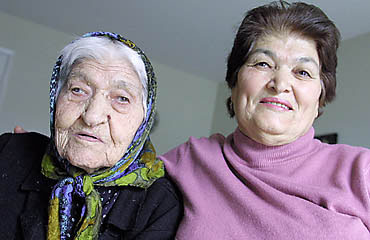
THE STORY OF NARGUES YADEGARIMOOSHABAD Courtesy of the Campbell Reporter; story by Jennifer D. Shih Yadegarimooshabad was born in 1898 in the village of Mooshabad in Urmie, Iran. Back then the country was still called Persia. It was from this village that she derived part of her name. Yadegarimooshabad's passport shows 1901 as her official birth year, but her relatives believe she was most likely born in 1898 or even earlier, making her at least 105 years old. The discrepancy in this case probably resulted from a late registration, explains her granddaughter Shemiran Farhad.
Yadegarimooshabad grew up working on a farm, a life that was tough and carefree at the same time. Yadegarimooshabad says, as Farhad translates, "We worked hard, but we were happy." She grew a variety of foods on her farm, including green peppers, cucumbers and grapes. "We would dry the grapes and make raisins," Yadegarimooshabad says fondly. But life wasn't carefree for long as political dissension brewed. Yadegarimooshabad's family was Christian Assyrian, and the country's official religion was Shi'ite Muslim. Farhad, 34, says that times were difficult for Christians. "She's been through a lot," says Farhad. Around the time of World War I, political unrest rocked Iran, forcing Yadegarimooshabad and her family to flee her village to the city of Tabriz, Iran and to Baghdad in Iraq. The trip was long and painful, and loved ones were left behind. "When they escaped, they had little children," says Yadegarimooshabad's daughter Jeresha Yadegari. "They had to leave my aunt by the road." The old and the young were often left on the journey. Yadegari says it's likely her aunt was eaten or killed by coyotes or other animals that roamed the wild. Once the family arrived in Iraq, they were forced to live in refugee camps for about a year. Yadegarmooshabad was still a teenager. "I used to break rocks [at the camps]," Yadegarimooshabad says. "We would see who could break more. I was the best." After a year in Baghdad's Baquba camp, the country's political climate settled down, and refugees were allowed to return to their village. Yadegarimooshabad stayed in her village until she was about 60 years old; then she moved to Tehran, Iran, to live with her family. Over time Yadegarimooshabad's immediate family moved to the United States, but she remained in Iran with distant cousins due to delays in the immigration process. "There was no one taking care of her back in Iran," Fahrad says. "She was all by herself." So Yadegarimooshabad took a circuitous route by immigrating to Italy before reaching U.S soil in 1986. By then she was 87 years old. These last few years have been hard on Yadegarimooshabad, who lost her vision seven years ago. "She never admitted she's blind," Fahrad says. "When she's sick, she denies it." Yadegarimooshabad doesn't have live-in help, but she does use a wheelchair because, Fahrad says, her grandmother is afraid of falling. They are also fairly new to Campbell, having moved in September 2002 from Sunnyvale. "She has a good appetite," Fahrad says. "She loves junk food like potato chips and popcorn." The family pulls together to look after Yadegarimooshabad. "We all help out to take care of her," Fahrad says. "We take shifts." Yadegarimooshabad only takes aspirin to help with her blood circulation. She has 16 grandchildren and nine great-grandchildren. She neither learned to read or write, which was not uncommon for women from her generation who grew up in rural communities. But what has enabled them to live for more than a century may remain a mystery. Fahrad has asked her grandmother what the secret to long life is and has decided the answer is good food. "They all ate healthy food," Fahrad says. "There were no hormones like these days." Or maybe it was leading an innocent existence. "That's why they've lived so long," Fahrad guesses. "They've had simple lives."
|
Visit the Zinda Magazine Calendar at http://www.zindamagazine.com/calendar
|
Zindamagazine would like to thank: David Chibo (Australia) |
ZINDA Magazine is published weekly. Views expressed in ZINDA do not necessarily represent those of the ZINDA editors, or any of our associated staff. This publication reserves the right, at its sole discretion, not to publish comments or articles previously printed in or submitted to other journals. ZINDA reserves the right to publish and republish your submission in any form or medium. All letters and messages require the name(s) of sender and/or author. All messages published in the SURFS UP! section must be in 500 words or less and bear the name of the author(s). Distribution of material featured in ZINDA is not restricted, but permission from ZINDA is required. This service is meant for the exchange of information, analyses and news. To subscribe, send e-mail to: z_info@zindamagazine.com.
Zinda Magazine™ Copyright © Zinda Inc., 2001-2003 - All Rights Reserved - http://www.zindamagazine.com
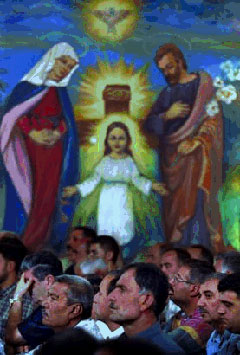


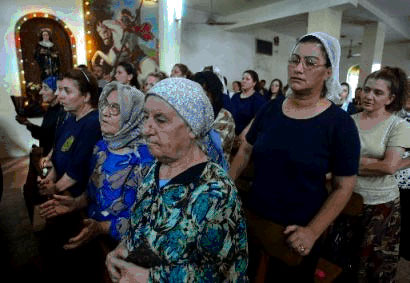 In July, a band
of criminals threatened to kill members of Saint George unless the
church paid $10,000. The church refused and American forces sent
extra patrols, but officers told Hermiz they couldn't provide 24-hour
security. Despite offers of help from a local mosque, Hermiz began
advising church members to move out of Baghdad to safer ground in
northern Iraq.
In July, a band
of criminals threatened to kill members of Saint George unless the
church paid $10,000. The church refused and American forces sent
extra patrols, but officers told Hermiz they couldn't provide 24-hour
security. Despite offers of help from a local mosque, Hermiz began
advising church members to move out of Baghdad to safer ground in
northern Iraq.