|
|||||
 |
101
San Fernando Street, Suite 552
San Jose, CA 95112 U.S. Voice (408) 918-9200 Fax (208) 723-1240 |
||||
|
|||||
|
|||||||||||
|

|
THE COMPELLING VISION OF DEFEATLast Saturday a disturbing “statement” was released via the Internet in which two U.S. Chaldean bishops demanded the recognition of a separate Chaldean ethnic identity for the “Chaldean” people of Iraq. In so doing, they expressed a desire for complete separation from the other Assyrian groups – both political and ethnic in nature (See News Digest). Fortunately the two bishops receive very little support on this issue from within the Chaldean communities in either Iraq or the United States. They are revered for their esteemed positions in the Chaldean Catholic Church, yet their political views stop before the doorsteps of their eparchies in Detroit and San Diego. No Assyrian or Chaldean civic leader is persuaded to dissolve the historic ties among the Syriac-speaking people of Iraq. Then why do these two bishops insist on creating a new identity in Iraq? In 1970, the Iraqi government invited the late-Patriarch Mar Shimmun Ishaya to visit Iraq after four decades of exile. On 24 April of the same year, His Holiness arrived in Baghdad with much fanfare and met the Iraqi president. Hence the Assyrian nationalists, much like today’s, were galvanized to begin several political, cultural, and journalistic endeavors in Iraq. Two years later Assyrians petitioned for an autonomous region in Dohuk (Nohadra) Province when Baghdad granted the Kurds an option of autonomy in Arbil and Sulaimaniya. Sounds familiar? In April of that year Baghdad reacted negatively by offering the "Syriac speaking" people of Iraq (not "Assyrians”) limited cultural rights. Decree #251 granted the “Assyrian, Chaldean, and Syrian” groups the right to teach their own language at schools provided that 25 percent of the children in a class were Christian. The name “Assyrian” was sliced into three separate identities in order to reduce the impact of the Christian interests in Iraq. At the heart of the controversy were the affluent and influential Chaldean-Assyrian Catholics whose sway in the business and cultural sectors of the Iraqi society was and has always been noteworthy. Without historic ties to the Assyrian people the Arabization process of these less politically-minded Chaldean-Assyrians could be increased many folds and the Assyrians of non-Chaldean affiliation would be forced to leave North Iraq and Baghdad. This devious plot was effective. Tens of thousands of Assyrians – both Chaldean and non-Chaldean – left Iraq beginning in the late 1970s and the remaining groups were monitored under the watchful eyes of the Baathist government’s Mokhaberat. To cloak their hideous actions in the Assyrian communities outside of Iraq, paid agents were installed among various Assyrian organizations and churches. The secret documents obtained by Zinda Magazine indicate the Baathist government’s elevated interest in the Assyrian political and cultural self-awareness inside and outside of Iraq. According to a Modesto Bee report published on 2 August 1982, for example, the priest of the St. Thomas parish in Turlock, California -- Monsignor Abalhad Najor -- was shot because he had accepted $250,000 from the Iraqi government. According to Detective Sgt. Charles Van Vooren: "the Iraqi money was the source of extreme disagreement within Najor's congregation and the greater Assyrian community.". Indeed Najor had been chastised along with several other Chaldean rite priests in pro-nationalist literature for accepting cash gifts from the Iraqi government totaling $3.25 millions. So what happened to this money?” In June 1979 Saddam Hussein assumed complete control of Iraq as its new president. Between 1979 and 1981 over one million dollars as noted on the www.chaldeandiocese.org were received by various Chaldean churches as gifts from Iraq to help with the construction of several Chaldean Catholic parishes in the United States. A few of the churches which either were purchased or constructed during this time are listed herein:
In 1980 Pastor Jacob Yasso of Detroit's Sacred Heart Parish even presented the key to the city of Detroit to Saddam Hussein (see 24 March 2003 issue). His parish had received a donation of $200,000 from Iraq. Slowly, but surely, the Assyrian-Chaldean idenity was being eroded by that of “Arab & Chaldean”. On the political frontier an attempt to reverse the ‘Arabization’ and “anti-Assyrianization” process was encouraged by the election of Mr. Aprim Rayis – a Chaldean-Assyrian from Michigan as the Secretary General of the Assyrian Universal Alliance. His tenure during the early days of the Iran-Iraq War and the mass immigration of Assyrians from Iran and Iraq gave little chance of any effective measures for such social turnaround. Since the most impacted group in the Chaldean community was that of the Churches, the answer had to come not from a political entity, rather the churches themselves. And so from within the non-politically minded Assyrian-Chaldean masses emerged a figure whose voice struck a chord with the young Chaldean parishioners and entreprenuers. The man at the forefront of monitoring and confronting the Assyrian-Chaldean identity denial.was none other than Mar Sarhad Jammo, the controversial Chaldean bishop whose signature at the bottom of the statement released on Saturday effectively annuled over twenty years of his dedication toward the unity of the Chaldean and non-Chaldean Assyrian people. In 1981 Mar Sarhad spearheaded the founding of the Chaldean Federation of America and enthusiastically pursued a Chaldean identity, totally unattached to any Arab-like character. In his article titled “Contemporary Chaldeans and Assyrians: One Primoridal Nation, One Original Church” Mar Sarhad writes: “We have to realize that having established two ecclesiastic jurisdictions, within the frame of the legacy of the Church of the East, has led gradually to the formation of two distinct communities, each one of them having developed some different liturgical practices, as well as variant social and cultural patterns…Therefore, to restore this Church to its primordial unity, and to bring its Chaldean and Assyrian people to share in a united nation, the same heritage, and walk together toward a common destiny, will require to deal not only with theological and ecclesiastical matters but with cultural and social issues as well. That is the challenge of our generation.” Beginning in the late 1980’s he and his Church of the East counterpart, Mar Bawai Soro, commenced stimulating discussions on the possibility of bringing together the two branches of the original Church of the East. On 29 September 1996 His Holinesses Mar Dinkha IV and His Beatitude Mar Raphael I Bidawid met in Southfield, Michigan to inaugurate the process of dialogue and collaboration between the Church of the East and the Chaldean Catholic Church. The result: a "Joint Synodal Decree for Promoting Unity" was signed on by both Churches on 15 August 1997. Two years after the signing of the “Joint Synodal” Mar Sarhad and two of his close confidants met with a group of Assyrians from Chicago in an effort to repeal the “Assyrian-only” category of the U.S. Census tabulations. The idea of placing “slashes” between the terms “Chaldean”, “Assyrian”, “Syriac” to signify unity received some praise from civic leaders, but was defiantly opposed by Assyrian activists and the editorial board of this magazine. The slashes were in fact not unlike the ‘commas and spaces’ introduced by the 1972 Decree #251 in Iraq. The jubilation of the Assyrian groups after the signing of the “Joint Synodal” slowly metamorphosed into thought-provoking ideas of conspiracy theories and Baath-sponsored activities against Assyrian political conscience. The signers of the “Compelling Vision” statement on Saturday are the same two bishops who pronounced common understanding and unity of our people at every meeting held between the Church of the East and the Chaldean Catholic Church prior to the ordination of Mar Sarhod last fall. Nevetheless, they now embrace different views on the unanimity of our people’s identity. Was the 20-year plan to unite the two churches a misleading attempt to grind down the political identity of Assyrian-Chaldean people? Or did these two holy-men have a change of heart after the news of Mar Raphael Bidawid’s illness in Baghdad? There are many other untold facts and fables not revealed in this article. Some are better unheard. The fact of the matter is that at this juncture in our history it matters not what our bishops or leaders dictate in their statements promoting disunity. For our common identity to thrive and our voices be heard in Iraq we must all be represented under the same political banner. Anything preventing the progress of our collective national and political representation is no less damaging than the Arabization policies of the Baathists in Saddam’s regime and the Kurdification efforts of Massoud Barazani in North Iraq. Zinda Magazine urges an immediate rejection of the statement distributed on Saturday, 10 May, by all Assyrian and Chaldean civic and political leaders, churches, and finally the drafters of the statement themselves. We hope that Mar Sarhad Jammo will then join other Assyrian leaders in drafting a new “statement of unity” to be presented at the U.S. State Department and to the new Chief of U.S. Administration in Iraq, Mr. Paul Bremer in Baghdad. The future Assyrian and Chaldean generations will not pay tribute to us for how we divided ourselves and stepped away from our common destiny, rather for how we affixed that which was broken 500 years ago. Wilfred Bet-Alkhas
|
THE DEADLY MISTAKE OF CERTAIN
ASSYRIAN ORGANIZATIONS:
|

| IRAQ'S ASSYRIANS STRUGGLE FOR POWER Courtesy of the Jerusalem Post (8 May); by Matthew Gutman (ZNDA: Baghdad) Last week, Yonadam Y. Kanna, secretary-general of the Assyrian Democratic Movement (ADM), did something unusual for one of the leaders of Iraq's 60 or so emerging political parties: He cleaned the bathroom sink at ADM's headquarters. While other leaders enjoy the princely luxury allotted for the first time to leaders other than Saddam Hussein, Kanna seems to work hard at practicing the democracy he preaches. Considered a medium-sized movement, ADM has all the trappings of what is considered a serious Iraqi party these days—impressive offices, a charismatic leader, a clear vision, and lots of men with AK-47s standing guard outside. ADM is not one of the six parties, including Ahmed Chalabi's Iraqi National Congress and the Kurdish groups, on the steering committee that is set to establish an interim government later this month. However, the fate of Iraq one day might hinge upon parties like ADM, which might swing the country away from Islamization or authoritarianism. A grassroots leader, who ate standing with the rest of his men Tuesday, Kanna fears the return of "fossil ideology," the type of arcane and impracticable policies that guided many Arab states, including Iraq, toward civil and financial ruin. Kanna, who derides the "Pan-Arabic media" as "extremist and bribed by Saddam," paints himself as a true moderate. He believes in a secular, democratic, and constitutional Iraq, which would accept the cultures and traditions of its minorities. Unabashedly, he envisions a peace agreement with Israel, once the issue of "Palestinian statehood is solved." Many Arab countries, he says, "continue to invest heavily in the conflict, using it as a tool to persuade their own people. They have been too busy lining their own pockets and looking after their own interests." Nobody wants an American presence on Iraqi soil, adds Kanna, but he remains a steadfast supporter of an international presence in the country, "because we need the tools, the technology, and the experts to rebuild." It is ironic, or perhaps a symbol of what could happen in the new Iraq, that ADM has ensconced itself, and its many armed guards, in the former headquarters the Fedayeen Saddam paramilitary group, the regime's main tool of repression. Midway through the interview, Kanna notes offhandedly the two death sentences the regime meted out against him. Isaak Ishak, the movement's deputy secretary-general, reasons that for years Iraq sought the patronage of the communist bloc, "and the country is now much worse off than it was before Saddam. So now we will try to follow the lead of Europe and the US." The cooperation has already begun in earnest. Saddam's regime often considered the Assyrians its most faithful servants. Nevertheless, it was an Assyrian employee of the regime who on April 10 alerted American intelligence officers that Saddam and his sons had entered a Mansur district restaurant. While the bombing missed its mark, American officials nonetheless hailed it as the closest it had come to decapitating the regime. ADM, its officials make pains to note, also took part in the liberation of the key oil cities of Kirkuk and Mosul in the North. Long before Arabic dominated the Middle East, the Assyrian language and Aramaic served as the region's lingua franca. But the centuries have not treated this shrinking Christian sect kindly. ADM began fighting Saddam in 1979. Suffering continuous losses, it moved north toward Iraqi Kurdistan in 1988 and joined the Kurdish forces fighting there to carve out a semi-autonomous safe haven. The Assyrians claim to hail from the biblical-era nation that conquered much of what is today Israel. They claim a 7,000-year-old history in present-day Iraq. A few churches dating back to the fifth century still dot the northern countryside. In modern times, the group, which today numbers about 1.25 million, was doubly mistreated; first by the regime and then by their Kurdish landlords. Few locals have heard of ADM, and it appears doubtful that it will be able to garner enough votes to influence Iraq's future when the country goes to a referendum later this month. The balance of power is heavily tilted toward Shi'ite groups, many of them radical. While they cling to a semblance of tolerance, proffering a future democracy and multi-party system, there could be cause for suspicion among the burgeoning Shi'ite groups. During a visit to the Diyala Governorate, a stronghold of the Iran-backed and funded Supreme Council for Islamic Revolution in Iraq, its local leader, Abu Muslim al-Jaffari, offered Iran as a model for a "democratic state," arguing intensely for over an hour that minorities enjoyed rights and even some power there. Responding to reports that as many as 700 of the party's Badr Brigades militia flooded Diyala, he vowed that none had entered any part of Iraq. "No one here is armed. We are politicians and civil servants only," he said. But merchants hawking vegetables, AK-47s, and pistols lined
Diyala's capital of Ba'aquba. When Jaffari's interview with
The Jerusalem Post ended, he accompanied me to the large lobby
of the former governor's office, now commandeered by SCIRI. Al-Dawa, the most veteran of the Shi'ite political groups, which struggled against and suffered bitterly at the hands of the regime, also promises democracy. But Iraq must be Islamic, argues an eloquent Abdul Karim al-Anzi, the group's Baghdad leader. He refused to say that he desires a state with "constitutional Islamic laws." When probed on what action he would take to limit the hundreds of vendors selling alcohol in Baghdad's streets, he replied, "We would have to persuade them against it." Back at the partially destroyed Fedayeen headquarters, Kanna concluded: "There is still some of the virus that was Saddam in this region, still extremism and frankly, we need some help to save us from that fate."
TWO CHRISTIANS IN IRAQ MURDERED FOR SELLING ALCOHOL Courtesy of the Daily Telegraph (9 May); by Kate Connolly (ZNDA: Basra) Christians fell victim to the upsurge in Islamic fundamentalism sweeping Iraq when they were shot dead in Basra yesterday by suspected militants attempting to stamp out the sale of alcohol. The men, who were alcohol vendors in a district of the southern Iraqi city that is home to Armenian and Syrian Catholics, were shot within 10 minutes of each other in their shops by two men, witnesses said. Shia clerics - whose influence was suppressed under Saddam Hussein - have been warning shopkeepers for weeks to stop selling alcohol or risk severe punishment. The clerics have become increasingly vocal on a variety of issues, including the status of women, since Saddam's fall. Under Saddam, Iraqi Christians were the only citizens permitted to sell alcohol. The trade would attract day trippers from neighboring Kuwait, about two hours' drive away, which has a complete ban on alcohol. Yesterday shopkeepers closed their doors and warned that such killings were to be expected while the country had no rule of law.
IRAQI CHRISTIANS FEAR OUTBREAK OF SHIITE FUNDAMENTALISM Courtesy of the Newhouse News Service (13 May); by Mark Mueller (ZNDA: Baghdad) Two weeks ago, Raad Karim Essa arrived home from work to find his furniture on the street. His Muslim landlord wasn't renting to Christians anymore. "He told us not to argue and threatened us," said Essa, 42, a father of four. "He said the government was no longer here to protect us. What could we do? We feared for our lives." "The Muslims want to destroy us," said Amira Nisan, 38, Essa's wife. "I think we were better off under Saddam." Such a statement, once unthinkable, is voiced increasingly today among Iraq's 800,000 Christians. Like most of their countrymen, Christians greeted the fall of Iraqi President Saddam Hussein with celebration and hope. But in little more than a month, their desire for greater religious freedom has been replaced by fear of the fundamentalism rippling through Iraq's Shiite Muslim majority, which has moved quickly to exert its influence after decades of violent repression. Christian women say they've been harassed by Shiite men for walking on the street without head scarves, and priests complain that Shiite clerics inflame religious hatred by calling for the expulsion from Iraq of "non-believers." The most overt acts have been directed at Iraq's liquor stores and manufacturers, almost universally run by Christians. The owners of those facilities say they've been threatened with death for selling alcohol, forbidden under a strict interpretation of Islamic law. "I'm afraid for my people," said Bishop Ishlemon Warduni, the religious leader of Iraq's Chaldean community, which represents about 80 percent of the nation's Christians. The remaining 20 percent is comprised mostly of Syrians, Assyrians and Armenians. "During the war, we were not afraid like we are now," said Warduni, 60. "All Christians are in danger." Last week, Warduni expressed his concerns in a letter to President Bush, British Prime Minister Tony Blair and U.N. Secretary-General Kofi Annan. Tuesday, the bishop is scheduled to make his case in a meeting with Jay Garner, the retired U.S. Army general who has been administering Iraq. "We would like a guarantee of our rights, our freedom and our protection," Warduni said. "We have a 2,000-year history in Iraq, and that is now threatened. The fanatics would see us gone." The worries are most pronounced in southern Iraq, a Shiite stronghold where clerics have issued the most strident calls for the creation of an Islamic republic. Underscoring the dangers, the Christian owners of two liquor stores were shot to death last week in Basra, Iraq's second-largest city, after rebuffing demands to shutter their shops. But religious tensions are high and rising in Baghdad as well. "Ten days ago was better than a week ago, and a week ago was better than today," Warduni said. "I have no doubt that tomorrow will be worse. We're losing what little protection we had." Under Saddam, Christians were permitted to worship but not to publicly express their views or proselytize. It also was forbidden to give children Christian names. While those strictures have been swept aside, Christians say they feel even less free in the face of growing Shiite pride and power. In the chaotic days after Baghdad's fall, Shiite clerics sent armed followers to patrol neighborhoods and to safeguard schools and hospitals from looting. Still under Shiite control, some of those hospitals now bear signs ordering any woman seeking treatment to wear a head scarf. More disconcerting to many Christians is the belief that they're being targeted for violence and rape by Muslim men. Parishioners and priests at a half-dozen churches in recent days told stories of women and young girls snatched from the streets in broad daylight. Almost inevitably, however, those telling the stories can provide no details, saying they heard them from a friend or family member. According to one account repeated at several parishes, a Christian man, Arkan David Belu, 28, was shot to death by several Shiite men as he left a church service Sunday. "They killed him only because he was a Christian," said Zuher Butros, 60, the caretaker at St. George Chaldean Church in the New Baghdad neighborhood. Belu, 28, was indeed shot to death, but his uncle, Hikmat Belu, said the killing had nothing to do with his nephew's religion. Belu, the uncle said, was simply caught in the cross fire between warring gangs, which have terrorized the capital in the absence of any police presence. The relationship between Muslims and Christians has grown more sensitive with the profusion of new mosques. In almost every Baghdad neighborhood, vacant buildings and former government offices have been converted into Shiite houses of worship. One such mosque, Jama Al-Wehda Al-Islamiya, or Unity of Islam, sits directly across the street from Warduni's church, Our Lady of the Sacred Heart. Before the war, the building served as the neighborhood headquarters for the ruling Ba'ath Party. Later, it was looted and partially burned. The Shiite moved in three weeks ago, mounting a half-dozen loudspeakers that blare the call to prayer five times a day, sometimes interfering with church services across the street. The mosque's imam, Sheik Ali Al-Bahadili, said he is supportive of an Islamic state, but he said it should be one that respects the rights of Christians and other Iraqi minority groups. He flatly rejected claims that Muslims have been targeting or intimidating Christians. Sam Hanna argues otherwise. One morning last week, the 43-year-old Christian arrived at his Baghdad liquor store to find a note that had been slipped under the door. "It said that if we didn't stop selling alcohol, the shop would be bombed and we would be killed," Hanna said. "They said alcohol was against God's law. Hah! It's against God's law to sell alcohol but not to kill people? They are hypocrites." The situation is equally grave for the region's distilleries. About 20 miles north of Baghdad, in the town of Baquba, six factories that once manufactured whiskey, gin and arak, a sweet Arabic liquor, have been closed for a month or more. A Shiite cleric went from factory to factory with a large group of armed men, decreeing that only medicinal alcohol could be manufactured in the future. "Everyone's afraid," said Albert Paul Younan, 42, the manager at the Al-Abraj alcohol plant. "We agreed that we would make alcohol only for medicine, and still they come." Younan said he sought help from a United Nations facility in Baghdad, where he spoke with an American military commander. "I told him we need protection, and he said, `I'm sorry. You're going to have to protect yourselves,"' Younan said. "There is no law anymore. There is only Islamic law. God help us all." [Z-info: Mark Mueller is a staff writer for The Star-Ledger of Newark, New Jersey. Write comments to Mark at mmueller@starledger.com.]
LAUNCH OF INTERIM GOVERNMENT MAY BE DELAYED 2 OR 3 MONTHS Courtesy of the Kyodo News Service (13 May) (ZNDA: Baghdad) Paul Bremer, the chief U.S. administrator of Iraq, told Japanese Senior Vice Foreign Minister Toshimitsu Motegi on Tuesday it would take one or two months for an interim government to be set up by Iraqis. The remarks suggest a delay in the launch of an interim government from late May as agreed upon by groups of Iraqis opposed to toppled Iraqi President Saddam Hussein. Various groups of Iraqis have met twice under the U.S. leadership
to forge an interim government, and some 300 participants in
a meeting April 28 agreed to hold a third meeting by the end
of May to select officials in the government. |
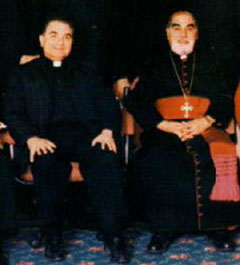
TWO U.S. CHALDEAN BISHOPS DEMAND TOTAL SEPARATION FROM ASSYRIANS(ZNDA: Chicago) On Saturday, May 10, in a signed statement two U.S. Chaldean bishops announced their demand for full and immediate separation of ethnic and religious identity of the Chaldean population of Iraq from the Assyrians. “The statement is intended for distribution in Washington”, according to a senior Assyrian political representative in Chicago. Observers in Chicago, Michigan, and California are calling the statement as the "most devastating blow to Christian political unity and power in post-Saddam Iraq". Another commentator said in an interview with Zinda Magazine: “The new Iraq has no place for religious fervor and the separation of Church and State will not be easily accepted by many Moslem and Christian heads.” The Assyrians, according to this statement, comprise less than one percent of the Iraqi population and should be treated as any other ethnic group: "Chaldeans are ready to work in harmony and collaboration with all the other ethnic and religious groups in Iraq, particularly with the Assyrians, provided that the Chaldean identity is recognized and preserved," says the statement. Last week leaders of local Moslem Iraqi groups in Detroit were invited by the Chaldean bishops to discuss the future role of the Chaldeans in a post-Saddam Iraq. To further illustrate their desire for separating the Chaldean identity from the Assyrian national character the controversial Chaldean bishops in the U.S. demanded a separate ethnic category for the Chaldean population between the Kurdish-Arab constituency and before the Assyrians and Turkomen: "Since Chaldeans are numerically the third segment of the actual Iraqi population (being approximately 650,000 people inside Iraq) and since they represent 3.5% of the total population, it is fair and democratic to mention them, in the official US documents and speeches, immediately after the Arabs and Kurds, i.e. before the Turkmen and the Assyrians and other minorities." According to Zinda Magazine sources in Iraq and North America, neither any other Chaldean bishop nor His Beatitude Mar Raphael Bidawid, the Patriarch of the Chaldean Catholic Church, have endorsed the released statement. Assyrian political observers and political groups are meeting this week in Chicago to discuss this latest divisive tactic perpetrated by the controversial Chaldean bishops in the U.S. A "statement of unity and hope" among all Christian denominations with respect to all Assyrian and Christian religious denominations is expected at the end of this meeting. ===================================== [Z-info: The following is the full statement released on 11 May, courtesy of the Chaldean News Agency. CNA is supported by the two Chaldean eparchies in the United States.]
In a historic move reflecting the newly acquired confidence of Iraq's Christian minority in demanding its involvement in the shaping of its own future in the new Iraq, the United States Chaldean bishops, representing the largest Chaldean community outside Iraq, presented a compelling vision for the Chaldeans. A vision that could well serves as the political program and agenda of the Chaldeans in the new Iraq. Iraqi Christians, and for centuries, have been treated as second class citizens by its Muslim rulers. During the regime of Saddam Hussein an aggressive Arabization campaign was unleashed against Iraq's non-Arab citizens, including its Chaldean natives. Tens of Chaldean villages and churches were razed to ground in the government efforts to crush the Kurdish revolt resulting in a massive immigration of Chaldeans to Arab towns and specifically to Baghdad. There, they were subjected to Saddam's propaganda machine in an attempt to kill their Chaldean identity and replace it with an Arab one. With the Chaldean masses closely attached to their ancient two-thousands-years-old church, the voices of the two Chaldean Bishops should add a powerful momentum to the Chaldean nationalist movement. It would also have a tremendous impact on the involvement of Chaldean laymen in the events currently shaping the future of Iraq and that of their nation; an involvement that would certainly have a positive impact on Iraq's movement towards a democratic and pluralistic system. Below is the historic memorandum of Bishop Ibrahim Ibrahim of Detroit,
Michigan and Bishop Sarhad Jammo of San Diego, California: MEMORANDUM ON CHALDEANS IN THE NEW IRAQ A. Chaldean Ethnic and Cultural Identity 1) Contemporary Chaldeans are the descendants of the inhabitants of ancient Mesopotamia, and are the heirs to and the continuation of its civilization, particularly through their preservation of the Aramaic language, culture and heritage. Their ancestors converted to Christianity during the first centuries of the Christian era. Their Church, the Chaldean Catholic Church, in communion with the Roman Catholic Church, is the heir of the ancient Mesopotamian Church of the East. 2) Since the middle of the 16th century until the present time, the
majority of Christians of Mesopotamia, today's Iraq, restored their
ancient name "Chaldean" as the expression of their ethnic
and cultural identity. 3) The cultural and ethnic grouping of the population of Iraq consists of the following ethnicities: 70 % Arabs 2.5% Turkmen Though relatively a small segment in number, the Chaldeans of today's Iraq are more than a mere minority group. They represent the historic remnant of ancient Mesopotamia. Moreover, they have their ancestral towns and villages within the actual borders of present-day Iraq. B. Political Background 1) The Iraqi Chaldeans, since the establishment of the Iraqi state in the early twenties, have been recognized as valuable force in the Iraqi cultural and political arena, and many of them have emerged in modern times as prominent civil servants. Several Chaldeans were appointed Ministers of Government; the Chaldean Patriarch himself served, until the establishment of the Republic of Iraq in 1958, as Senator in the Iraqi Senate. The regime of Saddam Hussein continued adopting the well established governmental attitude of relying on the expertise and skills of the Chaldean technocrats. 2) Nonetheless, because of their ethnic and cultural identity, different from that of the Arabs, and because of their Christian religion, different from Islam, Chaldeans endured discrimination and persecution since the Arab invasion of Iraq (A.D. 634) until the present time. In the last century, until the collapse of the Baath Regime in Iraq, Chaldeans suffered greatly. Their Chaldean language, the major dialect of Aramaic, had no chance to be taught in schools and used in communication media; Arabization was sponsored and enforced by the State. Their villages and properties were confiscated or destroyed; their private and parochial schools were nationalized without compensation; they were forced out of their ancestral lands to become refugees all over the world. Actual Political Implications: 1) The Chaldeans in the United States, approximately 150,000 strong, have in recent decades freely expressed an ethnic and cultural awareness of who they are, by asserting that Chaldeans are a distinct people different from Arabs, Kurds, Persians, Turkish, or Turkmen. In fact, they were recognized by the Census Federal Bureau as a distinct ethnic and cultural community. 2) The Chaldeans, being a distinct ethnic and cultural segment of the population of Iraq, genuinely rooted in its millenarian history, they will accept to be represented only by Chaldeans speaking in the name of Chaldean organizations, and maintain everywhere that they shall reject any non-Chaldean, political or otherwise, individual or organization, claiming to represent them. Nevertheless, Chaldeans are ready to work in harmony and collaboration with all the other ethnic and religious groups in Iraq, particularly with the Assyrians, provided that the Chaldean identity is recognized and preserved. 3) The Chaldeans agree with the United States government policy in promoting a new Iraq that is based on the principles of territorial integrity, respect of human rights, minority rights, and of pluralistic democracy. As implementation of that very policy we present the following legitimate demands of Chaldeans in the new Iraq:
C. Recommendations for immediate action 1) We recommend that the United States support the inclusion of Chaldeans as a recognized and valid partner in the process, currently being undertaken, that will expectedly result in a new government in Iraq, and that the United States will endorse, as well, a secured recognition of their rights in the new Iraqi Constitution and government. At the present time, there are two Chaldean organizations working to express and represent the political aspirations of Chaldeans; we endorse both of them:
2) Since Chaldeans are numerically the third segment of the actual Iraqi population (being approximately 650,000 people inside Iraq) and since they represent 3.5 % of the total population, it is fair and democratic to mention them, in the official US documents and speeches, immediately after the Arabs and Kurds, i.e. before the Turkmen and the Assyrians and other minorities. May 5, 2003 Bishop Ibrahim N. Ibrahim Bishop Sarhad Y. Jammo
PROUD CHALDEANS DEFEND HERITAGE Courtesy of the Detroit Free Press (13 May); by Marsha Low & Victoria Turk (ZNDA: Detroit) A battle over identity erupted thousands of years ago in a dusty land known as Mesopotamia. It persisted into modern-day Iraq, and migrated to the sweetshops, restaurants and business meetings of metro Detroit. Now the dispute between Chaldeans and Arabs is reaching full boil as it seeps into the offices of U.S. Attorney Jeffrey Collins and even into Detroit Tigers events planning. At issue: Are Chaldeans also Arabs? Chaldeans say no. Arabs say yes. And the debate continues. As Iraq struggles to rebuild, attention continues to center on the country and its mosaic of ethnicities. And as people of Middle Eastern descent continue to be scrutinized and detained throughout the country and metro Detroit in the wake of the Sept. 11, 2001, terror attacks, more are trying to disassociate themselves from the umbrella term frequently used when referring to people of the region: Arab. Metro Detroit's Arab community -- with ancestral roots in Arabic-speaking countries such as Egypt, Jordan, Lebanon and Saudi Arabia -- quickly established itself by organizing help agencies, building cultural centers and assigning leaders to speak on its behalf. Chaldeans -- Iraqi Catholics who speak a distinct language -- recently began making strides to assimilate, organize and interject their newfound voices into the political arena. As Chaldeans gain confidence and assert themselves, Arab leaders are growing more impatient. Meanwhile, the public at large remains baffled by the debate as the communities try to work toward consensus. "This is growing pains," said Adhid Miri, president of the Chaldean Iraqi American Association of Michigan, based in Southfield. "This struggle for identity is what all new communities face when they immigrate. Through time, things will change, and this issue of Chaldeans being Arabs will no longer exist." Disparate treatment After Sept. 11, 2001, Collins, the U.S. attorney, began hosting monthly meetings with local leaders of Middle Eastern descent. Held in Collins' Detroit office, the discussions center on protecting the community from hate crimes and on what government agencies can do tohelp. At first, both Arab and Chaldean leaders participated, but Chaldean attendance waned last year and has been sporadic since. Saad Marouf, chairman of the Southfield-based Chaldean Federation of America, said that he and others within his organization initially attended the meetings. While most people of Middle Eastern ancestry say they faced harassment after Sept. 11 because the general public is unable to differentiate between the various ethnicities by appearance, Marouf claims Chaldeans did not experience the difficulty that Arabs did. For that reason, he said, Chaldeans stopped participating in the meetings. Last month, Ramsay Dass, a Chaldean American representing a fledgling group of Middle East Christians, went to the meeting and told the group that Chaldeans are distinct from Arabs and require their own representation. "It was irritating to so many around the table to hear this desire for separation when at the end of the day, we have the same issues," said Imad Hamad, director of the Dearborn-based American Arab Anti-Discrimination Committee. "Nothing he said was new to us, but we never expected that this meeting would be used as a forum to air this desire for separation." According to Hamad and most other Arabs, the debate breaks down this way: Chaldeans are from Iraq, Iraq is an Arab nation, Chaldeans therefore are Arabs. Chaldeans argue they are the descendants of the Babylonians. They speak Chaldean -- derived from Aramaic, much as French comes from Latin. They are Catholic and they have their own cuisine and culture. For these reasons, Chaldeans claim not to be Arab. "When we say we are not Arab, we do this without malice," Marouf said. "It is unfortunate, but people don't want to be called Arab because of 9/11. The work of a handful of people tarnished the reputation and name of an entire group. But now when you say Arab, people think Muslim. This is another reason we do not want to be called Arab." Similarly, the Kurds who hail from northern Iraq have their own language and do not claim to be Arab. But because the population of Kurds in Michigan and the United States is small, the debate over identity is subdued. Others say the identity battle is moot because there is no right or wrong. "We academics don't think there is any such thing as a correct identity. We believe it is a matter of invention," said Juan Cole, a University of Michigan professor of history and the modern Middle East. "Being identified as Arab is a matter of political negotiation and dispute." Some say it can be a matter of money. Many Chaldeans say that Arab-led agencies claiming to represent both Arabs and Chaldeans have received state and private funding to support programs and to build community centers. Chaldeans say they are not using these resources and are building their own center in West Bloomfield. Martin Manna, board president for Chaldean Americans Reaching & Encouraging (CARE), a West Bloomfield-based agency that promotes diversity and education, said: "The Arab community lobbies the state and corporations all the time saying they represent us. Now we're going for our own, so the Arabs have a lot to lose -- they might lose money." Arab leaders dispute the suggestion and deny that they attempt to represent the Chaldeans. "Chaldeans should represent themselves," said Nasser Beydoun, executive director of the American Arab Chamber of Commerce in Dearborn. "They have their own social and cultural issues to address." Special Day at The Park But there are some who say they do not think separation is prudent for Iraqi Americans. They argue that separation dilutes the power of the collective voice. And they think there are more important issues at hand. "This is the wrong time to make distinctions between people," said Ashley Mammo, an attorney from Southfield who is Chaldean, but also identifies herself as Iraqi and Arab. "Right now, we should see ourselves as Iraqi Americans for the welfare of the Iraqi people who are dealing with conflict in the country right now." The debate found its way into the offices of Comerica Park, home of the Detroit Tigers. Last year, the Tigers began discussions with the region's Arab Americans to plan a day of appreciation. Jim Stapleton, senior vice president of business affairs for the ball club, said plans are tentative and that the event is one of several the organization is planning to honor minority groups. Arab leaders said plans would include offering discounted tickets to the area's Arab organizations. Achieving Arabs would be honored at the beginning of every inning. The national anthem would be sung by an Arab American. Arab vendors would be hired to serve shawarma, hummus and tabbouleh. But when Chaldeans learned of the event, they wanted to be included. They wanted one of their own to sing, and they wanted recognition for their people. Manna, who is working to plan the event, said that concessions were made and the Aug. 30 game against the Chicago White Sox will be called Arab Chaldean Day. "We know the Arabs will be upset, but we hope they will understand that we are our own voice," said Manna of CARE. "Maybe they will boycott, but if they do, they would be sending the wrong message. I hope we can resolve the issue and enjoy the day." Beydoun said metro Detroit's Arab community is thankful for the recognition. But he also expects the name of the occasion to be a source of agitation. "Of course, this will irritate some people," Beydoun said. "But I do not believe there will be a protest of that day. The Tigers aren't doing that well anyway, so maybe no one will go."
IRAQ'S FORGOTTEN CHRISTIANS FACE EXCLUSION IN GREECE Courtesy of the Athens News (2 May); by Kathy Tzilivakis (ZNDA: Athens) They are descendants of the ancient Assyrians - builders of the earliest civilisation - and are determined to keep their culture alive, though thousands are undocumented and marginalised A DREAM lost in limbo: After 14 years, one man - an Assyrian from northern Iraq - has all but given up hope that he and his family will one day call Greece their home. "It's a shame," says the man, who wants to be called Petros, although that is not his real name. "We've been in Greece for many years. We don't make any trouble, we live a quiet life. Two of my children were born here. My oldest daughter was very young when we came to Greece. This is the only home they know." Like several thousand other Assyrians (from Iraq, Iran, Syria and Turkey) in Greece, Petros has no papers, no residence permit. And like countless others who fled Iraq seeking shelter in Greece, his application for political asylum was rejected. Twice. "We are not asking anyone for money," says Petros. "All we want is papers. But the government says there is no way. We are now waiting. Will they pass another law? Will my two children who were born here be eligible for citizenship one day?" For Petros and thousands of other Assyrians in this country, home is where the end of the line is: Greece. But the vast majority of Iraqi Assyrians in Greece are undocumented. Many of them arrived over a decade ago to escape the Iran-Iraq war. Others fled the difficult conditions under the embargo. An estimated 90 percent are without papers and many of them are trying to reunite with relatives in other European countries or in the United States, Canada and Australia. They lead a shadowy existence. Like many others, Petros does not have proper identification to open a bank account and he has no health insurance for his family. His children will soon graduate from high school but will have no ID card in order to obtain their certificate of studies. Modern Assyrians in Greece An estimated 6,000 Assyrians live in Greece. Only several hundred have applied for asylum. Some have managed to obtain residence and work permits. About 1,000 are naturalised Greek citizens. The rest have no papers. Greece's Assyrian community can be traced back to the 1920s, when the Assyrian Federation of Greece was formed. This organisation was officially recognised by the Greek state in 1934. Today, the group serves as the community's social support network. In Athens, Assyrian migrants are concentrated mainly in the western Athens suburb of Aegaleo and in the eastern suburb of Kalamaki. In Aegaleo, Assyrians gather at least twice a month in a small makeshift church for Sunday prayer. Mass is conducted by an Assyrian priest from Sweden. The Assyrians were the first to embrace Christianity in the 1st century AD. In a bid to keep their culture alive, special lessons in the ancient language were held at a centre run by the Social Work Foundation, a non-governmental organisation assisting asylum-seekers and refugees in Athens. About 100 youngsters attended these classes last year. Today, lessons are offered by the Assyrian Federation of Greece. Without a homeland Even though the Assyrian empire fell in 612 BC, there are some 4.5 million people who call themselves Assyrians. The heartland of Assyria is located in present-day northern Iraq, northeastern Syria, southeastern Turkey and northwestern Iran. The remains of the ancient capital of Assyria, Nineveh, are near Mosul in northern Iraq. Today, millions of Assyrians are spread across Iraq, Syria, Turkey and Iran. There are also hundreds of thousands living outside the Middle East. The diaspora is heavily concentrated in Canada, the US (about 400,000) and across Europe. An estimated 30,000 live in Germany, 15,000 in France, 8,000 in the United Kingdom and some 3,000 in Italy. "Now that the war in Iraq is over, if the regime changes, if there is polyphony and freedom for Assyrians in Iraq, many will probably return to their homes," notes Mr. Batsaras, president of the Assyrian Federation of Greece.
ASSYRIAN STATUE, GOING CHEAP Courtesy of the Guardian – London (24 April); by Jane Morris (ZNDA: London) We do not know how bad the looting of Iraq's museums has been, nor how many historic objects are smashed or sitting in Iraqi homes. But at least some of Iraq's historic treasures will have started the long journey west to be sold in the shady corners of London's antiquities market. Assyrian statues and cuneiform tablets will join the tide of objects flooding west, from Cambodia and Latin America, Africa and China. Some objects are stolen to order, but many are passed from local people up a chain that starts with a handful of dollars and ends in a Mayfair or Manhattan gallery. On the way, they will be smuggled across borders, disguised as fakes or passed off with forged documents. Unlike the glamorous high jinks of films such as Topkapi or The Thomas Crown Affair, much of this crime begins as something fairly mundane. Ordinary people sell in local markets. Stallholders sell to dealers in capital cities. Dealers in capital cities have international contacts, legal and illegal. A few, very valuable and recognisable artefacts may be bought by that shadowy figure, the rapacious international art collector who wants what he wants and does not care about price or legality. Last week the first rumours started circulating of looted Iraqi pieces for sale in Paris. On Monday, the FBI confiscated suspected loot in a US airport. With London one of the most important markets for art and antiquities, including objects from the Middle East, there is little doubt that artefacts are making their way towards the UK. How does an Assyrian statue end up in a private London gallery in the chaotic aftermath of a war? All too easily. London has long had a reputation, second only to Switzerland, for handling objects that are dubious, and which many experts believe are looted. So much so that London and Geneva are now the two main marketplaces for stolen antiquities. The trade in stolen artefacts is not new. But it is getting more widespread, as western collectors expand their interests to Asia and Africa. Non-western collectors are also joining the fray. Since the Soviet withdrawal from Afghanistan in 1989, the Kabul Museum has been stripped almost bare. Archaeologists believe that many of its items are in the hands of wealthy Pakistanis. Tokyo is also becoming as important a market as London, Geneva and New York. Meanwhile, the desecration of historic sites continues unabated. Since 1975, the temples and monuments of Angkor Wat, Cambodia, have been wrecked. Hundreds of stone Buddhas have been hacked off, with the heads particularly prized. In China, archaeological sites are routinely plundered. Yet the local looter risks paying a terrible price. In 2000, three local men were executed in Shanxi Province for passing 15 Tang dynasty murals to the international trade. The market exploits some of the poorest people in the world, who loot their heritage at risk of their lives. What is surprising is the weakness of international legislation. Britain, after years of resistance, finally signed the most basic of international treaties, the Unesco treaty on illicit trade, but it rejects the sort of legislation in force in Italy or Finland, where it is difficult for dealers to claim that stolen goods were bought in good faith. China, Argentina and Brazil all have tougher regimes than the UK. Meanwhile, the laxity of Swiss law and international legal loopholes allow many items to be "laundered" via Geneva and appear, apparently clean, in London. Last week, the culture secretary, Tessa Jowell, claimed that everything was being done to stop the illicit trade. This is far from the truth. An important piece of legislation that would make dealing in illicit artefacts a criminal offence is stalled in a line of 12 private members' bills. Jowell claimed that sanctions prohibit the trade in Iraqi antiquities, but the British School of Archaeology in Iraq believes that 10,000 items have passed through London since the first Gulf war. Hope for Iraq's plundered heritage is not entirely gone. The government could answer the calls of the British Museum and Unesco to halt sales of Iraqi antiquities until their origins are established. Instead of leaving it to the eagle eyes of museums and the most ethical dealers to spot suspicious objects, it could draw up a database of types of objects and actively police it. It could break the confidentiality that surrounds the art and antiques trade and so often acts as a shield. Most crucially, it could change the burden of proof, so dealers have to show that an artefact isn't stolen, rather than forcing the authorities to prove that it was - an often difficult undertaking. But it is not all about the law. The government could also start to educate ordinary collectors to ask themselves how ancient objects in their local dealer's came to be where they are. Until ordinary, all-too-innocent buyers do that, they areunwittingly feeding the international markets just as much as their unscrupulous and criminal counterparts. [Z-info: Jane Morris is the editor of Museums Journal in London.]
POPE STRESSES RELIGIOUS LIBERTY FOR EASTERN RITE CATHOLICS Courtesy of Zenit News (12 May) (ZNDA: Vatican) In his meeting with students of the Eastern rite Pontifical Seminaries of Rome this week, John Paul II appealed for peace, development, and religious liberty in countries inhabited by Eastern rite Catholics. These Catholic communities, while in communion with the Bishop of Rome, differ from the Latin tradition in their various rites. According to the Pontifical Yearbook, there are five Eastern rite traditions: Alexandrian, Antiochian, Armenian, Chaldean, and Byzantine or Constantinopolitan. Although some of these Catholics have had to leave their countries because of persecutions or political and economic problems, the majority of these faithful are in the Middle East and Eastern Europe. They are spread over a wide geographic area that extends from North Africa to Asia. "Turning to the many countries you come from," the Holy Father said, "I must strongly repeat the hope that peace will be ever more consolidated in that region; that fair and peaceful solutions will restore harmony and good living conditions to the populations so sorely tried by tensions and unjust oppression." "May the Lord illuminate the leaders of nations so that they will courageously work, with respect for the law, for the good of everyone, and for the freedom of every religious community," he added. The Pope exercises his ministry as Bishop of Rome to the Eastern rite Churches with the Vatican Congregation for the Oriental Churches, whose prefect is Cardinal Ignace Moussa I Daoud, patriarch emeritus of Antioch of the Syrians. The Holy Father applauded this congregation's initiative to offer Arabic-speaking priests of different Eastern rites the possibility of a center of formation in Rome, at the College of St. Ephrem, to pursue their ecclesiastical studies and carry out apostolic activities. John Paul II said this service is decisive for the "defense of the ritual identity and ecclesial and pastoral maturation" of these priests. In particular, the Holy Father suggested "knowledge of the liturgy of the Oriental Churches and of the spiritual traditions of the Fathers and Doctors of the Christian East." Lastly, the Pope encouraged greater mutual understanding between Latin and Eastern rite Catholics, to grow in "the unity" of the universal Church. It is necessary to "avoid tensions between Latins and Orientals and to stimulate dialogue between Catholics and Orthodox," he concluded. On Tuesday, the Indian bishops met the Holy Father before concluding their 'ad limina' visit to Rome in two separate gatherings, one for the Eastern rite Syro-Malabar Churches, the other for the Syro-Malankara Churches. Their origins, according to tradition go back 1950 years, when they received the Gospel from the lips of the Apostle, St. Thomas. The Holy Father stressed, particularly to the Eastern rite Catholics who have an extraordinary cultural richness, that differences in rituals should not be the cause of divisions within the Church. Christians of the Syro-Malabar Church, belonging to the Chaldean ritual tradition, have Cardinal Varkey Vithayathil as their pastor. This Church numbers over 3.5 million faithful. In 1992, John Paul II recognized it as an "autonomous Church" in full communion with Rome. The great vitality and growth of the Syro-Malabar Church is reflected especially in the great number of vocations to the priesthood and consecrated life. Close to 70% of the 120,000 vocations in India -- whose Catholic population numbers 15 million -- come from this Church. The Syro-Malankara Church belongs to the Antiochian ritual tradition, and has as its pastor, Archbishop Cyril Mar Baselios of Trivandrum who is also president of the episcopal conference of India. This Church of 400,000 faithful, 4 dioceses, 7 Bishops, and 4 religious Congregations, recovered full communion with Rome in 1930, at the time of Pius XI. "Evangelization lies at the heart of the Christian faith. India, blessed with so many different cultures, is a land in which the people yearn for God; this makes your distinctly Indian liturgy an excellent way of evangelization," the Pope said. "Authentic evangelization is sensitive to local culture and custom, always respecting the 'inalienable right' of each and every person to religious freedom," he added. "Here the principle remains valid: 'The Church proposes, she imposes nothing' (Redemptoris Missio, 39)." This "openness, however, can never diminish the obligation to proclaim Jesus Christ as 'the Way, and the Truth, and the Life' (John 14:6). For the Incarnation of the Lord enriches all human values, enabling them to bear new and better fruit," he said. In this connection, the Pope made several recommendations to Eastern rite Catholics. Addressing the Syro-Malabar bishops, John Paul II urged them to keep the Eucharist as "the most precious possession which the Church can have in her journey through history, in particular, "against unwarranted experimentation by individual priests which violate the integrity of the liturgy itself and can also cause great harm to the faithful." The Holy Father also invited them to renew their "ritual patrimony," but emphasized the "urgent need to overcome the fears and misunderstandings which appear at times between the Eastern Churches and the Latin Church." When addressing the bishops of the Syro-Malankara Church, the Holy Father said: "At a moment of growing secularism and, at times, of blatant disregard for the sanctity of human life, bishops are called to remind the people by their preaching and teaching of the need for an ever deeper reflection on moral and social issues." "All Christians are obliged to participate in this prophetic mission by taking a firm stand against the current crisis of values and by constantly reminding others of the universal truths which must be manifest in daily living," the Pope concluded. Pope's Address to the Bishops of the Syro-Malankara Church of India [Z-info: The following is the address John Paul II delivered to the bishops of the Syro-Malankara Church of India at the conclusion of their "ad Limina Apostolorum" visit.] Dear Brother Bishops, 1. "Christo pastorum Principi". Repeating the words employed by my illustrious predecessor, Pope Pius XI, when he received your forefathers into full communion just over seventy years ago, I am pleased to welcome you, the Bishops of the Syro-Malankara Church, on the occasion of your ad Limina visit. In being with you, I draw closer to the priests, Religious and lay faithful of your Eparchies. Indeed, it is fitting that as your community celebrates the Fiftieth Anniversary of the death of Archbishop Mar Ivanios, a tireless apostle for unity, you find yourselves at the tombs of the Apostles Peter and Paul praying with Christ "ut omnes unum sint". I take this opportunity to greet especially Archbishop Cyril Mar Baselios. I am grateful for the good wishes you have conveyed on behalf of the clergy, Religious and faithful of the Syro-Malankara Church. As we give thanks together for these important landmarks in your ecclesial life, we are also mindful of the multiple blessings that have been bestowed on your Church in a relatively short time. You have become one of the fastest growing Catholic communities in the world, boasting large numbers of vocations to the priesthood and religious life, and your pusillus grex is home to many educational and welfare institutions. The new Law of Christ which compels us to go beyond the boundaries of family, race, tribe or nation is concretely manifested in your generosity to others (cf. Mt 5:44). 2. An undaunted commitment to Christian love, so clearly demonstrated in the Syro-Malankara community, is the product of a strong and vibrant spirituality. The people of India rightly take pride in their rich cultural and spiritual heritage, expressed in the innate characteristics of "contemplation, simplicity, harmony, detachment, non-violence, discipline, frugal living, the thirst for learning and philosophical enquiry" which distinguish those living on the subcontinent. These same traits permeate the Syro-Malankara community, allowing the Church to "communicate the Gospel in a way which is faithful both to her own traditions and to the Asian soul" (cf. Ecclesia in Asia, 6). The mystical heritage of your continent is not only expressed in the spiritual life of your faithful but is also seen in your time-honored rites. The ancient and revered Syro-Malankara liturgical tradition is a treasure which reflects the universal nature of Christ s salvific work in a uniquely Indian context. Your Eucharistic Celebration, like all celebrations of the Paschal Sacrifice, "contains the Church s entire spiritual wealth: Christ himself, our Passover and living bread. Consequently the gaze of the Church is constantly turned to her Lord present in the Sacrament of the Altar, in which she discovers the full manifestation of his boundless love" (Ecclesia de Eucharistia, 4). 3. At a moment of growing secularism and, at times, of blatant disregard for the sanctity of human life, Bishops are called to remind the people by their preaching and teaching of the need for an ever deeper reflection on moral and social issues. The Syro-Malankara presence in the fields of education and social services places you in an excellent position to prepare all men and women of good will to face these issues in a truly human manner. In fact, all Christians are obliged to participate in this prophetic mission by taking a firm stand against the current crisis of values and by constantly reminding others of the universal truths which must be manifest in daily living. More often than not, this lesson is taught by actions rather than by words. As the Apostle Paul says: "Make love your aim, and earnestly desire the spiritual gifts, especially that you may prophesy" (1 Cor 14:1). Responding to this challenge in a proper fashion necessitates an inculturation of Christian ethics at all levels of human society; this is a difficult and delicate task. "By her very mission the Church travels the same journey as all humanity and shares the same human lot with the world: she is to be leaven, and as it were the soul of human society in its renewal by Christ and transformation into the family of God" (cf. Catechism of the Catholic Church, 854). Your long experience as a small community of Christians in a predominately non-Christian land has prepared you to become this "leaven", a fitting instrument of transformation. The process is never simply an "external" one but requires an intimate change of cultural values through integration into Christianity and subsequent insertion into the various human cultures. This complicated task cannot be accomplished, however, without adequate reflection and evaluation, ensuring always that Christ s saving message is never diluted or altered in an attempt to make it more culturally or socially acceptable (cf. Ecclesia in Asia, 21). 4. Your special ministry, as shepherds of growing flocks, requires close collaboration with your co-workers. As I wrote in my Post-Synodal Apostolic Exhortation Pastores Dabo Vobis, "priests exist and act in order to proclaim the Gospel to the world and to build up the Church in the name of Christ the Head and Shepherd" (No.15). Properly trained ambassadors of Christ are necessary for this ministry of "building up the Church". For this reason Bishops must work unceasingly to identify and encourage young people to answer the call to the priesthood and the religious life. In this regard, I pray that you will continue to do all in your power to ensure that those with priestly or religious vocations are well prepared. This entails ensuring that the seminaries under your protection are always models of formation according to the example of Jesus Christ and his commandment to love (cf. Jn 15:12). Training must be specifically Christ-centered through the proclamation of the holy Scriptures and the celebration of the Sacraments. The same is true of the formation of candidates for consecrated life. "All are to have appropriate formation and training which should be Christ-centered ... with emphasis on personal sanctity and witness; their spirituality and lifestyle should be sensitive to the religious heritage of the people among whom they live and whom they serve" (Ecclesia in Asia, 44). As Bishops, you are the source of guidance and strength for the religious communities in your Eparchies. Through close cooperation with religious superiors you must help to guarantee that the training received by candidates transforms their hearts, minds and souls in such a way that they are enabled to give themselves without reservation to the work of the Church. Your strong leadership will do much to encourage religious communities to persevere in their edifying example as witnesses to Christ s joy. 5. Dear Brother Bishops, these are some of the thoughts that your
visit evokes. The Solemnity of Easter which we have just celebrated
urges you to allow the Risen Lord to renew continually the Churches
under your care. Entrusting you to Mary, Queen of the Rosary, I pray
that through her intercession the Holy Spirit will indeed fill you
with joy and peace, and I impart my Apostolic Blessing to you and
to the priests, Religious and faithful of your Eparchies.
|

|

ATMAN & ABOONA SPEAK AT LONDON LECTURESSaturday, 10th of May 2003 Two Assyrian authors, Sabri Atman from Holland and Hirmez Aboona from Canada gave a lecture about the Assyrian Genocide (SEYFO 1915) in ALAP Youth & Community Service. Before Atman commenced with his lecture he presented Shoshan Lamassu (Alap YCS’s Project Director) with a cluster of roses to express his appreciation for this initiative and said, “I am proud of Alap’s activities and I am delighted to be here among our community in London, also I would like to wish they the Alap team best of success in their endeavours”. The meaning of the following words: Genocide, Holocaust, Seyfo, Ferman, Kafle etc. were all explained. He also said that the Seyfo issue is a very wide subject, and it will be impossible to approach all and every point in detail, hence he summarized all the necessary and relevant topics. He also explained the rule of ‘Ittihat & Terakki’ (The Society for Unity and progress). Atman illuminated how it all started in 1911 with the preparation and planning by the ‘Ittihat & Terakki’ to finally initiate the Genocide of the Christian in 1915.
Some international experts on the Armenian Genocide, reserve to acknowledge the Assyrian Seyfo, in fact it is pushed to the side, ignored and sometimes intentionally forgotten. But the last few years, we have witnessed some changes. Many people now have realised that the Assyrian people were also victims of this Genocide. He also said, “Our people have only just started working on this subject, and that our Assyrian Institutes must further study this topic, strategise their actions and propagate Seyfo on parliamentary level, while creating awareness among our own people”. He gave us a few examples:
These are a few essential points that we must emphasise on, especially our energetic youth from all around the globe, the Netherlands, Germany, Sweden, England, USA and Australia. There is a large potential for us in Europe to have Seyfo recognised in the European Parliament, according to Atman. It was a lively and interactive lecture with participation from the attendees. Up on concluding, Atman presented Aboona to the fore, and asked to be excused to attend a prearranged interview with Revelation TV to talk about the same subject. Then, Aboona captured the audience with his magnetic oratory skills, thanked Alap for hosting him and for organising this activity, he also thanked Fr. Dr. Khushaba Gewrgis, then said, “Seyfo may have been the primary blow to eradicate the indigenous Assyrians, and oust them from their ancestral Land. But there were many similar preludes without which Seyfo would not have been possible to implement. According to Aboona the elimination of the Assyrians became an official policy in the mid 1800s, when the Ottomans finally decided to weaken the main strongholds of the Assyrians, the two fortresses of Turabdin and Hakkari. He said, ”We often ignore the massacres of Badri Khan Beg, the merciless tyrant and mercenary, who with the instruction of his Ottoman masters executed the initial preparations that paved the way for Seyfo”. Apparently, the then British Consul of Mosul, in his communication to London reported that “The Assyrians of Turabdin, had contacted the Ottoman officials to inform them of their will to gather 15,000 strong and brave fighters to serve in the ottoman army, if the ottomans are willing to combat this Badri khan Beg, the criminal who was slaughtering their kith and kin in Hakkari” naturally the ottomans ignored their appeal. Aboona concluded with his own appeal “See our forefathers, the great theologians explained why Jesus gave us the example of the mustard seed, they said that the Mustard seed, is the only leguminous seed that is not formed of two parts, thus emphasising the importance of unity. It is unity and not only believe that can move mountains. Our people were once united like the Mustard seed, and they were trodden by those foreign invaders, that entered Assyria after the battle of Chaldiran 1514 A.D. (The Kurds of today), who immediately started to loot and massacre, and change the demographic map of our country. We the Assyrians of today must reunite to emulate the mustard seed once again; we must be conscious about what is facing us or else we may witness the conclusion of the final chapter of our rich history”. When Aboona uttered these moving words, we both saw how Mr. Bahram Zaya, a prominent Assyrian activist in London, look to his eight years old son and sigh. The gestured seemed to speak a thousand words. George Christopher Hanna & Nineb Lamassu
|
WHO ARE THE ASSYRIAN CHRISTIANS OF NORTHERN IRAQ?Courtesy of the News & Observer (9 May); by Yonat Shimron Q. Charles Gregory of Raleigh asks, "Who are the Assyrian Christians of northern Iraq?" A. Located at the crossroads of so many ancient civilizations, Iraq has always had a minority of Jews and Christians. While most of its Jews emigrated to Israel, the country still has more than 1 million Christians of various denominations. Christians in Iraq originally belonged to a branch of Christianity that split off from the early Christian church in the fifth century. With the rise of Islam in the seventh century, Christians become a minority, but enjoyed a relatively peaceful co-existence with the emerging Muslim leadership. Under the Abbasid Empire, from 750 to 1258, Christians collaborated with Muslims in a monumental project of translating Greek philosophical and scientific texts into Arabic. In the 16th century, a number of Christians in present-day Iraq allied themselves with the Roman Catholic Church. By the 19th century, they created their own church, called the Chaldean Church. It is part of the Catholic Church and recognizes the authority of the pope, but maintains its own liturgy and much of its tradition. To this day, Chaldean Christians constitute the largest segment of the Iraqi Christian population. Tariq Aziz, the former deputy prime minister of Iraq under Saddam Hussein, is a Chaldean Christian. Those Christians who did not unify with Rome remained in what was called the Church of the East. At the end of the 19th century, as archaeological remains of the ancient Assyrian Empire were unearthed, some of these Christians -- who never considered themselves Arab -- began identifying as Assyrian Christians. In so doing, they were trying to link their heritage to that of the sophisticated Assyrian Empire that ruled over the region of northern Iraq from 1300 to 600 B.C. The Assyrians are known from the Bible and from their own literary heritage, written down on clay tablets in cuneiform script. They built the city of Nineveh (present-day Mosul) described in the book of Jonah. Most important, Assyrian Christians see their Aramaic tongue (the language spoken by Jesus) as an offshoot of an earlier Assyrian language. Lucas Van Rompay, a professor of Eastern Christianity at Duke University, said the Assyrian Christian quest for self-determination parallels the rise of nation states across the world during the late 19th century. But whether there was a direct link between these Christians and the ancient Assyrian Empire is disputed. "It's difficult to establish a real connection," said van Rompay. "It's a political issue." After World War I when the British ruled over Iraq, Assyrian Christians were promised some sort of independence especially in the north, where most of them lived. That never materialized, and over the years many Assyrian Christians emigrated to the United States, especially California, where many now live. Other Christian groups in Iraq include Armenian Orthodox, Syrian Orthodox, Syrian Catholic, and, beginning with the modern missionary movement, several Protestant groups as well. "Under Hussein, the Christians of Iraq were relatively free," said Van Rompay. "But they kept a low profile." [Z-info: To comment on Yonat Shimron’s piece send e-mail to yshimron@newsobserver.com or write to me at The News & Observer, P.O. Box 191, Raleigh, N.C. 27602.]
|
|
IRAQI ASSYRIAN POETS RETURNING AFTER MANY YEARS OF EXILE Courtesy of the Post-Gazette (8 May); by Mackenzie Carpenter One is a great Iraqi poet, who expresses his longing for home and ambivalence about American military might in Walt Whitmanesque language. Another is an editor at an Arab literary journal who adores America, particularly its movies. A third, one of Iraq's best short-story writers in the 1960s, today translates American poetry into Arabic. Saadi Youssef, Samuel Shimon and Sargon Boulus are among hundreds of Iraqi poets and writers scattered around the globe who have spent much of the past quarter century in exile, while continuing to create a literature brimming with anguish, desolation and longing, in journals, in poetry readings and on Web sites. And now, they wonder: Can we go home again? "Of course. I have to be back in the country," said Youssef, one of Iraq's foremost contemporary poets, during a telephone interview from his home in London. "It is an exciting time." Youssef, who has written dozens of books of poetry, including an anthology in English that was published several years ago, was a staunch opponent of Saddam Hussein's regime, and was imprisoned and eventually cut off from his family after he left Iraq for good in 1979. Although relieved that the dictator is gone, the 72-year old poet continues to express ambivalence toward America, a country he has visited twice. He loves the United States -- and mistrusts it. In his widely published poem "America, America," he asks, at one point, that Americans "take what you do not have/and give us what we have/take the stripes of your flag/and give us the stars/... take Saddam Hussein/and give us Abraham Lincoln/or give us no one." Youssef says he has watched the televised images of mass street demonstrations by Shiite Muslims demanding an Islamic government run by religious clerics, but remains confident that Iraq's unique history in the Middle East as a pluralistic, cosmopolitan culture will prevail. "We have had a history, at times, of political parties, of a free press, of open-minded religious leaders and honest businessmen," Youssef said. "We are really, in many ways, a multinational country." Salih Altoma, a noted scholar of Arabic literature who has translated Youssef's poetry into several languages, agreed. "Iraq is a fragile mosaic of cultures, religions and ethnic groups" with a strong tradition of secularism, Altoma said. History of Pluralism The secularism wasn't just imposed by Saddam's Baathist Party but goes back to Iraq's formal creation in 1919, Altoma said. The more moderate Iraqi Shiite clerics, he said, should not be confused with their neighbors in Iran. "Iraq is different from Iran, which is mostly Persian, more homogeneous. Let us not rush to judgment" about the inevitability that the majority Shiites would like to set up an Islamic republic, said Altoma, a professor emeritus at Indiana University in Bloomington. Youssef's communist sympathies as a youth led to him being jailed in Iraq and Algeria, although he said he never joined the party. But he has always been a strong voice for democratizing Iraq, and has spent much of his time in recent years encouraging young writers in Iraq's expatriate community. Still, he said, it will be hard for the Iraqi people, after so many years of repression, to relearn freedom. Boulus, an Iraqi writer whose sensitive translations of American poetry into Arabic have earned him praise among scholars, agreed.
"This war created a tremendous vacuum, and everyone is rushing to fill it," said Boulus, an American citizen who divides his time between San Francisco and Europe. The people filling the vacuum aren't just Muslim clerics or self-appointed mayors. They also include many writers, critics, artists and others who are hurrying back home to take over newspapers, publishing houses and other cultural institutions. Many of the expatriates are leftists, drummed out of Iraq after the Baathist Party cracked down on them in the late 1970s. Others are members of the Baathist Party who fled after falling out of favor with Saddam. Still others are "entrepreneurs," Boulus said, with agendas of their own. "This thing is so complicated," he said. "If you go back after a month or two or three, all the newspapers, all the magazines, all the educational facilities, these will be taken over by certain groups. These are the places that publish your writing, and so, if you are not with them, they are closed to you." Some See Freedom But Shimon, assistant editor of the Arab literary journal Banipal in London, remained optimistic that intellectual freedom would survive in post-Saddam Iraq, noting that a communist publication, The People's Way, began publishing again in Baghdad three weeks ago. Shimon is staunchly pro-American. He was raised as an Assyrian Christian in a town 80 miles north of Baghdad and was "never made to feel an outsider." He became infatuated with American culture as a youth, especially John Ford Westerns. In 1979, he left Iraq during the political purges "to become a moviemaker," but instead found himself cooling his heels in various jails in Syria, Jordan and Lebanon because authorities mistakenly thought he was a communist. He finally ended up in London. Eventually, he believes, anti-American sentiment will die down, "once people start working again, once all the [electrical] power is restored." But Boulus, whose work appears in Shimon's magazine, scoffed at his editor's notion that all will be well. "That is simplistic," he said. "It's a nice idea to think that everything will be hunky-dory, and we all dream of that, but the Shiites are part of this tremendous vacuum of power, and they see their historical chance. Their ambitions go back hundreds if not thousands of years, and Iran has a hand in it. So they may try to grab power, and it might break this whole structure or mosaic apart." Moreover, religious fundamentalists aren't the only ones who will try to control Iraqi intellectual freedom, he said. "The ones who are working for the American organizations, they're the ones who will control the culture, to make sure that nothing comes out that's anti-American. They know that you can't control the politics otherwise," Boulus said. The battle for Iraq's intellectual life appears to be intensifying on all sides. Just last month, Shimon launched an online Web site showcasing Middle Eastern artists and writers, www.kikah.com, which also criticized Arab newspapers for encouraging religious fundamentalism. It was attacked in no short order by the Saudi Arabian newspaper Al-Watan, which claimed that the Web site was brought into being "by American tanks" and that Shimon's aim was to tear Iraq from its Arab and Islamic roots. Not so, Shimon said. "I did this to encourage an atmosphere of dialogue and tolerance. We need a human literature that allows dialogue." As Youssef, the poet, prepares to return to Iraq, he also dreads what he will find there. "After I watched the first day of the bombings, I woke up the next morning semi-paralyzed. I could not move," he said, speaking in a deep voice. He said the scenes of combat around Basra were particularly painful. "I knew the places, the bridges, the rivers, all of them," he said. Asked if he felt different about the United States in the wake of Saddam's fall, Youssef seemed to sidestep the question. America's culture has always beguiled him, he said, and he has always been able to separate the democratic, fun-loving adventurous side of our character -- personified for him by Abraham Lincoln, Marilyn Monroe and Walt Whitman -- while rejecting what he perceives as our darker, more aggressive side. "I am always fascinated by that playful side in American life and letters," he said. "I acknowledge an America apart. "Wars or no wars, I always have that remote America within
me."
|
Visit the Zinda Magazine Calendar at http://www.zindamagazine.com/calendar
|
Zindamagazine would like to thank: David Chibo |


ZINDA Magazine is published weekly. Views expressed in ZINDA do not necessarily represent those of the ZINDA editors, or any of our associated staff. This publication reserves the right, at its sole discretion, not to publish comments or articles previously printed in or submitted to other journals. ZINDA reserves the right to publish and republish your submission in any form or medium. All letters and messages require the name(s) of sender and/or author. All messages published in the SURFS UP! section must be in 500 words or less and bear the name of the author(s). Distribution of material featured in ZINDA is not restricted, but permission from ZINDA is required. This service is meant for the exchange of information, analyses and news. To subscribe, send e-mail to: z_info@zindamagazine.com.
Zinda Magazine™ Copyright © Zinda Inc., 2001-2003 - All Rights Reserved - http://www.zindamagazine.com