|
|||||
 |
101
San Fernando Street, Suite 552
San Jose, CA 95112 U.S. Voice (408) 918-9200 Fax (208) 723-1240 |
||||
|
|||||
|
|||||||||||
|

|
WELCOME TO BAGHDAD! NOW WHAT?In Baghdad and Mosul there is a heightened sense of vulnerability on the Assyrians side. The casual attitude of the U.S. armed forces during the looting of the museums in Baghdad has alarmed the Christians in the capital to possible offhand U.S. policy if anti-Christian sentiments erupt in Iraq.
The question of representation begs the issue of leadership and in turn the issue of unity among different Christian groups. Perhaps the conference should also endeavor to tackle two more fundamental questions:
The most important distinction between this week’s conference and the London Meeting last December is that this time there is a political impetus to unite the Aramaic-Speaking Iraqi-Christian groups under a single all-encompassing identity. The success of Assyrian leadership in Iraq depends on the total commitment of all major political parties and the churches in that country. In the beginning, such an alliance will be extremely fragile. However, as long as all churches and political parties remain resolute in placing the general welfare of all Christians in Iraq ahead of their own organization’s inclinations, a strong political force will be organized that can quickly transform our weakened society to a powerful socio-economic force in Bet-Nahrain. Zinda Magazine will be posting daily updates from the Amsterdam Conference this week. See this week’s Surfers Corner. Wilfred Bet-Alkhas
Interview with Mar Gewargis Sliwa: Z: Your Grace, our people outside of Iraq are quite distraught about the condition of the Christians in the homeland, in Baghdad in particular. H.G.: Please allow me to begin by thanking our people everywhere whose prayers saved us from death and destruction. Marya Allaha heard your prayers and we have not seriously suffered. Z: Do you have a more accurate estimates of the number of injuries and fatalities? H.G.: We have very few injuries and deaths reported in Baghdad. I just met with a few representatives from the Dorah district and so far I know of three serious injuries from Dorah. Reports coming from the Mosul and Arbil diocese indicate the same. Let our people know that we are safe and have experienced little bodily harm. Z: Can you tell us something about this year’s Easter celebrations? H.G.: Our churches were overflowing with parishioners. This year’s Easter celebration was extraordinary as it truly reflected the message of our Savior’s ascension from death.
H.G.: The basic necessities are slowly – thanks to God – returning to the people of Baghdad. Everyone has been affected by the war. Please remember us in your prayers. Z: Has the American leadership approached you regarding the appointment of a local or national authority for the Assyrians in Baghdad or Iraq? H.G.: No one has so far discussed such matters with me from the American side. On the other hand, we have already appointed a few individuals from within our church as possible candidates for local civic positions. These individuals would then speak on behalf of the Assyrian people, should there be a need. I can assure you that Americans have not met with any Christian leaders in Baghdad yet. Z: Are you in contact with the Assyrian Democratic Movement officials in Baghdad? H.G.: A little while ago I met with their representatives here. They have just opened an office in Baghdad. We will be working together in handling the situation on hand in Baghdad. Z: Are you working also with the other Assyrian Christian churches in Baghdad in forming a single representation? H.G.: The Church of the East has a very good relationship with all other Christian churches in Baghdad. We celebrated Easter with our Chaldean and Syrian Orthodox brothers this weekend and have discussed certain applicable issues. Z: Can you be more specific? H.G.: At this time there is chaos in Baghdad. There is looting and lack of security. No one is concerned with representation in the government at this time. When time comes, I am certain that we will work with our people to resolve these important issues. Z: Your Grace, thank you for your time and please offer our greetings to the Assyrian people in Baghdad and Iraq. H.G.: God bless you and all your efforts for our people. Interview with Mr. Ishamel Nanno Z: Mr. Nanno, the last time we spoke – you and Mr. Yonan Hozaya were visiting the United States and discussing the prospects of a better future for the Assyrian people in North Iraq. Today Zinda Magazine is talking to you from Baghdad on the issue of Assyrian representation in a newly liberated Iraq. How do you feel about that? Nanno: These are unprecedented times requiring unprecedented sacrifices. The Assyrian Democratic Movement is now in Baghdad and working with our people here and in every major city making sure that the rights of the Christian people are fully recognized. Z: Are you satisfied with the outcome of the Ur (Nasiriyah) Meeting last week? Nanno: I was the official delegate from Zowaa at this meeting and we reached certain agreements by the end of the meeting (See This Week’s Good Morning Bet-Nahrain). Zowaa has successfully built strong ties with the other ethnic groups in Iraq and we are all working toward a new Iraq. Z: Can you describe Baghdad today? Nanno: There is lack of basic human necessities, there is lack of transporation, and worst yet, lack of communication. This has made our job very difficult, as we cannot reach all our people as quickly as we want yet. Z: Have you had a chance to meet with the Americans in Baghdad yet? Nanno: I will be meeting with Ret. General Jay Garner at 3:00 pm today and there will be another meeting/rally coordinated with our people on Thursday. Z: Are there any preparations made for elections in the near future? Nanno: The topic of elections at this time is premature. The ADM is here to help our people with their most basic needs after the devastation that you have witnessed on CNN. We have for example opened a pharmacy to distribute medical supplies to our people in Baghdad, as there is a severe lack of medical aid in this city. We are in direct contact with the American authority in Iraq and will prepare for any such political matters in due time. Z: Do you have an estimate of the number of injuries or deaths in Baghdad as a result of the bombings? Nanno: We are told that 4 persons have been killed from the Church of the East, 10 from the Syrian Orthodox Church, and a few from the Syrian Catholic Church. We are presently awaiting information from the Chaldean Catholic Church. Z: What do you feel is a looming social calamity that we should prepare for in the west? Nanno: No one is working in Baghdad and there is no money in the hands of our people. Be prepared to offer your assistance in time as we will require money to rebuild a new infrastructure for our people in the homeland. Z: Zinda Magazine is told that certain Assyrians have been demonstrating in front of the Palestine Hotel demanding independence for Assyrians in Iraq. Is the ADM supporting such claims? Nanno: There were a few men, including Rev. Ken Joseph, waving signs reading “Independence for Six Million Assyrians” in front of the Palestine Hotel this weekend. These are personal remarks and not acknowledged by Zowaa. The ADM strives for the recognition of our people’s rights in a free Iraq. Z: Earler, Rev. Joseph was saying that the the Christian population is not being represented by a single authority in Iraq and the Assyrian groups, including Zowaa and the Churches, are avoiding CNN and FoxNews in Baghdad. There is apparently a fear of Moslem backlash against the Christian population. Can you comment on these? Nanno: Christians are not afraid of a backlash from the Moslems as one CNN report on Saturday indicated. There is no such thing as Shiites angered against Christians either. Neither is the ADM avoiding any news media. We will discuss our position and voice our people’s wishes through any medium of information. Z: Mr. Nanno, is the ADM participating at this week’s conference in Amsterdam? Nanno: To my knowledge Zowaa is not sending any representatives from Iraq. Z: Mr. Nanno, thank you for taking a few minutes from your busy schedule in Baghdad. We send our warm greetings to the ADM officials and our people in the homeland. Nanno: Thank you very much for all your efforts at Zinda Magazine. [Z-info: Rev. Ken Joseph is an Assyrian minister living in Tokyo, Japan and on a humanitarian trip to Baghdad. With the help of Rev. Joseph, Zinda Magazine was able to contact Mr. Joseph Sarhan Sando, the brother of Ms. Dina Sando in Baghdad. Dina, 23, was a victim of the U.S. bombing on 10 April. Her left leg has been amputated above the knee to stop further infection and she requires further treatment. Zinda
Magazine also spoke with the mother and wife of two other Assyrian
victims of the bombings in Baghdad: Ranya Brikha, 17, and her
father, Nasir Brikha, 40. Amira, the mother and wife of the
victims spoke of her personal anguish. While weeping, she explained
that the Americans are not permitting her to take possession
of their bodies as they lay in a location near the Baghdad International
Airport. At press time, Zinda Magazine has confirmed that both
bodies have been brought back to Baghdad and proper burials
were conducted this week.]
|
AN ANCIENT PEOPLE STANDS GUARDWhen the Victorian Empire was at its most powerful, the poet laureate of British imperialism, Rudyard Kipling, experienced a moment of cold doubt. The result was the famous poem Recessional, which frets on the transience of earthly glory and prophetically looks forward to the imminent decline of Kipling's own beloved empire.
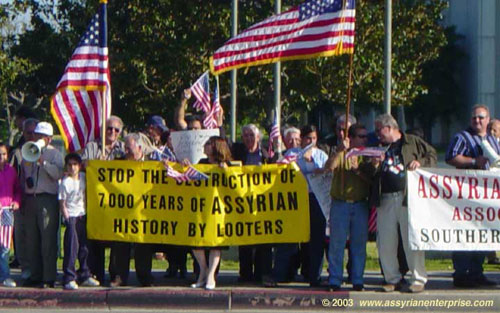
Today, the ruins of Nineveh lie just across the River Tigris from Iraq's third city of Mosul. The spiritual centre and eventually the capital of the Assyrian empire, Nineveh dominated its world absolutely. Its army was the largest, most innovative and most professional in the ancient Middle East, and great rulers like Sargon and Sennacherib earned a reputation for preferring direct force to messy diplomacy. Founded in the third millennium before Christ, the Assyrian Empire went downhill for a few centuries before rising to its peak in the seventh century BC. Final decline came abruptly, however, and in 612 BC, Nineveh was sacked by the Babylonians and the Medes (curiously enough, descendants of the Medes, the Kurds, also did quite a bit of sacking in and around Mosul last week). By the time Nineveh fell, the heavy-handed policies of the Assyrian rulers had so thoroughly alienated subjects and foes alike that few people mourned their passing. Today, Nineveh is nominally in the control of the occupying forces of the US, although they have not visited yet. Despite having won the war on Monday, US forces were fighting invisible assailants in central Mosul this week. Local doctors said the clashes had left at least 16 Iraqis dead, many, if not all of them, unarmed protesters or bystanders. The US has insisted that its troops responded correctly to hostile fire. On Tuesday, its fighter jets sought to impress American power on Mosul's increasingly unfriendly Arab population by making repeated low-level passes over the city, breaking windows and terrifying civilians with their thunderous sonic booms. As one American soldier told a New York Times reporter: "It's a show of force, but people don't understand it." Next day there were more shootings, and two Apache attack helicopters circled and darted low above the increasingly hostile town. After days of looting and ethnic clashes, the city and its outskirts were tense with latent violence, and a group of grim-looking armed men swarmed out onto the deserted street when a strange car pulled up outside Nineveh's Nergal gate. A moment of nerves and then relaxation - these, it turned out, were the Assyrians themselves, guarding their old neighbourhood against would-be looters. Although humbled by successive waves of foreign masters, the Assyrian people lingered in and around their ancient empire, converting to Christianity in the first century AD. Saddam's recent efforts to erase their ancient identity drove many if not most Iraqi Assyrians to leave - a great number of them for Australia - but thousands still linger in the ancient land of Mesopotamia. This particular group, from the Democratic Assyrian Movement, was guarding a Christian neighbourhood on the edge of Nineveh, basing themselves in a commandeered headquarters of Saddam's Baath Party. "They told us there was no such thing as Assyrians any more, that we would all have to change our names and be Arabs," said Akkad Youanna Isac, 21, a Kalashnikov-toting computer student. "But Saddam's gone now, and we're still here. We were here thousands of years before Christ. We will be here forever." Inside the reconstructed gate stood two giant bas-reliefs of the human-headed winged bull, symbol of Assyria's power and wisdom. Irregular mounds of mud marked the 12-kilometre circuit of the ancient wall. Inside, a stone tablet marked with Mesopotamia's ancient cuneiform script protruded from the rain-soaked soil. The interior of the ancient city is now given over to government-owned farmland. A few Australian eucalyptus trees have colonised this ancient ground. Off in the distance, on a high artificial mound in the centre of the city, tiny figures were scavenging for loot among the antennas of an abandoned Iraqi military post. For heathen heart that puts her trust/In reeking tube and iron shard,/All valiant dust that builds on dust,/And guarding, calls not Thee to guard,/For frantic boast and foolish word,/Thy mercy on Thy People, Lord! Ed O’Loughlin
|

| FINAL STATEMENT OF IRAQI OPPOSITION MEETING IN NASIRIYAH
(ZNDA: Ur) Iraqi leaders opposed to former Iraqi President Saddam Hussein convened last Tuesday in the ancient southern Mesopotamian city of Ur - the first of several U.S.- sponsored meetings on the nation's future. Following is a 13-point statement released by the U.S. Central Command about the proposed new Iraqi government and future meetings: 1. Iraq must be democratic. ZOWAA OPENS OFFICES IN BAGHDAD (ZNDA: Baghdad) The Assyrian Democratic Movement (Zowaa) has opened two offices in Baghdad in the quarters of Zayoona and Dora, according to a report from the ADM Information Office in North Iraq. Reports from Baghdad and Northern Iraq indicate that the Assyrian
people have been visiting at the ADM offices in Kirkuk, Mosul
and Baghdad. SIX ASSYRIANS APPOINTED TO KIRKUK CITY COUNCIL (ZNDA: Kirkuk) On 17 April the Kirkuk City Council comprised of 24 members was appointed to oversee the local civic authority during the post-Saddam transition period. The 24 individuals represent four main ethnic populations of the oil-city of Kirkuk: Arabs, Kurds, Assyrians and Turkomen.
The Six Assyrian representatives are: 1. Dr. Emil Nasir Azo The council has since established many sub-committees to oversee
Kirkuk's various service groups. The first of such is the Security
Sub-committee, in which two members from each ethnic group are
reperesented. The Assyrian representation is headed by Colonel
Wa'el, an engineer; and Captain Ezaria, an attorney. (ZNDA: Arbil) On 18 April, the body of Julian Afram Yacoub,
13, a 7th-grade-student, was found in Ba'sheeqa in North Iraq.
Shortly afterwards a suspect was found with bloodied clothes,
and arrested on charges of murder. The body was found in a location
where a year ago a Yezidi man was also found dead. IRAQI CHRISTIANS WORRY ABOUT SHIITE SURGE Courtesy of the Associated Press; by Charles J. Hanley (ZNDA: Baghdad) Christians crowded into churches across Iraq on Sunday to celebrate Easter, the feast of new beginnings, nervous over what the new Iraq has in store for their resilient but dwindling minority in an overwhelmingly Muslim land.
A longtime bishop of Baghdad used the occasion to ask that President Bush help introduce an Iraqi constitution that treats Christians the same as Muslims. At Baghdad's Sacred Heart Church, meanwhile, the Chaldean Catholic pastor told a congregation overflowing out the doors that re-establishing law and order was everyone's first concern. “Jesus rose from the dead saying, `I give you peace’,” the Rev. Basic Shamoun said. “We're in a time when we need peace.” But in the courtyard outside, parishioners spoke frankly of a deeper worry, that the U.S. promise of democracy to replace Saddam Hussein's dictatorship might lead to rule by Iraq's poor, downtrodden Shiite Muslims, a majority whose fundamentalists are prone to religious intolerance. Saddam's regime was dominated by Sunni Muslims. “If they come to power, we'll leave the country,” electrician Jacob Koda, 51, said of the Shiites. “They're brainwashed with religious ideas. To them, Christians are bad people,” said pharmacist Noel Kadu, 51. Christians, most of them Chaldean Catholics, total 700,000 in Iraq, about 5 percent of the population. Although they have generally coexisted peacefully with their Muslim neighbors over the centuries, they also have been persecuted at times, and many have emigrated to the United States and Europe. As recently as the 1960s, before Saddam's Baath Party came to power, many prominent Christians were imprisoned. Under the Baath, Christian schools were nationalized, official discrimination was perpetuated in marriage rules, requiring Christians to convert to Islam in order to marry Muslims, and unofficial discrimination persisted in hiring, job promotion and other areas. In northern Iraq, Muslim mobs are reported to have attacked Assyrian Catholics several times in recent years, according to U.S. State Department human rights reports. In the southern city of Basra on Sunday, sunlight filtered through the stained glass panels of St. Therese Catholic Church as Archbishop Gabriel Kassab led parishioners in a prayer to remember war victims. “We must not forget those who have died,” he said, waving a gold cross in one hand. About 500 people crowded into well-worn wooden pews, voices raised in prayer and song during a three-hour service. Though Basra is a Shiite Muslim stronghold, it also has a sizable Christian community. “There's nothing nicer than peace,” said Boushra Thomas, 46, as she waved a lace fan to cut through the morning's heat. “We could not come to church during the war because there was so much shelling and bombing. Danger was everywhere. Now we can come anytime we like.” “As Iraqis we have to be united more than ever during this Easter,” said the Rev. Emmanuel Delly, freshly retired after 40 years as Baghdad's Chaldean bishop. But Delly, in an interview, said a top priority now must be to recover confiscated Christian schools and associated property - some 30 schools in Baghdad alone - and establish equal rights for Christians in a new constitution. “We can't meet Mr. Bush. But please tell Mr. Bush, `I am asking you in the name of all bishops to give us a good constitution,” Delly said. An Iraqi constituent assembly, chosen through a still-unannounced process, is expected to adopt a new constitution by next year. Arriving for mass at Sacred Heart Church, black-clad Nahida Issa, 54, talked nervously of recent protests by young Shiites in Baghdad's streets demanding that U.S. troops pull out. “They've done a lot of the looting, you know,” she said. “They might grow frenzied.” Another woman, with her husband and four children, said she heard about the new Shiite activism, now that the repressive, Sunni Muslim-dominated regime has fallen. “I'm worried,” said Ahlam Abed, 47. “The fundamentalists are forming political parties.” At a nearby convent, Sister Philip Kirma, general superior of a tiny international order of Chaldean nuns, the Daughters of Mary Immaculate, threw up her hands when asked about the Christians' future: “We don't know what our destiny will be.” The 53-year-old nun learned just two days earlier that a beloved Muslim guard at another of her convents, a young father, was killed when someone picked up a U.S. “bomblet”- a canister-size piece of a cluster bomb. As with many others, for her it wasn't a joyful Easter. “In Mass today, I cried the whole time,” she said.
“All the miseries of the Iraqi people came to me ... all
the thousands and thousands lost, fathers and mothers and brothers
and sisters.” IRAQI CHRISTIANS PRAY FOR PEACE AS GUNFIRE RINGS OUT Courtesy of the Daily Telegraph (19 April); by David Blair (ZNDA: Baghdad) The sound of gunfire accompanied a sermon on war and hymns blended with the whirring of generators yesterday as Baghdad's Christians attended Good Friday services.
Iraq's Christian community, numbering about one million, has survived countless storms over the centuries. Yesterday they gave thanks for surviving the latest ordeal. Inside the cool, whitewashed nave of the Syrian Catholic Cathedral of Our Lady of the Deliverance more than 600 people gathered in prayer. Veiled women held the hands of smartly dressed children. Elderly men in pinstriped suits, wreathed in clouds of incense, gazed into the blue dome above the Cathedral's altar, ringed by eight marble pillars. Every one of the heavy wooden pews was crowded and the congregation spilled over into the cathedral's entrance. They listened as Matti Shaba Matoka, the Syrian Catholic Archbishop of Baghdad, called on God to "save the Iraqi people from all of this war". The congregation sang every hymn and recited the Creed in Aramaic, the language of Christ. The Lord's Prayer was said in Arabic. Yet the entire service was conducted against the cacophonous background noise provided by the cathedral's generator, switched on to power the fans and ward off the day's heat. Nine days after the American troops captured Baghdad, most of the capital is still without electricity. Looting continues, although at a much reduced level, and gunfire was faintly audible during the service. Afterwards, Archbishop Matoka described the Good Friday of 2003 as " special for us, because of the war". "During one month, not yet finished, we didn't know what the future would bring," he said. "We pray that our country will see a future better than the past. We want peace. Peace, that is all we ask for." Among the congregation were people who lost friends and relatives during the war. Noor Henry, 17, narrowly escaped death when a bomb killed her neighbour and destroyed his home in the Baghdad suburb of al-Daura. Her school has been closed for a month and there is no sign of it re-opening. "Things will not be the same again, she said. "I
want to go abroad. Iraq is finished for me." FOR IRAQ'S CHRISTIANS, EASTER IS MARKED BY SORROW, DREAD Courtesy of the Washington Post (21 April); by Carol Morello (ZNDA: Baghdad) In all his 57 years, Samir Ahad had never experienced an Easter Sunday so filled with sorrow, hopelessness and dread as this one.
At every turn was a reminder of the war that left lives in shambles and usurped a government that had cosseted Iraq's small Christian minority. Parishioners arrived today at the Evangelical Protestant Church, where Ahad is the secretary, in cars pockmarked by shrapnel. The absence of the chocolates, colored eggs and new clothes that usually mark Easter services at the Presbyterian church underscored the poverty of the parishioners. The Italian organ donated by ousted president Saddam Hussein sat silent, for lack of $2,000 to repair it. Under a gloomy sky, nobody could muster even a perfunctory "Happy Easter" greeting. Instead, many wept through the sermon on a day meant to celebrate resurrection. "This is a sad Easter," said Ahad, sipping tea in the church office where ceiling fans rotated lazily under a generator's power. "We have suffered, not only from Saddam but from pollution of the air and the water, from having no jobs and no income. And in my mind I keep seeing my son carrying a Kalashnikov to protect the church from looters. I didn't want this for him. We are all afraid, for today and for the future." A smothering blanket of loss and worry stripped joy from Easter services at churches in this city, where the promise of rebirth seems a distant dream. Even those who managed a show of cheer upon seeing old friends acknowledged they didn't feel like smiling -- inside, they said, they were crying. Like most Iraqis, Christians are reeling from the double blow of the war and the massive looting that ensued. But many Christians are also concerned that the new, free Iraq will be dominated by Islamic parties. Some already predict they will feel less welcome here and are considering leaving the country. At the same time, many of the nation's Christian leaders say they are relieved to be rid of the despotic leadership of Hussein and his Baath Party followers. During his 24-year reign, a symbiotic relationship existed between the government, which was dominated by Sunni Muslims, and the Christian minority of less than 1 million out of 24 million Iraqis. One of the founders of the Iraqi Baath Party was a Syrian Christian, Michel Aflaq, who later converted to Islam. Christians held prominent positions in the government, including that of the deputy prime minister, Tariq Aziz. Hussein hired a Christian nanny when his two sons, Uday and Qusay, were young, and retained several Christian bodyguards and aides. Many Iraqi churches had a benefactor in the government. It gave land on which to build churches and sometimes paid for their construction. Their water and electricity were free. About a decade ago, Hussein gave every major church in the country a new organ. The largesse went beyond material goods. According to religious leaders, government-controlled newspapers were prohibited from publishing anything derogatory about Christians. In return, Hussein counted on their acquiescence, if not outright support. Iraqi television frequently showed Christian leaders warmly greeting him, shaking his hand and praising his leadership. "Saddam loved Christians," said Ikram Mehanni, the minister of the Evangelical Protestant Church. "He didn't abuse our religion. To the contrary, he gave us money." Asked why Hussein was so generous, Mehanni replied, "Christians
didn't give problems to the government." "Christians are afraid of the new government, and what
it will do with us," said Wisal Kotta, as she left Easter
services at Our Lady of Rescue, a Syrian Catholic church. "There
may be many political parties, religious parties." A knock at the heavy metal door in a wall about 15 feet high around the city's only functioning synagogue was answered by a Muslim watchman. He said it was forbidden for anyone to enter. Services were held every Saturday until about two months ago, he said. But the Jews who live in the area either fled to other parts of the city before the war or went abroad, he said. He did not know how to contact them. To a degree, the concern is as much about the perils and sorrows
of the present, as about dread of the future. At the nearby Armenian Catholic church, Vicar Antoine Atamian kissed the cheeks of hundreds of parishioners after Easter services. Many people in the church knew someone who had died, he said. Among the dead was one of his two drivers, who apparently was killed in crossfire during the war. During the worst of the bombardment, he said, hundreds of Iraqis, among them Kurds and Muslims, sought shelter in the church's underground meeting hall. Atamian said he feels "betrayed" by Hussein, who he believes fled the city rather than stay to the death as he had vowed. But before the war, Atamian felt gratitude and even affection for the president. "He was a dictator," said Atamian, pulling out a letter of appointment as vicar signed by Hussein. "The Shia were afraid. They couldn't move. But he respected us as religious men." Atamian said the Iraqi president never failed to dispatch greetings and gifts on religious holidays. "For Christmas and Easter, he sent greeting cards and a big box of dates and gifts," said Atamian, sitting behind a large desk in his office, which was furnished with red velvet sofas. "Very high officials, directly from the presidential palace, would come and ask us if we needed anything. I believed Saddam Hussein was a nationalist. We used to be beside him. I had many meetings with him. We used to express our feelings and love to him. Now, we are changed. He talked about staying with us, to the last bullet. He was on TV. 'Live or die with pride,' he said. But we heard he left the city." Atamian said he does not fear Christians will be ostracized
or made to feel uncomfortable by the Muslim majority. Not everyone shares his feelings. At Evangelical Protestant Church, a widowed parishioner said he was preparing to leave Iraq, hoping to provide his grown son with a better future. "It's going to be like Iran," warned the parishioner.
"Even Christians will have to wear head scarves. There
will be no alcohol. No dancing. All Christians are afraid now."
IRAQI CHRISTIANS WARY OF ISLAMISTS Courtesy of the Christian Science Monitor (22 April); by Peter Ford
"This Easter has a special taste," said Vaghinak Vahanian, a leader of the Armenian orthodox church. "People are coming out, breathing, laughing, and seeing each other. It's a good sign." But other Christians were less sanguine. "We are afraid that the fanatics could do something bad, especially among our Muslim brothers," says Bishop Ishlemon Wardouni, head of the Chaldean Catholic church. "We have a long history of persecutions here," dating back to Genghis Khan and earlier. Keeping a low profile The power vacuum that has left Iraq without any authority since Saddam Hussein's regime fell 10 days ago is unnerving local Christians, who make up about 3 percent of the population and tend to be better educated and more prosperous than their Muslim neighbors. The prospect of sectarian religious violence is especially frightening to them. So they are keeping a low profile. The Chaldeans, members of a church founded by St. Thomas in the first century, celebrated their traditional midnight mass on Saturday afternoon, so as to be home by nightfall. The Armenian Orthodox archbishop chose to hold his service not in the main Armenian church downtown, an area still infested with thieves, but in a quieter outlying district of Baghdad. The soaring voices of the Armenian choir filled the ochre brick church Sunday morning as the congregation, dressed in Sunday best, overflowed onto the parched lawn outside. Worshippers who had not seen each other since the war began hugged and kissed one another, relieved to know they were safe. The evening before, Chaldean Bishop Shlimon Wardouni had preached a sermon of caution. "I told people to be especially reasonable and wise, because this time is very difficult," he said after the Mass. "I asked them not to spread rumors, but to speak constructive words." Muslims and Christians have lived peacefully side by side in Iraq for many years, Bishop Wardouni points out. "We must cooperate in love and unity for the good of our people," he says. But he is alarmed. Shiite Muslims in his neighborhood, who he says are followers of the late Ayatollah Khomeini, have said they want to convert a building next to his church - formerly belonging to the ruling Baath Party - into a mosque. "If this sort of thing happens, maybe later there could be problems," Wardouni worries. "We have heard their slogans, 'No Saddam, No Bush, Yes to an Islamic State.' " Christians here say they enjoyed as many rights and freedoms as any other Iraqi under Saddam Hussein, who made one of their number, Tariq Aziz, an influential deputy prime minister. "We enjoyed total religious freedom and there was no religious discrimination" against Christians, said Armenian Archbishop Avak Asadourian. The current sense of uncertainty about their future that most Iraqis feel today, however, means that "anything could happen now," says Sarmed Hazem, a pharmacist who teaches Sunday school at the Chaldean church. "We want to stay, we don't want to emigrate, we just want to be free and safe," he adds. There are 650,000 Christians in Iraq, most Chaldeans but also Syrian, Latin, and Armenian Catholics, and members of a variety of Orthodox sects. Their numbers have fallen from more than a million during the past 20 years, as emigration has taken its toll. "We are few, and they [Muslims] are more than us," says Raad Rassam, a commercial translator who wears a pearl crucifix on a gold necklace. "I don't know what to expect, but in these days we fear many people from the outside." American marines and soldiers, to whom most Iraqis had looked for security, are present in only a few neighborhoods of Baghdad. In other parts of the city, armed Shiite Muslim militiamen have taken upon themselves the duty of preserving public order. "We are very afraid that the Americans will withdraw from the cities and leave them in the hands of those people," says Kevorg Zeretzian, an Armenian tire merchant in Baghdad's souk. "That would be very dangerous." Anxious for dialogue Christian leaders say they are anxious to talk to their Muslim counterparts, to establish a dialogue that could help ensure their future. "In this time we have no contacts, but I will try to do something because we cannot stay like this," says Wardouni. In the back of his mind, he explains, is the fate of Chaldean Christians in Turkey. There, a once-vibrant community has been reduced by governmental pressure over the past 80 years to 150 families led by a bishop who is forbidden to wear a cassock or crucifix in public. But Wardouni says he has grounds for hope of peaceful coexistence between Iraq's various religious groups. In the corner of his church courtyard, for example, a shrine to the Virgin Mary attracts a handful of Muslim supplicants every day, seeking divine intercession. "I think Iraqi people are smart and studious enough"
to avoid sectarian conflict, says Archbishop Asadourian. "There
will be some difficult times, but I have belief in the Iraqi
people and their ability to overcome them." Courtesy of Zenit News Agency (20 April) (ZNDA: Baghdad) Iraqi Christians are worried about the state of their country, given the general disorder and the fear of a rising Muslim fundamentalism. "The concept of freedom as a right does not exist here," explained Catholic Latin-rite Archbishop Jean Benjamin Sleiman of Baghdad. "Also the concept of laicism, often applied to this country, must be understood with caution." "If the influence and pressure of extremist groups, which are regaining their vigor, increases in the future, I don't know what kind of future can be envisioned," he said. According to Archbishop Sleiman, in the Arab world the concept of laicism is different from that of the West, as Arabs are used to a close relation between religion, society and the state. "I certainly don't see a democratic prospect being close," he added, expressing the general feeling of 800,000 Christians in the country, who nevertheless express satisfaction over the fall of Saddam Hussein's regime. Among the Church agencies coping in the postwar era is the House of Love. The small orphanage at 52 Al Wada Street, run by four nuns of the Missionaries of Charity, looks after 22 children with mental disabilities and physical malformations. Sister Carol explained: "During the war, the children understood that things were not going well. During the bombings we told them that it was a bad storm. Some of them asked us to let them see the rain." Over the three weeks of the war, churches were open to shelter all those in need, regardless of religion. Once the bombings were over, they all went home. There is only one hospital in Baghdad, St. Raphael's, which has not been the object of lootings, perhaps because it had two armed guards -- or because of the Franciscan nuns there who inspire respect. When the bombings were over, they asked the Americans to guard the clinic. "We lack nothing," said Sister Maryanne Pierre, who is in charge of the hospital's administration. "We have medicines, food, water. We are only worried about the generator of electric energy. We have only one and it is working a lot." "During the war, we were especially worried about the maternity department," she said. "The fear caused many women to have premature births; 350 babies were born in two weeks." The women arrived, gave birth, and returned home after two hours, as they refused to be away from the rest of their families, the nun explained. Archbishop Sleiman said: "On one hand, Christians did not want the bombs to fall on them, but on the other, they wanted a change." Warned Sister Maryanne: "For a Muslim, the American soldiers
are Christians and the conflict is seen as a war against Islam." BAGHDAD CHRISTIANS PRAY FOR PEACE ON GOOD FRIDAY Courtesy of Reuters (17 April); Edmund Blair (ZNDA: Baghdad) Iraqi Christians marked Good Friday with prayers for a resurrection of peace and normality in the war-torn country where they enjoyed relative religious freedom under Saddam Hussein's secular rule. "We are praying that the Lord helps us. We need peace
and security for Iraq. We pray everyday that the Lord protects
our homes, our people and our country," said 53-year-old
Edward Fransu Abu Ramir after a protestant church "We don't have electricity and water. We don't have the
basics for living. We still don't have stability," he said,
standing near a small church garden where roses were in bloom
-- - a rare area of tranquility in the war-torn Baghdad's streets were busy on Friday as Christians marked
the suffering and death of Jesus. But many shops remain closed
for lack of power, many buildings have been ransacked by looters
or are blackened by fire and water So far, churches -- like mosques -- appear to be off limits to looters and there are no signs that Christians were deliberately targeted in the chaos that engulfed Baghdad after U.S. troops arrived. But many Christians worry that the collapse of Saddam's government and the advent of democracy in a Muslim majority nation could spell an end to the relative religious freedom they enjoyed under the secular Baath Party. Some fear a backlash from those who considered them allies of Saddam. "We hope that the Lord will answer our prayers and return the situation to normal," said 34-year-old Saad Behnam, holding his 10-month-old daughter. Roots in Mesopotamia Iraq's Christians say their roots go back to the first century when the apostle Thomas evangelized Iraq, then Mesopotamia. But today, there are only an estimated 700,000 Christians in a country of some 26 million people, most of whom are Muslim. Ishlemon Warduni, Chaldean auxiliary bishop, said Christians accounted for roughly 400,000 of the five million people in Baghdad, most of them Chaldeans -- an old Catholic sect that originated in Iraq. But there are many other denominations, including protestants. Some denominations celebrate Good Friday, followed on Sunday by what Christians believe was the resurrection of Jesus, on different days of the year. Warduni said many thousands of Christians left the country in recent decades as war and sanctions battered the economy. "Today, especially, our prayer is to pray for peace... because I think our war is not finished yet," he said, adding that Pope John Paul II had called for such prayers on Good Friday. Prayers For the Dead Warduni, who was due to minister at a church service later in the day, said he would also be praying for all those killed, including Iraqi, U.S. and British soldiers. "They (the people) are happy at the change of regime, the bad regime, but they are sad because until now nothing has been done -- only destruction, killing and trouble until now." He was voicing the sentiments of many Iraqis, who have welcomed the end of Saddam's harsh rule, but are baffled that the U.S.-led invaders have still not put any form of government in place to restore full order and services. In the protestant church, 32-year-old Bashar Francis Josef was praying to see his wife and two children, now in the Netherlands. They fled five years ago as conditions deteriorated in Iraq. He has not seen them since. Like many others, he has not even been able to speak to them by telephone recently because the national network has broken down. "God willing, I will see them. Maybe the situation will get better and I can go to see them. It would be even better if they could come back," he said. |
BNA PRESS RELEASE: BNDP IS NOW BNAPress Release Subject: Name Change April 16, 2003 Formerly known as the Bet-Nahrain Democratic Party, the vigilant and dynamic Assyrian political party announced today that it has changed its name to Bet-Nahrain National Alliance (BNA) or Khoyada Omtanaya d'Bet-Nahrain. The new name reflects BNA's commitment to the unity of the Assyrian people and their eternal bond to the land of Bet-Nahrain (Mesopotamia). The decision to revise the name came as the result of a long legal encounter with another Assyrian political party. As the judicial proceedings continued, greater erosion of respect between the two political parties became inevitable. To curtail further financial burden on both parties and in the spirit of unity among all Assyrian political groups, Bet-Nahrain Democratic Party - under the leadership of Mr. Shimon Khamo, BNA Secretary General- amicably ended the legal skirmish with the decision to adopt the new name. The Bet-Nahrain National Alliance hopes that with the decision to assume a new name, a new era of improved relations among all Assyrian political parties and the two fighting parties in particular, shall commence. God bless the Assyrian nation. Bet-Nahrain National Alliance
(ZNDA: Phoenix) Representatives of the Assyrian Democratic Movement
and the Assyrian Aid Society met with Senator Jon Kyl (Arizona-R)
on Friday, 18 April. The discussion entailed the current Iraqi situation
and future Iraq. Senator Kyl also recorded a message for the Assyrian
Christian Community worldwide. The message will be broadcast on the
Assyrian Star radio program from Arizona on Saturday April 19, 2003.
(www.KXEG1280.com) at 4 pm AZ
time. 'LET THEM ARREST HIM,' TARIQ AZIZ'S AUNT SAYS Courtesy of the Washington Post (20 April); by Davie Rohde
"Let them arrest him," Selma Dawood said dismissively. "It's not important to me. What can I do with Tariq Aziz?" The blunt, baritone-voiced 75-year-old widow was speaking of the man identified here as her sister's son. He was deputy prime minister in Saddam Hussein's government and to Americans, Iraq's voice to the outside world through two gulf wars. Mr. Aziz, the portly, gray-haired, senior aide who wore trademark thick, black-rimmed glasses, offered up blistering critiques of the United States through both conflicts. Today, both he and his boss are missing. Mr. Aziz was the top Christian on Iraq's Revolutionary Command Council. Today, his relatives and hundreds of thousands of other Christians, who make up nearly 4 percent of Iraq's population, celebrated Easter. But Ms. Dawood, a striking woman with broad shoulders, a thick gray braid and a wizened face, offered few words of charity toward her nephew. It was unclear whether it was bad blood, crotchetiness or fear of arousing suspicion that fueled her attitude. Asked if her nephew had done anything to aid Christians, she tartly replied: "Zero. Zero. He's very, very bad." She added that he was part of a "criminal regime." Mr. Aziz, who is about 66, played a pivotal role in thwarting efforts by United Nations weapons inspectors in the mid-1990's and lived in a villa on the Tigris River in Baghdad. "Saddam is finished, and we are O.K.," his aunt proclaimed. "We are very happy and merciful to God and the Americans, our uncles." "God bless America," she added. "God protect America." American Special Operations soldiers are patrolling this area, but they do not appear to be hunting for Mr. Aziz. American commanders said they recently sent troops to the area to discourage looting and clashes between Kurds and Christians. Today, the soldiers appeared relaxed. "So far, it's quiet," one of them said this afternoon. Surrounded by some of her 18 grandchildren and 7 great-grandchildren, Ms. Dawood said she had lost contact with her relatives in Baghdad and had not seen her famous nephew since 1995. She was in Baghdad then, she said, and his driver picked her up for a family gathering. "Just greetings," she said, dryly describing their conversation. "`How are you?' `Everything is O.K.' He never asked if we needed anything." She said Mr. Aziz was the son of a doctor who emigrated from Turkey though some biographies say his father had a humbler profession and of Ms. Dawood's sister, who grew up here. As a child, Mr. Aziz and his brother and sister moved every two years as his father held different health posts, she said, but they spent some time in the Mosul area before moving to Baghdad. Mr. Aziz has two sons, Ziad and Saddam, and two daughters, Zaina and Mayisa, she said. All are adults who had been living in Baghdad with their families. Both she and local residents said Mr. Aziz's wife stayed in this town during the first Persian Gulf war in 1991. But she said Mr. Aziz had not been in Qaraqosh for years. This quiet, farming town of 25,000 people is 99 percent Assyrian Christian, residents said. Local priests do not know its exact age, but say it dates back thousands of years. It is part of a belt of Assyrian settlements in northern Iraq that date in some cases to the Assyrian Empire, which flourished from roughly 900 to 600 B.C. and had its capital near Mosul. Today, two large churches dominate the town's skyline. One is a Chaldean, or Catholic, Assyrian Christian church, which celebrated Easter today. Women carrying girls in White and yellow Easter dresses streamed into the church this afternoon for services. The other church, which is Assyrian Orthodox, will celebrate Easter next Sunday. Most portraits of Mr. Hussein have been removed from the town, but one remains. On the outskirts, a mural depicts him on horseback slaying a dragon with a spear flying. Ms. Dawood's enthusiastic welcome of Americans is not universal here. Residents said they were relieved that Mr. Hussein had been toppled, but were apprehensive about lawlessness. "We are uncertain about our future this Easter," said Mathi Habib, a 36-year-old worker. "Our only worry is the instability and power vacuum." Near the end of the conversation, Ms. Dawood grew more charitable about her nephew. "He is afraid of Saddam Hussein," she said. "They forced him to do things." But she repeated that she had no ties to him. "We have no link,"
she said, "neither good nor evil. CHICAGO TRIBUNE'S INTERVIEW WITH NADIA MIRZA Courtesy of Chicago Tribune (16 April); by Barbara Brotman (ZNDA: Chicago) Nadia Mirza follows the news closely. War in Iraq has preoccupied the world, but Iraq was once Mirza's world. She was 9 years old when her family fled in 1980. She grew up in the Baghdad neighborhood of Dora, watching American TV. "I remember watching `The Brady Bunch' and `Star Trek.' Those were my favorite shows," she said. She learned English from her father, who taught it in high school. But her parents, Assyrian Christians who were both teachers, had a growing sense of dread. Mirza's grandfather had been arrested in the late `60s after he had allowed two relatives who had opposed the Baath regime to stay overnight. When he was released after six months in solitary confinement, Mirza said, he would only say that he had been through something terrible. One of Mirza's aunts, who was 17, had a friend whose brother was working against Saddam Hussein. "He was executed, along with his entire family and his friends," Mirza said. The aunt was questioned, suffered a mental breakdown and has never entirely recovered, Mirza said. "I remember my parents coming home and saying, `What are we going to do next? Do we wait for something to happen?' If my father was arrested, what would we do then? People disappeared. My mom and dad were very afraid." "They said, `We have to leave. Now.'" They fled to Damascus, Syria, and from there to Italy and then to the U.S. They settled in the North Side of Chicago. Her father taught Aramaic/English bilingual education in a North Side Chicago public school; her mother operated the family's businesses, a video store and a dollar discount store. In the years after they left, stories surfaced about the fate of family members left behind. Mirza heard that about 20 years ago, her 17-year-old cousin had failed to come home after school after expressing anti-Baath Party sentiment. No one knew what had become of her. But now, with Hussein's government toppled, Mirza wanted to find out. She called her aunt, the cousin's mother, who had fled to Australia. Her aunt told her a ghastly story. After her daughter's disappearance, Mirza's aunt told her, she had been contacted by a man who had helped kidnap her. He felt remorse, he told Mirza's aunt, and offered to help. "He said, `I can help you bring her back, but you have to put her in hiding,"' Mirza said. The man brought her to a rented room in Baghdad, and told her mother where to find her. "My aunt saw her," Mirza said. "She was completely drugged. She could not communicate anything at all. She couldn't say where she had been or what had happened to her." Her mother kept her in the room, away from the family, lest contact place them all in danger. But danger came anyway, she told Mirza. "The police found out about the person who helped my aunt," Mirza said. "They beat him to death. Then they came to my aunt. They requested that my cousin be returned; otherwise, they would take her two other daughters." The other teenage daughters were hiding under the bed. But the police told their mother that they would be back for them unless she gave up her other daughter. She would have to make a choice, the worst a parent can imagine. She chose. She told them where to find her daughter. She and her husband took her other two daughters and her three sons and left the country. She never saw or heard from her captured daughter again. "I said to her, `How could you not ever say anything (about it)?"' Mirza said. "She said, `What is there to say? That I handed back my daughter?' But my aunt had no choice. You sacrifice one (daughter) to keep the other two safe." Mirza, 31, lives in Skokie, Ill., and works as a paralegal at a downtown law firm. She was among a group of Iraqi exiles who met recently with President Bush in Washington, D.C., to express their gratitude and urge that the U.S. remain active in the country's reconstruction. She hopes she and her parents can return someday to help rebuild Iraq. She thinks her aunt will go back eventually to find out what happened to her daughter. War and tyranny are massive events that play out in countless individual
lives. Attention is turning to the rebuilding of Iraq. But the stories
emerging from there tell us that countless mothers' hearts will stay
broken. SNAPSHOTS OF AMERICAN LIFE: THE ASSYRIAN PRIDE Courtesy of the Harford Courant (17 April); story by Oshrat Carmiel (ZNDA: Hartford) Agnes Y. Pireh was in tears this weekend as she watched looters destroy or steal hundreds of priceless artifacts at the National Museum in Baghdad. For Pireh, 39, the sadness was personal. Her history was being destroyed. Pireh is of Assyrian heritage, one of 4.5 million Christians worldwide who trace their cultural roots to an ancient homeland in an area that today includes northern Iraq and parts of Turkey, Iran and Syria. She also is a regional director of the Assyrian American National Federation. “We are all so upset over it,” said Pireh, a Wethersfield resident who also is of Iranian descent. “Those [artifacts] are part of our culture; they are telling stories from our past.” Hundreds of irreplaceable objects were stolen or destroyed, including Sumerian clay pots, Assyrian marble carvings, Babylonian statues and a stone tablet etched with cuneiform writing. But that does not mean that local Assyrian Americans are wavering
in their the support for the war, Pireh said. The Assyrian community
in Connecticut “We the undersigned members of the Assyrian community in Connecticut support our American troops and our joint leadership to liberate the people of Iraq,” the letter begins. Then it explains why: “Due to the barbaric policy of Saddam [Hussein's] regime, over one million Assyrians, 25 percent of our total number worldwide, have fled Iraq over the last 30 years. The Iraqi census in 1977 forced Assyrians to register either as Arabs or Kurds, an unjust act of forced Arabization attempting to eliminate the identity of Assyrians.” The Connecticut group urged that the American government encourage democracy in Iraq, creating a place “where all ethnic groups are treated and looked upon equally.” The letter estimates that 2 million Assyrians still live in northern Iraq. “As American citizens of Assyrian descent, we stand by the
United States in its effort to bring about a lasting peace to the
world,” it says. “Our thoughts and prayers are with the
American troops and the innocent people of Iraq.” Courtesy of the Modesto Bee (21 April); by Julissa McKinnon (ZNDA: Modesto) Bill Dadesho prays every day for a democracy to emerge in his native Iraq. But he's not betting on it. Dadesho, a 67-year-old Modesto insurance agent, fled Iraq in 1963 as a religious refugee. He said he was tired of the discrimination he experienced as a Christian living in a Muslim state. "The people in power called us infidels, and didn't let us live our lives," he said. "We couldn't follow the dreams every person has, to go to college and raise a family in peace." Watching the unraveling of Saddam Hussein's dictatorship, Dadesho, like many local Assyrians, rejoiced. But now, as Iraq's myriad religious and ethnic leaders start jockeying for power, Dadesho's joy is turning to dread. "There's no way to force democracy on people who've lived for centuries where the strong rule the weak," he said. "This mentality isn't going to change overnight. "They're going to fight among themselves," he said matter-of-factly as he served up hot dogs and burritos at the snack bar window of the Assyrian Cultural Center of Bet-Nahrain in Ceres last week. "The suicide bombings will start and then our American soldiers will come home and they will kill each other." Meanwhile, in the next room, most of his fellow volunteers at KBSV Assyria-Vision TV station in Ceres said they believe a long-lasting democracy in Iraq is possible if coalition forces stay to quell the postwar chaos. William Mikhail, 54, co-host of an Assyrian political show, believes coalition forces need to stay at least 10 years for peace to prosper. "I hope they stay there 100 years to teach people how to live free. Right now, they don't know how," said Mikhail, who was born and raised in the Iraqi city of Basra. "It's like letting a bird out of a cage. When the bird goes free, it starts flying everywhere and hitting the walls. It's not used to freedom." Sargon Dadesho, the president of the Assyrian National Congress and head of the TV station, said looters who ransacked Iraq's National Museum stole more than million-dollar treasures. He said the thieves made away with some of Assyrians' last links to their ancestry. Modern-day Assyrian culture was squashed under Saddam, who outlawed their Christian religion and Aramaic language, and erased their ethnic category from census records. "Somehow these statues and artifacts tied us to our history, to our glorious past," Sargon Dadesho said quietly. With their history in shambles, he said, there's nothing to focus on but the future. In the coming weeks, he plans to return to Iraq to help fellow Assyrians vie for political power in the emerging government. Sargon Dadesho said he's not sure how he plans to help. He's going, he said, to see what is needed by people in Assyrian villages in Northern Iraq. Though infighting is raging among minority groups trying to reclaim their former homes from present-day Arab owners, Sargon Dadesho said he believes the fighting will die down soon. Ramin Odisho, past president of the Assyrian American Civic Club of Turlock, said Assyrians from inside and outside Iraq stand a chance to play a role in the new Iraq if they stay united. In the past, power struggles have divided leaders from the various Assyrian organizations. "If we play our role right, we have a big opportunity to hold different positions in the new government," he said. "It's now time to talk, not divide."
Courtesy of the Associated Press (20 April); by Rachel Zoll (ZNDA: Baghdad) In Iraq, and throughout the Islamic world - using satellite TV, radio, cassette tapes and videos - Christian groups say they are having more success than ever evangelizing Muslims, despite the obvious tensions created by war and the Sept. 11 terrorist attacks. Because Christian converts often worship clandestinely in the Muslim world, the progress of missionaries is difficult to confirm. However, top mission groups and the academics who study them say there are now hundreds, if not thousands, of Muslim converts in places where there used to be none. And satellite TV networks are reaching millions more Muslims for the first time. With allied troops in control of Iraq, many Muslims worry another invasion will soon follow, this time by U.S.-based Christian evangelists trying to spread their faith throughout the country. But the truth is that the missionaries' work has already begun. In Iraq, and throughout the Islamic world - using satellite TV, radio, cassette tapes and videos - Christian groups say they are having more success than ever evangelizing Muslims, despite the obvious tensions created by war and the Sept. 11 terrorist attacks. Missionaries have circumvented bans on proselytizing by beaming Christian programs into the Mideast and North Africa. Even before the U.S.-led war to topple Saddam Hussein, they said their broadcasts were reaching Iraqis. They also are making inroads among the millions of Muslim immigrants in Europe and the United States who often return to their native countries with Bibles and videos about Jesus. One of the top North American-based mission groups, Christar, trains field workers each summer by sending them to mingle with Muslims communities in New York and New Jersey. Because Christian converts often worship clandestinely in the Muslim world, the progress of missionaries is difficult to confirm. However, top mission groups and the academics who study them say there are now hundreds, if not thousands, of Muslim converts in places where there used to be none. And satellite TV networks are reaching millions more Muslims for the first time. "It's not by coercion or trying to force anyone to do anything," said Roy Oksnevad, director of the Muslim ministry department at evangelical Wheaton College in Illinois. "We're looking for where God is working in people's lives." These gains are especially remarkable considering conditions for missionaries in many Muslim nations. Some have been attacked and even murdered, including three Americans slain Dec. 30 at a Southern Baptist hospital in Yemen. In some Muslim countries, it is a crime for Christians to proselytize. Leaders of the largest U.S.-based missionary organizations are so concerned about the safety of their missionaries overseas that they either declined to be interviewed for this article or spoke only on condition of anonymity. Until the 1990s, it was common for missionaries to spend years in a country without reaching any Muslims. Islam has always regarded abandoning the faith as unthinkable, and some militants believe Muslims who convert to Christianity should be executed. Dudley Woodberry, an Islam expert at the Fuller Theological Seminary's School of World Mission, said mistrust and cultural barriers were often too much for Christians to overcome. "Islam is understood to be a total way of life, including the political, so non-Muslims are generally considered to be second class and much of the history of the two communities has included conflict," he said. Christians also partly blame themselves. At one time, it was common to try to win over Muslims by disparaging their beliefs and proclaiming Christianity superior - an approach that had little success. But Oksnevad said events like the Iranian hostage crisis in 1979 made Christians more sensitive to the Muslim world. Missionaries changed their approach in Islamic nations, and started devoting more resources to them. Groups that translate Scripture began providing extra materials in Arabic. Seminaries offered additional courses in Muslim evangelization, and Christians more effectively communicated their message. They seized on the Islamic belief that Jesus was a prophet to begin a dialogue with Muslims about Christianity. Many missionaries incorporated local worship customs into church services, calling God "Allah" and keeping women separate from men, just like in a mosque. However, one of the biggest boosts has come from technology. The Christian satellite TV network SAT-7, in operation for seven years, is one example. It broadcasts religious drama and other programming into Muslim nations, including many that bar missionaries from entering the country. Ron Ensminger, co-founder and president of the organization, said more than 90 percent of households in the Mideast and North Africa have satellite dishes, even in countries like Saudi Arabia, which bans the dishes and imposes fines on violators. "Morocco for a number of years banned satellite television," Ensminger said. "They found it impossible to enforce." Bible courses over the Internet have also proven popular, but illiteracy rates are high in the Mideast, making broadcasts like SAT-7's key for Christians. Ensminger estimates that 11 million people in the region watch programs from SAT-7, which advertises phone numbers for counseling centers where viewers can learn more about Christianity. He said viewer response from Iraq "has grown exponentially" because of the war. The broadcasts attract Muslims elsewhere, missionaries say, who are angry about repression by their own governments. Still, the Muslim world is considered so challenging that success for missionaries is measured not by how many churches they build or baptisms they conduct, as in other regions, but whether they develop relationships with local people that could help spread Christianity. And missionaries are further hampered by the political baggage of being American in the Muslim world as a U.S.-led coalition occupies Iraq and threatens other countries that support terrorism. Yet a missionary who has worked for more than 25 years in the Muslim world, who spoke on condition of anonymity, said years of spiritual and financial investment are helping Christians overcome these obstacles. "In nearly every Muslim country, there is a community of Muslim believers in Jesus who are sharing their faith in language their people understand. We didn't have that in the 1970s and '80s," he said. "Just like compound interest, the slow but steady growth of
the church in Muslim countries in the 1970s and '80s has 'rolled over'
into the next generation of local believers."
|

|

THE AMSTERDAM CONFERENCE FOR A NATION AT WARAPRIL 25, 26 AND 27, 2003 · Our Nation before the War - Unable to be one voice - A
Nation of several voices Remember we are ONE NATION of Assyrians, Chaldeans and Syriac people…… The PURPOSE of the conference is to agree on having one representation and be of one voice at this crucial time limited to the issues concerning our nation in Iraq. The GOAL of the conference is to agree on a temporary leadership for our purpose and agree on the declaration on Assyrian demands for our nation (consider enclosed adopted 11 point Declaration). Let us put any differences aside at this last opportunity to be
one voice for the future of our nation. All political parties, federations, associations and media around the world are invited to send delegates with authority to fully represent their organizations. Each independent party, all federations and associations will be allowed one vote. Several Assyrian activists, independents, academic scholars and media are being invited to participate in the conference to give advice and direction relevant to the purpose and goal of the conference. Sen. John J. Nimrod The following declaration by Assyrians was adopted unanimously at a conference held on November 1, 2 & 3, 2002 in London, England. In attendance at the Conference were the Assyrian political parties, organizations, federations and observer activists. The Assyrians of Iraq including Chaldean and Syriac are the indigenous people of Iraq and the remnants of the Assyrian Empire. They number over four (4) million scattered throughout the world with two (2) million still in the homeland of Iraq. They are the second largest minority after the Kurds and as Christians the second largest religion of Iraq. The declaration adopted was as follows: 1. That we support the integrity of Iraq.
Conference Information Mr. Shlimon Haddad Landgoed 'De Horst' te Driebergen.De Horst 13971 KR DRIEBERGEN Reservation: Reserve at once, space limited. Registration: $25.00 per person. Conference program to follow. Directions: For all who arrive at the Amsterdam Airport (Schiphol). From the airport, take the train and exit at Driebergen-Zeist station. Take a taxi to the hotel. The estate 'de Horst' is located at the road from Driebergen to Doorn, Directly after the built-up area from Driebergen. Highway Utrecht-Arnhem (A12): junction Driebergen-Zeist. At the traffic lights right, straight on through the Hoofdstraat till the roundabout (approximately 10 minutes). Turn left at the roundabout (three-quarter) into the Horstlaan. After 200 meter you will find on your right in the bend the entrance from the estate 'de Horst'. You can park your car at P1 or P2. Public Traffic From NS-station Driebergen/Zeist: Or with the bus 50 or 56 in the direction of Doorn (every fifteen minutes, in the evening and in the weekend every 30 minutes). Travel time approximately 10 minutes plus ± 5 minutes walking. Get off at the bus stop 'Akkerweg'. Cross the road and walk into the Horstlaan. The entrance of the estate is on your right in the bend straight after 'de Hogeschool de Horst" (a 200 meter walk).
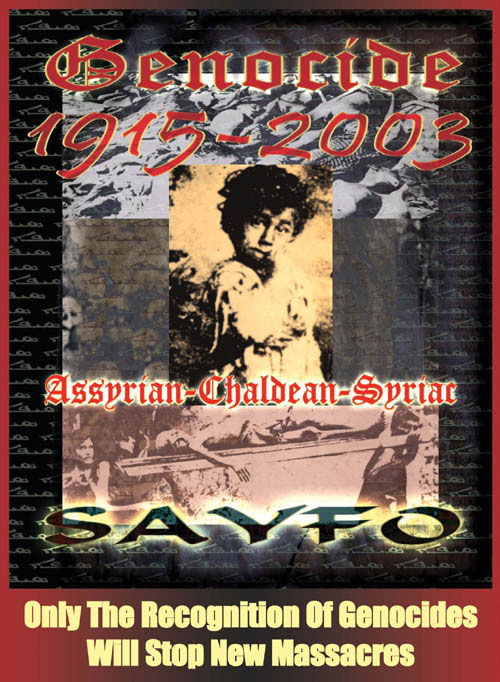
PROGRAMME DES COMMEMORATIONS DU 88° ANNIVERSAIRE DU GENOCIDE ARMENIEN ET ASSYRO-CHALDEEN DE 1915, PERPETRE PAR LA TURQUIE 24 Avril 2003
18H15 : Ravivage de la Flamme du soldat inconnu â l'Arc de Triomphe - Paris 8ème 19H00 : Rassemblement autour de la statue du Révérand Père Komitas - Place du Canada - Paris 8ème Interventions de: · Gérard Chaliand, Ecrivain et Spécialiste
des Conflits 20H00 : Départ vers l'Ambassade de Turquie - Avenue Lamballe - Paris 16ème VENEZ NOMBREUX Association des Assyro-Chaldéens de
France SEYFO COMMEMORATION AT UC, BERKELEY On Thursday April 24th, the Armenian Student Association and the Assyrian Student Alliance at UC Berkeley will be holding a rally in the main plaza from 12 noon till throughout the afternoon to commemorate those who were slaughtered at the hands of the Ottoman Empire in WWI. We the Assyrian Student Alliance will be speaking and actively participating in the activities that day. Please come out and attend. Ramond Takhsh
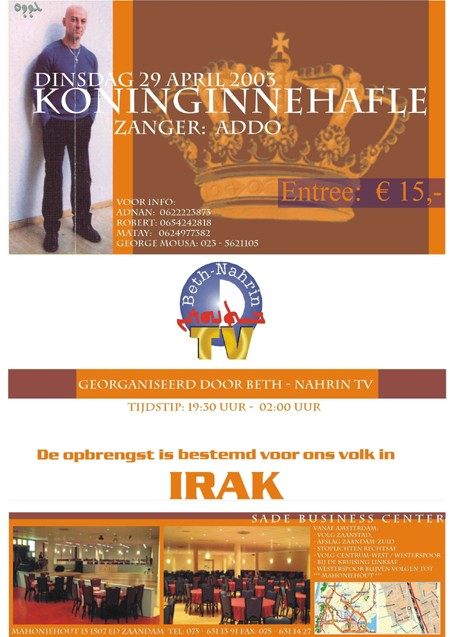
Language Resources of America, a translation and interpreting service business, needs to translate from English to Assyrian 4 documents containing an estated count of 11,000 English words. Our local School District requested the translation of these documents. The documents to be translated contain the evaluation by the School District of handicapped Assyrian students, and include recommendations on the educational, physical, mental and medical needs of these children. The translation will be used for the information and benefit of the parents of these Assyrian children. We are trying to located an English to Assyrian experienced and professional translator interested in executing this translation for a fee. Should you know of such person we would appreciate being contacted. Language Resources of America has been in Buisiness since 1990. We are located in Los Angeles, California. Our telphone number is 323-933-1006. Our Fax number is 323-933-1153. Language Resources of America. DE ASSYRIERS (SURYOYE) IN IRAK HEBBEN ONZE STEUN HARD NODIG Stichting Beth-Nahrin TV-Amsterdam organiseert een feest om geld in te zamelen voor de Assyrische-Suryoye christenen in Irak die het slachtoffer zijn geweest van jaren onderdrukking van het regime en nu leven onder zeer moeilijke economische omstandigheden.
Het geld zal in zijn geheel overhandigd worden aan de Assyrian Aid Society, een officiele organisatie die verantwoordelijk is voor de wederopbouw van dorpen, scholen, ziekenhuizen, kerken en irrigatie systemen in de assyrische-Suryoye dorpen en steden in Irak. Geef zodat zij mogen leven in ons Vaderland Beth-Nahrin: Mesopotamie!
|
DO CHRISTIANS HAVE A FUTURE IN THE MIDDLE EAST?Two decades ago, while I was researching a book on the role of the Vatican in the Middle East, the late Lebanese scholar and jurist Edmond Rabbath told me that Arab Christians were in the process of becoming “fossilized” communities. This statement seems prophetic in retrospect when we consider the state of the Christian communities in the Arab world today. Their plight has become even more dramatic in light of the current US-led invasion of Iraq. In the last 30 years, Arab Christians have attempted to weather several storms: the Lebanese war, the intifada and Israeli violence, the Iranian revolution and the resurgence of Islamic revivalism and now the war on Iraq. Lebanon’s civil war began in 1975 and lasted more than 15
years. Though it has become popular in recent years to reduce the
war years to Christian vs. Muslim, or Lebanese vs. Palestinian,
the actual picture was much more complex. During the war, some influential Maronite politicians and clergy chose to take a confrontational approach not only with the Muslim world, but with the Vatican as well. These Maronites thought that they could count on the total and unswerving support of the Holy See in their struggle against the Palestinians and their Muslim allies, simply because of their Christian identity. However, it was the welfare of Christianity in the Middle East in general that dictated (and still dictates) the Vatican’s approach to Lebanese Christians the Holy See’s goal was to save Lebanon as a sovereign entity in order to save the Christians. This policy explains the Pope’s consistent opposition to partition or other schemes, such as federation, cantonization, etc. proposed by some Maronite groups. If Lebanon were to be carved up into small ethno-religious entities, the creation of a Christian mini-state could have negative repercussions on other Christian communities living in Arab and Islamic countries, the Vatican held. At the war’s end in 1990, and with the signing of the Taif Accord, Lebanese Christians saw their power attenuating rapidly away in a new political milieu dominated by US, Saudi and Syrian interests. Today, Lebanese Christians suffer from a serious leadership deficit, with the exception of Maronite Patriarch Nasrallah Sfeir, who still wields influence and garners respect in Lebanese politics. In 1993, a group of Maronite intellectuals living in Paris issued a document (which unfortunately has never received the follow-up attention it deserves). They held that, since independence, the Maronites have traded their religious heritage and teachings for positions of power. In so doing, they substituted a volatile political order for the cultural foundations of their own community and thus, that of wider Lebanese society. According to these intellectuals, religion has been tribalized and reduced to a political identity. Maronites “need to go back to their monastic traditions, intertwined with prayer, silence and modesty” in order to heal themselves communally of the political vices of the war years. The predicament of Lebanon’s Christians is not as dramatic as that of the Christians living in other countries of the Middle East. Non-Lebanese Christian communities have faced the same problems encountered by other communities in the Levant. In fact, throughout history, under Arab and Ottoman dominations, non-Muslims (Christians and Jews) were treated as dhimmis tolerated and protected minorities by the Muslim majority. In the Ottoman Empire, tolerance of Christians was defined by the millet system. This system estranged Christians from political life and deepened suspicions between them and the Muslim population. Their loyalty was often in doubt, given Arab Christians’ connection with Western missionary activities. After the fall of the Ottoman Empire, and in reaction to the Arab predicament, Christians were at the forefront of Arab nationalist and secular movement. Some, such as Michel Aflaq, founded parties such as the Baath. In Iraq one of the countries where the Baath ruled, or misruled the Baath is no longer in power, and hence the Christians of Iraq may now face dimmer prospects as the Bush administration advances leaders such as Ahmed Chalabi in a manner evidencing utter disregard for the true interests, visions, and history of the people, be they Christians or Muslims, Arabs or Kurds. In the 1980s, Christians in Iraq (Chaldeans, Assyrians, Armenians)
numbered 2 million. Today, their number has dwindled to around 800,000.
The regime used the Christians as an ally in its policy of divide-and-rule
in Iraq. Chaldean Patriarch Bidawid astutely built solid relationships
with the Baath regime in order to protect his community. Dramatizing the plight of his community, the Assyrian Catholic
Patriarch of Iraq, Monsignor Ignace VIII Abdel Ahad, recently stated
that the “Christians of Iraq are foremostly in solidarity
with their Muslim compatriots. Like all Iraqis who are proud and
attached to their land, they will defend their country.” Referring
to the US-UK invading troops, Abdel Ahad stated: “Iraqis do
not consider foreign armies as liberators but colonizers. Those
who are now invading the country are not here to defend human rights.”
This attitude is very similar to the one adopted by the Lebanese,
Palestinian and Syrian religious hierarchies: Arab Christians and
Muslims are united in their struggle against Israeli occupation,
Western-based schemes for regime change, and attempts at creating
“Christian” islands in the Middle East. In the current transitional and unsettled context, Christian communities in the Middle East could play a very important role by going back to the roots of their various faith traditions and by grooming new leaders, women as well as men. These are not impossible tasks. As for now, Arab Christians have to lie low and wait for the storm to pass by. Their task is to limit the damage that the war in Iraq has wrought and prepare for the future while forging common bonds of solidarity with their Muslim brothers and sisters and creating more humane and participatory democratic systems. A democratic governance system tailored to the region’s culture and history is the ideal solution to stop the hemorrhage of Christian Arabs from their countries. Their presence in the region is a must and a powerful proof that coexistence between Christians and Muslims can be an exemplary model in a democratic Middle East. Professor George Emile Irani [Z-info: Prof. Irani
teaches conflict resolution at Royal Roads University in Victoria,
British Columbia, Canada. He is the author of The Papacy and The
Middle East. This commentary was written for The Daily Star Online
on 22 April as “Do Arab Christians Have a Future in Iraq?”]
|
|
SCHOLARS HERE MAKE CATALOG OF SACKED MUSEUM Courtesy of the Chicago Sun Times (19 April); by Dave Newbard Among the archeologically irreplaceable items feared stolen or destroyed is a 2,700-year-old stone relief from the grand palace of King Sargon II, the Assyrian leader who ruled in what is now northern Iraq from 722 to 705 B.C. Also potentially missing are 4,500-year-old, 2-1/2-foot-tall statues from the temple of the god Abu in central Iraq. The wealthy of antiquity thought the statues helped them communicate with the deity. "It's like the Garden of Eden was trampled on,” said Clemens Reichel, a research associate at the University of Chicago's Oriental Institute, of the looting that took place at the National Museum in Baghdad after the United States military took over the city. Those items were among thousands excavated by the U. of C. over the past century and sent to the National Museum. The fear that the artifacts are now gone has driven U. of C. researchers and students to launch a desperate attempt to recreate the inventory of the National Museum. Officials at the Oriental Institute and the school's anthropology department held a "crisis meeting” Friday to discuss the creation of an online database that will eventually include thousands of digital images of items believed to have been in the National Museum's collection. A link to the database is at www.oi.uchicago.edu, the institute's Web site. It will eventually include the status of the artifacts--whether they are missing, destroyed, recovered or unknown. It will be updated regularly so art collectors and others can determine if something they come across has been stolen. "We are going to do everything we can possibly do to hinder the flow of this art out of Iraq and into the art market,” said Nicholas Kouchoukos, an assistant professor of anthropology who has studied the museum's collection. "If an object appears on our page and it's not in Iraq, it can be assumed it was stolen or looted.” No one knows for sure how many items were stolen, nor does anyone know the size of the museum's collection, but some estimates suggest the collection could include 170,000 or more items. Many of the items are well known to researchers at the U. of C., which has conducted several excavations in Iraq dating to the 1920s. That includes the city of Nippur, a sacred Sumerian site in southern Iraq with items dating to 3000 B.C. It also includes four sites in the Diyala region in central Iraq in the heart of Mesopotamia. Early antiquities laws required sending half the items dug up to Baghdad, while half went to the Oriental Institute; in the 1970s, the law required keeping everything in Iraq. The U. of C. kept detailed records of everything excavated, including black and white photos of varying quality from earlier digs and color shots more recently. But Reichel had hoped to visit Baghdad to take new photos of the items from the Diyala project, which includes 17,000 items in Baghdad and Chicago. Still, the university is putting everything it has online, and is soliciting photos from around the world. Working almost around the clock this week, graduate students have scanned some 1,500 photos from the institute's archives, books and elsewhere. "This is so important because it's not just Iraq's heritage, it's the world's heritage,” Reichel said.
|
Visit the Zinda Magazine Calendar at http://www.zindamagazine.com/calendar
|
Zindamagazine would like to thank: David Chibo |


ZINDA Magazine is published weekly. Views expressed in ZINDA do not necessarily represent those of the ZINDA editors, or any of our associated staff. This publication reserves the right, at its sole discretion, not to publish comments or articles previously printed in or submitted to other journals. ZINDA reserves the right to publish and republish your submission in any form or medium. All letters and messages require the name(s) of sender and/or author. All messages published in the SURFS UP! section must be in 500 words or less and bear the name of the author(s). Distribution of material featured in ZINDA is not restricted, but permission from ZINDA is required. This service is meant for the exchange of information, analyses and news. To subscribe, send e-mail to: z_info@zindamagazine.com.
Zinda Magazine™ Copyright © Zinda Inc., 2001-2002 - All Rights Reserved - http://www.zindamagazine.com

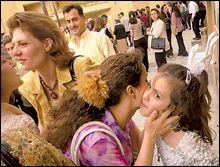 On
Monday, 21 April, Zinda Magazine conducted two exclusive interviews
in Baghdad with Mar Gewargis Sliwa, Archbishop of the Church
of the East for Iraq and Russia and Mr. Ishmael Nanno, the Assyrian
Democratic Movement’s representative at the Ur (Nasiriyah)
Meeting and the Baghdad Office.
On
Monday, 21 April, Zinda Magazine conducted two exclusive interviews
in Baghdad with Mar Gewargis Sliwa, Archbishop of the Church
of the East for Iraq and Russia and Mr. Ishmael Nanno, the Assyrian
Democratic Movement’s representative at the Ur (Nasiriyah)
Meeting and the Baghdad Office.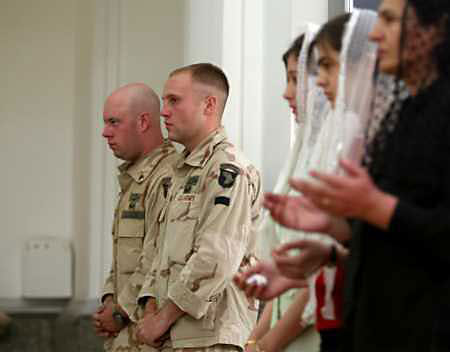 Z: What
about basic needs such as food and water? What kind of support
can be offered from the Diaspora?
Z: What
about basic needs such as food and water? What kind of support
can be offered from the Diaspora?
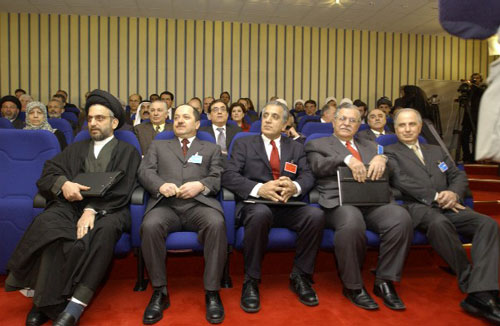
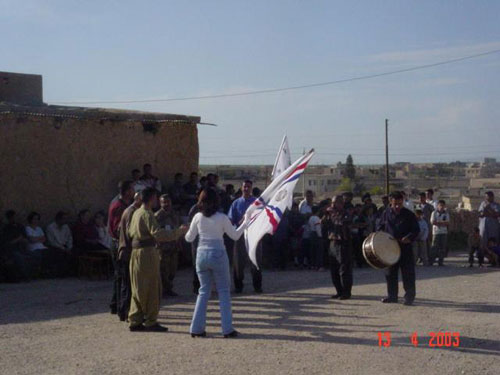
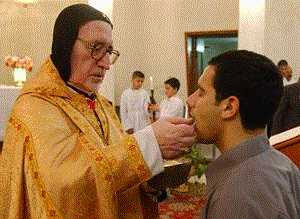
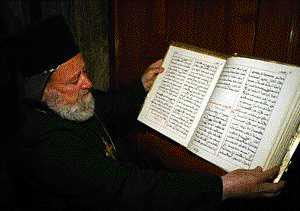
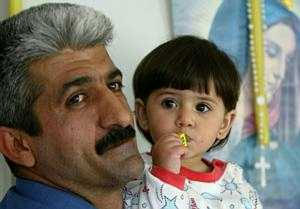 (ZNDA: Baghdad)
Iraqi Christians, feeling vulnerable in the wave of lawlessness
that has swept this city, celebrated Easter Sunday with a special
sense of joy and gratitude that the war, and the looting that
followed the fighting, are over.
(ZNDA: Baghdad)
Iraqi Christians, feeling vulnerable in the wave of lawlessness
that has swept this city, celebrated Easter Sunday with a special
sense of joy and gratitude that the war, and the looting that
followed the fighting, are over. 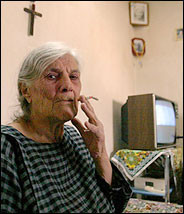 (ZNDA: Araqosh)
She has a picture of Tariq Aziz meeting Pope John Paul II on her living
room wall, but on this Easter Sunday she had few kind words for her
nephew.
(ZNDA: Araqosh)
She has a picture of Tariq Aziz meeting Pope John Paul II on her living
room wall, but on this Easter Sunday she had few kind words for her
nephew.